Nothing matches these filters —
clear the search or widen the filters.
Summaries Cecilia gave as host
· 1500 summaries
Recaps of other experts' statements, not Cecilia's own clinical position.
Summaries Cecilia gave as host · Abdominal Compartment Syndrome
6 summaries
Open the Abdominal Compartment Syndrome collection →
Quick Literature Updates Episode 20
 ▶
Ep 8 · 3:01
▶
Ep 8 · 3:01
host summary
Cecilia Gigena summarizes what Dr. Alex Halpern said: Esposito et al. retrospective comparison conducted in Italy included 83 patients who underwent laparoscopic cholecystectomy without ICG (group one) and 90 patients with ICG (group two).
↗
▶
Ep 8 · 3:23
host summary
Cecilia Gigena summarizes what Dr. Alex Halpern said: Laparoscopic cholecystectomy with ICG had no complications compared to 12% complication rate without ICG.
↗
▶
Ep 8 · 3:23
host summary
Cecilia Gigena summarizes what Dr. Alex Halpern said: Laparoscopic cholecystectomy with ICG provided better visualization of the biliary tree compared to without ICG.
↗
▶
Ep 8 · 3:23
host summary
Cecilia Gigena summarizes what Dr. Alex Halpern said: Laparoscopic cholecystectomy with ICG had shorter surgery time compared to without ICG.
↗
▶
Ep 8 · 3:38
host summary
Cecilia Gigena summarizes what Dr. Alex Halpern said: Laparoscopic cholecystectomy with ICG can be the new standard in pediatric surgery practice.
↗
▶
Ep 8 · 3:38
host summary
Cecilia Gigena summarizes what Dr. Alex Halpern said: So it seems that laparoscopic cholecystectomy with ICG can be the new standard in our practice.
↗
Summaries Cecilia gave as host · Abdominal Wall Defects
30 summaries
Open the Abdominal Wall Defects collection →
Quick Literature Updates Episode 6
 ▶
Ep 29 · 3:33
▶
Ep 29 · 3:33
host summary
Cecilia Gigena summarizing a resource: Patients receiving massive transfusions had shortened alpha angles on TEG analysis.
↗
▶
Ep 29 · 3:33
host summary
Cecilia Gigena summarizing a resource: Philips et al. conducted a retrospective study from 2015 to 2018 evaluating 117 patients from two trauma centers.
↗
▶
Ep 29 · 3:33
host summary
Cecilia Gigena summarizing a resource: TEG may help identify hemorrhagic trauma patients who will benefit from cryoprecipitate or platelet transfusions.
↗
▶
Ep 29 · 3:33
host summary
Cecilia Gigena summarizing a resource: Patients receiving massive transfusions had lower platelet counts.
↗
▶
Ep 29 · 3:33
host summary
Cecilia Gigena summarizing a resource: Patients receiving massive transfusions had lower maximum amplitude values on TEG analysis.
↗
Quick Literature Updates Episode 11
 ▶
Ep 31 · 3:07
▶
Ep 31 · 3:07
host summary
Cecilia Gigena summarizing a resource: The overall rate for periumbilical hernias after gastroschisis closure was 22.7%.
↗
▶
Ep 31 · 3:07
host summary
Cecilia Gigena summarizing a resource: Patients who underwent sutureless gastroschisis closures had 50% rates of persistent hernia.
↗
▶
Ep 31 · 3:07
host summary
Cecilia Gigena summarizing a resource: Frazier et al. conducted a retrospective study from the Midwest Pediatric Surgery Consortium following 375 patients with gastroschisis who underwent closure between 2013 and 2016.
↗
▶
Ep 31 · 3:07
host summary
Cecilia Gigena summarizing a resource: Periumbilical hernia rate was significantly higher in patients who underwent primary closure versus those who needed silo placement.
↗
▶
Ep 31 · 3:07
host summary
Cecilia Gigena summarizing a resource: Only 16.4% of patients who underwent sutured gastroschisis closure had a persistent hernia.
↗
▶
Ep 31 · 3:07
host summary
Cecilia Gigena summarizing a resource: Spontaneous closure of periumbilical hernias after gastroschisis was seen in 38.8% of cases.
↗
▶
Ep 31 · 3:07
host summary
Cecilia Gigena summarizing a resource: Only 31.8% of patients with periumbilical hernias after gastroschisis needed surgery.
↗
▶
Ep 31 · 3:07
host summary
Cecilia Gigena summarizing a resource: Sutureless gastroschisis closures lead to more periumbilical hernias, but they can be managed as any other congenital umbilical hernia and have no additional risk.
↗
Quick Literature Updates Episode 16
 ▶
Ep 40 · 3:08
▶
Ep 40 · 3:08
host summary
Cecilia Gigena summarizes what Dr. Alex Halpern said: The Phoenix study by Lie et al. was a retrospective single institution study from 2017 to 2021 comparing patients who underwent Nuss procedure with cryoanalgesia in the first quarter versus the fourth quarter of their experience.
↗
▶
Ep 40 · 3:27
host summary
Cecilia Gigena summarizes what Dr. Alex Halpern said: The Phoenix study included 350 patients who underwent Nuss procedure with cryoanalgesia.
↗
▶
Ep 40 · 3:32
host summary
Cecilia Gigena summarizes what Dr. Alex Halpern said: Patients in the last quarter of the Phoenix cryoablation experience required 74% less opioids than those in the first quarter.
↗
▶
Ep 40 · 3:32
host summary
Cecilia Gigena summarizes what Dr. Alex Halpern said: Patients in the last quarter of the Phoenix cryoablation experience were discharged 1.3 days earlier than patients in the first quarter.
↗
▶
Ep 40 · 3:44
host summary
Cecilia Gigena summarizes what Dr. Alex Halpern said: So it seems that experience really plays a role talking about cryoatissia.
↗
▶
Ep 40 · 3:44
host summary
Cecilia Gigena summarizes what Dr. Alex Halpern said: Experience plays a role in outcomes when using cryoanalgesia for Nuss procedures.
↗
Quick Literature Updates Episode 20
▶
Ep 42 · 3:01
host summary
Cecilia Gigena summarizes what Dr. Alex Halpern said: Esposito et al. retrospective comparison conducted in Italy included 83 patients who underwent laparoscopic cholecystectomy without ICG (group one) and 90 patients with ICG (group two).
↗
▶
Ep 42 · 3:23
host summary
Cecilia Gigena summarizes what Dr. Alex Halpern said: Laparoscopic cholecystectomy with ICG had no complications compared to 12% complication rate without ICG.
↗
▶
Ep 42 · 3:23
host summary
Cecilia Gigena summarizes what Dr. Alex Halpern said: Laparoscopic cholecystectomy with ICG had shorter surgery time compared to without ICG.
↗
▶
Ep 42 · 3:23
host summary
Cecilia Gigena summarizes what Dr. Alex Halpern said: Laparoscopic cholecystectomy with ICG provided better visualization of the biliary tree compared to without ICG.
↗
▶
Ep 42 · 3:38
host summary
Cecilia Gigena summarizes what Dr. Alex Halpern said: So it seems that laparoscopic cholecystectomy with ICG can be the new standard in our practice.
↗
▶
Ep 42 · 3:38
host summary
Cecilia Gigena summarizes what Dr. Alex Halpern said: Laparoscopic cholecystectomy with ICG can be the new standard in pediatric surgery practice.
↗
Quick Literature Updates Ep 22
 ▶
Ep 43 · 3:16
▶
Ep 43 · 3:16
host summary
Cecilia Gigena summarizing a resource: The Pefer et al. study is a retrospective study done in Texas using a state hospital database examining CDH outcomes by center volume.
↗
▶
Ep 43 · 3:32
host summary
Cecilia Gigena summarizing a resource: The Pefer study identified 1,314 CDH patients: 728 from high volume centers, 9 from mid-volume centers, and 79 from low volume centers.
↗
▶
Ep 43 · 3:46
host summary
Cecilia Gigena summarizing a resource: High volume centers had significantly shorter length of stay for CDH patients.
↗
▶
Ep 43 · 3:46
host summary
Cecilia Gigena summarizing a resource: High volume centers had significantly lower mortality rates for CDH, even though they have significantly sicker patients.
↗
▶
Ep 43 · 4:00
host summary
Cecilia Gigena summarizing a resource: High volume centers had better outcomes for patients with CDH.
↗
Summaries Cecilia gave as host · Achalasia
4 summaries
Open the Achalasia collection →
Update Course Rewind: Updates in Achalasia 2023
 ▶
Ep 4 · 5:03
▶
Ep 4 · 5:03
host summary
Cecilia Gigena summarizing the discussion: If there is a perforation of the anterior esophagus during laparoscopic esophageal myotomy, an anterior fundoplication can help with healing or preventing complications, but you can also put a couple stitches in it and be just fine.
↗
▶
Ep 4 · 8:20
host summary
Cecilia Gigena summarizing the discussion: EndoFLIP measures the diameter of the esophagus before and after myotomy and also measures distensibility index, which is the amount of pressure needed to distend the esophagus a certain amount.
↗
▶
Ep 4 · 8:40
host summary
Cecilia Gigena summarizing the discussion: There are accepted standards for normal distensibility index in adults, which are extrapolated to kids as treatment targets.
↗
▶
Ep 4 · 8:50
host summary
Cecilia Gigena summarizing the discussion: The gold standard treatment for achalasia is laparoscopic Heller myotomy, but POEM is increasing in popularity and is better for recurrences.
↗
Summaries Cecilia gave as host · Acute Appendicitis
6 summaries
Open the Acute Appendicitis collection →
Unanticipated consequences of COVID-19 pandemic policies on pediatric acute appendicitis surgery
 ▶
Ep 2 · 0:00
▶
Ep 2 · 0:00
host summary
Cecilia Gigena summarizing a resource: The pandemic period had more readmissions rates compared to the pre-pandemic period.
↗
▶
Ep 2 · 0:00
host summary
Cecilia Gigena summarizing a resource: Did you also feel that COVID-19 led to more complicated appendicitis?
↗
▶
Ep 2 · 0:00
host summary
Cecilia Gigena summarizing a resource: The study included 1,107 patients total: 491 from the pre-pandemic period and 616 from the pandemic period.
↗
▶
Ep 2 · 0:00
host summary
Cecilia Gigena summarizing a resource: A retrospective cohort study was conducted at the Hospital for Sick Children in Toronto comparing pre-pandemic and pandemic periods for acute appendicitis cases.
↗
▶
Ep 2 · 0:00
host summary
Cecilia Gigena summarizing a resource: The pandemic period had significantly more complicated appendicitis compared to the pre-pandemic period.
↗
▶
Ep 2 · 0:00
host summary
Cecilia Gigena summarizing a resource: Patients from the pre-pandemic period were significantly younger than those during the pandemic.
↗
Summaries Cecilia gave as host · Acute Cholecystitis
12 summaries
Open the Acute Cholecystitis collection →
Index admission cholecystectomy for acute cholecystitis reduces 30-day readmission rates in pediatric patients
 ▶
Ep 3 · 0:00
▶
Ep 3 · 0:00
host summary
Cecilia Gigena summarizing a resource: The study was a retrospective study conducted in San Francisco using a national database.
↗
▶
Ep 3 · 0:00
host summary
Cecilia Gigena summarizing a resource: Do you operate acute cholecystitis in index admission or after discharge?
↗
▶
Ep 3 · 0:30
host summary
Cecilia Gigena summarizing a resource: The study aim was to compare 30-day readmission rates between index cholecystectomy and cholecystectomy after discharge for acute cholecystitis.
↗
▶
Ep 3 · 0:50
host summary
Cecilia Gigena summarizing a resource: The study included 550 patients with acute cholecystitis.
↗
▶
Ep 3 · 1:00
host summary
Cecilia Gigena summarizing a resource: 435 of the 550 patients had an index cholecystectomy.
↗
▶
Ep 3 · 1:10
host summary
Cecilia Gigena summarizing a resource: Index cholecystectomy had a significantly lower 30-day readmission rate of 2.8% compared to 22.6% for cholecystectomy performed after discharge.
↗
▶
Ep 3 · 1:35
host summary
Cecilia Gigena summarizing a resource: Index cholecystectomy appears to be a good option for acute cholecystitis in pediatric patients.
↗
▶
Ep 3 · 1:35
host summary
Cecilia Gigena summarizing a resource: So, it seems that index cholecystectomy is a good option for acute cholecystitis in pediatric patients.
↗
La colecistectomía al ingreso por colecistitis aguda reduce las tasas de reingreso a 30 días en pacientes pediátricos
 ▶
Ep 4 · 0:00
▶
Ep 4 · 0:00
host summary
Cecilia Gigena summarizing a resource: The study included 550 patients, of whom 435 were operated during the index admission.
↗
▶
Ep 4 · 0:00
host summary
Cecilia Gigena summarizing a resource: The readmission rate in patients operated acutely was 2.8%, compared to 22.6% in those operated in an interval fashion.
↗
▶
Ep 4 · 0:00
host summary
Cecilia Gigena summarizing a resource: A study was conducted in California using a national database to compare 30-day readmission rates in patients with acute cholecystitis operated at admission versus discharged for interval surgery.
↗
▶
Ep 4 · 0:00
host summary
Cecilia Gigena summarizing a resource: Operating on acute cholecystitis appears to be a good option in pediatric patients.
↗
Summaries Cecilia gave as host · Acute Pancreatitis
2 summaries
Open the Acute Pancreatitis collection →
Update Course Rewind: Management of Acute Pancreatitis 2023
 ▶
Ep 10 · 5:55
▶
Ep 10 · 5:55
host summary
Cecilia Gigena summarizing the discussion: Fluid resuscitation is key in pancreatitis management
↗
▶
Ep 10 · 5:57
host summary
Cecilia Gigena summarizing the discussion: Patients should be reassessed at the 12 and 24 hour mark to avoid fluid overload
↗
Summaries Cecilia gave as host · Acute Recurrent Pancreatitis
6 summaries
Open the Acute Recurrent Pancreatitis collection →
Update Course Rewind: Management of Recurrent Pancreatitis
 ▶
Ep 9 · 2:26
▶
Ep 9 · 2:26
host summary
Cecilia Gigena summarizes what Dr. Juan Gurria said: If a patient has more than one episode of acute pancreatitis or a first severe episode, an MRCP and genetic panel should be performed to rule out genetic anomalies.
↗
▶
Ep 9 · 3:37
host summary
Cecilia Gigena summarizes what Dr. Juan Gurria said: Genetics are very important before any resection procedure to avoid losing pancreatic cells in pathologies that will not benefit from resection and drainage but instead from islet cell transplant.
↗
▶
Ep 9 · 4:37
host summary
Cecilia Gigena summarizes what Dr. Juan Gurria said: Endoscopic treatment should be attempted first, but if it fails, transfer to a specialized center that performs TPIAT (total pancreatectomy with islet autotransplantation).
↗
▶
Ep 9 · 5:11
host summary
Cecilia Gigena summarizes what Dr. Juan Gurria said: For pancreatic imaging, start with ultrasound, then CT, and for better visualization of pancreatic anatomy, use MRCP with T2 sequences.
↗
▶
Ep 9 · 5:40
host summary
Cecilia Gigena summarizes what Dr. Juan Gurria said: Recurrent pancreatitis is a rare pathology that can lead to chronic pancreatitis and is associated with genetic mutations.
↗
▶
Ep 9 · 5:50
host summary
Cecilia Gigena summarizes what Dr. Juan Gurria said: If genetic mutations are confirmed, partial resection (e.g., Frey procedure) should be avoided to preserve pancreatic cells, and TPIAT should be considered sooner rather than later if endoscopic treatment fails.
↗
Summaries Cecilia gave as host · Aerodigestive / ENT
7 summaries
Open the Aerodigestive / ENT collection →
Esophageal Surveillance Practices in Esophageal Atresia Patients
 ▶
Ep 14 · 0:00
▶
Ep 14 · 0:00
host summary
Cecilia Gigena summarizing a resource: Only 37% of respondents performed follow-up endoscopy regardless of symptoms
↗
▶
Ep 14 · 0:00
host summary
Cecilia Gigena summarizing a resource: The Eastern Pediatric Surgery Network in the US created a survey distributed among pediatric surgeons to understand current practices of esophageal surveillance in esophageal atresia patients
↗
▶
Ep 14 · 0:00
host summary
Cecilia Gigena summarizing a resource: 75% of respondents strongly agree or agree with current guidelines for esophageal atresia surveillance
↗
▶
Ep 14 · 0:00
host summary
Cecilia Gigena summarizing a resource: Only 37% of respondents reported that their esophageal atresia patients have pre-determined outpatient clinic follow-up schedule
↗
▶
Ep 14 · 0:00
host summary
Cecilia Gigena summarizing a resource: 80% of respondents agree or strongly agree that endoscopy should follow a set schedule
↗
▶
Ep 14 · 0:00
host summary
Cecilia Gigena summarizing a resource: There is high agreement with current guidelines but weak adherence to them in esophageal atresia surveillance
↗
▶
Ep 14 · 0:00
host summary
Cecilia Gigena summarizing a resource: 139 pediatric surgeons responded to the survey
↗
Summaries Cecilia gave as host · ALL
2 summaries
Open the ALL collection →
Update Course Rewind: Management of Acute Pancreatitis 2023
▶
Ep 1 · 5:55
host summary
Cecilia Gigena summarizing the discussion: Fluid resuscitation is key in pancreatitis management
↗
▶
Ep 1 · 5:57
host summary
Cecilia Gigena summarizing the discussion: Patients should be reassessed at the 12 and 24 hour mark to avoid fluid overload
↗
Summaries Cecilia gave as host · Anastomotic Strictures
25 summaries
Open the Anastomotic Strictures collection →
Prophylactic Acid-suppression Medication to Prevent Anastomotic Strictures After Oesophageal Atresia Surgery
 ▶
Ep 1 · 0:00
▶
Ep 1 · 0:00
host summary
Cecilia Gigena summarizing a resource: A systematic review analyzed whether prophylactic acid suppression would reduce the rates of strictures after esophageal atresia repair.
↗
▶
Ep 1 · 0:00
host summary
Cecilia Gigena summarizing a resource: Do you use prophylactic acid suppression after an esophageal atresia repair to prevent strictures?
↗
▶
Ep 1 · 0:20
host summary
Cecilia Gigena summarizing a resource: This is a systematic review that aimed to analyze whether prophylactic acid suppression would reduce the rates of strictures after an esophageal repair.
↗
▶
Ep 1 · 0:30
host summary
Cecilia Gigena summarizing a resource: The systematic review included 12 observational studies.
↗
▶
Ep 1 · 0:35
host summary
Cecilia Gigena summarizing a resource: They had 12 observational studies, and what they found is that prophylactic acid suppression actually had a trend towards increasing the strictures after an EA repair, but it was not significantly different.
↗
▶
Ep 1 · 0:45
host summary
Cecilia Gigena summarizing a resource: Prophylactic acid suppression had a trend towards increasing strictures after EA repair, but the difference was not statistically significant.
↗
▶
Ep 1 · 1:10
host summary
Cecilia Gigena summarizing a resource: Prophylactic acid suppression does not appear to work to prevent strictures after EA repair.
↗
Supresión ácida profiláctica para prevenir estenosis anastomóticas después de la cirugía de atresia esofágica
 ▶
Ep 2 · 0:00
▶
Ep 2 · 0:00
host summary
Cecilia Gigena summarizing a resource: This is a systematic review that analyzed whether prophylaxis with acid suppression was effective to reduce stricture rates after esophageal atresia repair.
↗
▶
Ep 2 · 0:00
host summary
Cecilia Gigena summarizing a resource: Con lo cual parece que la profilaxis con supresión ácida no sirve para prevenir estenosis después de una reparación de atresia de esófago.
↗
▶
Ep 2 · 0:00
host summary
Cecilia Gigena summarizing a resource: ¿Y vos, usás supresión ácida profiláctica para prevenir las estenosis después de una reparación de atresia de esófago?
↗
▶
Ep 2 · 0:00
host summary
Cecilia Gigena summarizing a resource: Prophylaxis with acid suppression does not appear to prevent strictures after esophageal atresia repair.
↗
▶
Ep 2 · 0:00
host summary
Cecilia Gigena summarizing a resource: Prophylaxis with acid suppression tended to have higher stricture rates than those without suppression, but there was no significant difference.
↗
▶
Ep 2 · 0:00
host summary
Cecilia Gigena summarizing a resource: The review identified 12 observational articles.
↗
Comparison of robotic versus thoracoscopic repair for congenital esophageal atresia
 ▶
Ep 3 · 0:10
▶
Ep 3 · 0:10
host summary
Cecilia Gigena summarizing a resource: The study is a retrospective multi-center study done in China
↗
▶
Ep 3 · 0:21
host summary
Cecilia Gigena summarizing a resource: After propensity score matching, there were 126 patients total, 63 in each group
↗
▶
Ep 3 · 0:28
host summary
Cecilia Gigena summarizing a resource: The robotic group had lower unplanned readmissions within 2 years post-op compared to thoracoscopic repair
↗
▶
Ep 3 · 0:28
host summary
Cecilia Gigena summarizing a resource: The robotic group had lower anastomotic strictures compared to thoracoscopic repair
↗
▶
Ep 3 · 0:28
host summary
Cecilia Gigena summarizing a resource: Robotic surgery had longer operative time compared to thoracoscopic repair
↗
▶
Ep 3 · 0:28
host summary
Cecilia Gigena summarizing a resource: Robotic surgery had shorter anastomotic time compared to thoracoscopic repair
↗
▶
Ep 3 · 0:46
host summary
Cecilia Gigena summarizing a resource: Robotic surgery appears to be a good option for esophageal atresia repair
↗
▶
Ep 3 · 0:46
host summary
Cecilia Gigena summarizing a resource: So, it seems that robotic surgery is a good answer for esophageal tissue repair.
↗
Journal of Pediatric Surgery Article Review: October 2023
 ▶
Ep 4 · 2:37
▶
Ep 4 · 2:37
host summary
Cecilia Gigena summarizing the discussion: Within 1,395 patients across 12 observational studies, 753 received acid suppression medication but this did not reduce the odds of having an esophageal stricture
↗
▶
Ep 4 · 7:08
host summary
Cecilia Gigena summarizing the discussion: Some randomized trials showed that doing something to the pleura does not actually reduce recurrences of spontaneous pneumothorax
↗
▶
Ep 4 · 7:40
host summary
Cecilia Gigena summarizing the discussion: For the asymptomatic contralateral side in children with spontaneous pneumothorax, do not do anything unless it develops symptoms
↗
▶
Ep 4 · 9:00
host summary
Cecilia Gigena summarizing the discussion: The asymptomatic CPAM group had shorter operating times, shorter postoperative mechanical ventilation, shorter chest tube durations, and shorter hospital stays
↗
Summaries Cecilia gave as host · Anorectal Malformation
35 summaries
Open the Anorectal Malformation collection →
Quick Literature Updates Episode 14
 ▶
Ep 52 · 3:48
▶
Ep 52 · 3:48
host summary
Cecilia Gigena summarizes what Dr. Alex Halpern said: The Bokova et al. study is a multi-institutional one-year outcome study of anal sphincter reconstruction for patulous sphincter in 6 patients.
↗
▶
Ep 52 · 4:00
host summary
Cecilia Gigena summarizes what Dr. Alex Halpern said: Four patients in the sphincter reconstruction study received only anal sphincter reconstruction without redo pull-through.
↗
▶
Ep 52 · 4:00
host summary
Cecilia Gigena summarizes what Dr. Alex Halpern said: Of the 6 patients in the sphincter reconstruction study, 2 had Down syndrome and underwent redo pull-through with anal sphincter reconstruction.
↗
▶
Ep 52 · 4:12
host summary
Cecilia Gigena summarizes what Dr. Alex Halpern said: Anal sphincter reconstruction appears to be an option for overstretched anal sphincters in patients with Hirschsprung disease after a pull-through.
↗
▶
Ep 52 · 4:12
host summary
Cecilia Gigena summarizes what Dr. Alex Halpern said: The 4 patients who received only anal sphincter reconstruction achieved voluntary bowel movements with higher productivity and confidence.
↗
Transitional Care in Anorectal Malformation and Hirschsprung's Disease
 ▶
Ep 55 · 0:00
▶
Ep 55 · 0:00
host summary
Cecilia Gigena summarizing a resource: Do you have a transitional care coordinator for colorectal patients in your hospital?
↗
▶
Ep 55 · 0:10
host summary
Cecilia Gigena summarizing a resource: A systematic review was conducted in the UK to establish and categorize challenges and solutions related to transitional care in colorectal patients
↗
▶
Ep 55 · 0:23
host summary
Cecilia Gigena summarizing a resource: The systematic review included 234 studies
↗
▶
Ep 55 · 0:28
host summary
Cecilia Gigena summarizing a resource: The first challenge identified was patients' lack of understanding of their own pathology
↗
▶
Ep 55 · 0:34
host summary
Cecilia Gigena summarizing a resource: The second challenge was the lack of education and awareness of adult surgeons about pediatric colorectal pathologies
↗
▶
Ep 55 · 0:44
host summary
Cecilia Gigena summarizing a resource: The third challenge was the lack of an instructional transitional care program
↗
▶
Ep 55 · 0:46
host summary
Cecilia Gigena summarizing a resource: The third proposed solution was to create a structured and coordinated transition program
↗
▶
Ep 55 · 0:46
host summary
Cecilia Gigena summarizing a resource: The first proposed solution was to foster young adult patients' autonomy
↗
▶
Ep 55 · 0:46
host summary
Cecilia Gigena summarizing a resource: The second proposed solution was to conduct joint pediatric adult transitional clinics
↗
Quick Literature Updates Episode 18
 ▶
Ep 61 · 3:13
▶
Ep 61 · 3:13
host summary
Cecilia Gigena summarizes what Dr. Alex Halpern said: A retrospective cohort study of CPAM included 110 patients comparing outcomes based on timing of surgery relative to symptom onset.
↗
▶
Ep 61 · 3:21
host summary
Cecilia Gigena summarizes what Dr. Alex Halpern said: Patients with CPAM who underwent surgery before becoming symptomatic had shorter mechanical ventilation time after surgery compared to those operated after symptom onset.
↗
▶
Ep 61 · 3:21
host summary
Cecilia Gigena summarizes what Dr. Alex Halpern said: Patients with CPAM who underwent surgery before becoming symptomatic had shorter operating times compared to those operated after symptom onset.
↗
▶
Ep 61 · 3:21
host summary
Cecilia Gigena summarizes what Dr. Alex Halpern said: Patients with CPAM who underwent surgery before becoming symptomatic had shorter length of stay compared to those operated after symptom onset.
↗
▶
Ep 61 · 3:31
host summary
Cecilia Gigena summarizes what Dr. Alex Halpern said: In the CPAM study, there was no significant difference in conversion rates or post-operative complications between patients operated before versus after symptom onset.
↗
▶
Ep 61 · 3:44
host summary
Cecilia Gigena summarizes what Dr. Alex Halpern said: The CPAM study findings suggest it is safer to operate these patients before they become symptomatic.
↗
▶
Ep 61 · 3:44
host summary
Cecilia Gigena summarizes what Dr. Alex Halpern said: So it seems that it's safer to operate these patients before they become symptomatic.
↗
Quick Literature Updates Ep 23
 ▶
Ep 70 · 3:10
▶
Ep 70 · 3:10
host summary
Cecilia Gigena summarizes what Dr. Alex Halpern said: A UK systematic review aimed to establish and categorize challenges and solutions related to transitional care in colorectal patients with anorectal malformations and Hirschsprung's disease.
↗
▶
Ep 70 · 3:23
host summary
Cecilia Gigena summarizes what Dr. Alex Halpern said: The systematic review included 234 studies and established 3 challenges and solutions.
↗
▶
Ep 70 · 3:29
host summary
Cecilia Gigena summarizes what Dr. Alex Halpern said: The first challenge in transitional care for colorectal patients is the patients' lack of understanding of their own pathology.
↗
▶
Ep 70 · 3:34
host summary
Cecilia Gigena summarizes what Dr. Alex Halpern said: The second challenge is the lack of education and awareness of adult surgeons about pediatric colorectal pathologies.
↗
▶
Ep 70 · 3:42
host summary
Cecilia Gigena summarizes what Dr. Alex Halpern said: The third challenge is the lack of a structured transitional care program.
↗
▶
Ep 70 · 3:46
host summary
Cecilia Gigena summarizes what Dr. Alex Halpern said: The second proposed solution is to conduct joint pediatric-adult transitional clinics.
↗
▶
Ep 70 · 3:46
host summary
Cecilia Gigena summarizes what Dr. Alex Halpern said: The first proposed solution is to foster young adult patients' autonomy.
↗
▶
Ep 70 · 3:46
host summary
Cecilia Gigena summarizes what Dr. Alex Halpern said: The third proposed solution is to create a structured and coordinated transition program.
↗
Journal of Pediatric Surgery Article Review: March 2023
 ▶
Ep 90 · 3:21
▶
Ep 90 · 3:21
host summary
Cecilia Gigena summarizing the discussion: Besides cloaca, rectal perineal and recto vestibular fistulas in ARM patients also have an association with gynecologic anomalies.
↗
▶
Ep 90 · 8:13
host summary
Cecilia Gigena summarizing the discussion: In a Dutch study of 224 patients 3 years old or younger needing stoma reversal between 1998 and 2018, 10% had strictures prior to reversal, and 95% of those with strictures had necrotizing enterocolitis.
↗
▶
Ep 90 · 8:46
host summary
Cecilia Gigena summarizing the discussion: Only one stricture case was not in a NEC patient; it was a patient treated for duodenal atresia who had a volvulus afterwards with ischemic injury of the bowel.
↗
▶
Ep 90 · 8:57
host summary
Cecilia Gigena summarizing the discussion: Of all patients in the stoma reversal study, only 68% had a contrast enema, which detected 92% of the strictures.
↗
▶
Ep 90 · 9:07
host summary
Cecilia Gigena summarizing the discussion: Most patients who develop strictures after stoma creation are those with vascular problems, particularly NEC patients.
↗
▶
Ep 90 · 9:24
host summary
Cecilia Gigena summarizing the discussion: In patients with intestinal atresia, there is a chance of having two strictures, so if an atresia is found during antegrade enema, a retrograde enema should also be performed to check for a second stricture.
↗
Summaries Cecilia gave as host · Appendicitis
27 summaries
Open the Appendicitis collection →
Quick Literature Updates Episode 11
▶
Ep 19 · 3:07
host summary
Cecilia Gigena summarizing a resource: Patients who underwent sutureless gastroschisis closures had 50% rates of persistent hernia.
↗
▶
Ep 19 · 3:07
host summary
Cecilia Gigena summarizing a resource: Sutureless gastroschisis closures lead to more periumbilical hernias, but they can be managed as any other congenital umbilical hernia and have no additional risk.
↗
▶
Ep 19 · 3:07
host summary
Cecilia Gigena summarizing a resource: Only 31.8% of patients with periumbilical hernias after gastroschisis needed surgery.
↗
▶
Ep 19 · 3:07
host summary
Cecilia Gigena summarizing a resource: Spontaneous closure of periumbilical hernias after gastroschisis was seen in 38.8% of cases.
↗
▶
Ep 19 · 3:07
host summary
Cecilia Gigena summarizing a resource: Only 16.4% of patients who underwent sutured gastroschisis closure had a persistent hernia.
↗
▶
Ep 19 · 3:07
host summary
Cecilia Gigena summarizing a resource: Frazier et al. conducted a retrospective study from the Midwest Pediatric Surgery Consortium following 375 patients with gastroschisis who underwent closure between 2013 and 2016.
↗
▶
Ep 19 · 3:07
host summary
Cecilia Gigena summarizing a resource: Periumbilical hernia rate was significantly higher in patients who underwent primary closure versus those who needed silo placement.
↗
▶
Ep 19 · 3:07
host summary
Cecilia Gigena summarizing a resource: The overall rate for periumbilical hernias after gastroschisis closure was 22.7%.
↗
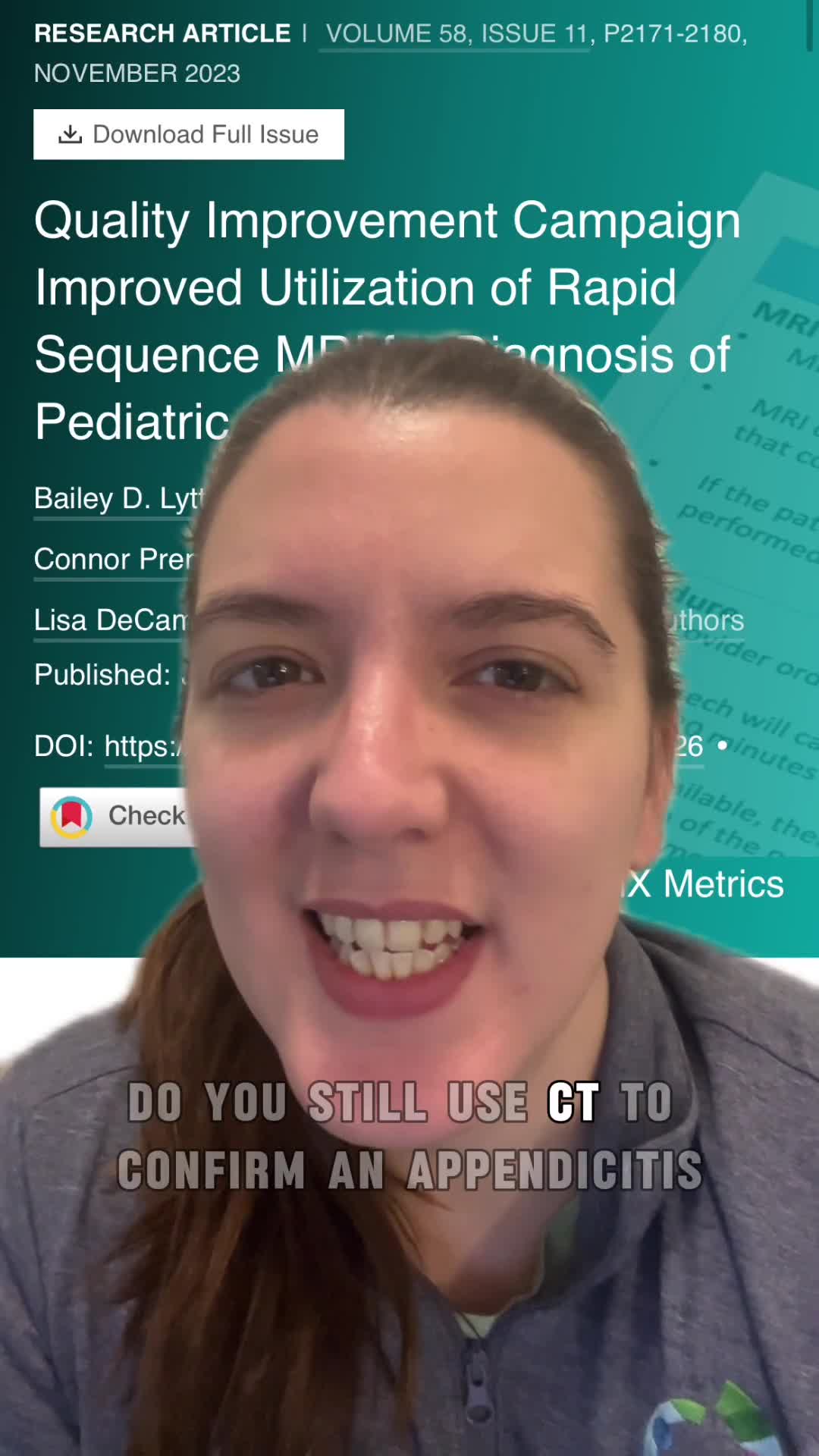
Quality Improvement Campaign Improved Utilization of Rapid Sequence MRI for Diagnosis of Pediatric Appendicitis
 ▶
Ep 23 · 0:00
▶
Ep 23 · 0:00
host summary
Cecilia Gigena summarizing a resource: A mixed-method study done in Colorado aimed to reduce the rate of CT by implementing a quality improvement campaign to stimulate the use of rapid sequence MRI for appendicitis
↗
▶
Ep 23 · 0:00
host summary
Cecilia Gigena summarizing a resource: it seems that we can use rapid sequence MRI instead of CT for equivocal ultrasound in a suspected appendicitis
↗
▶
Ep 23 · 0:00
host summary
Cecilia Gigena summarizing a resource: The quality improvement campaign was implemented in May 2021
↗
▶
Ep 23 · 0:00
host summary
Cecilia Gigena summarizing a resource: The study retrospectively examined all patients with appendicitis from 2016 to 2022
↗
▶
Ep 23 · 0:00
host summary
Cecilia Gigena summarizing a resource: The campaign significantly reduced the rates of CT use while increasing the rates of rapid sequence MRI with similar diagnostic results
↗
▶
Ep 23 · 0:00
host summary
Cecilia Gigena summarizing a resource: Rapid sequence MRI can be used instead of CT for equivocal ultrasound in suspected appendicitis
↗
▶
Ep 23 · 0:00
host summary
Cecilia Gigena summarizing a resource: Do you still use CT to confirm an appendicitis when you have an equivocal ultrasound?
↗
Journal of Pediatric Surgery Article Review: November 2023
 ▶
Ep 24 · 2:41
▶
Ep 24 · 2:41
host summary
Cecilia Gigena summarizing the discussion: If perforated appendicitis with suspected abscess, CT should be used instead of MRI because CT is better for abscess evaluation
↗
▶
Ep 24 · 2:41
host summary
Cecilia Gigena summarizing the discussion: The MRI protocol was only for patients 7 years or older during normal MRI technologist hours
↗
▶
Ep 24 · 3:16
host summary
Cecilia Gigena summarizing the discussion: Following the quality improvement campaign, MRI rate increased almost tenfold while CT use decreased markedly
↗
▶
Ep 24 · 7:15
host summary
Cecilia Gigena summarizing the discussion: There is a lack of evidence regarding the effect of laparoscopic surgery and lack of comparative studies on whether laparoscopic surgery reduces long-term postoperative adhesive obstructions in pediatric patients
↗
▶
Ep 24 · 9:37
host summary
Cecilia Gigena summarizing the discussion: With open esophageal atresia surgery, you highly likely have scoliosis and shoulder girdle weakness, which with thoracoscopic repair you can prevent 100%
↗
▶
Ep 24 · 10:01
host summary
Cecilia Gigena summarizing the discussion: The Chinese center was able to change their practice from open to thoracoscopic esophageal atresia repair in about 10 years
↗
Quick Literature Updates Ep 24
 ▶
Ep 27 · 3:34
▶
Ep 27 · 3:34
host summary
Cecilia Gigena summarizes what Dr. Carlos Colunga said: The Rao et al. study is a multi-center retrospective study done in the US from 2018 to 2022.
↗
▶
Ep 27 · 3:34
host summary
Cecilia Gigena summarizes what Dr. Carlos Colunga said: The Rao study compared patients with suspected choledocholithiasis who underwent transcystic laparoscopic common bile duct exploration versus those who underwent ERCP first.
↗
▶
Ep 27 · 3:53
host summary
Cecilia Gigena summarizes what Dr. Carlos Colunga said: The Rao study included 252 patients total: 156 in the transcystic laparoscopic common bile duct exploration group and 96 in the ERCP-first group.
↗
▶
Ep 27 · 4:02
host summary
Cecilia Gigena summarizes what Dr. Carlos Colunga said: Patients who underwent transcystic laparoscopic common bile duct exploration had lower length of stay compared to ERCP-first patients.
↗
▶
Ep 27 · 4:02
host summary
Cecilia Gigena summarizes what Dr. Carlos Colunga said: Patients who underwent transcystic laparoscopic common bile duct exploration had significantly less complication rates compared to ERCP-first patients.
↗
▶
Ep 27 · 4:16
host summary
Cecilia Gigena summarizes what Dr. Carlos Colunga said: Attempting a transcystic laparoscopic common bile duct exploration may benefit pediatric choledocholithiasis patients.
↗
Summaries Cecilia gave as host · Appendicitis
14 summaries
Open the Appendicitis collection →
Quick Literature Updates Episode 11
▶
Ep 11 · 3:07
host summary
Cecilia Gigena summarizing a resource: Spontaneous closure of periumbilical hernias after gastroschisis was seen in 38.8% of cases.
↗
▶
Ep 11 · 3:07
host summary
Cecilia Gigena summarizing a resource: Only 31.8% of patients with periumbilical hernias after gastroschisis needed surgery.
↗
▶
Ep 11 · 3:07
host summary
Cecilia Gigena summarizing a resource: Periumbilical hernia rate was significantly higher in patients who underwent primary closure versus those who needed silo placement.
↗
▶
Ep 11 · 3:07
host summary
Cecilia Gigena summarizing a resource: Patients who underwent sutureless gastroschisis closures had 50% rates of persistent hernia.
↗
▶
Ep 11 · 3:07
host summary
Cecilia Gigena summarizing a resource: Only 16.4% of patients who underwent sutured gastroschisis closure had a persistent hernia.
↗
▶
Ep 11 · 3:07
host summary
Cecilia Gigena summarizing a resource: The overall rate for periumbilical hernias after gastroschisis closure was 22.7%.
↗
▶
Ep 11 · 3:07
host summary
Cecilia Gigena summarizing a resource: Sutureless gastroschisis closures lead to more periumbilical hernias, but they can be managed as any other congenital umbilical hernia and have no additional risk.
↗
▶
Ep 11 · 3:07
host summary
Cecilia Gigena summarizing a resource: Frazier et al. conducted a retrospective study from the Midwest Pediatric Surgery Consortium following 375 patients with gastroschisis who underwent closure between 2013 and 2016.
↗
Quick Literature Updates Ep 24
▶
Ep 12 · 3:34
host summary
Cecilia Gigena summarizes what Dr. Carlos Colunga said: The Rao et al. study is a multi-center retrospective study done in the US from 2018 to 2022.
↗
▶
Ep 12 · 3:34
host summary
Cecilia Gigena summarizes what Dr. Carlos Colunga said: The Rao study compared patients with suspected choledocholithiasis who underwent transcystic laparoscopic common bile duct exploration versus those who underwent ERCP first.
↗
▶
Ep 12 · 3:53
host summary
Cecilia Gigena summarizes what Dr. Carlos Colunga said: The Rao study included 252 patients total: 156 in the transcystic laparoscopic common bile duct exploration group and 96 in the ERCP-first group.
↗
▶
Ep 12 · 4:02
host summary
Cecilia Gigena summarizes what Dr. Carlos Colunga said: Patients who underwent transcystic laparoscopic common bile duct exploration had significantly less complication rates compared to ERCP-first patients.
↗
▶
Ep 12 · 4:02
host summary
Cecilia Gigena summarizes what Dr. Carlos Colunga said: Patients who underwent transcystic laparoscopic common bile duct exploration had lower length of stay compared to ERCP-first patients.
↗
▶
Ep 12 · 4:16
host summary
Cecilia Gigena summarizes what Dr. Carlos Colunga said: Attempting a transcystic laparoscopic common bile duct exploration may benefit pediatric choledocholithiasis patients.
↗
Summaries Cecilia gave as host · Biliary Atresia
12 summaries
Open the Biliary Atresia collection →
Prof. Shilpa Sharma - Best of the Best in Pediatric Surgery 2024
 ▶
Ep 17 · 5:08
▶
Ep 17 · 5:08
host summary
Cecilia Gigena summarizes what Dr. Shilpa Sharma said: The team resected the left liver (segments 2 and 3) to leave enough liver to regenerate, particularly in patients presenting late after 80 days of life.
↗
Clinical Characteristics and Prognosis of Biliary Atresia with Low Serum Matrix Metalloproteinase-7 Levels
 ▶
Ep 21 · 0:11
▶
Ep 21 · 0:11
host summary
Cecilia Gigena summarizing a resource: This is a retrospective cohort study done in China that aimed to evaluate the characteristics and prognosis of patients with biliary atresia and low MMP 7.
↗
▶
Ep 21 · 0:11
host summary
Cecilia Gigena summarizing a resource: The study was a retrospective cohort study conducted in China
↗
▶
Ep 21 · 0:21
host summary
Cecilia Gigena summarizing a resource: 40 of the 329 patients had low MMP-7 levels
↗
▶
Ep 21 · 0:21
host summary
Cecilia Gigena summarizing a resource: The study included 329 patients with biliary atresia
↗
▶
Ep 21 · 0:21
host summary
Cecilia Gigena summarizing a resource: They had 329 patients, and 40 of them had low MMP7.
↗
▶
Ep 21 · 0:27
host summary
Cecilia Gigena summarizing a resource: Patients with low MMP-7 had significantly lower 1-year native liver survival
↗
▶
Ep 21 · 0:27
host summary
Cecilia Gigena summarizing a resource: And what they found is that these patients had significantly lower 3 month and 6 month jaundice clearance and significantly lower 1 year native liver survival.
↗
▶
Ep 21 · 0:27
host summary
Cecilia Gigena summarizing a resource: Patients with low MMP-7 had significantly lower 3-month jaundice clearance
↗
▶
Ep 21 · 0:27
host summary
Cecilia Gigena summarizing a resource: Patients with low MMP-7 had significantly lower 6-month jaundice clearance
↗
▶
Ep 21 · 0:40
host summary
Cecilia Gigena summarizing a resource: MMP-7 measurement may in the future help with treatment of biliary atresia patients
↗
▶
Ep 21 · 0:40
host summary
Cecilia Gigena summarizing a resource: Measuring MMP-7 can help with prognosis in biliary atresia patients
↗
Summaries Cecilia gave as host · Blunt Abdominal Trauma
18 summaries
Open the Blunt Abdominal Trauma collection →
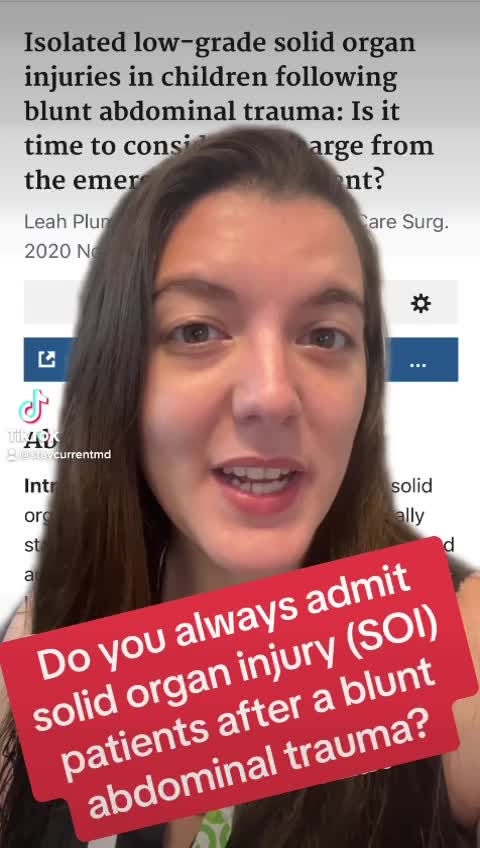
Isolated low-grade solid organ injuries in children following blunt abdominal trauma
 ▶
Ep 6 · 0:00
▶
Ep 6 · 0:00
host summary
Cecilia Gigena summarizing a resource: Isolated solid organ injuries after blunt abdominal trauma, grades 1 or 2, can be discharged from the emergency department.
↗
▶
Ep 6 · 0:00
host summary
Cecilia Gigena summarizing a resource: Only 3 of 114 patients with grade 3 solid organ injuries required an acute intervention.
↗
▶
Ep 6 · 0:00
host summary
Cecilia Gigena summarizing a resource: The study included 262 patients with isolated solid organ injuries, grades 1 to 3.
↗
▶
Ep 6 · 0:00
host summary
Cecilia Gigena summarizing a resource: 114 patients had grade 3 solid organ injuries.
↗
▶
Ep 6 · 0:00
host summary
Cecilia Gigena summarizing a resource: 148 patients had solid organ injuries grades 1 or 2.
↗
▶
Ep 6 · 0:00
host summary
Cecilia Gigena summarizing a resource: A retrospective study was conducted in South Carolina examining isolated solid organ injuries after blunt abdominal trauma in children.
↗
▶
Ep 6 · 0:00
host summary
Cecilia Gigena summarizing a resource: None of the 148 patients with grade 1 or 2 solid organ injuries required an acute intervention.
↗
▶
Ep 6 · 0:00
host summary
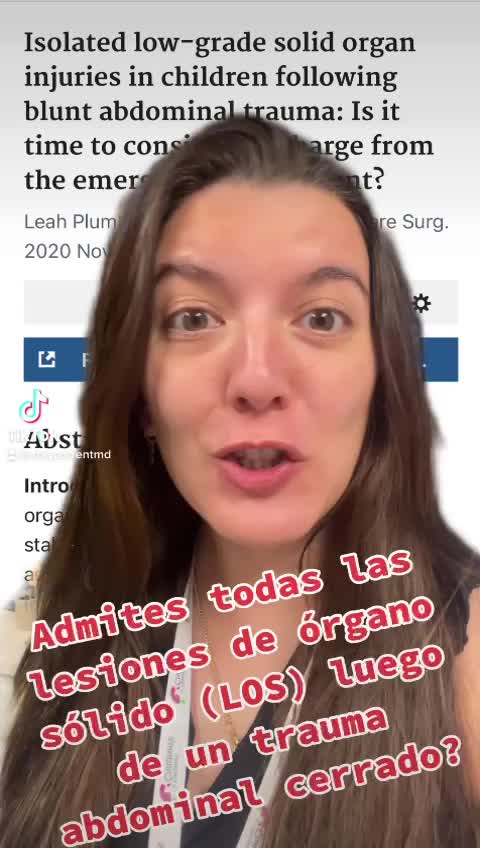
Cecilia Gigena summarizing a resource: Do you admit every solid organ injury after a blunt abdominal trauma?
↗
Lesiones de órgano sólido aisladas de bajo grado luego de un trauma abdominal cerrado…
 ▶
Ep 7 · 0:00
▶
Ep 7 · 0:00
host summary
Cecilia Gigena summarizing a resource: Patients with isolated grade 1 and 2 solid organ injuries can be discharged from the emergency department
↗
▶
Ep 7 · 0:00
host summary
Cecilia Gigena summarizing a resource: The study included 262 patients with isolated solid organ injuries
↗
▶
Ep 7 · 0:00
host summary
Cecilia Gigena summarizing a resource: 148 patients had grade 1 and 2 solid organ injuries
↗
▶
Ep 7 · 0:00
host summary
Cecilia Gigena summarizing a resource: None of the 148 patients with grade 1-2 injuries required any acute intervention
↗
▶
Ep 7 · 0:00
host summary
Cecilia Gigena summarizing a resource: 114 patients had grade 3 solid organ injuries
↗
▶
Ep 7 · 0:00
host summary
Cecilia Gigena summarizing a resource: Three of the 114 patients with grade 3 injuries required acute intervention
↗
▶
Ep 7 · 0:00
host summary
Cecilia Gigena summarizing a resource: A retrospective study was conducted in South Carolina examining whether all isolated solid organ injuries after blunt abdominal trauma require hospital admission
↗
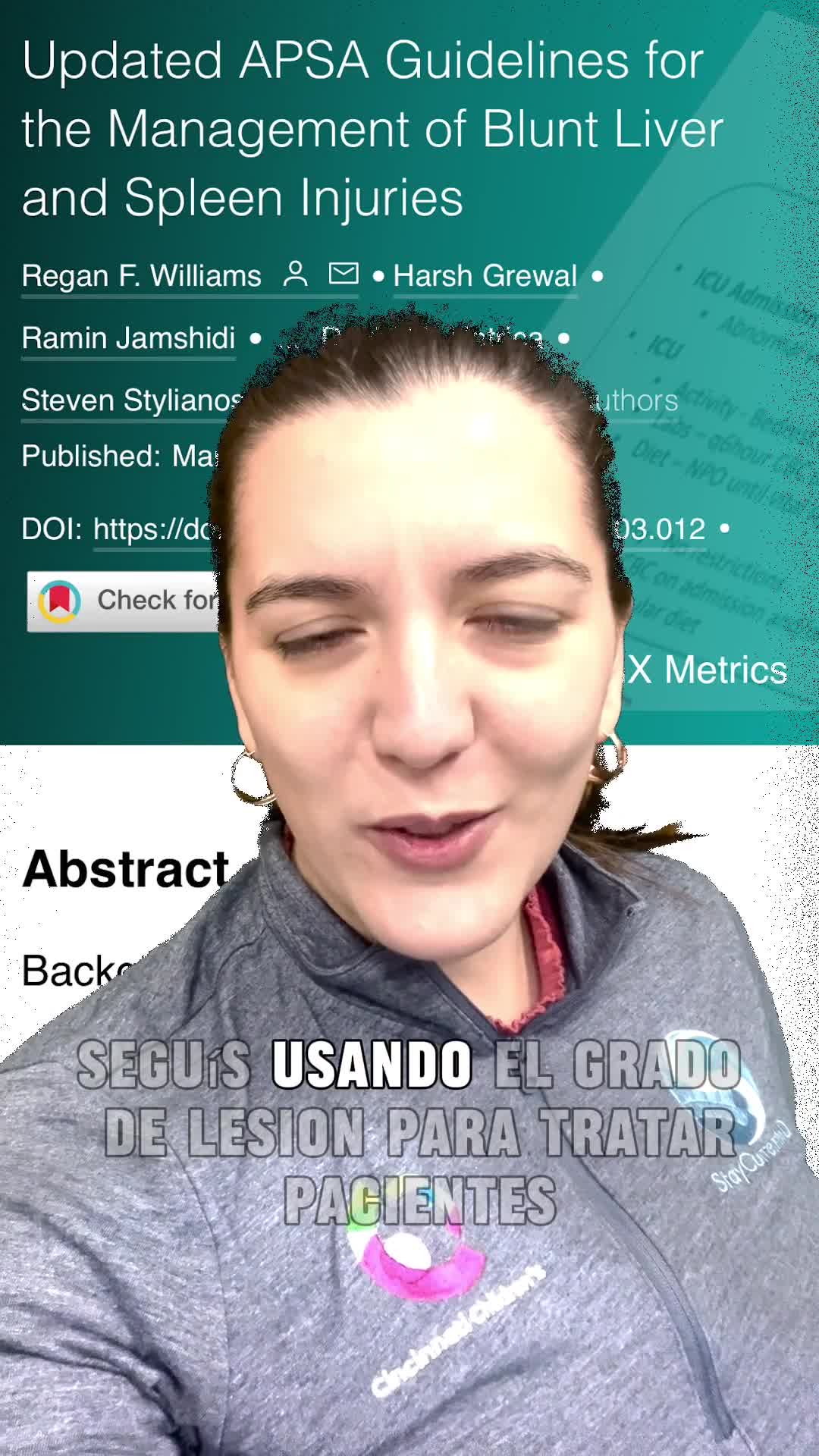
Guías APSA actualizadas para el tratamiento de lesiones contusas del hígado y del bazo
 ▶
Ep 8 · 0:00
▶
Ep 8 · 0:00
host summary
Cecilia Gigena summarizing a resource: The updated guidelines divide treatment into four stages using the APSA acronym: A for Admission, P for Procedures, S for Set Free (discharge), and A for post-operative care
↗
▶
Ep 8 · 0:00
host summary
Cecilia Gigena summarizing a resource: The most important change is that all treatment is now based on the patient's clinical signs and symptoms rather than the injury grade of the spleen or liver
↗
▶
Ep 8 · 0:00
host summary
Cecilia Gigena summarizing a resource: The APSA Trauma Committee conducted a review to update guidelines on treatment of blunt abdominal trauma with liver or splenic injuries
↗
Summaries Cecilia gave as host · Button Battery Ingestion
15 summaries
Open the Button Battery Ingestion collection →
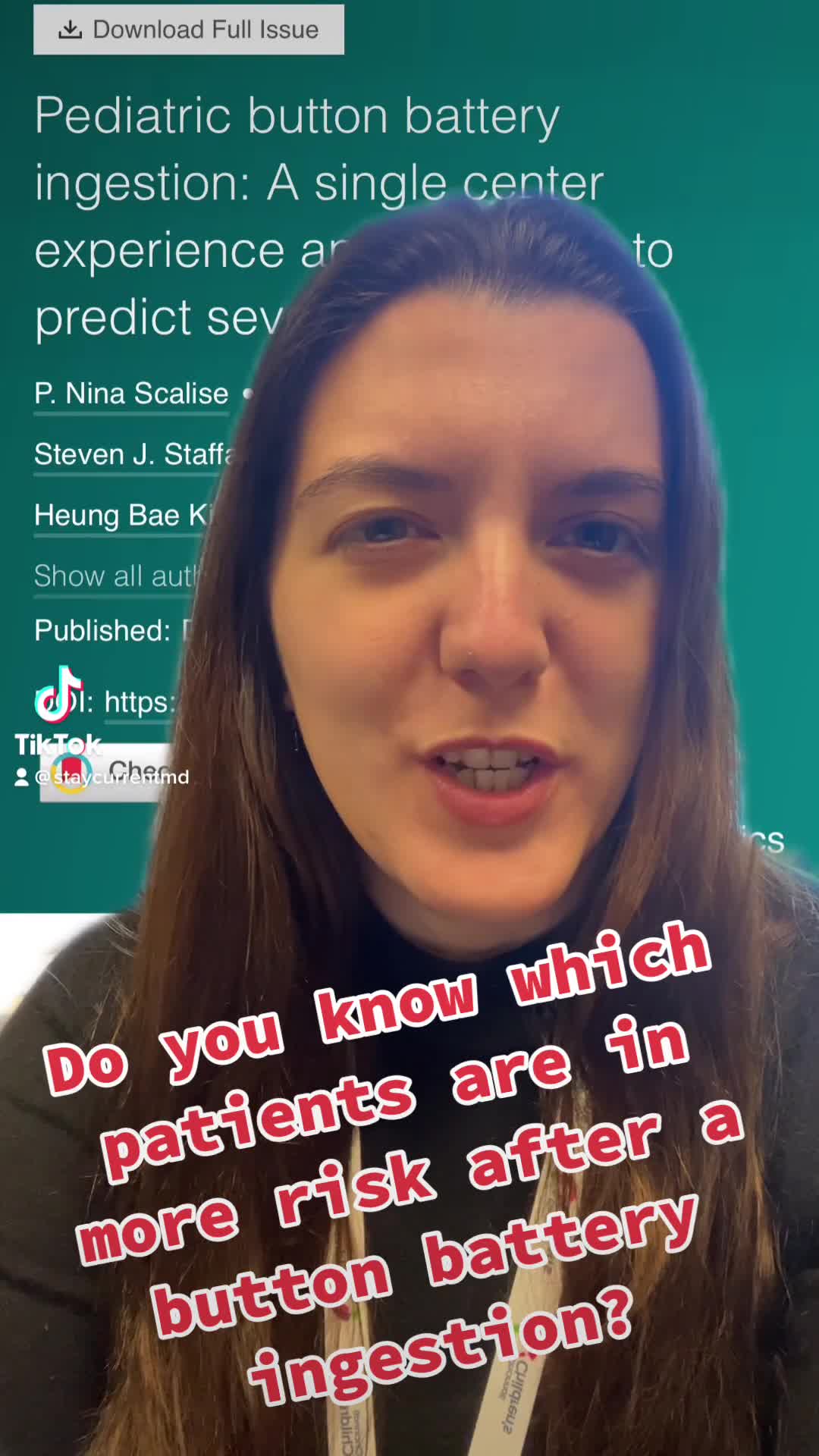
Pediatric button battery ingestion: A single center experience and risk score to predict severe outcomes
 ▶
Ep 2 · 0:00
▶
Ep 2 · 0:00
host summary
Cecilia Gigena summarizing a resource: A retrospective study was conducted at Boston Children's Hospital from 2008 to 2021 examining button battery ingestion outcomes.
↗
▶
Ep 2 · 0:00
host summary
Cecilia Gigena summarizing a resource: The study proposes a risk score to predict severe outcomes in patients with button battery ingestion.
↗
▶
Ep 2 · 0:00
host summary
Cecilia Gigena summarizing a resource: Presence of symptoms at presentation is an independent predictor of severe outcomes.
↗
▶
Ep 2 · 0:00
host summary
Cecilia Gigena summarizing a resource: Button battery size larger than 2 cm is an independent predictor of severe outcomes.
↗
▶
Ep 2 · 0:00
host summary
Cecilia Gigena summarizing a resource: Esophageal location of the button battery is an independent predictor of severe outcomes.
↗
▶
Ep 2 · 0:00
host summary
Cecilia Gigena summarizing a resource: 24 of 143 patients (16.8%) had severe outcomes after button battery ingestion.
↗
▶
Ep 2 · 0:00
host summary
Cecilia Gigena summarizing a resource: The study analyzed 143 patients with button battery ingestion.
↗
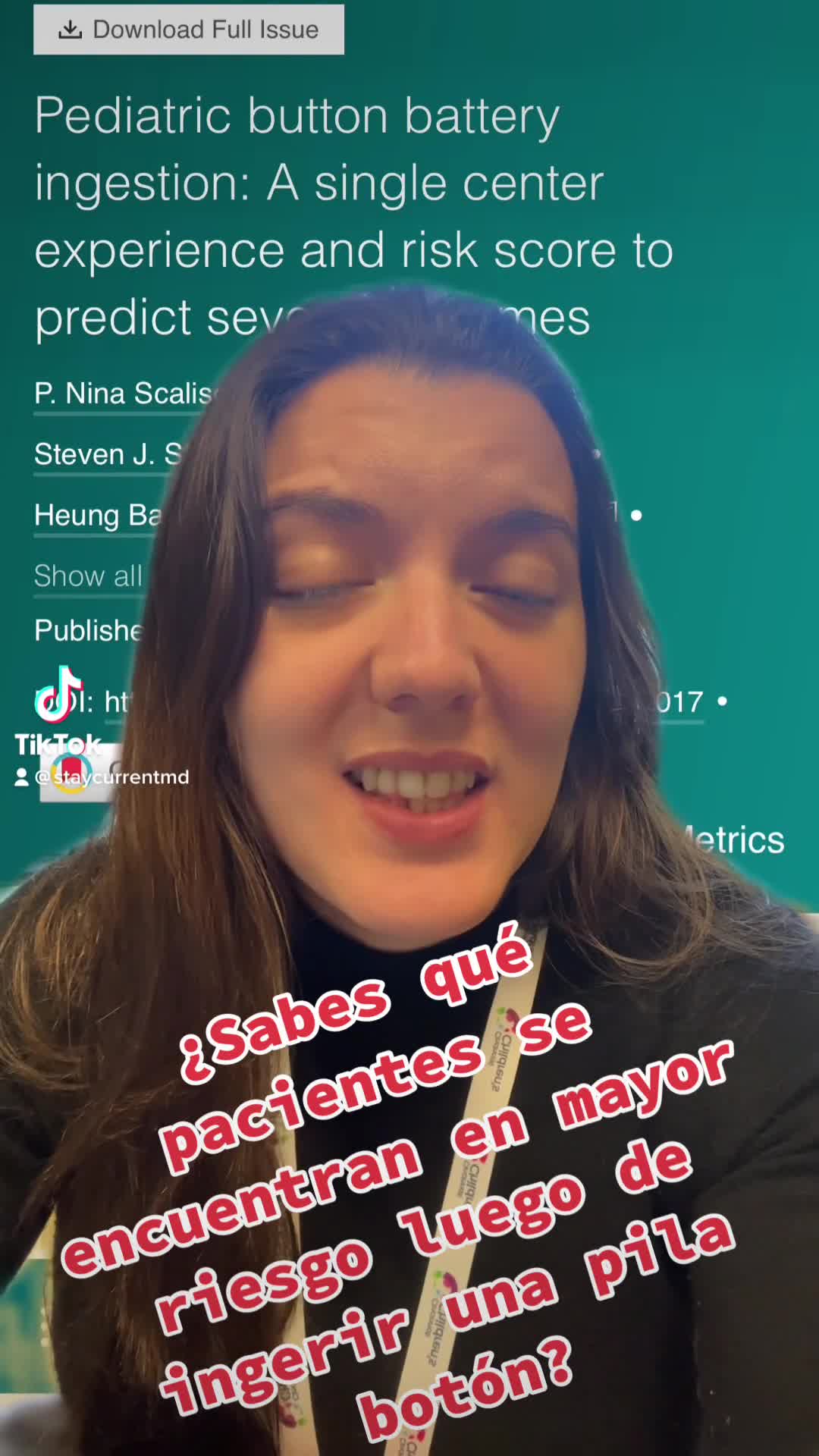
Ingestión de pila boton en pediatría: Experiencia de un centro y score de riesgo para predecir resultados
 ▶
Ep 3 · 0:00
▶
Ep 3 · 0:00
host summary
Cecilia Gigena summarizing a resource: The third risk factor is the presence of symptoms at onset
↗
▶
Ep 3 · 0:00
host summary
Cecilia Gigena summarizing a resource: This is a retrospective study conducted at Boston Children's Hospital from 2008 to 2021
↗
▶
Ep 3 · 0:00
host summary
Cecilia Gigena summarizing a resource: The study objective was to identify risk factors to create a score in patients who had ingested a button battery
↗
▶
Ep 3 · 0:00
host summary
Cecilia Gigena summarizing a resource: The second risk factor is a button battery greater than 2 cm in diameter
↗
▶
Ep 3 · 0:00
host summary
Cecilia Gigena summarizing a resource: The study included 143 patients
↗
▶
Ep 3 · 0:00
host summary
Cecilia Gigena summarizing a resource: 24 patients had serious injuries from button battery ingestion
↗
▶
Ep 3 · 0:00
host summary
Cecilia Gigena summarizing a resource: Three risk factors predict serious injuries in button battery ingestion patients
↗
▶
Ep 3 · 0:00
host summary
Cecilia Gigena summarizing a resource: The first risk factor is the location of the button battery in the esophagus at the time of consultation
↗
Summaries Cecilia gave as host · Cancer
9 summaries
Open the Cancer collection →
Female Fertility Cryopreservation Outcomes in Childhood Cancer: A Systematic Review
 ▶
Ep 8 · 0:00
▶
Ep 8 · 0:00
host summary
Cecilia Gigena summarizing a resource: Do you indicate cryopreservation in girls that are going to need chemotherapy?
↗
▶
Ep 8 · 0:11
host summary
Cecilia Gigena summarizing a resource: The systematic review aimed to highlight outcomes of cryopreservation in pediatric female patients with cancer
↗
▶
Ep 8 · 0:20
host summary
Cecilia Gigena summarizing a resource: The review included 12 studies with 612 patients total
↗
▶
Ep 8 · 0:26
host summary
Cecilia Gigena summarizing a resource: 501 patients underwent ovarian tissue cryopreservation
↗
▶
Ep 8 · 0:31
host summary
Cecilia Gigena summarizing a resource: Only 30 of the 501 patients received ovarian tissue transplantation
↗
▶
Ep 8 · 0:36
host summary
Cecilia Gigena summarizing a resource: Of the 30 patients who received transplantation, 9 got pregnant
↗
▶
Ep 8 · 0:40
host summary
Cecilia Gigena summarizing a resource: Only 6 of the 9 pregnancies resulted in live birth
↗
▶
Ep 8 · 0:43
host summary
Cecilia Gigena summarizing a resource: So even though cryopreservation can be successful, we still need more high quality studies to understand it better and improve its outcomes.
↗
▶
Ep 8 · 0:43
host summary
Cecilia Gigena summarizing a resource: More high quality studies are needed to understand cryopreservation better and improve its outcomes
↗
Summaries Cecilia gave as host · Choledochal Cyst / Biliary
12 summaries
Open the Choledochal Cyst / Biliary collection →
Quick Literature Updates Episode 15
 ▶
Ep 5 · 0:59
▶
Ep 5 · 0:59
host summary
Cecilia Gigena summarizing a resource: The Hirschsprung-associated IBD study was a retrospective study gathering patients from 2000 to 2021 at 17 institutions.
↗
▶
Ep 5 · 1:14
host summary
Cecilia Gigena summarizing a resource: The study gathered 55 Hirschsprung patients, and 50% had long segment disease.
↗
▶
Ep 5 · 1:19
host summary
Cecilia Gigena summarizing a resource: 10% of the Hirschsprung patients had trisomy 21.
↗
▶
Ep 5 · 1:19
host summary
Cecilia Gigena summarizing a resource: 68% of the Hirschsprung patients had Hirschsprung-associated enterocolitis.
↗
▶
Ep 5 · 1:19
host summary
Cecilia Gigena summarizing a resource: Long segment disease, Hirschsprung-associated enterocolitis, and trisomy 21 can be potential risk factors for IBD-like symptoms in Hirschsprung patients after pull through.
↗
▶
Ep 5 · 1:19
host summary
Cecilia Gigena summarizing a resource: it seems that lung segment disease, Hirschprung associated enterocolitis, and trisomy 21 can be potential risk factors for IVD-like symptoms in Hirschprung patients after pull through.
↗
▶
Ep 5 · 3:09
host summary
Cecilia Gigena summarizing a resource: The solid organ injury study was a retrospective study done in South Carolina examining if isolated solid organ injuries after blunt abdominal trauma can be discharged from the ED.
↗
▶
Ep 5 · 3:19
host summary
Cecilia Gigena summarizing a resource: The study gathered 262 patients with isolated solid organ injuries, grades 1 to 3.
↗
▶
Ep 5 · 3:26
host summary
Cecilia Gigena summarizing a resource: 148 patients had solid organ injuries grades 1 or 2, and none of them required an acute intervention.
↗
▶
Ep 5 · 3:34
host summary
Cecilia Gigena summarizing a resource: Of 114 patients with grade 3 solid organ injuries, only 3 patients required an acute intervention.
↗
▶
Ep 5 · 3:44
host summary
Cecilia Gigena summarizing a resource: So it seems that isolated solid organ injuries after a blunt abdominal trauma, grades 1 or 2 can be discharged from the ED.
↗
▶
Ep 5 · 3:44
host summary
Cecilia Gigena summarizing a resource: Isolated solid organ injuries after blunt abdominal trauma, grades 1 or 2, can be discharged from the ED.
↗
Summaries Cecilia gave as host · Choledocholithiasis
18 summaries
Open the Choledocholithiasis collection →
Quick Literature Updates Episode 12
 ▶
Ep 3 · 4:07
▶
Ep 3 · 4:07
host summary
Cecilia Gigena summarizing a resource: The Treider et al. study is a retrospective study done in Norway between 2003 and 2020 that analyzed 100 patients with congenital duodenal obstruction.
↗
▶
Ep 3 · 4:07
host summary
Cecilia Gigena summarizing a resource: 37% of the 100 patients received a transanastomotic feeding tube after congenital duodenal obstruction repair.
↗
Transcystic Laparoscopic Common Bile Duct Exploration for Pediatric Patients with Choledocholithiasis
 ▶
Ep 4 · 0:09
▶
Ep 4 · 0:09
host summary
Cecilia Gigena summarizing a resource: The study aim was to compare patients with suspected choledocholithiasis who underwent transcystic laparoscopic common bile duct exploration versus those who underwent ERCP first
↗
▶
Ep 4 · 0:09
host summary
Cecilia Gigena summarizing a resource: This is a multi-center retrospective study done in the US from 2018 to 2022, and their aim was to compare patients with suspected.
↗
▶
Ep 4 · 0:09
host summary
Cecilia Gigena summarizing a resource: The study was a multi-center retrospective study conducted in the US from 2018 to 2022
↗
▶
Ep 4 · 0:28
host summary
Cecilia Gigena summarizing a resource: The study included 252 patients total
↗
▶
Ep 4 · 0:28
host summary
Cecilia Gigena summarizing a resource: 156 patients were in group one (transcystic laparoscopic common bile duct exploration)
↗
▶
Ep 4 · 0:38
host summary
Cecilia Gigena summarizing a resource: 96 patients were in group two (ERCP first)
↗
▶
Ep 4 · 0:38
host summary
Cecilia Gigena summarizing a resource: Patients in group one (transcystic laparoscopic approach) had lower length of stay compared to group two
↗
▶
Ep 4 · 0:38
host summary
Cecilia Gigena summarizing a resource: Patients in group one (transcystic laparoscopic approach) had significantly less complication rates compared to group two
↗
▶
Ep 4 · 0:52
host summary
Cecilia Gigena summarizing a resource: So it seems that attempting a transcystic laparoscopic common bile duct exploration may benefit our patients.
↗
▶
Ep 4 · 0:52
host summary
Cecilia Gigena summarizing a resource: Attempting a transcystic laparoscopic common bile duct exploration may benefit pediatric patients with choledocholithiasis
↗
Choledocholithiasis with Drs. David Vitale & Lucas Neff
 ▶
Ep 5 · 0:43
▶
Ep 5 · 0:43
host summary
Cecilia Gigena summarizing the discussion: Choledocholithiasis stones may be made up of bile pigments or calcium and cholesterol salts.
↗
▶
Ep 5 · 2:11
host summary
Cecilia Gigena summarizing the discussion: Patients with intermediate risk (abnormal liver biochemical tests or dilated common bile ducts) can undergo endoscopic ultrasound, MRCP, laparoscopic cholangiogram, or intraoperative ultrasound.
↗
▶
Ep 5 · 2:50
host summary
Cecilia Gigena summarizing the discussion: Common bile duct diameter greater than 6 millimeters was most sensitive for predicting common bile duct stones in children, although without statistical significance.
↗
▶
Ep 5 · 4:18
host summary
Cecilia Gigena summarizing the discussion: Randomized trials from 2013 show no significant difference in morbidity, mortality, retained stones, or failure rates between ERCP and laparoscopic common bile duct exploration.
↗
▶
Ep 5 · 8:59
host summary
Cecilia Gigena summarizing the discussion: Most free-standing children's hospitals do not have ERCP capabilities.
↗
▶
Ep 5 · 12:24
host summary
Cecilia Gigena summarizing the discussion: If the pancreatic duct is visualized during fluoroscopy, the procedure should be stopped due to higher risk for pancreatitis.
↗
Summaries Cecilia gave as host · Choledocholithiasis
16 summaries
Open the Choledocholithiasis collection →
Transcystic Laparoscopic Common Bile Duct Exploration for Pediatric Patients with Choledocholithiasis
▶
Ep 1 · 0:09
host summary
Cecilia Gigena summarizing a resource: The study was a multi-center retrospective study conducted in the US from 2018 to 2022
↗
▶
Ep 1 · 0:09
host summary
Cecilia Gigena summarizing a resource: This is a multi-center retrospective study done in the US from 2018 to 2022, and their aim was to compare patients with suspected.
↗
▶
Ep 1 · 0:09
host summary
Cecilia Gigena summarizing a resource: The study aim was to compare patients with suspected choledocholithiasis who underwent transcystic laparoscopic common bile duct exploration versus those who underwent ERCP first
↗
▶
Ep 1 · 0:28
host summary
Cecilia Gigena summarizing a resource: 156 patients were in group one (transcystic laparoscopic common bile duct exploration)
↗
▶
Ep 1 · 0:28
host summary
Cecilia Gigena summarizing a resource: The study included 252 patients total
↗
▶
Ep 1 · 0:38
host summary
Cecilia Gigena summarizing a resource: 96 patients were in group two (ERCP first)
↗
▶
Ep 1 · 0:38
host summary
Cecilia Gigena summarizing a resource: Patients in group one (transcystic laparoscopic approach) had significantly less complication rates compared to group two
↗
▶
Ep 1 · 0:38
host summary
Cecilia Gigena summarizing a resource: Patients in group one (transcystic laparoscopic approach) had lower length of stay compared to group two
↗
▶
Ep 1 · 0:52
host summary
Cecilia Gigena summarizing a resource: Attempting a transcystic laparoscopic common bile duct exploration may benefit pediatric patients with choledocholithiasis
↗
▶
Ep 1 · 0:52
host summary
Cecilia Gigena summarizing a resource: So it seems that attempting a transcystic laparoscopic common bile duct exploration may benefit our patients.
↗
Choledocholithiasis with Drs. David Vitale & Lucas Neff
▶
Ep 2 · 0:43
host summary
Cecilia Gigena summarizing the discussion: Choledocholithiasis stones may be made up of bile pigments or calcium and cholesterol salts.
↗
▶
Ep 2 · 2:11
host summary
Cecilia Gigena summarizing the discussion: Patients with intermediate risk (abnormal liver biochemical tests or dilated common bile ducts) can undergo endoscopic ultrasound, MRCP, laparoscopic cholangiogram, or intraoperative ultrasound.
↗
▶
Ep 2 · 2:50
host summary
Cecilia Gigena summarizing the discussion: Common bile duct diameter greater than 6 millimeters was most sensitive for predicting common bile duct stones in children, although without statistical significance.
↗
▶
Ep 2 · 4:18
host summary
Cecilia Gigena summarizing the discussion: Randomized trials from 2013 show no significant difference in morbidity, mortality, retained stones, or failure rates between ERCP and laparoscopic common bile duct exploration.
↗
▶
Ep 2 · 8:59
host summary
Cecilia Gigena summarizing the discussion: Most free-standing children's hospitals do not have ERCP capabilities.
↗
▶
Ep 2 · 12:24
host summary
Cecilia Gigena summarizing the discussion: If the pancreatic duct is visualized during fluoroscopy, the procedure should be stopped due to higher risk for pancreatitis.
↗
Summaries Cecilia gave as host · Cholelithiasis
11 summaries
Open the Cholelithiasis collection →
Case-Based Journal Review: Cholelithiasis 2024
 ▶
Ep 3 · 3:11
▶
Ep 3 · 3:11
host summary
Cecilia Gigena summarizes what Dr. Jose Campos said: In a multi-center study of 167 early cholecystectomy patients versus 79 delayed, early cholecystectomy had 2% recurrence of pancreatitis compared to 22% in delayed surgery
↗
▶
Ep 3 · 3:36
host summary
Cecilia Gigena summarizes what Dr. Jose Campos said: When cholecystectomy was delayed more than 6 weeks after gallstone pancreatitis, recurrence rate increased to 60%
↗
▶
Ep 3 · 4:27
host summary
Cecilia Gigena summarizes what Dr. Jose Campos said: Patients who underwent early cholecystectomy did not have more biliary complications than delayed surgery patients
↗
▶
Ep 3 · 11:27
host summary
Cecilia Gigena summarizes what Dr. Jose Campos said: In a multi-center study of 252 patients with choledocholithiasis, 156 underwent OR-first approach (laparoscopic cholecystectomy with intraoperative cholangiogram) and 96 underwent ERCP-first approach
↗
▶
Ep 3 · 11:41
host summary
Cecilia Gigena summarizes what Dr. Jose Campos said: Patients who underwent intraoperative cholangiogram first had fewer complications and shorter length of stay than ERCP-first patients, and 86% needed only the surgery without subsequent ERCP
↗
Choledocholithiasis with Drs. David Vitale & Lucas Neff
▶
Ep 4 · 0:43
host summary
Cecilia Gigena summarizing the discussion: Choledocholithiasis stones may be made up of bile pigments or calcium and cholesterol salts.
↗
▶
Ep 4 · 2:11
host summary
Cecilia Gigena summarizing the discussion: Patients with intermediate risk (abnormal liver biochemical tests or dilated common bile ducts) can undergo endoscopic ultrasound, MRCP, laparoscopic cholangiogram, or intraoperative ultrasound.
↗
▶
Ep 4 · 2:50
host summary
Cecilia Gigena summarizing the discussion: Common bile duct diameter greater than 6 millimeters was most sensitive for predicting common bile duct stones in children, although without statistical significance.
↗
▶
Ep 4 · 4:18
host summary
Cecilia Gigena summarizing the discussion: Randomized trials from 2013 show no significant difference in morbidity, mortality, retained stones, or failure rates between ERCP and laparoscopic common bile duct exploration.
↗
▶
Ep 4 · 8:59
host summary
Cecilia Gigena summarizing the discussion: Most free-standing children's hospitals do not have ERCP capabilities.
↗
▶
Ep 4 · 12:24
host summary
Cecilia Gigena summarizing the discussion: If the pancreatic duct is visualized during fluoroscopy, the procedure should be stopped due to higher risk for pancreatitis.
↗
Summaries Cecilia gave as host · Cholelithiasis
16 summaries
Open the Cholelithiasis collection →
Case-Based Journal Review: Cholelithiasis 2024
▶
Ep 3 · 3:11
host summary
Cecilia Gigena summarizes what Dr. Jose Campos said: In a multi-center study of 167 early cholecystectomy patients versus 79 delayed, early cholecystectomy had 2% recurrence of pancreatitis compared to 22% in delayed surgery
↗
▶
Ep 3 · 3:36
host summary
Cecilia Gigena summarizes what Dr. Jose Campos said: When cholecystectomy was delayed more than 6 weeks after gallstone pancreatitis, recurrence rate increased to 60%
↗
▶
Ep 3 · 4:27
host summary
Cecilia Gigena summarizes what Dr. Jose Campos said: Patients who underwent early cholecystectomy did not have more biliary complications than delayed surgery patients
↗
▶
Ep 3 · 11:27
host summary
Cecilia Gigena summarizes what Dr. Jose Campos said: In a multi-center study of 252 patients with choledocholithiasis, 156 underwent OR-first approach (laparoscopic cholecystectomy with intraoperative cholangiogram) and 96 underwent ERCP-first approach
↗
▶
Ep 3 · 11:41
host summary
Cecilia Gigena summarizes what Dr. Jose Campos said: Patients who underwent intraoperative cholangiogram first had fewer complications and shorter length of stay than ERCP-first patients, and 86% needed only the surgery without subsequent ERCP
↗
Choledocholithiasis with Drs. David Vitale & Lucas Neff
▶
Ep 4 · 0:43
host summary
Cecilia Gigena summarizing the discussion: Choledocholithiasis stones may be made up of bile pigments or calcium and cholesterol salts.
↗
▶
Ep 4 · 2:11
host summary
Cecilia Gigena summarizing the discussion: Patients with intermediate risk (abnormal liver biochemical tests or dilated common bile ducts) can undergo endoscopic ultrasound, MRCP, laparoscopic cholangiogram, or intraoperative ultrasound.
↗
▶
Ep 4 · 2:50
host summary
Cecilia Gigena summarizing the discussion: Common bile duct diameter greater than 6 millimeters was most sensitive for predicting common bile duct stones in children, although without statistical significance.
↗
▶
Ep 4 · 4:18
host summary
Cecilia Gigena summarizing the discussion: Randomized trials from 2013 show no significant difference in morbidity, mortality, retained stones, or failure rates between ERCP and laparoscopic common bile duct exploration.
↗
▶
Ep 4 · 8:59
host summary
Cecilia Gigena summarizing the discussion: Most free-standing children's hospitals do not have ERCP capabilities.
↗
▶
Ep 4 · 12:24
host summary
Cecilia Gigena summarizing the discussion: If the pancreatic duct is visualized during fluoroscopy, the procedure should be stopped due to higher risk for pancreatitis.
↗
Case Based Journal Review: Cholelithiasis 2024
 ▶
Ep 7 · 3:21
▶
Ep 7 · 3:21
host summary
Cecilia Gigena summarizes what Dr. Jose Campos said: Patients who underwent early cholecystectomy had only 2% recurrence of pancreatitis compared to 22% in patients with delayed surgical approach
↗
▶
Ep 7 · 3:36
host summary
Cecilia Gigena summarizes what Dr. Jose Campos said: If surgery was delayed more than 6 weeks, the recurrence rate of pancreatitis went up to 60%
↗
▶
Ep 7 · 4:27
host summary
Cecilia Gigena summarizes what Dr. Jose Campos said: Patients who underwent early cholecystectomy didn't have more biliary complications
↗
▶
Ep 7 · 11:27
host summary
Cecilia Gigena summarizes what Dr. Jose Campos said: Patients who underwent intraoperative cholangiogram first had less complications and shorter length of stay compared to ERCP-first approach
↗
▶
Ep 7 · 11:41
host summary
Cecilia Gigena summarizes what Dr. Jose Campos said: In the OR-first approach for choledocholithiasis, 86% of patients only needed the initial surgery
↗
Summaries Cecilia gave as host · Cholestasis
11 summaries
Open the Cholestasis collection →
Intestinal Rehabilitation, Episode 6: Cholestasis
 ▶
Ep 5 · 1:48
▶
Ep 5 · 1:48
host summary
Cecilia Gigena summarizing the discussion: Advanced liver disease is defined as conjugated bilirubin above 5 or 6 mg/dL.
↗
▶
Ep 5 · 2:36
host summary
Cecilia Gigena summarizing the discussion: Historically, 25-50% of intestinal failure patients died because of associated liver disease; now it is less than 2%.
↗
▶
Ep 5 · 3:19
host summary
Cecilia Gigena summarizing the discussion: Risk factors for intestinal failure-associated liver disease include prematurity, lack of enteral feeding, sepsis, and TPN components.
↗
▶
Ep 5 · 12:24
host summary
Cecilia Gigena summarizing the discussion: Prophylactic cholecystectomy is not recommended because the gallbladder helps with enterohepatic circulation and many patients will not need it.
↗
Realimentación de Fistula Mucosa en Neonatos: Una revisión sistemática con meta-análisis
 ▶
Ep 6 · 0:00
▶
Ep 6 · 0:00
host summary
Cecilia Gigena summarizing a resource: Neonates who had mucous fistula refeeding had lower rates of cholestasis
↗
▶
Ep 6 · 0:00
host summary
Cecilia Gigena summarizing a resource: Neonates who had mucous fistula refeeding had shorter hospital stays
↗
▶
Ep 6 · 0:00
host summary
Cecilia Gigena summarizing a resource: Mucous fistula refeeding appears to be very useful
↗
▶
Ep 6 · 0:00
host summary
Cecilia Gigena summarizing a resource: This is a retrospective review with meta-analysis conducted in Toronto, Canada
↗
▶
Ep 6 · 0:00
host summary
Cecilia Gigena summarizing a resource: The objective was to evaluate the complications and effectiveness of mucous fistula refeeding in neonates
↗
▶
Ep 6 · 0:00
host summary
Cecilia Gigena summarizing a resource: The review pooled 16 observational studies with a total of 623 patients
↗
▶
Ep 6 · 0:00
host summary
Cecilia Gigena summarizing a resource: Neonates who had mucous fistula refeeding had shorter duration of parenteral nutrition
↗
Summaries Cecilia gave as host · Cholestasis
4 summaries
Open the Cholestasis collection →
Intestinal Rehabilitation, Episode 6: Cholestasis
▶
Ep 4 · 1:48
host summary
Cecilia Gigena summarizing the discussion: Advanced liver disease is defined as conjugated bilirubin above 5 or 6 mg/dL.
↗
▶
Ep 4 · 2:36
host summary
Cecilia Gigena summarizing the discussion: Historically, 25-50% of intestinal failure patients died because of associated liver disease; now it is less than 2%.
↗
▶
Ep 4 · 3:19
host summary
Cecilia Gigena summarizing the discussion: Risk factors for intestinal failure-associated liver disease include prematurity, lack of enteral feeding, sepsis, and TPN components.
↗
▶
Ep 4 · 12:24
host summary
Cecilia Gigena summarizing the discussion: Prophylactic cholecystectomy is not recommended because the gallbladder helps with enterohepatic circulation and many patients will not need it.
↗
Summaries Cecilia gave as host · Chronic Pancreatitis
6 summaries
Open the Chronic Pancreatitis collection →
Update Course Rewind: Management of Recurrent Pancreatitis
▶
Ep 7 · 2:26
host summary
Cecilia Gigena summarizes what Dr. Juan Gurria said: If a patient has more than one episode of acute pancreatitis or a first severe episode, an MRCP and genetic panel should be performed to rule out genetic anomalies.
↗
▶
Ep 7 · 3:37
host summary
Cecilia Gigena summarizes what Dr. Juan Gurria said: Genetics are very important before any resection procedure to avoid losing pancreatic cells in pathologies that will not benefit from resection and drainage but instead from islet cell transplant.
↗
▶
Ep 7 · 4:37
host summary
Cecilia Gigena summarizes what Dr. Juan Gurria said: Endoscopic treatment should be attempted first, but if it fails, transfer to a specialized center that performs TPIAT (total pancreatectomy with islet autotransplantation).
↗
▶
Ep 7 · 5:11
host summary
Cecilia Gigena summarizes what Dr. Juan Gurria said: For pancreatic imaging, start with ultrasound, then CT, and for better visualization of pancreatic anatomy, use MRCP with T2 sequences.
↗
▶
Ep 7 · 5:40
host summary
Cecilia Gigena summarizes what Dr. Juan Gurria said: Recurrent pancreatitis is a rare pathology that can lead to chronic pancreatitis and is associated with genetic mutations.
↗
▶
Ep 7 · 5:50
host summary
Cecilia Gigena summarizes what Dr. Juan Gurria said: If genetic mutations are confirmed, partial resection (e.g., Frey procedure) should be avoided to preserve pancreatic cells, and TPIAT should be considered sooner rather than later if endoscopic treatment fails.
↗
Summaries Cecilia gave as host · Colorectal / ARM & Hirschsprung
97 summaries
Open the Colorectal / ARM & Hirschsprung collection →
Journal of Pediatric Surgery Article Review: February 2023, BAPS issue
 ▶
Ep 135 · 9:23
▶
Ep 135 · 9:23
host summary
Cecilia Gigena summarizing the discussion: The Tanzania soap bathing study included 252 patients, with 114 receiving a preoperative bath with plain soap
↗
▶
Ep 135 · 9:26
host summary
Cecilia Gigena summarizing the discussion: In the soap bathing group, 11.4% developed surgical site infections compared to 40.6% in the control group
↗
▶
Ep 135 · 9:43
host summary
Cecilia Gigena summarizing the discussion: Preoperative soap bathing reduced the odds of surgical site infections by 80%
↗
Routine contrast enema prior to stoma reversal seems only required following treatment for necrotizing enterocolitis: An evaluation of the diagnostic accuracy of the contrast enema
 ▶
Ep 137 · 0:00
▶
Ep 137 · 0:00
host summary
Cecilia Gigena summarizing a resource: Do you always do a contrast enema prior to stoma reversal?
↗
▶
Ep 137 · 0:13
host summary
Cecilia Gigena summarizing a resource: A retrospective study was conducted in the Netherlands between 1998 and 2018 examining contrast enema use prior to stoma reversal.
↗
▶
Ep 137 · 0:24
host summary
Cecilia Gigena summarizing a resource: The study included patients under three years old who underwent stoma reversal.
↗
▶
Ep 137 · 0:38
host summary
Cecilia Gigena summarizing a resource: The study gathered 244 patients.
↗
▶
Ep 137 · 0:40
host summary
Cecilia Gigena summarizing a resource: 10% of patients developed strictures.
↗
▶
Ep 137 · 0:43
host summary
Cecilia Gigena summarizing a resource: 95% of patients with strictures had necrotizing enterocolitis.
↗
▶
Ep 137 · 0:47
host summary
Cecilia Gigena summarizing a resource: Only 68% of all patients had a contrast enema prior to stoma reversal.
↗
▶
Ep 137 · 0:51
host summary
Cecilia Gigena summarizing a resource: Contrast enema was able to detect 92% of strictures.
↗
▶
Ep 137 · 0:54
host summary
Cecilia Gigena summarizing a resource: Contrast enema prior to stoma reversal is only useful if patients had necrotizing enterocolitis.
↗
▶
Ep 137 · 0:54
host summary
Cecilia Gigena summarizing a resource: So it seems that contrast enema prior to stoma reversal is only useful if patients had NEC.
↗
Quick Literature Updates Episode 7
 ▶
Ep 138 · 2:43
▶
Ep 138 · 2:43
host summary
Cecilia Gigena summarizing a resource: The definition of a high volume surgeon varies widely, ranging from 9 thyroidectomies per year to over 200 thyroidectomies with at least 30 being in pediatric patients.
↗
▶
Ep 138 · 2:43
host summary
Cecilia Gigena summarizing a resource: Olsen et al. systematic review analyzed 10 studies with 6,430 patients examining surgeon volume and pediatric thyroid surgery outcomes.
↗
▶
Ep 138 · 2:43
host summary
Cecilia Gigena summarizing a resource: Thyroidectomies performed by high volume surgeons show shorter length of stays.
↗
Journal of Pediatric Surgery Article Review: May 2023, CAPS Issue
 ▶
Ep 144 · 1:33
▶
Ep 144 · 1:33
host summary
Cecilia Gigena summarizing the discussion: The Hirschsprung-associated IBD study was a retrospective study from 2000 to 2021 at 17 institutions with 55 patients.
↗
▶
Ep 144 · 2:05
host summary
Cecilia Gigena summarizing the discussion: 50% of Hirschsprung-associated IBD patients had long segment disease.
↗
▶
Ep 144 · 2:05
host summary
Cecilia Gigena summarizing the discussion: Enterocolitis was reported in 68% of Hirschsprung patients after pull-through.
↗
▶
Ep 144 · 2:17
host summary
Cecilia Gigena summarizing the discussion: The most common presentation for Hirschsprung-associated IBD was colonic or small bowel inflammation resembling IBD.
↗
▶
Ep 144 · 7:54
host summary
Cecilia Gigena summarizing the discussion: The button battery study evaluated whether implementation of a clinical algorithm shortened time from diagnosis to removal of esophageal button battery.
↗
▶
Ep 144 · 8:09
host summary
Cecilia Gigena summarizing the discussion: The algorithm was based on the national database algorithm and implemented in October 2019.
↗
▶
Ep 144 · 8:45
host summary
Cecilia Gigena summarizing the discussion: After implementing the critical airway response team algorithm, time from chest X-ray to button battery removal was reduced from 73 minutes to 35 minutes.
↗
Meta-Analysis of Enhanced Recovery After Surgery Protocols for the Perioperative Management of Pediatric Colorectal Surgery
 ▶
Ep 148 · 0:10
▶
Ep 148 · 0:10
host summary
Cecilia Gigena summarizing a resource: This is a meta-analysis that wanted to see the effects of the ERS protocol in pediatric colorectal surgery.
↗
Quick Literature Updates Episode 14
▶
Ep 149 · 3:48
host summary
Cecilia Gigena summarizes what Dr. Alex Halpern said: The Bokova et al. study is a multi-institutional one-year outcome study of anal sphincter reconstruction for patulous sphincter in 6 patients.
↗
▶
Ep 149 · 4:00
host summary
Cecilia Gigena summarizes what Dr. Alex Halpern said: Four patients in the sphincter reconstruction study received only anal sphincter reconstruction without redo pull-through.
↗
▶
Ep 149 · 4:00
host summary
Cecilia Gigena summarizes what Dr. Alex Halpern said: Of the 6 patients in the sphincter reconstruction study, 2 had Down syndrome and underwent redo pull-through with anal sphincter reconstruction.
↗
▶
Ep 149 · 4:12
host summary
Cecilia Gigena summarizes what Dr. Alex Halpern said: Anal sphincter reconstruction appears to be an option for overstretched anal sphincters in patients with Hirschsprung disease after a pull-through.
↗
▶
Ep 149 · 4:12
host summary
Cecilia Gigena summarizes what Dr. Alex Halpern said: The 4 patients who received only anal sphincter reconstruction achieved voluntary bowel movements with higher productivity and confidence.
↗
Meta-Analysis of Enhaced Recovery After Ssurgery Protocols for the Perioperative Management of Pediatric Colorectal Surgery
 ▶
Ep 155 · 0:10
▶
Ep 155 · 0:10
host summary
Cecilia Gigena summarizing a resource: The meta-analysis was conducted in China
↗
▶
Ep 155 · 0:10
host summary
Cecilia Gigena summarizing a resource: This is a meta-analysis done in China that wanted to analyze the effects and safety of ERES particle for colorectal surgery in pediatric patients.
↗
▶
Ep 155 · 0:22
host summary
Cecilia Gigena summarizing a resource: The meta-analysis included studies with 1,298 patients
↗
▶
Ep 155 · 0:27
host summary
Cecilia Gigena summarizing a resource: ERAS protocols significantly reduced intraoperative fluid administration in pediatric colorectal surgery
↗
▶
Ep 155 · 0:27
host summary
Cecilia Gigena summarizing a resource: ERAS protocols significantly reduced postoperative opioid use in pediatric colorectal surgery
↗
▶
Ep 155 · 0:34
host summary
Cecilia Gigena summarizing a resource: ERAS protocols shortened time to first enteral nutrition in pediatric colorectal surgery
↗
▶
Ep 155 · 0:34
host summary
Cecilia Gigena summarizing a resource: ERAS protocols shortened time to bowel function return in pediatric colorectal surgery
↗
▶
Ep 155 · 0:39
host summary
Cecilia Gigena summarizing a resource: ERAS protocols reduced hospital costs in pediatric colorectal surgery
↗
▶
Ep 155 · 0:39
host summary
Cecilia Gigena summarizing a resource: ERAS protocols reduced hospital length of stay in pediatric colorectal surgery
↗
▶
Ep 155 · 0:44
host summary
Cecilia Gigena summarizing a resource: ERAS protocols are needed in pediatric colorectal surgery
↗
▶
Ep 155 · 0:44
host summary
Cecilia Gigena summarizing a resource: So it seems that ERA's protocols are in need in colorectal pediatric surgery.
↗
Quick Literature Updates Episode 15
▶
Ep 156 · 0:59
host summary
Cecilia Gigena summarizing a resource: The Hirschsprung-associated IBD study was a retrospective study gathering patients from 2000 to 2021 at 17 institutions.
↗
▶
Ep 156 · 1:14
host summary
Cecilia Gigena summarizing a resource: The study gathered 55 Hirschsprung patients, and 50% had long segment disease.
↗
▶
Ep 156 · 1:19
host summary
Cecilia Gigena summarizing a resource: 68% of the Hirschsprung patients had Hirschsprung-associated enterocolitis.
↗
▶
Ep 156 · 1:19
host summary
Cecilia Gigena summarizing a resource: Long segment disease, Hirschsprung-associated enterocolitis, and trisomy 21 can be potential risk factors for IBD-like symptoms in Hirschsprung patients after pull through.
↗
▶
Ep 156 · 1:19
host summary
Cecilia Gigena summarizing a resource: it seems that lung segment disease, Hirschprung associated enterocolitis, and trisomy 21 can be potential risk factors for IVD-like symptoms in Hirschprung patients after pull through.
↗
▶
Ep 156 · 1:19
host summary
Cecilia Gigena summarizing a resource: 10% of the Hirschsprung patients had trisomy 21.
↗
▶
Ep 156 · 3:09
host summary
Cecilia Gigena summarizing a resource: The solid organ injury study was a retrospective study done in South Carolina examining if isolated solid organ injuries after blunt abdominal trauma can be discharged from the ED.
↗
▶
Ep 156 · 3:19
host summary
Cecilia Gigena summarizing a resource: The study gathered 262 patients with isolated solid organ injuries, grades 1 to 3.
↗
▶
Ep 156 · 3:26
host summary
Cecilia Gigena summarizing a resource: 148 patients had solid organ injuries grades 1 or 2, and none of them required an acute intervention.
↗
▶
Ep 156 · 3:34
host summary
Cecilia Gigena summarizing a resource: Of 114 patients with grade 3 solid organ injuries, only 3 patients required an acute intervention.
↗
▶
Ep 156 · 3:44
host summary
Cecilia Gigena summarizing a resource: Isolated solid organ injuries after blunt abdominal trauma, grades 1 or 2, can be discharged from the ED.
↗
▶
Ep 156 · 3:44
host summary
Cecilia Gigena summarizing a resource: So it seems that isolated solid organ injuries after a blunt abdominal trauma, grades 1 or 2 can be discharged from the ED.
↗
Journal of Pediatric Surgery Article Review: September 2023
 ▶
Ep 159 · 1:43
▶
Ep 159 · 1:43
host summary
Cecilia Gigena summarizing the discussion: In the pectus arcuatum study, 34 patients were reviewed with a mean age of 10 years, and 47% required X-ray or CT scan for diagnosis.
↗
▶
Ep 159 · 7:41
host summary
Cecilia Gigena summarizing the discussion: ERAS protocols significantly reduce intraoperative fluids needed and postoperative opiate use in pediatric colorectal surgery.
↗
▶
Ep 159 · 7:55
host summary
Cecilia Gigena summarizing the discussion: Time to first oral intake and time for complete nutrition was less in patients managed with ERAS protocols.
↗
Transitional Care in Anorectal Malformation and Hirschsprung's Disease
▶
Ep 161 · 0:00
host summary
Cecilia Gigena summarizing a resource: Do you have a transitional care coordinator for colorectal patients in your hospital?
↗
▶
Ep 161 · 0:10
host summary
Cecilia Gigena summarizing a resource: A systematic review was conducted in the UK to establish and categorize challenges and solutions related to transitional care in colorectal patients
↗
▶
Ep 161 · 0:23
host summary
Cecilia Gigena summarizing a resource: The systematic review included 234 studies
↗
▶
Ep 161 · 0:28
host summary
Cecilia Gigena summarizing a resource: The first challenge identified was patients' lack of understanding of their own pathology
↗
▶
Ep 161 · 0:34
host summary
Cecilia Gigena summarizing a resource: The second challenge was the lack of education and awareness of adult surgeons about pediatric colorectal pathologies
↗
▶
Ep 161 · 0:44
host summary
Cecilia Gigena summarizing a resource: The third challenge was the lack of an instructional transitional care program
↗
▶
Ep 161 · 0:46
host summary
Cecilia Gigena summarizing a resource: The third proposed solution was to create a structured and coordinated transition program
↗
▶
Ep 161 · 0:46
host summary
Cecilia Gigena summarizing a resource: The second proposed solution was to conduct joint pediatric adult transitional clinics
↗
▶
Ep 161 · 0:46
host summary
Cecilia Gigena summarizing a resource: The first proposed solution was to foster young adult patients' autonomy
↗
Quick Literature Updates Episode 17
 ▶
Ep 172 · 0:58
▶
Ep 172 · 0:58
host summary
Cecilia Gigena summarizes what Dr. Alex Halpern said: The Zeng et al. study was a retrospective multi-center study done in China comparing robotic repair versus thoracoscopic repair for esophageal atresia.
↗
▶
Ep 172 · 1:07
host summary
Cecilia Gigena summarizes what Dr. Alex Halpern said: Robotic surgery for esophageal atresia had longer operative time but shorter anastomotic time compared to thoracoscopic repair.
↗
▶
Ep 172 · 1:07
host summary
Cecilia Gigena summarizes what Dr. Alex Halpern said: After propensity score matching, the study included 126 patients with 63 in each group (robotic vs thoracoscopic).
↗
▶
Ep 172 · 1:22
host summary
Cecilia Gigena summarizes what Dr. Alex Halpern said: The robotic group had lower anastomotic strictures and lower readmissions within 2 years post-op compared to thoracoscopic repair.
↗
▶
Ep 172 · 1:32
host summary
Cecilia Gigena summarizes what Dr. Alex Halpern said: So it seems that robotic surgery is a good answer for esophageal tissue repair.
↗
▶
Ep 172 · 1:32
host summary
Cecilia Gigena summarizes what Dr. Alex Halpern said: Robotic surgery is a good answer for esophageal atresia repair.
↗
Quick Literature Updates Episode 18
▶
Ep 174 · 3:13
host summary
Cecilia Gigena summarizes what Dr. Alex Halpern said: A retrospective cohort study of CPAM included 110 patients comparing outcomes based on timing of surgery relative to symptom onset.
↗
▶
Ep 174 · 3:21
host summary
Cecilia Gigena summarizes what Dr. Alex Halpern said: Patients with CPAM who underwent surgery before becoming symptomatic had shorter length of stay compared to those operated after symptom onset.
↗
▶
Ep 174 · 3:21
host summary
Cecilia Gigena summarizes what Dr. Alex Halpern said: Patients with CPAM who underwent surgery before becoming symptomatic had shorter operating times compared to those operated after symptom onset.
↗
▶
Ep 174 · 3:21
host summary
Cecilia Gigena summarizes what Dr. Alex Halpern said: Patients with CPAM who underwent surgery before becoming symptomatic had shorter mechanical ventilation time after surgery compared to those operated after symptom onset.
↗
▶
Ep 174 · 3:31
host summary
Cecilia Gigena summarizes what Dr. Alex Halpern said: In the CPAM study, there was no significant difference in conversion rates or post-operative complications between patients operated before versus after symptom onset.
↗
▶
Ep 174 · 3:44
host summary
Cecilia Gigena summarizes what Dr. Alex Halpern said: So it seems that it's safer to operate these patients before they become symptomatic.
↗
▶
Ep 174 · 3:44
host summary
Cecilia Gigena summarizes what Dr. Alex Halpern said: The CPAM study findings suggest it is safer to operate these patients before they become symptomatic.
↗
Quick Literature Updates Ep 22
▶
Ep 184 · 3:16
host summary
Cecilia Gigena summarizing a resource: The Pefer et al. study is a retrospective study done in Texas using a state hospital database examining CDH outcomes by center volume.
↗
▶
Ep 184 · 3:32
host summary
Cecilia Gigena summarizing a resource: The Pefer study identified 1,314 CDH patients: 728 from high volume centers, 9 from mid-volume centers, and 79 from low volume centers.
↗
▶
Ep 184 · 3:46
host summary
Cecilia Gigena summarizing a resource: High volume centers had significantly lower mortality rates for CDH, even though they have significantly sicker patients.
↗
▶
Ep 184 · 3:46
host summary
Cecilia Gigena summarizing a resource: High volume centers had significantly shorter length of stay for CDH patients.
↗
▶
Ep 184 · 4:00
host summary
Cecilia Gigena summarizing a resource: High volume centers had better outcomes for patients with CDH.
↗
Quick Literature Updates Ep 23
▶
Ep 185 · 3:10
host summary
Cecilia Gigena summarizes what Dr. Alex Halpern said: A UK systematic review aimed to establish and categorize challenges and solutions related to transitional care in colorectal patients with anorectal malformations and Hirschsprung's disease.
↗
▶
Ep 185 · 3:23
host summary
Cecilia Gigena summarizes what Dr. Alex Halpern said: The systematic review included 234 studies and established 3 challenges and solutions.
↗
▶
Ep 185 · 3:29
host summary
Cecilia Gigena summarizes what Dr. Alex Halpern said: The first challenge in transitional care for colorectal patients is the patients' lack of understanding of their own pathology.
↗
▶
Ep 185 · 3:34
host summary
Cecilia Gigena summarizes what Dr. Alex Halpern said: The second challenge is the lack of education and awareness of adult surgeons about pediatric colorectal pathologies.
↗
▶
Ep 185 · 3:42
host summary
Cecilia Gigena summarizes what Dr. Alex Halpern said: The third challenge is the lack of a structured transitional care program.
↗
▶
Ep 185 · 3:46
host summary
Cecilia Gigena summarizes what Dr. Alex Halpern said: The second proposed solution is to conduct joint pediatric-adult transitional clinics.
↗
▶
Ep 185 · 3:46
host summary
Cecilia Gigena summarizes what Dr. Alex Halpern said: The third proposed solution is to create a structured and coordinated transition program.
↗
▶
Ep 185 · 3:46
host summary
Cecilia Gigena summarizes what Dr. Alex Halpern said: The first proposed solution is to foster young adult patients' autonomy.
↗
Quick Literature Updates Ep 26
 ▶
Ep 188 · 3:20
▶
Ep 188 · 3:20
host summary
Cecilia Gigena summarizes what Dr. Alex Halpern said: The Schlapbach et al. study is a worldwide study with a Delphi consensus process that aimed to update the definitions of sepsis and septic shock
↗
▶
Ep 188 · 3:29
host summary
Cecilia Gigena summarizes what Dr. Alex Halpern said: The Phoenix sepsis score includes variables in cardiovascular function, respiratory function, coagulation, and neurological function
↗
▶
Ep 188 · 3:42
host summary
Cecilia Gigena summarizes what Dr. Alex Halpern said: The Phoenix sepsis score helped correlate the definition of sepsis with an actual mortality rate
↗
▶
Ep 188 · 3:48
host summary
Cecilia Gigena summarizes what Dr. Alex Halpern said: The definition of sepsis is suspected infection plus 2 points in the Phoenix sepsis score
↗
▶
Ep 188 · 3:48
host summary
Cecilia Gigena summarizes what Dr. Alex Halpern said: Septic shock is defined as sepsis plus cardiovascular dysfunction that is seen when there is 1 point in the cardiovascular variable of the Phoenix sepsis score
↗
▶
Ep 188 · 4:06
host summary
Cecilia Gigena summarizes what Dr. Alex Halpern said: Septic shock has a mortality rate of 10.8 to 33.5% according to the research settings
↗
▶
Ep 188 · 4:06
host summary
Cecilia Gigena summarizes what Dr. Alex Halpern said: Sepsis has a mortality rate of 7.1%
↗
Summaries Cecilia gave as host · Complicated Appendicitis
20 summaries
Open the Complicated Appendicitis collection →
Unanticipated consequences of COVID-19 pandemic policies on pediatric acute appendicitis surgery
▶
Ep 3 · 0:00
host summary
Cecilia Gigena summarizing a resource: The pandemic period had significantly more complicated appendicitis compared to the pre-pandemic period.
↗
▶
Ep 3 · 0:00
host summary
Cecilia Gigena summarizing a resource: Patients from the pre-pandemic period were significantly younger than those during the pandemic.
↗
▶
Ep 3 · 0:00
host summary
Cecilia Gigena summarizing a resource: Did you also feel that COVID-19 led to more complicated appendicitis?
↗
▶
Ep 3 · 0:00
host summary
Cecilia Gigena summarizing a resource: The study included 1,107 patients total: 491 from the pre-pandemic period and 616 from the pandemic period.
↗
▶
Ep 3 · 0:00
host summary
Cecilia Gigena summarizing a resource: A retrospective cohort study was conducted at the Hospital for Sick Children in Toronto comparing pre-pandemic and pandemic periods for acute appendicitis cases.
↗
▶
Ep 3 · 0:00
host summary
Cecilia Gigena summarizing a resource: The pandemic period had more readmissions rates compared to the pre-pandemic period.
↗
Journal of Pediatric Surgery Article Review: Q1 (Jan-Mar) 2024
 ▶
Ep 4 · 2:45
▶
Ep 4 · 2:45
host summary
Cecilia Gigena summarizing the discussion: The appendicitis study had 185 patients in the home antibiotic group and 121 patients in the no home antibiotic group.
↗
▶
Ep 4 · 2:55
host summary
Cecilia Gigena summarizing the discussion: There was no significant difference in deep organ space infection requiring intervention between home antibiotic and no home antibiotic groups for complicated appendicitis.
↗
▶
Ep 4 · 3:03
host summary
Cecilia Gigena summarizing the discussion: There was no difference in length of stay between home antibiotic and no home antibiotic groups for complicated appendicitis.
↗
▶
Ep 4 · 5:43
host summary
Cecilia Gigena summarizing the discussion: Type C esophageal atresia is the most common type and means esophageal atresia with a distal fistula; type A means pure esophageal atresia with no fistula to the trachea.
↗
▶
Ep 4 · 8:47
host summary
Cecilia Gigena summarizing the discussion: The pectus study is a prospective cohort study from a single center in Phoenix aiming to quantify long-term hyperesthesia and neuropathic pain after minimally invasive repair of pectus excavatum with cryoablation.
↗
▶
Ep 4 · 9:04
host summary
Cecilia Gigena summarizing the discussion: The pectus study selected patients under 21 years of age who presented for bar removal between November 2021 and May 2023.
↗
▶
Ep 4 · 9:15
host summary
Cecilia Gigena summarizing the discussion: Testing for cold and soft touch and pinprick was performed just before bar removal.
↗
▶
Ep 4 · 9:25
host summary
Cecilia Gigena summarizing the discussion: The pectus study enrolled 47 patients with a median bar dwell time of approximately 2.9 years.
↗
▶
Ep 4 · 9:41
host summary
Cecilia Gigena summarizing the discussion: Patients had a median of 2 bars placed, and almost 81% were secured with pericostal sutures.
↗
▶
Ep 4 · 9:51
host summary
Cecilia Gigena summarizing the discussion: Almost half of the pectus patients had some degree of hypoesthesia, with T5 being the most common dermatome affected.
↗
▶
Ep 4 · 10:00
host summary
Cecilia Gigena summarizing the discussion: The area with hypoesthesia was less than 5% of the entire surface that was treated with cryo.
↗
▶
Ep 4 · 10:18
host summary
Cecilia Gigena summarizing the discussion: Neuropathic symptoms were identified by only 13% of pectus patients, and none required treatment.
↗
▶
Ep 4 · 10:26
host summary
Cecilia Gigena summarizing the discussion: In the long term after minimally invasive repair of pectus excavatum with cryo, many patients will experience some chest wall hypoesthesia limited to one or two dermatomes, and chronic symptomatic neuropathic pain is very rare.
↗
▶
Ep 4 · 11:00
host summary
Cecilia Gigena summarizing the discussion: Pericostal sutures used to secure bars can damage nerves.
↗
Summaries Cecilia gave as host · Congenital Diaphragmatic Hernia
24 summaries
Open the Congenital Diaphragmatic Hernia collection →
Case-Based Journal Review: Congenital Diaphragmatic Hernia 2023
 ▶
Ep 24 · 2:43
▶
Ep 24 · 2:43
host summary
Cecilia Gigena summarizes what Dr. Fernando Bullettin said: FETO (fetal endoscopic tracheal occlusion) shows higher general survival in severe CDH compared to no FETO, based on 4 randomized controlled trials with 341 patients total
↗
▶
Ep 24 · 6:10
host summary
Cecilia Gigena summarizes what Dr. Fernando Bullettin said: Boston Children's Hospital retrospective study found on-ECMO repair group had lower mortality rate, lower hazard ratio, and lower incidence of non-repair compared to after-ECMO repair
↗
▶
Ep 24 · 6:10
host summary
Cecilia Gigena summarizes what Dr. Fernando Bullettin said: Early repair on ECMO was associated with lower mortality rate, hazard ratio, and lower incidence of non-repair compared to late repair on ECMO
↗
▶
Ep 24 · 11:41
host summary
Cecilia Gigena summarizes what Dr. Fernando Bullettin said: University of Colorado retrospective study (52 patients, 2008-2018) found patients with flap repair have lower risk of recurrence compared to patch repair
↗
▶
Ep 24 · 11:41
host summary
Cecilia Gigena summarizes what Dr. Fernando Bullettin said: Lower recurrence with flap repair might be due to the flap's ability to grow over time with the child
↗
▶
Ep 24 · 13:21
host summary
Cecilia Gigena summarizes what Dr. Fernando Bullettin said: Synthetic patches were associated with 80% chest wall deformity rate in the UK meta-analysis
↗
▶
Ep 24 · 13:21
host summary
Cecilia Gigena summarizes what Dr. Fernando Bullettin said: UK systematic review and meta-analysis (986 patients: 226 biological, 760 synthetic) found biological patches had 30.3% recurrence rate versus 16.7% for synthetic patches
↗
▶
Ep 24 · 13:21
host summary
Cecilia Gigena summarizes what Dr. Fernando Bullettin said: Biological patches had adhesion rates of 7-35% and synthetic patches 4-29% in the UK meta-analysis
↗
▶
Ep 24 · 15:44
host summary
Cecilia Gigena summarizes what Dr. Fernando Bullettin said: French prospective cohort study (762 CDH neonates, 81 underwent fundoplication) found preventive fundoplication during patch repair does not decrease the need for curative fundoplication and is associated with adverse GI outcomes
↗
▶
Ep 24 · 16:58
host summary
Cecilia Gigena summarizes what Dr. Fernando Bullettin said: Prophylactic fundoplication was associated with 81% failure-to-thrive rate versus 51% without fundoplication in the French study
↗
El momento de la reparación de la HDC en ECMO influye en el riesgo de hemorragia quirúrgica
 ▶
Ep 25 · 0:00
▶
Ep 25 · 0:00
host summary
Cecilia Gigena summarizing a resource: si tenés un paciente con hernia diafragmática congénita en ECMO, es mejor repararlo de manera temprana
↗
▶
Ep 25 · 0:00
host summary
Cecilia Gigena summarizing a resource: Cuando tenés un paciente con una hernia diafragmática congénita en ECMO, ¿lo reparás temprano o tardíamente?
↗
▶
Ep 25 · 0:00
host summary
Cecilia Gigena summarizing a resource: If you have a CDH patient on ECMO, it appears better to repair early.
↗
▶
Ep 25 · 0:00
host summary
Cecilia Gigena summarizing a resource: Patients repaired early had much shorter ECMO runs.
↗
▶
Ep 25 · 0:00
host summary
Cecilia Gigena summarizing a resource: Patients repaired late had an odds ratio of 11.7 times greater risk for postoperative bleeding compared to early repair.
↗
▶
Ep 25 · 0:00
host summary
Cecilia Gigena summarizing a resource: The study included 146 patients total: 102 repaired early and 44 repaired late.
↗
▶
Ep 25 · 0:00
host summary
Cecilia Gigena summarizing a resource: This is a retrospective study conducted at Boston Children's Hospital comparing postoperative bleeding in CDH patients on ECMO repaired early versus late.
↗
▶
Ep 25 · 0:00
host summary
Cecilia Gigena summarizing a resource: aquellos pacientes reparados de manera tardía, tenían un odds ratio de 11.7 veces mayor para el sangrado postoperatorio
↗
Quick Literature Updates Episode 20
▶
Ep 35 · 3:01
host summary
Cecilia Gigena summarizes what Dr. Alex Halpern said: Esposito et al. retrospective comparison conducted in Italy included 83 patients who underwent laparoscopic cholecystectomy without ICG (group one) and 90 patients with ICG (group two).
↗
▶
Ep 35 · 3:23
host summary
Cecilia Gigena summarizes what Dr. Alex Halpern said: Laparoscopic cholecystectomy with ICG had no complications compared to 12% complication rate without ICG.
↗
▶
Ep 35 · 3:23
host summary
Cecilia Gigena summarizes what Dr. Alex Halpern said: Laparoscopic cholecystectomy with ICG had shorter surgery time compared to without ICG.
↗
▶
Ep 35 · 3:23
host summary
Cecilia Gigena summarizes what Dr. Alex Halpern said: Laparoscopic cholecystectomy with ICG provided better visualization of the biliary tree compared to without ICG.
↗
▶
Ep 35 · 3:38
host summary
Cecilia Gigena summarizes what Dr. Alex Halpern said: Laparoscopic cholecystectomy with ICG can be the new standard in pediatric surgery practice.
↗
▶
Ep 35 · 3:38
host summary
Cecilia Gigena summarizes what Dr. Alex Halpern said: So it seems that laparoscopic cholecystectomy with ICG can be the new standard in our practice.
↗
Summaries Cecilia gave as host · Congenital Diaphragmatic Hernia
6 summaries
Open the Congenital Diaphragmatic Hernia collection →
Quick Literature Updates Episode 20
▶
Ep 10 · 3:01
host summary
Cecilia Gigena summarizes what Dr. Alex Halpern said: Esposito et al. retrospective comparison conducted in Italy included 83 patients who underwent laparoscopic cholecystectomy without ICG (group one) and 90 patients with ICG (group two).
↗
▶
Ep 10 · 3:23
host summary
Cecilia Gigena summarizes what Dr. Alex Halpern said: Laparoscopic cholecystectomy with ICG provided better visualization of the biliary tree compared to without ICG.
↗
▶
Ep 10 · 3:23
host summary
Cecilia Gigena summarizes what Dr. Alex Halpern said: Laparoscopic cholecystectomy with ICG had no complications compared to 12% complication rate without ICG.
↗
▶
Ep 10 · 3:23
host summary
Cecilia Gigena summarizes what Dr. Alex Halpern said: Laparoscopic cholecystectomy with ICG had shorter surgery time compared to without ICG.
↗
▶
Ep 10 · 3:38
host summary
Cecilia Gigena summarizes what Dr. Alex Halpern said: Laparoscopic cholecystectomy with ICG can be the new standard in pediatric surgery practice.
↗
▶
Ep 10 · 3:38
host summary
Cecilia Gigena summarizes what Dr. Alex Halpern said: So it seems that laparoscopic cholecystectomy with ICG can be the new standard in our practice.
↗
Summaries Cecilia gave as host · Congenital Diaphragmatic Hernia
6 summaries
Open the Congenital Diaphragmatic Hernia collection →
Quick Literature Updates Episode 20
▶
Ep 15 · 3:01
host summary
Cecilia Gigena summarizes what Dr. Alex Halpern said: Esposito et al. retrospective comparison conducted in Italy included 83 patients who underwent laparoscopic cholecystectomy without ICG (group one) and 90 patients with ICG (group two).
↗
▶
Ep 15 · 3:23
host summary
Cecilia Gigena summarizes what Dr. Alex Halpern said: Laparoscopic cholecystectomy with ICG had shorter surgery time compared to without ICG.
↗
▶
Ep 15 · 3:23
host summary
Cecilia Gigena summarizes what Dr. Alex Halpern said: Laparoscopic cholecystectomy with ICG provided better visualization of the biliary tree compared to without ICG.
↗
▶
Ep 15 · 3:23
host summary
Cecilia Gigena summarizes what Dr. Alex Halpern said: Laparoscopic cholecystectomy with ICG had no complications compared to 12% complication rate without ICG.
↗
▶
Ep 15 · 3:38
host summary
Cecilia Gigena summarizes what Dr. Alex Halpern said: So it seems that laparoscopic cholecystectomy with ICG can be the new standard in our practice.
↗
▶
Ep 15 · 3:38
host summary
Cecilia Gigena summarizes what Dr. Alex Halpern said: Laparoscopic cholecystectomy with ICG can be the new standard in pediatric surgery practice.
↗
Summaries Cecilia gave as host · Congenital Lung Lesions (CPAM)
25 summaries
Open the Congenital Lung Lesions (CPAM) collection →
Clinical Symptoms Affect Treatment and Prognosis in Pediatric Patients with Congenital Pulmonary Airway Malformation
 ▶
Ep 30 · 0:00
▶
Ep 30 · 0:00
host summary
Cecilia Gigena summarizing a resource: Do you wait for symptoms to treat congenital pulmonary airway malformations?
↗
▶
Ep 30 · 0:11
host summary
Cecilia Gigena summarizing a resource: The study was retrospective and aimed to investigate safety and efficacy of surgery in asymptomatic versus symptomatic CPAM patients
↗
▶
Ep 30 · 0:22
host summary
Cecilia Gigena summarizing a resource: The study included 110 patients
↗
▶
Ep 30 · 0:22
host summary
Cecilia Gigena summarizing a resource: Patients who underwent surgery before becoming symptomatic had shorter mechanical ventilation after surgery
↗
▶
Ep 30 · 0:22
host summary
Cecilia Gigena summarizing a resource: Patients who underwent surgery before becoming symptomatic had shorter length of stay
↗
▶
Ep 30 · 0:22
host summary
Cecilia Gigena summarizing a resource: Patients who underwent surgery before becoming symptomatic had shorter operating times
↗
▶
Ep 30 · 0:39
host summary
Cecilia Gigena summarizing a resource: There was no significant difference in conversion rates between asymptomatic and symptomatic groups
↗
▶
Ep 30 · 0:39
host summary
Cecilia Gigena summarizing a resource: There was no significant difference in postoperative complications between asymptomatic and symptomatic groups
↗
▶
Ep 30 · 0:39
host summary
Cecilia Gigena summarizing a resource: It appears safer to operate on CPAM patients before they become symptomatic
↗
▶
Ep 30 · 0:39
host summary
Cecilia Gigena summarizing a resource: it seems that it's safer to operate these patients before they become symptomatic.
↗
Journal of Pediatric Surgery Article Review: October 2023
▶
Ep 31 · 2:37
host summary
Cecilia Gigena summarizing the discussion: Within 1,395 patients across 12 observational studies, 753 received acid suppression medication but this did not reduce the odds of having an esophageal stricture
↗
▶
Ep 31 · 2:37
host summary
Cecilia Gigena summarizing the discussion: Within 1,395 patients across 12 observational studies, 753 received acid suppression medication but this did not reduce the odds of having an esophageal stricture
↗
▶
Ep 31 · 7:08
host summary
Cecilia Gigena summarizing the discussion: Some randomized trials showed that doing something to the pleura does not actually reduce recurrences of spontaneous pneumothorax
↗
▶
Ep 31 · 7:08
host summary
Cecilia Gigena summarizing the discussion: Some randomized trials showed that doing something to the pleura does not actually reduce recurrences of spontaneous pneumothorax
↗
▶
Ep 31 · 7:40
host summary
Cecilia Gigena summarizing the discussion: For the asymptomatic contralateral side in children with spontaneous pneumothorax, do not do anything unless it develops symptoms
↗
▶
Ep 31 · 7:40
host summary
Cecilia Gigena summarizing the discussion: For the asymptomatic contralateral side in children with spontaneous pneumothorax, do not do anything unless it develops symptoms
↗
▶
Ep 31 · 9:00
host summary
Cecilia Gigena summarizing the discussion: The asymptomatic CPAM group had shorter operating times, shorter postoperative mechanical ventilation, shorter chest tube durations, and shorter hospital stays
↗
▶
Ep 31 · 9:00
host summary
Cecilia Gigena summarizing the discussion: The asymptomatic CPAM group had shorter operating times, shorter postoperative mechanical ventilation, shorter chest tube durations, and shorter hospital stays
↗
Quick Literature Updates Episode 18
▶
Ep 32 · 3:13
host summary
Cecilia Gigena summarizes what Dr. Alex Halpern said: A retrospective cohort study of CPAM included 110 patients comparing outcomes based on timing of surgery relative to symptom onset.
↗
▶
Ep 32 · 3:21
host summary
Cecilia Gigena summarizes what Dr. Alex Halpern said: Patients with CPAM who underwent surgery before becoming symptomatic had shorter operating times compared to those operated after symptom onset.
↗
▶
Ep 32 · 3:21
host summary
Cecilia Gigena summarizes what Dr. Alex Halpern said: Patients with CPAM who underwent surgery before becoming symptomatic had shorter length of stay compared to those operated after symptom onset.
↗
▶
Ep 32 · 3:21
host summary
Cecilia Gigena summarizes what Dr. Alex Halpern said: Patients with CPAM who underwent surgery before becoming symptomatic had shorter mechanical ventilation time after surgery compared to those operated after symptom onset.
↗
▶
Ep 32 · 3:31
host summary
Cecilia Gigena summarizes what Dr. Alex Halpern said: In the CPAM study, there was no significant difference in conversion rates or post-operative complications between patients operated before versus after symptom onset.
↗
▶
Ep 32 · 3:44
host summary
Cecilia Gigena summarizes what Dr. Alex Halpern said: So it seems that it's safer to operate these patients before they become symptomatic.
↗
▶
Ep 32 · 3:44
host summary
Cecilia Gigena summarizes what Dr. Alex Halpern said: The CPAM study findings suggest it is safer to operate these patients before they become symptomatic.
↗
Summaries Cecilia gave as host · Congenital Pulmonary Airway Malformation
21 summaries
Open the Congenital Pulmonary Airway Malformation collection →
Clinical Symptoms Affect Treatment and Prognosis in Pediatric Patients with Congenital Pulmonary Airway Malformation
▶
Ep 22 · 0:00
host summary
Cecilia Gigena summarizing a resource: Do you wait for symptoms to treat congenital pulmonary airway malformations?
↗
▶
Ep 22 · 0:11
host summary
Cecilia Gigena summarizing a resource: The study was retrospective and aimed to investigate safety and efficacy of surgery in asymptomatic versus symptomatic CPAM patients
↗
▶
Ep 22 · 0:22
host summary
Cecilia Gigena summarizing a resource: Patients who underwent surgery before becoming symptomatic had shorter length of stay
↗
▶
Ep 22 · 0:22
host summary
Cecilia Gigena summarizing a resource: The study included 110 patients
↗
▶
Ep 22 · 0:22
host summary
Cecilia Gigena summarizing a resource: Patients who underwent surgery before becoming symptomatic had shorter operating times
↗
▶
Ep 22 · 0:22
host summary
Cecilia Gigena summarizing a resource: Patients who underwent surgery before becoming symptomatic had shorter mechanical ventilation after surgery
↗
▶
Ep 22 · 0:39
host summary
Cecilia Gigena summarizing a resource: it seems that it's safer to operate these patients before they become symptomatic.
↗
▶
Ep 22 · 0:39
host summary
Cecilia Gigena summarizing a resource: There was no significant difference in postoperative complications between asymptomatic and symptomatic groups
↗
▶
Ep 22 · 0:39
host summary
Cecilia Gigena summarizing a resource: It appears safer to operate on CPAM patients before they become symptomatic
↗
▶
Ep 22 · 0:39
host summary
Cecilia Gigena summarizing a resource: There was no significant difference in conversion rates between asymptomatic and symptomatic groups
↗
Journal of Pediatric Surgery Article Review: October 2023
▶
Ep 7 · 2:37
host summary
Cecilia Gigena summarizing the discussion: In a meta-analysis of 1,395 patients, 753 received acid suppression medication but it did not increase the odds of having an esophageal stricture
↗
▶
Ep 7 · 2:57
host summary
Cecilia Gigena summarizing the discussion: There was no evidence to associate prophylactic acid suppression with protection from stricture formation after esophageal atresia repair
↗
▶
Ep 7 · 7:40
host summary
Cecilia Gigena summarizing the discussion: For the asymptomatic contralateral side in children with pneumothorax, do not do anything unless it develops symptoms
↗
▶
Ep 7 · 8:57
host summary
Cecilia Gigena summarizing the discussion: In a study of 110 CPAM patients, the asymptomatic group had shorter operating times, shorter post-operative mechanical ventilation, shorter chest tube durations, and shorter hospital stays
↗
Quick Literature Updates Episode 18
▶
Ep 9 · 3:21
host summary
Cecilia Gigena summarizes what Dr. Alex Halpern said: Patients who underwent surgery before becoming symptomatic had shorter mechanical ventilation after surgery
↗
▶
Ep 9 · 3:21
host summary
Cecilia Gigena summarizes what Dr. Alex Halpern said: The CPAM study included 110 patients
↗
▶
Ep 9 · 3:21
host summary
Cecilia Gigena summarizes what Dr. Alex Halpern said: Patients who underwent surgery before becoming symptomatic had shorter length of stay
↗
▶
Ep 9 · 3:21
host summary
Cecilia Gigena summarizes what Dr. Alex Halpern said: Patients who underwent surgery before becoming symptomatic had shorter operating times
↗
▶
Ep 9 · 3:31
host summary
Cecilia Gigena summarizes what Dr. Alex Halpern said: There was no significant difference in conversion or post-operative complications between symptomatic and asymptomatic CPAM patients undergoing surgery
↗
▶
Ep 9 · 3:44
host summary
Cecilia Gigena summarizes what Dr. Alex Halpern said: So it seems that it's safer to operate these patients before they become symptomatic.
↗
▶
Ep 9 · 3:44
host summary
Cecilia Gigena summarizes what Dr. Alex Halpern said: It appears safer to operate on CPAM patients before they become symptomatic
↗
Summaries Cecilia gave as host · Congenital Pulmonary Airway Malformation
10 summaries
Open the Congenital Pulmonary Airway Malformation collection →
Clinical Symptoms Affect Treatment and Prognosis in Pediatric Patients with Congenital Pulmonary Airway Malformation
▶
Ep 23 · 0:00
host summary
Cecilia Gigena summarizing a resource: Do you wait for symptoms to treat congenital pulmonary airway malformations?
↗
▶
Ep 23 · 0:11
host summary
Cecilia Gigena summarizing a resource: The study was retrospective and aimed to investigate safety and efficacy of surgery in asymptomatic versus symptomatic CPAM patients
↗
▶
Ep 23 · 0:22
host summary
Cecilia Gigena summarizing a resource: The study included 110 patients
↗
▶
Ep 23 · 0:22
host summary
Cecilia Gigena summarizing a resource: Patients who underwent surgery before becoming symptomatic had shorter operating times
↗
▶
Ep 23 · 0:22
host summary
Cecilia Gigena summarizing a resource: Patients who underwent surgery before becoming symptomatic had shorter mechanical ventilation after surgery
↗
▶
Ep 23 · 0:22
host summary
Cecilia Gigena summarizing a resource: Patients who underwent surgery before becoming symptomatic had shorter length of stay
↗
▶
Ep 23 · 0:39
host summary
Cecilia Gigena summarizing a resource: It appears safer to operate on CPAM patients before they become symptomatic
↗
▶
Ep 23 · 0:39
host summary
Cecilia Gigena summarizing a resource: There was no significant difference in conversion rates between asymptomatic and symptomatic groups
↗
▶
Ep 23 · 0:39
host summary
Cecilia Gigena summarizing a resource: it seems that it's safer to operate these patients before they become symptomatic.
↗
▶
Ep 23 · 0:39
host summary
Cecilia Gigena summarizing a resource: There was no significant difference in postoperative complications between asymptomatic and symptomatic groups
↗
Summaries Cecilia gave as host · Esophageal Atresia
90 summaries
Open the Esophageal Atresia collection →
Journal of Pediatric Surgery Article Review: February 2023, BAPS issue
▶
Ep 34 · 9:23
host summary
Cecilia Gigena summarizing the discussion: The Tanzania soap bathing study included 252 patients, with 114 receiving a preoperative bath with plain soap
↗
▶
Ep 34 · 9:26
host summary
Cecilia Gigena summarizing the discussion: In the soap bathing group, 11.4% developed surgical site infections compared to 40.6% in the control group
↗
▶
Ep 34 · 9:43
host summary
Cecilia Gigena summarizing the discussion: Preoperative soap bathing reduced the odds of surgical site infections by 80%
↗
La vigilancia esofágica en pacientes pos reparación de atresia de esófago
 ▶
Ep 36 · 0:00
▶
Ep 36 · 0:00
host summary
Cecilia Gigena summarizing a resource: 80% of respondents agreed or strongly agreed that endoscopies should have a structured follow-up schedule.
↗
▶
Ep 36 · 0:00
host summary
Cecilia Gigena summarizing a resource: si bien están bastante de acuerdo con las guías, la adherencia a las mismas es bastante débil
↗
▶
Ep 36 · 0:00
host summary
Cecilia Gigena summarizing a resource: Despite general agreement with guidelines, adherence to them is quite weak.
↗
▶
Ep 36 · 0:00
host summary
Cecilia Gigena summarizing a resource: Only 36% of respondents performed surveillance endoscopies in asymptomatic patients.
↗
▶
Ep 36 · 0:00
host summary
Cecilia Gigena summarizing a resource: Only 37% of respondents had scheduled visits at patient discharge.
↗
▶
Ep 36 · 0:00
host summary
Cecilia Gigena summarizing a resource: 75% of respondents agreed or strongly agreed with current esophageal atresia follow-up guidelines.
↗
▶
Ep 36 · 0:00
host summary
Cecilia Gigena summarizing a resource: 139 people responded to the survey.
↗
▶
Ep 36 · 0:00
host summary
Cecilia Gigena summarizing a resource: The study created and distributed a survey among pediatric surgeons to understand different types of surveillance practices for esophageal atresia patients.
↗
▶
Ep 36 · 0:00
host summary
Cecilia Gigena summarizing a resource: The study was conducted by the Eastern United States Pediatric Surgery Network (Red de Cirujanos Pediátricos del Este de Estados Unidos).
↗
Esophageal Surveillance Practices in Esophageal Atresia Patients
▶
Ep 37 · 0:00
host summary
Cecilia Gigena summarizing a resource: 139 pediatric surgeons responded to the survey
↗
▶
Ep 37 · 0:00
host summary
Cecilia Gigena summarizing a resource: 75% of respondents strongly agree or agree with current guidelines for esophageal atresia surveillance
↗
▶
Ep 37 · 0:00
host summary
Cecilia Gigena summarizing a resource: 80% of respondents agree or strongly agree that endoscopy should follow a set schedule
↗
▶
Ep 37 · 0:00
host summary
Cecilia Gigena summarizing a resource: Only 37% of respondents performed follow-up endoscopy regardless of symptoms
↗
▶
Ep 37 · 0:00
host summary
Cecilia Gigena summarizing a resource: There is high agreement with current guidelines but weak adherence to them in esophageal atresia surveillance
↗
▶
Ep 37 · 0:00
host summary
Cecilia Gigena summarizing a resource: Only 37% of respondents reported that their esophageal atresia patients have pre-determined outpatient clinic follow-up schedule
↗
▶
Ep 37 · 0:00
host summary
Cecilia Gigena summarizing a resource: The Eastern Pediatric Surgery Network in the US created a survey distributed among pediatric surgeons to understand current practices of esophageal surveillance in esophageal atresia patients
↗
Prophylactic Acid-suppression Medication to Prevent Anastomotic Strictures After Oesophageal Atresia Surgery
▶
Ep 50 · 0:00
host summary
Cecilia Gigena summarizing a resource: Do you use prophylactic acid suppression after an esophageal atresia repair to prevent strictures?
↗
▶
Ep 50 · 0:00
host summary
Cecilia Gigena summarizing a resource: A systematic review analyzed whether prophylactic acid suppression would reduce the rates of strictures after esophageal atresia repair.
↗
▶
Ep 50 · 0:20
host summary
Cecilia Gigena summarizing a resource: This is a systematic review that aimed to analyze whether prophylactic acid suppression would reduce the rates of strictures after an esophageal repair.
↗
▶
Ep 50 · 0:30
host summary
Cecilia Gigena summarizing a resource: The systematic review included 12 observational studies.
↗
▶
Ep 50 · 0:35
host summary
Cecilia Gigena summarizing a resource: They had 12 observational studies, and what they found is that prophylactic acid suppression actually had a trend towards increasing the strictures after an EA repair, but it was not significantly different.
↗
▶
Ep 50 · 0:45
host summary
Cecilia Gigena summarizing a resource: Prophylactic acid suppression had a trend towards increasing strictures after EA repair, but the difference was not statistically significant.
↗
▶
Ep 50 · 1:10
host summary
Cecilia Gigena summarizing a resource: Prophylactic acid suppression does not appear to work to prevent strictures after EA repair.
↗
Supresión ácida profiláctica para prevenir estenosis anastomóticas después de la cirugía de atresia esofágica
▶
Ep 51 · 0:00
host summary
Cecilia Gigena summarizing a resource: Con lo cual parece que la profilaxis con supresión ácida no sirve para prevenir estenosis después de una reparación de atresia de esófago.
↗
▶
Ep 51 · 0:00
host summary
Cecilia Gigena summarizing a resource: Prophylaxis with acid suppression does not appear to prevent strictures after esophageal atresia repair.
↗
▶
Ep 51 · 0:00
host summary
Cecilia Gigena summarizing a resource: Prophylaxis with acid suppression tended to have higher stricture rates than those without suppression, but there was no significant difference.
↗
▶
Ep 51 · 0:00
host summary
Cecilia Gigena summarizing a resource: The review identified 12 observational articles.
↗
▶
Ep 51 · 0:00
host summary
Cecilia Gigena summarizing a resource: This is a systematic review that analyzed whether prophylaxis with acid suppression was effective to reduce stricture rates after esophageal atresia repair.
↗
▶
Ep 51 · 0:00
host summary
Cecilia Gigena summarizing a resource: ¿Y vos, usás supresión ácida profiláctica para prevenir las estenosis después de una reparación de atresia de esófago?
↗
Comparación de la cirugía robótica versus toracoscópica para la reparación de la atresia de esófago
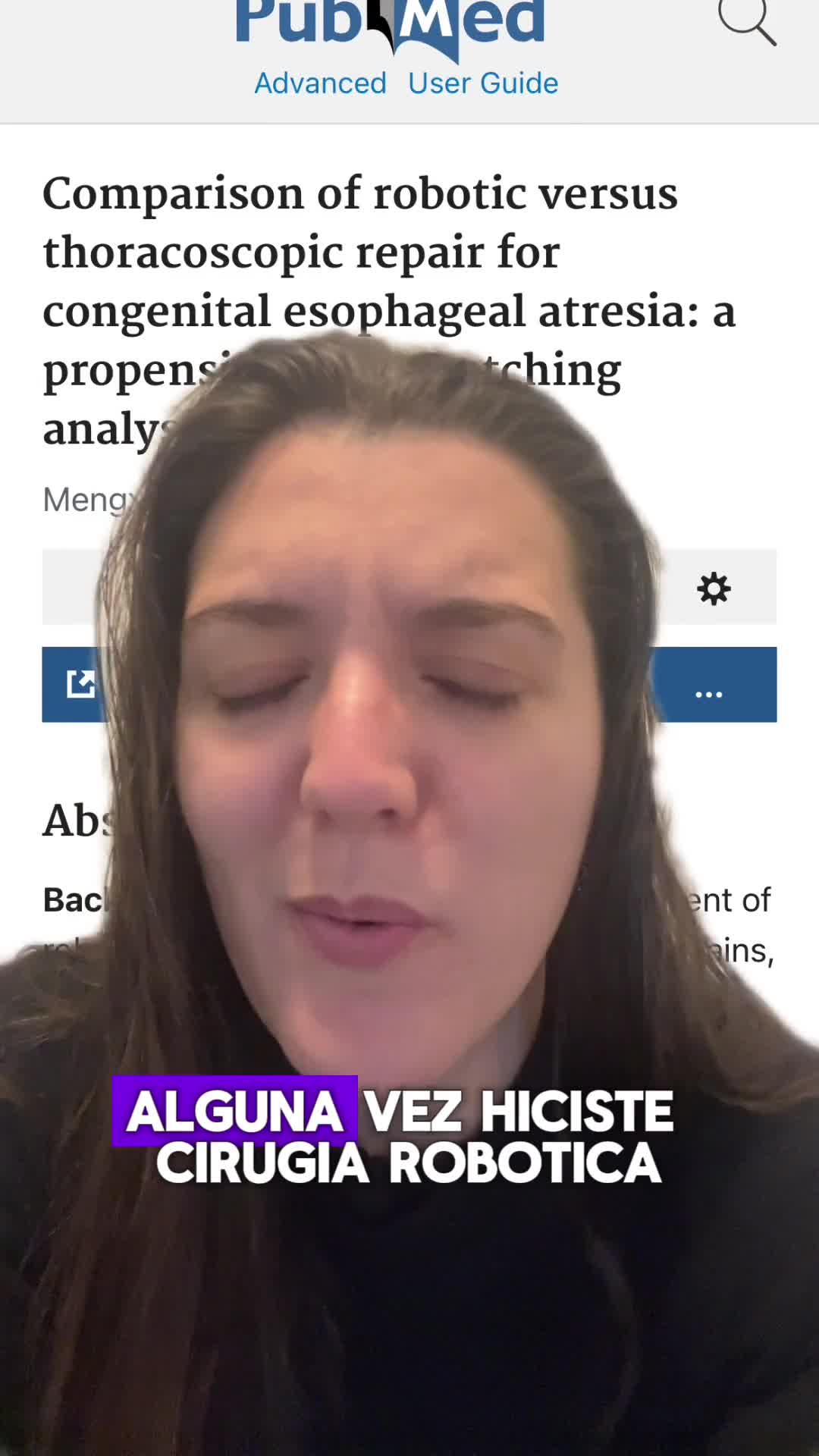 ▶
Ep 53 · 0:00
▶
Ep 53 · 0:00
host summary
Cecilia Gigena summarizing a resource: After matched analysis, there were 126 patients total, 63 in each group (robotic and thoracoscopic).
↗
▶
Ep 53 · 0:00
host summary
Cecilia Gigena summarizing a resource: This is a retrospective multicenter study conducted in China comparing outcomes of robotic versus thoracoscopic surgery for esophageal atresia repair.
↗
▶
Ep 53 · 0:00
host summary
Cecilia Gigena summarizing a resource: Robotic surgery had longer total operative time compared to thoracoscopic surgery.
↗
▶
Ep 53 · 0:00
host summary
Cecilia Gigena summarizing a resource: Robotic surgery had shorter anastomosis time compared to thoracoscopic surgery.
↗
▶
Ep 53 · 0:00
host summary
Cecilia Gigena summarizing a resource: Patients who had robotic surgery had a lower rate of postoperative leak compared to thoracoscopic surgery.
↗
▶
Ep 53 · 0:00
host summary
Cecilia Gigena summarizing a resource: Patients who had robotic surgery had a lower rate of postoperative stricture compared to thoracoscopic surgery.
↗
▶
Ep 53 · 0:00
host summary
Cecilia Gigena summarizing a resource: Patients who had robotic surgery had a lower rate of unplanned readmissions compared to thoracoscopic surgery.
↗
▶
Ep 53 · 0:00
host summary
Cecilia Gigena summarizing a resource: Robotic surgery may be a viable option for esophageal atresia repair.
↗
Comparison of robotic versus thoracoscopic repair for congenital esophageal atresia
▶
Ep 54 · 0:10
host summary
Cecilia Gigena summarizing a resource: The study is a retrospective multi-center study done in China
↗
▶
Ep 54 · 0:21
host summary
Cecilia Gigena summarizing a resource: After propensity score matching, there were 126 patients total, 63 in each group
↗
▶
Ep 54 · 0:28
host summary
Cecilia Gigena summarizing a resource: Robotic surgery had longer operative time compared to thoracoscopic repair
↗
▶
Ep 54 · 0:28
host summary
Cecilia Gigena summarizing a resource: Robotic surgery had shorter anastomotic time compared to thoracoscopic repair
↗
▶
Ep 54 · 0:28
host summary
Cecilia Gigena summarizing a resource: The robotic group had lower anastomotic strictures compared to thoracoscopic repair
↗
▶
Ep 54 · 0:28
host summary
Cecilia Gigena summarizing a resource: The robotic group had lower unplanned readmissions within 2 years post-op compared to thoracoscopic repair
↗
▶
Ep 54 · 0:46
host summary
Cecilia Gigena summarizing a resource: So, it seems that robotic surgery is a good answer for esophageal tissue repair.
↗
▶
Ep 54 · 0:46
host summary
Cecilia Gigena summarizing a resource: Robotic surgery appears to be a good option for esophageal atresia repair
↗
Journal of Pediatric Surgery Article Review: October 2023
▶
Ep 56 · 2:37
host summary
Cecilia Gigena summarizing the discussion: Within 1,395 patients across 12 observational studies, 753 received acid suppression medication but this did not reduce the odds of having an esophageal stricture
↗
▶
Ep 56 · 7:08
host summary
Cecilia Gigena summarizing the discussion: Some randomized trials showed that doing something to the pleura does not actually reduce recurrences of spontaneous pneumothorax
↗
▶
Ep 56 · 7:40
host summary
Cecilia Gigena summarizing the discussion: For the asymptomatic contralateral side in children with spontaneous pneumothorax, do not do anything unless it develops symptoms
↗
▶
Ep 56 · 9:00
host summary
Cecilia Gigena summarizing the discussion: The asymptomatic CPAM group had shorter operating times, shorter postoperative mechanical ventilation, shorter chest tube durations, and shorter hospital stays
↗
Journal of Pediatric Surgery Article Review: Q1 (Jan-Mar) 2024
▶
Ep 58 · 2:45
host summary
Cecilia Gigena summarizing the discussion: The appendicitis study had 185 patients in the home antibiotic group and 121 patients in the no home antibiotic group.
↗
▶
Ep 58 · 2:55
host summary
Cecilia Gigena summarizing the discussion: There was no significant difference in deep organ space infection requiring intervention between home antibiotic and no home antibiotic groups for complicated appendicitis.
↗
▶
Ep 58 · 3:03
host summary
Cecilia Gigena summarizing the discussion: There was no difference in length of stay between home antibiotic and no home antibiotic groups for complicated appendicitis.
↗
▶
Ep 58 · 5:43
host summary
Cecilia Gigena summarizing the discussion: Type C esophageal atresia is the most common type and means esophageal atresia with a distal fistula; type A means pure esophageal atresia with no fistula to the trachea.
↗
▶
Ep 58 · 8:47
host summary
Cecilia Gigena summarizing the discussion: The pectus study is a prospective cohort study from a single center in Phoenix aiming to quantify long-term hyperesthesia and neuropathic pain after minimally invasive repair of pectus excavatum with cryoablation.
↗
▶
Ep 58 · 9:04
host summary
Cecilia Gigena summarizing the discussion: The pectus study selected patients under 21 years of age who presented for bar removal between November 2021 and May 2023.
↗
▶
Ep 58 · 9:15
host summary
Cecilia Gigena summarizing the discussion: Testing for cold and soft touch and pinprick was performed just before bar removal.
↗
▶
Ep 58 · 9:25
host summary
Cecilia Gigena summarizing the discussion: The pectus study enrolled 47 patients with a median bar dwell time of approximately 2.9 years.
↗
▶
Ep 58 · 9:41
host summary
Cecilia Gigena summarizing the discussion: Patients had a median of 2 bars placed, and almost 81% were secured with pericostal sutures.
↗
▶
Ep 58 · 9:51
host summary
Cecilia Gigena summarizing the discussion: Almost half of the pectus patients had some degree of hypoesthesia, with T5 being the most common dermatome affected.
↗
▶
Ep 58 · 10:00
host summary
Cecilia Gigena summarizing the discussion: The area with hypoesthesia was less than 5% of the entire surface that was treated with cryo.
↗
▶
Ep 58 · 10:18
host summary
Cecilia Gigena summarizing the discussion: Neuropathic symptoms were identified by only 13% of pectus patients, and none required treatment.
↗
▶
Ep 58 · 10:26
host summary
Cecilia Gigena summarizing the discussion: In the long term after minimally invasive repair of pectus excavatum with cryo, many patients will experience some chest wall hypoesthesia limited to one or two dermatomes, and chronic symptomatic neuropathic pain is very rare.
↗
▶
Ep 58 · 11:00
host summary
Cecilia Gigena summarizing the discussion: Pericostal sutures used to secure bars can damage nerves.
↗
Quick Literature Updates Episode 17
▶
Ep 60 · 0:58
host summary
Cecilia Gigena summarizes what Dr. Alex Halpern said: The Zeng et al. study was a retrospective multi-center study done in China comparing robotic repair versus thoracoscopic repair for esophageal atresia.
↗
▶
Ep 60 · 1:07
host summary
Cecilia Gigena summarizes what Dr. Alex Halpern said: Robotic surgery for esophageal atresia had longer operative time but shorter anastomotic time compared to thoracoscopic repair.
↗
▶
Ep 60 · 1:07
host summary
Cecilia Gigena summarizes what Dr. Alex Halpern said: After propensity score matching, the study included 126 patients with 63 in each group (robotic vs thoracoscopic).
↗
▶
Ep 60 · 1:22
host summary
Cecilia Gigena summarizes what Dr. Alex Halpern said: The robotic group had lower anastomotic strictures and lower readmissions within 2 years post-op compared to thoracoscopic repair.
↗
▶
Ep 60 · 1:32
host summary
Cecilia Gigena summarizes what Dr. Alex Halpern said: Robotic surgery is a good answer for esophageal atresia repair.
↗
▶
Ep 60 · 1:32
host summary
Cecilia Gigena summarizes what Dr. Alex Halpern said: So it seems that robotic surgery is a good answer for esophageal tissue repair.
↗
Quick Literature Updates Ep 27
 ▶
Ep 70 · 3:04
▶
Ep 70 · 3:04
host summary
Cecilia Gigena summarizes what Dr. Alex Halpern said: Huncheid et al. conducted a multi-center non-inferiority trial that compared preterm infants treated with expectant management versus early ibuprofen for patent ductus arteriosus.
↗
▶
Ep 70 · 3:14
host summary
Cecilia Gigena summarizes what Dr. Alex Halpern said: The trial included 273 infants: 136 treated with expectant management and 137 with early ibuprofen.
↗
▶
Ep 70 · 3:24
host summary
Cecilia Gigena summarizes what Dr. Alex Halpern said: In the expectant management group for PDA, there was 17.6% necrotizing enterocolitis, 33% bronchopulmonary dysplasia, and 14% death rates.
↗
▶
Ep 70 · 3:36
host summary
Cecilia Gigena summarizes what Dr. Alex Halpern said: In the ibuprofen group for PDA, there was 15.4% necrotizing enterocolitis, 50% bronchopulmonary dysplasia, and 80% death rates.
↗
▶
Ep 70 · 3:53
host summary
Cecilia Gigena summarizes what Dr. Alex Halpern said: So it seems that expectant management is not inferiority that early ibuprofen in preterm patients with PDA.
↗
▶
Ep 70 · 3:53
host summary
Cecilia Gigena summarizes what Dr. Alex Halpern said: Expectant management is not inferior to early ibuprofen in preterm patients with patent ductus arteriosus.
↗
Update Course Rewind: Management of Esophageal Leaks 2022
 ▶
Ep 75 · 0:07
▶
Ep 75 · 0:07
host summary
Cecilia Gigena summarizing the discussion: Hello everyone, I'm Cecilia Jigena from Cincinnati Children's Hospital.
↗
▶
Ep 75 · 1:16
host summary
Cecilia Gigena summarizing the discussion: Every small or moderate leak that is contained can be managed by observation with no need for new intervention
↗
▶
Ep 75 · 1:29
host summary
Cecilia Gigena summarizing the discussion: New intervention for esophageal leaks is only considered when leaks create huge pneumothorax that are not well drained, or if the patient is unstable
↗
▶
Ep 75 · 1:41
host summary
Cecilia Gigena summarizing the discussion: Botulinum toxin can be used to block the secretion of saliva in management of esophageal leaks
↗
▶
Ep 75 · 1:55
host summary
Cecilia Gigena summarizing the discussion: Glycopyrrolate is a medicine available in the US that blocks the secretion of saliva
↗
▶
Ep 75 · 2:50
host summary
Cecilia Gigena summarizing the discussion: Retrograde endoscopy via gastrostomy tube can be used to dilate esophageal strictures when antegrade visualization is inadequate
↗
▶
Ep 75 · 5:24
host summary
Cecilia Gigena summarizing the discussion: Endoscopic vacuum closure (endo-bag) consists of an NG tube with a hose covered by a surgical sponge, which is covered by a perforated transparent adhesive, connected to suction
↗
▶
Ep 75 · 5:38
host summary
Cecilia Gigena summarizing the discussion: Endoscopic vacuum closure helps granulation tissue form by negative pressure and makes the patient heal faster
↗
▶
Ep 75 · 7:22
host summary
Cecilia Gigena summarizing the discussion: Most esophageal leaks can be treated by observation or chest drain
↗
▶
Ep 75 · 7:28
host summary
Cecilia Gigena summarizing the discussion: If there is an external leak like in the neck or a fistula that is not healing well, an endovac can be a great solution
↗
▶
Ep 75 · 7:37
host summary
Cecilia Gigena summarizing the discussion: For some patients with deteriorated status or great leaks, a re-anastomosis can be attempted
↗
▶
Ep 75 · 7:45
host summary
Cecilia Gigena summarizing the discussion: After a leak, a stricture is more common, so the patient must be followed more thoroughly
↗
Summaries Cecilia gave as host · Esophageal Atresia
48 summaries
Open the Esophageal Atresia collection →
Journal of Pediatric Surgery Article Review: February 2023, BAPS issue
▶
Ep 23 · 9:23
host summary
Cecilia Gigena summarizing the discussion: The Tanzania soap bathing study included 252 patients, with 114 receiving a preoperative bath with plain soap
↗
▶
Ep 23 · 9:26
host summary
Cecilia Gigena summarizing the discussion: In the soap bathing group, 11.4% developed surgical site infections compared to 40.6% in the control group
↗
▶
Ep 23 · 9:43
host summary
Cecilia Gigena summarizing the discussion: Preoperative soap bathing reduced the odds of surgical site infections by 80%
↗
Esophageal Surveillance Practices in Esophageal Atresia Patients
▶
Ep 25 · 0:00
host summary
Cecilia Gigena summarizing a resource: The Eastern Pediatric Surgery Network in the US created a survey distributed among pediatric surgeons to understand current practices of esophageal surveillance in esophageal atresia patients
↗
▶
Ep 25 · 0:00
host summary
Cecilia Gigena summarizing a resource: 75% of respondents strongly agree or agree with current guidelines for esophageal atresia surveillance
↗
▶
Ep 25 · 0:00
host summary
Cecilia Gigena summarizing a resource: Only 37% of respondents reported that their esophageal atresia patients have pre-determined outpatient clinic follow-up schedule
↗
▶
Ep 25 · 0:00
host summary
Cecilia Gigena summarizing a resource: 80% of respondents agree or strongly agree that endoscopy should follow a set schedule
↗
▶
Ep 25 · 0:00
host summary
Cecilia Gigena summarizing a resource: Only 37% of respondents performed follow-up endoscopy regardless of symptoms
↗
▶
Ep 25 · 0:00
host summary
Cecilia Gigena summarizing a resource: There is high agreement with current guidelines but weak adherence to them in esophageal atresia surveillance
↗
▶
Ep 25 · 0:00
host summary
Cecilia Gigena summarizing a resource: 139 pediatric surgeons responded to the survey
↗
Comparison of robotic versus thoracoscopic repair for congenital esophageal atresia
▶
Ep 28 · 0:10
host summary
Cecilia Gigena summarizing a resource: The study is a retrospective multi-center study done in China
↗
▶
Ep 28 · 0:21
host summary
Cecilia Gigena summarizing a resource: After propensity score matching, there were 126 patients total, 63 in each group
↗
▶
Ep 28 · 0:28
host summary
Cecilia Gigena summarizing a resource: Robotic surgery had longer operative time compared to thoracoscopic repair
↗
▶
Ep 28 · 0:28
host summary
Cecilia Gigena summarizing a resource: The robotic group had lower unplanned readmissions within 2 years post-op compared to thoracoscopic repair
↗
▶
Ep 28 · 0:28
host summary
Cecilia Gigena summarizing a resource: The robotic group had lower anastomotic strictures compared to thoracoscopic repair
↗
▶
Ep 28 · 0:28
host summary
Cecilia Gigena summarizing a resource: Robotic surgery had shorter anastomotic time compared to thoracoscopic repair
↗
▶
Ep 28 · 0:46
host summary
Cecilia Gigena summarizing a resource: So, it seems that robotic surgery is a good answer for esophageal tissue repair.
↗
▶
Ep 28 · 0:46
host summary
Cecilia Gigena summarizing a resource: Robotic surgery appears to be a good option for esophageal atresia repair
↗
Journal of Pediatric Surgery Article Review: October 2023
▶
Ep 30 · 2:37
host summary
Cecilia Gigena summarizing the discussion: Within 1,395 patients across 12 observational studies, 753 received acid suppression medication but this did not reduce the odds of having an esophageal stricture
↗
▶
Ep 30 · 7:08
host summary
Cecilia Gigena summarizing the discussion: Some randomized trials showed that doing something to the pleura does not actually reduce recurrences of spontaneous pneumothorax
↗
▶
Ep 30 · 7:40
host summary
Cecilia Gigena summarizing the discussion: For the asymptomatic contralateral side in children with spontaneous pneumothorax, do not do anything unless it develops symptoms
↗
▶
Ep 30 · 9:00
host summary
Cecilia Gigena summarizing the discussion: The asymptomatic CPAM group had shorter operating times, shorter postoperative mechanical ventilation, shorter chest tube durations, and shorter hospital stays
↗
Journal of Pediatric Surgery Article Review: Q1 (Jan-Mar) 2024
▶
Ep 31 · 2:45
host summary
Cecilia Gigena summarizing the discussion: The appendicitis study had 185 patients in the home antibiotic group and 121 patients in the no home antibiotic group.
↗
▶
Ep 31 · 2:55
host summary
Cecilia Gigena summarizing the discussion: There was no significant difference in deep organ space infection requiring intervention between home antibiotic and no home antibiotic groups for complicated appendicitis.
↗
▶
Ep 31 · 3:03
host summary
Cecilia Gigena summarizing the discussion: There was no difference in length of stay between home antibiotic and no home antibiotic groups for complicated appendicitis.
↗
▶
Ep 31 · 5:43
host summary
Cecilia Gigena summarizing the discussion: Type C esophageal atresia is the most common type and means esophageal atresia with a distal fistula; type A means pure esophageal atresia with no fistula to the trachea.
↗
▶
Ep 31 · 8:47
host summary
Cecilia Gigena summarizing the discussion: The pectus study is a prospective cohort study from a single center in Phoenix aiming to quantify long-term hyperesthesia and neuropathic pain after minimally invasive repair of pectus excavatum with cryoablation.
↗
▶
Ep 31 · 9:04
host summary
Cecilia Gigena summarizing the discussion: The pectus study selected patients under 21 years of age who presented for bar removal between November 2021 and May 2023.
↗
▶
Ep 31 · 9:15
host summary
Cecilia Gigena summarizing the discussion: Testing for cold and soft touch and pinprick was performed just before bar removal.
↗
▶
Ep 31 · 9:25
host summary
Cecilia Gigena summarizing the discussion: The pectus study enrolled 47 patients with a median bar dwell time of approximately 2.9 years.
↗
▶
Ep 31 · 9:41
host summary
Cecilia Gigena summarizing the discussion: Patients had a median of 2 bars placed, and almost 81% were secured with pericostal sutures.
↗
▶
Ep 31 · 9:51
host summary
Cecilia Gigena summarizing the discussion: Almost half of the pectus patients had some degree of hypoesthesia, with T5 being the most common dermatome affected.
↗
▶
Ep 31 · 10:00
host summary
Cecilia Gigena summarizing the discussion: The area with hypoesthesia was less than 5% of the entire surface that was treated with cryo.
↗
▶
Ep 31 · 10:18
host summary
Cecilia Gigena summarizing the discussion: Neuropathic symptoms were identified by only 13% of pectus patients, and none required treatment.
↗
▶
Ep 31 · 10:26
host summary
Cecilia Gigena summarizing the discussion: In the long term after minimally invasive repair of pectus excavatum with cryo, many patients will experience some chest wall hypoesthesia limited to one or two dermatomes, and chronic symptomatic neuropathic pain is very rare.
↗
▶
Ep 31 · 11:00
host summary
Cecilia Gigena summarizing the discussion: Pericostal sutures used to secure bars can damage nerves.
↗
Quick Literature Updates Episode 17
▶
Ep 32 · 0:58
host summary
Cecilia Gigena summarizes what Dr. Alex Halpern said: The Zeng et al. study was a retrospective multi-center study done in China comparing robotic repair versus thoracoscopic repair for esophageal atresia.
↗
▶
Ep 32 · 1:07
host summary
Cecilia Gigena summarizes what Dr. Alex Halpern said: Robotic surgery for esophageal atresia had longer operative time but shorter anastomotic time compared to thoracoscopic repair.
↗
▶
Ep 32 · 1:07
host summary
Cecilia Gigena summarizes what Dr. Alex Halpern said: After propensity score matching, the study included 126 patients with 63 in each group (robotic vs thoracoscopic).
↗
▶
Ep 32 · 1:22
host summary
Cecilia Gigena summarizes what Dr. Alex Halpern said: The robotic group had lower anastomotic strictures and lower readmissions within 2 years post-op compared to thoracoscopic repair.
↗
▶
Ep 32 · 1:32
host summary
Cecilia Gigena summarizes what Dr. Alex Halpern said: Robotic surgery is a good answer for esophageal atresia repair.
↗
▶
Ep 32 · 1:32
host summary
Cecilia Gigena summarizes what Dr. Alex Halpern said: So it seems that robotic surgery is a good answer for esophageal tissue repair.
↗
Quick Literature Updates Ep 27
▶
Ep 39 · 3:04
host summary
Cecilia Gigena summarizes what Dr. Alex Halpern said: Huncheid et al. conducted a multi-center non-inferiority trial that compared preterm infants treated with expectant management versus early ibuprofen for patent ductus arteriosus.
↗
▶
Ep 39 · 3:14
host summary
Cecilia Gigena summarizes what Dr. Alex Halpern said: The trial included 273 infants: 136 treated with expectant management and 137 with early ibuprofen.
↗
▶
Ep 39 · 3:24
host summary
Cecilia Gigena summarizes what Dr. Alex Halpern said: In the expectant management group for PDA, there was 17.6% necrotizing enterocolitis, 33% bronchopulmonary dysplasia, and 14% death rates.
↗
▶
Ep 39 · 3:36
host summary
Cecilia Gigena summarizes what Dr. Alex Halpern said: In the ibuprofen group for PDA, there was 15.4% necrotizing enterocolitis, 50% bronchopulmonary dysplasia, and 80% death rates.
↗
▶
Ep 39 · 3:53
host summary
Cecilia Gigena summarizes what Dr. Alex Halpern said: Expectant management is not inferior to early ibuprofen in preterm patients with patent ductus arteriosus.
↗
▶
Ep 39 · 3:53
host summary
Cecilia Gigena summarizes what Dr. Alex Halpern said: So it seems that expectant management is not inferiority that early ibuprofen in preterm patients with PDA.
↗
Summaries Cecilia gave as host · Esophageal Atresia Masterclass
12 summaries
Open the Esophageal Atresia Masterclass collection →
Update Course Rewind: Management of Esophageal Leaks 2022
▶
Ep 8 · 0:07
host summary
Cecilia Gigena summarizing the discussion: Hello everyone, I'm Cecilia Jigena from Cincinnati Children's Hospital.
↗
▶
Ep 8 · 1:16
host summary
Cecilia Gigena summarizing the discussion: Every small or moderate leak that is contained can be managed by observation with no need for new intervention
↗
▶
Ep 8 · 1:29
host summary
Cecilia Gigena summarizing the discussion: New intervention for esophageal leaks is only considered when leaks create huge pneumothorax that are not well drained, or if the patient is unstable
↗
▶
Ep 8 · 1:41
host summary
Cecilia Gigena summarizing the discussion: Botulinum toxin can be used to block the secretion of saliva in management of esophageal leaks
↗
▶
Ep 8 · 1:55
host summary
Cecilia Gigena summarizing the discussion: Glycopyrrolate is a medicine available in the US that blocks the secretion of saliva
↗
▶
Ep 8 · 2:50
host summary
Cecilia Gigena summarizing the discussion: Retrograde endoscopy via gastrostomy tube can be used to dilate esophageal strictures when antegrade visualization is inadequate
↗
▶
Ep 8 · 5:24
host summary
Cecilia Gigena summarizing the discussion: Endoscopic vacuum closure (endo-bag) consists of an NG tube with a hose covered by a surgical sponge, which is covered by a perforated transparent adhesive, connected to suction
↗
▶
Ep 8 · 5:38
host summary
Cecilia Gigena summarizing the discussion: Endoscopic vacuum closure helps granulation tissue form by negative pressure and makes the patient heal faster
↗
▶
Ep 8 · 7:22
host summary
Cecilia Gigena summarizing the discussion: Most esophageal leaks can be treated by observation or chest drain
↗
▶
Ep 8 · 7:28
host summary
Cecilia Gigena summarizing the discussion: If there is an external leak like in the neck or a fistula that is not healing well, an endovac can be a great solution
↗
▶
Ep 8 · 7:37
host summary
Cecilia Gigena summarizing the discussion: For some patients with deteriorated status or great leaks, a re-anastomosis can be attempted
↗
▶
Ep 8 · 7:45
host summary
Cecilia Gigena summarizing the discussion: After a leak, a stricture is more common, so the patient must be followed more thoroughly
↗
Summaries Cecilia gave as host · Etiologies (Gastroschisis/NEC/Atresia/Volvulus)
51 summaries
Open the Etiologies (Gastroschisis/NEC/Atresia/Volvulus) collection →
Routine contrast enema prior to stoma reversal seems only required following treatment for necrotizing enterocolitis: An evaluation of the diagnostic accuracy of the contrast enema
▶
Ep 46 · 0:00
host summary
Cecilia Gigena summarizing a resource: Do you always do a contrast enema prior to stoma reversal?
↗
▶
Ep 46 · 0:13
host summary
Cecilia Gigena summarizing a resource: A retrospective study was conducted in the Netherlands between 1998 and 2018 examining contrast enema use prior to stoma reversal.
↗
▶
Ep 46 · 0:24
host summary
Cecilia Gigena summarizing a resource: The study included patients under three years old who underwent stoma reversal.
↗
▶
Ep 46 · 0:38
host summary
Cecilia Gigena summarizing a resource: The study gathered 244 patients.
↗
▶
Ep 46 · 0:40
host summary
Cecilia Gigena summarizing a resource: 10% of patients developed strictures.
↗
▶
Ep 46 · 0:43
host summary
Cecilia Gigena summarizing a resource: 95% of patients with strictures had necrotizing enterocolitis.
↗
▶
Ep 46 · 0:47
host summary
Cecilia Gigena summarizing a resource: Only 68% of all patients had a contrast enema prior to stoma reversal.
↗
▶
Ep 46 · 0:51
host summary
Cecilia Gigena summarizing a resource: Contrast enema was able to detect 92% of strictures.
↗
▶
Ep 46 · 0:54
host summary
Cecilia Gigena summarizing a resource: So it seems that contrast enema prior to stoma reversal is only useful if patients had NEC.
↗
▶
Ep 46 · 0:54
host summary
Cecilia Gigena summarizing a resource: Contrast enema prior to stoma reversal is only useful if patients had necrotizing enterocolitis.
↗
Quick Literature Updates Episode 6
▶
Ep 48 · 3:33
host summary
Cecilia Gigena summarizing a resource: Patients receiving massive transfusions had lower maximum amplitude values on TEG analysis.
↗
▶
Ep 48 · 3:33
host summary
Cecilia Gigena summarizing a resource: Patients receiving massive transfusions had lower platelet counts.
↗
▶
Ep 48 · 3:33
host summary
Cecilia Gigena summarizing a resource: TEG may help identify hemorrhagic trauma patients who will benefit from cryoprecipitate or platelet transfusions.
↗
▶
Ep 48 · 3:33
host summary
Cecilia Gigena summarizing a resource: Philips et al. conducted a retrospective study from 2015 to 2018 evaluating 117 patients from two trauma centers.
↗
▶
Ep 48 · 3:33
host summary
Cecilia Gigena summarizing a resource: Patients receiving massive transfusions had shortened alpha angles on TEG analysis.
↗
Quick Literature Updates Episode 11
▶
Ep 51 · 3:07
host summary
Cecilia Gigena summarizing a resource: Spontaneous closure of periumbilical hernias after gastroschisis was seen in 38.8% of cases.
↗
▶
Ep 51 · 3:07
host summary
Cecilia Gigena summarizing a resource: Frazier et al. conducted a retrospective study from the Midwest Pediatric Surgery Consortium following 375 patients with gastroschisis who underwent closure between 2013 and 2016.
↗
▶
Ep 51 · 3:07
host summary
Cecilia Gigena summarizing a resource: The overall rate for periumbilical hernias after gastroschisis closure was 22.7%.
↗
▶
Ep 51 · 3:07
host summary
Cecilia Gigena summarizing a resource: Periumbilical hernia rate was significantly higher in patients who underwent primary closure versus those who needed silo placement.
↗
▶
Ep 51 · 3:07
host summary
Cecilia Gigena summarizing a resource: Patients who underwent sutureless gastroschisis closures had 50% rates of persistent hernia.
↗
▶
Ep 51 · 3:07
host summary
Cecilia Gigena summarizing a resource: Only 16.4% of patients who underwent sutured gastroschisis closure had a persistent hernia.
↗
▶
Ep 51 · 3:07
host summary
Cecilia Gigena summarizing a resource: Only 31.8% of patients with periumbilical hernias after gastroschisis needed surgery.
↗
▶
Ep 51 · 3:07
host summary
Cecilia Gigena summarizing a resource: Sutureless gastroschisis closures lead to more periumbilical hernias, but they can be managed as any other congenital umbilical hernia and have no additional risk.
↗
Expectant Management or Early Ibuprofen for Patent Ductus Arteriosus
 ▶
Ep 52 · 0:09
▶
Ep 52 · 0:09
host summary
Cecilia Gigena summarizing a resource: A multi-center non-inferiority trial compared preterm infants treated with expectant management versus early ibuprofen for PDA
↗
▶
Ep 52 · 0:22
host summary
Cecilia Gigena summarizing a resource: The trial enrolled 273 infants total
↗
▶
Ep 52 · 0:25
host summary
Cecilia Gigena summarizing a resource: 136 infants were treated with expectant management and 137 with early ibuprofen
↗
▶
Ep 52 · 0:31
host summary
Cecilia Gigena summarizing a resource: In the expectant management group, the death rate was 14%
↗
▶
Ep 52 · 0:31
host summary
Cecilia Gigena summarizing a resource: In the expectant management group, 17.6% developed necrotizing enterocolitis
↗
▶
Ep 52 · 0:31
host summary
Cecilia Gigena summarizing a resource: In the expectant management group, 33% developed bronchopulmonary dysplasia
↗
▶
Ep 52 · 0:43
host summary
Cecilia Gigena summarizing a resource: In the ibuprofen group, 50% developed bronchopulmonary dysplasia
↗
▶
Ep 52 · 0:43
host summary
Cecilia Gigena summarizing a resource: In the ibuprofen group, 15.4% developed necrotizing enterocolitis
↗
▶
Ep 52 · 0:43
host summary
Cecilia Gigena summarizing a resource: In the ibuprofen group, the death rate was 80%
↗
▶
Ep 52 · 1:01
host summary
Cecilia Gigena summarizing a resource: Expectant management is non-inferior to early ibuprofen in preterm patients with PDA
↗
▶
Ep 52 · 1:01
host summary
Cecilia Gigena summarizing a resource: So it seems that expectant management is not inferiority that early ibuprofen in preterm patients with PDA.
↗
Quick Literature Updates Episode 16
▶
Ep 60 · 3:08
host summary
Cecilia Gigena summarizes what Dr. Alex Halpern said: The Phoenix study by Lie et al. was a retrospective single institution study from 2017 to 2021 comparing patients who underwent Nuss procedure with cryoanalgesia in the first quarter versus the fourth quarter of their experience.
↗
▶
Ep 60 · 3:27
host summary
Cecilia Gigena summarizes what Dr. Alex Halpern said: The Phoenix study included 350 patients who underwent Nuss procedure with cryoanalgesia.
↗
▶
Ep 60 · 3:32
host summary
Cecilia Gigena summarizes what Dr. Alex Halpern said: Patients in the last quarter of the Phoenix cryoablation experience were discharged 1.3 days earlier than patients in the first quarter.
↗
▶
Ep 60 · 3:32
host summary
Cecilia Gigena summarizes what Dr. Alex Halpern said: Patients in the last quarter of the Phoenix cryoablation experience required 74% less opioids than those in the first quarter.
↗
▶
Ep 60 · 3:44
host summary
Cecilia Gigena summarizes what Dr. Alex Halpern said: Experience plays a role in outcomes when using cryoanalgesia for Nuss procedures.
↗
▶
Ep 60 · 3:44
host summary
Cecilia Gigena summarizes what Dr. Alex Halpern said: So it seems that experience really plays a role talking about cryoatissia.
↗
Quick Literature Updates Ep 22
▶
Ep 67 · 3:16
host summary
Cecilia Gigena summarizing a resource: The Pefer et al. study is a retrospective study done in Texas using a state hospital database examining CDH outcomes by center volume.
↗
▶
Ep 67 · 3:32
host summary
Cecilia Gigena summarizing a resource: The Pefer study identified 1,314 CDH patients: 728 from high volume centers, 9 from mid-volume centers, and 79 from low volume centers.
↗
▶
Ep 67 · 3:46
host summary
Cecilia Gigena summarizing a resource: High volume centers had significantly shorter length of stay for CDH patients.
↗
▶
Ep 67 · 3:46
host summary
Cecilia Gigena summarizing a resource: High volume centers had significantly lower mortality rates for CDH, even though they have significantly sicker patients.
↗
▶
Ep 67 · 4:00
host summary
Cecilia Gigena summarizing a resource: High volume centers had better outcomes for patients with CDH.
↗
Quick Literature Updates Ep 27
▶
Ep 68 · 3:04
host summary
Cecilia Gigena summarizes what Dr. Alex Halpern said: Huncheid et al. conducted a multi-center non-inferiority trial that compared preterm infants treated with expectant management versus early ibuprofen for patent ductus arteriosus.
↗
▶
Ep 68 · 3:14
host summary
Cecilia Gigena summarizes what Dr. Alex Halpern said: The trial included 273 infants: 136 treated with expectant management and 137 with early ibuprofen.
↗
▶
Ep 68 · 3:24
host summary
Cecilia Gigena summarizes what Dr. Alex Halpern said: In the expectant management group for PDA, there was 17.6% necrotizing enterocolitis, 33% bronchopulmonary dysplasia, and 14% death rates.
↗
▶
Ep 68 · 3:36
host summary
Cecilia Gigena summarizes what Dr. Alex Halpern said: In the ibuprofen group for PDA, there was 15.4% necrotizing enterocolitis, 50% bronchopulmonary dysplasia, and 80% death rates.
↗
▶
Ep 68 · 3:53
host summary
Cecilia Gigena summarizes what Dr. Alex Halpern said: Expectant management is not inferior to early ibuprofen in preterm patients with patent ductus arteriosus.
↗
▶
Ep 68 · 3:53
host summary
Cecilia Gigena summarizes what Dr. Alex Halpern said: So it seems that expectant management is not inferiority that early ibuprofen in preterm patients with PDA.
↗
Summaries Cecilia gave as host · Fetal Surgery
4 summaries
Open the Fetal Surgery collection →
Quick Literature Updates Ep 19
 ▶
Ep 24 · 3:27
▶
Ep 24 · 3:27
host summary
Cecilia Gigena summarizes what Dr. Carlos Colunga said: The IPSO systematic review and meta-analysis gathered 8 retrospective studies with 490 patients comparing image-guided core needle biopsy to surgical biopsy for neuroblastoma.
↗
▶
Ep 24 · 3:40
host summary
Cecilia Gigena summarizes what Dr. Carlos Colunga said: Tissue adequacy and biological characterization of the biopsy was not significantly different between image-guided core needle biopsy and surgical biopsy groups for neuroblastoma.
↗
▶
Ep 24 · 3:54
host summary
Cecilia Gigena summarizes what Dr. Carlos Colunga said: Intraoperative transfusions and complications were higher in the surgical biopsy group compared to image-guided core needle biopsy for neuroblastoma.
↗
▶
Ep 24 · 4:00
host summary
Cecilia Gigena summarizes what Dr. Carlos Colunga said: Image-guided core needle biopsy is safe and effective for diagnosing neuroblastoma.
↗
Summaries Cecilia gave as host · Foreign Body Aspiration
19 summaries
Open the Foreign Body Aspiration collection →
A systematic review and meta-analysis of computed tomography in the diagnosis of pediatric foreign body aspiration
 ▶
Ep 2 · 0:00
▶
Ep 2 · 0:00
host summary
Cecilia Gigena summarizing a resource: So, it seems that CT is very accurate for the diagnosis of foreign body aspirations that could lead to avoid unnecessary rigid bronchoscopy.
↗
▶
Ep 2 · 0:00
host summary
Cecilia Gigena summarizing a resource: A systematic review and meta-analysis was conducted in Canada to assess the diagnostic accuracy of CT for diagnosing foreign body aspirations.
↗
▶
Ep 2 · 0:00
host summary
Cecilia Gigena summarizing a resource: The review included 16 manuscripts.
↗
▶
Ep 2 · 0:00
host summary
Cecilia Gigena summarizing a resource: 2,056 patients underwent CT scan for the diagnosis of foreign body aspiration in the included studies.
↗
▶
Ep 2 · 0:00
host summary
Cecilia Gigena summarizing a resource: The sensitivity of CT for diagnosing foreign body aspiration was 98.8%.
↗
▶
Ep 2 · 0:00
host summary
Cecilia Gigena summarizing a resource: The specificity of CT for diagnosing foreign body aspiration was 96.6%.
↗
▶
Ep 2 · 0:00
host summary
Cecilia Gigena summarizing a resource: CT appears very accurate for the diagnosis of foreign body aspirations and could lead to avoiding unnecessary rigid bronchoscopy.
↗
▶
Ep 2 · 0:00
host summary
Cecilia Gigena summarizing a resource: Do you use rated bronchoscopy to diagnose a foreign body aspiration?
↗
▶
Ep 2 · 0:00
host summary
Cecilia Gigena summarizing a resource: The sensitivity for this was 98.8% and the specificity was 96.6.
↗
Una revisión sistemática y metanálisis de la tomografía computarizada en el diagnóstico de aspiración de cuerpo extraño pediátrico
 ▶
Ep 3 · 0:00
▶
Ep 3 · 0:00
host summary
Cecilia Gigena summarizing a resource: The review identified 16 studies.
↗
▶
Ep 3 · 0:00
host summary
Cecilia Gigena summarizing a resource: The systematic review and meta-analysis was conducted in Canada.
↗
▶
Ep 3 · 0:00
host summary
Cecilia Gigena summarizing a resource: ¿Siempre se hace broncoscopia rígida para diagnosticar la aspiración de un cuerpo extraño?
↗
▶
Ep 3 · 0:00
host summary
Cecilia Gigena summarizing a resource: CT appears to be very efficient for the diagnosis of foreign body aspiration.
↗
▶
Ep 3 · 0:00
host summary
Cecilia Gigena summarizing a resource: The sensitivity of CT for diagnosing foreign body aspiration was 98.8%.
↗
▶
Ep 3 · 0:00
host summary
Cecilia Gigena summarizing a resource: The included studies contained 2,056 patients who had undergone CT for diagnosis of foreign body aspiration.
↗
▶
Ep 3 · 0:00
host summary
Cecilia Gigena summarizing a resource: The objective of the review was to evaluate the efficacy of computed tomography for the diagnosis of foreign body aspiration.
↗
▶
Ep 3 · 0:00
host summary
Cecilia Gigena summarizing a resource: The specificity of CT for diagnosing foreign body aspiration was 96.6%.
↗
▶
Ep 3 · 0:00
host summary
Cecilia Gigena summarizing a resource: la sensibilidad de la tomografía fue del 98.8% y la especificidad del 96.6%
↗
▶
Ep 3 · 0:00
host summary
Cecilia Gigena summarizing a resource: Soy Cecilia Gigena del Hospital de niños de Cincinnati y creo que este es un artículo que tenés que conocer.
↗
Summaries Cecilia gave as host · Functional Colorectal Disorders & Bowel Management
12 summaries
Open the Functional Colorectal Disorders & Bowel Management collection →
Journal of Pediatric Surgery Article Review: March 2023
▶
Ep 20 · 3:21
host summary
Cecilia Gigena summarizing the discussion: Besides cloaca, rectal perineal and recto vestibular fistulas in ARM patients also have an association with gynecologic anomalies.
↗
▶
Ep 20 · 3:21
host summary
Cecilia Gigena summarizing the discussion: Besides cloaca, rectal perineal and recto vestibular fistulas in ARM patients also have an association with gynecologic anomalies.
↗
▶
Ep 20 · 8:13
host summary
Cecilia Gigena summarizing the discussion: In a Dutch study of 224 patients 3 years old or younger needing stoma reversal between 1998 and 2018, 10% had strictures prior to reversal, and 95% of those with strictures had necrotizing enterocolitis.
↗
▶
Ep 20 · 8:13
host summary
Cecilia Gigena summarizing the discussion: In a Dutch study of 224 patients 3 years old or younger needing stoma reversal between 1998 and 2018, 10% had strictures prior to reversal, and 95% of those with strictures had necrotizing enterocolitis.
↗
▶
Ep 20 · 8:46
host summary
Cecilia Gigena summarizing the discussion: Only one stricture case was not in a NEC patient; it was a patient treated for duodenal atresia who had a volvulus afterwards with ischemic injury of the bowel.
↗
▶
Ep 20 · 8:46
host summary
Cecilia Gigena summarizing the discussion: Only one stricture case was not in a NEC patient; it was a patient treated for duodenal atresia who had a volvulus afterwards with ischemic injury of the bowel.
↗
▶
Ep 20 · 8:57
host summary
Cecilia Gigena summarizing the discussion: Of all patients in the stoma reversal study, only 68% had a contrast enema, which detected 92% of the strictures.
↗
▶
Ep 20 · 8:57
host summary
Cecilia Gigena summarizing the discussion: Of all patients in the stoma reversal study, only 68% had a contrast enema, which detected 92% of the strictures.
↗
▶
Ep 20 · 9:07
host summary
Cecilia Gigena summarizing the discussion: Most patients who develop strictures after stoma creation are those with vascular problems, particularly NEC patients.
↗
▶
Ep 20 · 9:07
host summary
Cecilia Gigena summarizing the discussion: Most patients who develop strictures after stoma creation are those with vascular problems, particularly NEC patients.
↗
▶
Ep 20 · 9:24
host summary
Cecilia Gigena summarizing the discussion: In patients with intestinal atresia, there is a chance of having two strictures, so if an atresia is found during antegrade enema, a retrograde enema should also be performed to check for a second stricture.
↗
▶
Ep 20 · 9:24
host summary
Cecilia Gigena summarizing the discussion: In patients with intestinal atresia, there is a chance of having two strictures, so if an atresia is found during antegrade enema, a retrograde enema should also be performed to check for a second stricture.
↗
Summaries Cecilia gave as host · Gallstone Pancreatitis
10 summaries
Open the Gallstone Pancreatitis collection →
Case-Based Journal Review: Cholelithiasis 2024
▶
Ep 3 · 3:11
host summary
Cecilia Gigena summarizes what Dr. Jose Campos said: In a multi-center study of 167 early cholecystectomy patients versus 79 delayed, early cholecystectomy had 2% recurrence of pancreatitis compared to 22% in delayed surgery
↗
▶
Ep 3 · 3:36
host summary
Cecilia Gigena summarizes what Dr. Jose Campos said: When cholecystectomy was delayed more than 6 weeks after gallstone pancreatitis, recurrence rate increased to 60%
↗
▶
Ep 3 · 4:27
host summary
Cecilia Gigena summarizes what Dr. Jose Campos said: Patients who underwent early cholecystectomy did not have more biliary complications than delayed surgery patients
↗
▶
Ep 3 · 11:27
host summary
Cecilia Gigena summarizes what Dr. Jose Campos said: In a multi-center study of 252 patients with choledocholithiasis, 156 underwent OR-first approach (laparoscopic cholecystectomy with intraoperative cholangiogram) and 96 underwent ERCP-first approach
↗
▶
Ep 3 · 11:41
host summary
Cecilia Gigena summarizes what Dr. Jose Campos said: Patients who underwent intraoperative cholangiogram first had fewer complications and shorter length of stay than ERCP-first patients, and 86% needed only the surgery without subsequent ERCP
↗
Case Based Journal Review: Cholelithiasis 2024
▶
Ep 4 · 3:21
host summary
Cecilia Gigena summarizes what Dr. Jose Campos said: Patients who underwent early cholecystectomy had only 2% recurrence of pancreatitis compared to 22% in patients with delayed surgical approach
↗
▶
Ep 4 · 3:36
host summary
Cecilia Gigena summarizes what Dr. Jose Campos said: If surgery was delayed more than 6 weeks, the recurrence rate of pancreatitis went up to 60%
↗
▶
Ep 4 · 4:27
host summary
Cecilia Gigena summarizes what Dr. Jose Campos said: Patients who underwent early cholecystectomy didn't have more biliary complications
↗
▶
Ep 4 · 11:27
host summary
Cecilia Gigena summarizes what Dr. Jose Campos said: Patients who underwent intraoperative cholangiogram first had less complications and shorter length of stay compared to ERCP-first approach
↗
▶
Ep 4 · 11:41
host summary
Cecilia Gigena summarizes what Dr. Jose Campos said: In the OR-first approach for choledocholithiasis, 86% of patients only needed the initial surgery
↗
Summaries Cecilia gave as host · Gastroesophageal Reflux Disease
7 summaries
Open the Gastroesophageal Reflux Disease collection →
Case-Based Journal Review: G-Tube & Fundoplication for GERD 2023
 ▶
Ep 11 · 3:20
▶
Ep 11 · 3:20
host summary
Cecilia Gigena summarizing the discussion: The 2018 North American and European Society for Pediatric Gastroenterology joint guideline found that no complementary study (barium imaging, ultrasonography, endoscopy, biomarkers, manometry, scintigraphy) is sufficient to diagnose gastroesophageal reflux disease requiring fundoplication
↗
▶
Ep 11 · 6:08
host summary
Cecilia Gigena summarizing the discussion: In the 2013 JAMA Pediatrics study of 42 children's hospitals and over 4000 infants, those with neurological impairment who underwent fundoplication at the time of gastrostomy placement did not have a reduced rate of reflux-related hospitalization during the first year compared to those who underwent gastrostomy placement alone
↗
▶
Ep 11 · 6:08
host summary
Cecilia Gigena summarizing the discussion: The 2013 JAMA Pediatrics study used propensity score matching to create two comparable groups of 1027 infants each (gastrostomy alone versus gastrostomy plus fundoplication)
↗
▶
Ep 11 · 11:42
host summary
Cecilia Gigena summarizing the discussion: In a 2022 systematic review of 58 publications and over 2000 patients comparing PEG versus laparoscopy, major complication rates significantly favored laparoscopy (1.2% versus 5.4%)
↗
▶
Ep 11 · 11:42
host summary
Cecilia Gigena summarizing the discussion: The major complications in the 2022 systematic review did not include leaks, dislodgements, or granulomas; they were re-operation for colonic perforation or colocutaneous fistula
↗
▶
Ep 11 · 14:42
host summary
Cecilia Gigena summarizing the discussion: There is no significant difference in patient outcomes between bolus and continuous feeding regimens after gastrostomy placement
↗
▶
Ep 11 · 14:42
host summary
Cecilia Gigena summarizing the discussion: In a randomized prospective study comparing bolus versus continuous feeding post-gastrostomy, patients receiving bolus feeding had more leakage and more feeding modifications but achieved total feeds in the same timeframe
↗
Summaries Cecilia gave as host · Gastroschisis
24 summaries
Open the Gastroschisis collection →
Quick Literature Updates Episode 6
▶
Ep 7 · 3:33
host summary
Cecilia Gigena summarizing a resource: TEG may help identify hemorrhagic trauma patients who will benefit from cryoprecipitate or platelet transfusions.
↗
▶
Ep 7 · 3:33
host summary
Cecilia Gigena summarizing a resource: Patients receiving massive transfusions had lower platelet counts.
↗
▶
Ep 7 · 3:33
host summary
Cecilia Gigena summarizing a resource: Patients receiving massive transfusions had lower maximum amplitude values on TEG analysis.
↗
▶
Ep 7 · 3:33
host summary
Cecilia Gigena summarizing a resource: Patients receiving massive transfusions had shortened alpha angles on TEG analysis.
↗
▶
Ep 7 · 3:33
host summary
Cecilia Gigena summarizing a resource: Philips et al. conducted a retrospective study from 2015 to 2018 evaluating 117 patients from two trauma centers.
↗
Quick Literature Updates Episode 11
▶
Ep 20 · 3:07
host summary
Cecilia Gigena summarizing a resource: Frazier et al. conducted a retrospective study from the Midwest Pediatric Surgery Consortium following 375 patients with gastroschisis who underwent closure between 2013 and 2016.
↗
▶
Ep 20 · 3:07
host summary
Cecilia Gigena summarizing a resource: The overall rate for periumbilical hernias after gastroschisis closure was 22.7%.
↗
▶
Ep 20 · 3:07
host summary
Cecilia Gigena summarizing a resource: Only 16.4% of patients who underwent sutured gastroschisis closure had a persistent hernia.
↗
▶
Ep 20 · 3:07
host summary
Cecilia Gigena summarizing a resource: Spontaneous closure of periumbilical hernias after gastroschisis was seen in 38.8% of cases.
↗
▶
Ep 20 · 3:07
host summary
Cecilia Gigena summarizing a resource: Only 31.8% of patients with periumbilical hernias after gastroschisis needed surgery.
↗
▶
Ep 20 · 3:07
host summary
Cecilia Gigena summarizing a resource: Sutureless gastroschisis closures lead to more periumbilical hernias, but they can be managed as any other congenital umbilical hernia and have no additional risk.
↗
▶
Ep 20 · 3:07
host summary
Cecilia Gigena summarizing a resource: Periumbilical hernia rate was significantly higher in patients who underwent primary closure versus those who needed silo placement.
↗
▶
Ep 20 · 3:07
host summary
Cecilia Gigena summarizing a resource: Patients who underwent sutureless gastroschisis closures had 50% rates of persistent hernia.
↗
Quick Literature Updates Episode 16
▶
Ep 25 · 3:08
host summary
Cecilia Gigena summarizes what Dr. Alex Halpern said: The Phoenix study by Lie et al. was a retrospective single institution study from 2017 to 2021 comparing patients who underwent Nuss procedure with cryoanalgesia in the first quarter versus the fourth quarter of their experience.
↗
▶
Ep 25 · 3:27
host summary
Cecilia Gigena summarizes what Dr. Alex Halpern said: The Phoenix study included 350 patients who underwent Nuss procedure with cryoanalgesia.
↗
▶
Ep 25 · 3:32
host summary
Cecilia Gigena summarizes what Dr. Alex Halpern said: Patients in the last quarter of the Phoenix cryoablation experience required 74% less opioids than those in the first quarter.
↗
▶
Ep 25 · 3:32
host summary
Cecilia Gigena summarizes what Dr. Alex Halpern said: Patients in the last quarter of the Phoenix cryoablation experience were discharged 1.3 days earlier than patients in the first quarter.
↗
▶
Ep 25 · 3:44
host summary
Cecilia Gigena summarizes what Dr. Alex Halpern said: Experience plays a role in outcomes when using cryoanalgesia for Nuss procedures.
↗
▶
Ep 25 · 3:44
host summary
Cecilia Gigena summarizes what Dr. Alex Halpern said: So it seems that experience really plays a role talking about cryoatissia.
↗
Quick Literature Updates Ep 22
▶
Ep 27 · 3:16
host summary
Cecilia Gigena summarizing a resource: The Pefer et al. study is a retrospective study done in Texas using a state hospital database examining CDH outcomes by center volume.
↗
▶
Ep 27 · 3:32
host summary
Cecilia Gigena summarizing a resource: The Pefer study identified 1,314 CDH patients: 728 from high volume centers, 9 from mid-volume centers, and 79 from low volume centers.
↗
▶
Ep 27 · 3:46
host summary
Cecilia Gigena summarizing a resource: High volume centers had significantly shorter length of stay for CDH patients.
↗
▶
Ep 27 · 3:46
host summary
Cecilia Gigena summarizing a resource: High volume centers had significantly lower mortality rates for CDH, even though they have significantly sicker patients.
↗
▶
Ep 27 · 4:00
host summary
Cecilia Gigena summarizing a resource: High volume centers had better outcomes for patients with CDH.
↗
Summaries Cecilia gave as host · Gastroschisis
19 summaries
Open the Gastroschisis collection →
Quick Literature Updates Episode 11
▶
Ep 19 · 3:07
host summary
Cecilia Gigena summarizing a resource: Sutureless gastroschisis closures lead to more periumbilical hernias, but they can be managed as any other congenital umbilical hernia and have no additional risk.
↗
▶
Ep 19 · 3:07
host summary
Cecilia Gigena summarizing a resource: Spontaneous closure of periumbilical hernias after gastroschisis was seen in 38.8% of cases.
↗
▶
Ep 19 · 3:07
host summary
Cecilia Gigena summarizing a resource: Only 31.8% of patients with periumbilical hernias after gastroschisis needed surgery.
↗
▶
Ep 19 · 3:07
host summary
Cecilia Gigena summarizing a resource: Frazier et al. conducted a retrospective study from the Midwest Pediatric Surgery Consortium following 375 patients with gastroschisis who underwent closure between 2013 and 2016.
↗
▶
Ep 19 · 3:07
host summary
Cecilia Gigena summarizing a resource: The overall rate for periumbilical hernias after gastroschisis closure was 22.7%.
↗
▶
Ep 19 · 3:07
host summary
Cecilia Gigena summarizing a resource: Periumbilical hernia rate was significantly higher in patients who underwent primary closure versus those who needed silo placement.
↗
▶
Ep 19 · 3:07
host summary
Cecilia Gigena summarizing a resource: Patients who underwent sutureless gastroschisis closures had 50% rates of persistent hernia.
↗
▶
Ep 19 · 3:07
host summary
Cecilia Gigena summarizing a resource: Only 16.4% of patients who underwent sutured gastroschisis closure had a persistent hernia.
↗
Quick Literature Updates Episode 16
▶
Ep 24 · 3:08
host summary
Cecilia Gigena summarizes what Dr. Alex Halpern said: The Phoenix study by Lie et al. was a retrospective single institution study from 2017 to 2021 comparing patients who underwent Nuss procedure with cryoanalgesia in the first quarter versus the fourth quarter of their experience.
↗
▶
Ep 24 · 3:27
host summary
Cecilia Gigena summarizes what Dr. Alex Halpern said: The Phoenix study included 350 patients who underwent Nuss procedure with cryoanalgesia.
↗
▶
Ep 24 · 3:32
host summary
Cecilia Gigena summarizes what Dr. Alex Halpern said: Patients in the last quarter of the Phoenix cryoablation experience were discharged 1.3 days earlier than patients in the first quarter.
↗
▶
Ep 24 · 3:32
host summary
Cecilia Gigena summarizes what Dr. Alex Halpern said: Patients in the last quarter of the Phoenix cryoablation experience required 74% less opioids than those in the first quarter.
↗
▶
Ep 24 · 3:44
host summary
Cecilia Gigena summarizes what Dr. Alex Halpern said: Experience plays a role in outcomes when using cryoanalgesia for Nuss procedures.
↗
▶
Ep 24 · 3:44
host summary
Cecilia Gigena summarizes what Dr. Alex Halpern said: So it seems that experience really plays a role talking about cryoatissia.
↗
Quick Literature Updates Ep 22
▶
Ep 26 · 3:16
host summary
Cecilia Gigena summarizing a resource: The Pefer et al. study is a retrospective study done in Texas using a state hospital database examining CDH outcomes by center volume.
↗
▶
Ep 26 · 3:32
host summary
Cecilia Gigena summarizing a resource: The Pefer study identified 1,314 CDH patients: 728 from high volume centers, 9 from mid-volume centers, and 79 from low volume centers.
↗
▶
Ep 26 · 3:46
host summary
Cecilia Gigena summarizing a resource: High volume centers had significantly shorter length of stay for CDH patients.
↗
▶
Ep 26 · 3:46
host summary
Cecilia Gigena summarizing a resource: High volume centers had significantly lower mortality rates for CDH, even though they have significantly sicker patients.
↗
▶
Ep 26 · 4:00
host summary
Cecilia Gigena summarizing a resource: High volume centers had better outcomes for patients with CDH.
↗
Summaries Cecilia gave as host · Giant Omphalocele
6 summaries
Open the Giant Omphalocele collection →
Quick Literature Updates Episode 20
▶
Ep 6 · 3:01
host summary
Cecilia Gigena summarizes what Dr. Alex Halpern said: Esposito et al. retrospective comparison conducted in Italy included 83 patients who underwent laparoscopic cholecystectomy without ICG (group one) and 90 patients with ICG (group two).
↗
▶
Ep 6 · 3:23
host summary
Cecilia Gigena summarizes what Dr. Alex Halpern said: Laparoscopic cholecystectomy with ICG provided better visualization of the biliary tree compared to without ICG.
↗
▶
Ep 6 · 3:23
host summary
Cecilia Gigena summarizes what Dr. Alex Halpern said: Laparoscopic cholecystectomy with ICG had no complications compared to 12% complication rate without ICG.
↗
▶
Ep 6 · 3:23
host summary
Cecilia Gigena summarizes what Dr. Alex Halpern said: Laparoscopic cholecystectomy with ICG had shorter surgery time compared to without ICG.
↗
▶
Ep 6 · 3:38
host summary
Cecilia Gigena summarizes what Dr. Alex Halpern said: Laparoscopic cholecystectomy with ICG can be the new standard in pediatric surgery practice.
↗
▶
Ep 6 · 3:38
host summary
Cecilia Gigena summarizes what Dr. Alex Halpern said: So it seems that laparoscopic cholecystectomy with ICG can be the new standard in our practice.
↗
Summaries Cecilia gave as host · Gunshot Wound
5 summaries
Open the Gunshot Wound collection →
Quick Literature Updates Episode 6
▶
Ep 2 · 3:33
host summary
Cecilia Gigena summarizing a resource: Philips et al. conducted a retrospective study from 2015 to 2018 evaluating 117 patients from two trauma centers.
↗
▶
Ep 2 · 3:33
host summary
Cecilia Gigena summarizing a resource: TEG may help identify hemorrhagic trauma patients who will benefit from cryoprecipitate or platelet transfusions.
↗
▶
Ep 2 · 3:33
host summary
Cecilia Gigena summarizing a resource: Patients receiving massive transfusions had lower platelet counts.
↗
▶
Ep 2 · 3:33
host summary
Cecilia Gigena summarizing a resource: Patients receiving massive transfusions had lower maximum amplitude values on TEG analysis.
↗
▶
Ep 2 · 3:33
host summary
Cecilia Gigena summarizing a resource: Patients receiving massive transfusions had shortened alpha angles on TEG analysis.
↗
Summaries Cecilia gave as host · Hepatoblastoma
8 summaries
Open the Hepatoblastoma collection →
Aggressive Pursuit of No Evidence of Disease Status in Hepatoblastoma Improves Survival
 ▶
Ep 9 · 0:00
▶
Ep 9 · 0:00
host summary
Cecilia Gigena summarizing a resource: The study was a retrospective observational study conducted at Cincinnati Children's Hospital from 2005 to 2021
↗
▶
Ep 9 · 0:00
host summary
Cecilia Gigena summarizing a resource: Do you pursue no evidence of disease status in hepatoblastoma?
↗
▶
Ep 9 · 0:20
host summary
Cecilia Gigena summarizing a resource: The study aim was to examine the effect of aggressive pursuit of no evidence of disease status on overall survival and event free status
↗
▶
Ep 9 · 0:35
host summary
Cecilia Gigena summarizing a resource: The study included 50 patients with hepatoblastoma
↗
▶
Ep 9 · 0:42
host summary
Cecilia Gigena summarizing a resource: 41 patients were rendered to no evidence of disease status
↗
▶
Ep 9 · 0:48
host summary
Cecilia Gigena summarizing a resource: Overall survival and event free status were significantly improved in both high risk and non-high risk patients who achieved no evidence of disease status
↗
▶
Ep 9 · 0:58
host summary
Cecilia Gigena summarizing a resource: Pursuing no evidence of disease status is better for overall survival in hepatoblastoma patients
↗
▶
Ep 9 · 0:58
host summary
Cecilia Gigena summarizing a resource: it seems that pursuing no evidence of disease status is better for overall survival in hepatoblastoma patients
↗
Summaries Cecilia gave as host · Hepatocellular Carcinoma
8 summaries
Open the Hepatocellular Carcinoma collection →
Update Course Rewind: Updates in Indocyanine Green (ICG) 2023
 ▶
Ep 3 · 1:31
▶
Ep 3 · 1:31
host summary
Cecilia Gigena summarizes what Dr. Seth Goldstein said: Technetium-99 radio tracer is normally used for sentinel node location and can be detected with a special detector.
↗
▶
Ep 3 · 1:31
host summary
Cecilia Gigena summarizes what Dr. Seth Goldstein said: Using radio tracer requires coordination between oncologists and surgeons to purchase machines and coordinate tracer injection with same-day operations.
↗
▶
Ep 3 · 2:53
host summary
Cecilia Gigena summarizes what Dr. Seth Goldstein said: Most new laparoscopic towers have an integrated system with a specific mode that can detect ICG.
↗
▶
Ep 3 · 2:53
host summary
Cecilia Gigena summarizes what Dr. Seth Goldstein said: ICG is being used as the primary localizer of the sentinel node while still confirming with Technetium.
↗
▶
Ep 3 · 3:20
host summary
Cecilia Gigena summarizes what Dr. Seth Goldstein said: For liver transplant due to hepatic carcinomas, zero metastasis is required, which often necessitates bilateral lung metastasectomies.
↗
▶
Ep 3 · 5:38
host summary
Cecilia Gigena summarizes what Dr. Seth Goldstein said: Given 24 hours in advance, ICG can be useful to detect hepatocarcinoma lung metastasis because it is primarily excreted through hepatic cells.
↗
▶
Ep 3 · 5:38
host summary
Cecilia Gigena summarizes what Dr. Seth Goldstein said: ICG can be used to detect sentinel nodes in many types of cancer using either laparoscopic or open instruments.
↗
▶
Ep 3 · 5:38
host summary
Cecilia Gigena summarizes what Dr. Seth Goldstein said: ICG is excreted by the biliary tract.
↗
Summaries Cecilia gave as host · Hirschsprung disease
53 summaries
Open the Hirschsprung disease collection →
Journal of Pediatric Surgery Article Review: February 2023, BAPS issue
▶
Ep 55 · 9:23
host summary
Cecilia Gigena summarizing the discussion: The Tanzania soap bathing study included 252 patients, with 114 receiving a preoperative bath with plain soap
↗
▶
Ep 55 · 9:26
host summary
Cecilia Gigena summarizing the discussion: In the soap bathing group, 11.4% developed surgical site infections compared to 40.6% in the control group
↗
▶
Ep 55 · 9:43
host summary
Cecilia Gigena summarizing the discussion: Preoperative soap bathing reduced the odds of surgical site infections by 80%
↗
Quick Literature Updates Episode 7
▶
Ep 58 · 2:43
host summary
Cecilia Gigena summarizing a resource: The definition of a high volume surgeon varies widely, ranging from 9 thyroidectomies per year to over 200 thyroidectomies with at least 30 being in pediatric patients.
↗
▶
Ep 58 · 2:43
host summary
Cecilia Gigena summarizing a resource: Olsen et al. systematic review analyzed 10 studies with 6,430 patients examining surgeon volume and pediatric thyroid surgery outcomes.
↗
▶
Ep 58 · 2:43
host summary
Cecilia Gigena summarizing a resource: Thyroidectomies performed by high volume surgeons show shorter length of stays.
↗
Journal of Pediatric Surgery Article Review: May 2023, CAPS Issue
▶
Ep 60 · 1:33
host summary
Cecilia Gigena summarizing the discussion: The Hirschsprung-associated IBD study was a retrospective study from 2000 to 2021 at 17 institutions with 55 patients.
↗
▶
Ep 60 · 2:05
host summary
Cecilia Gigena summarizing the discussion: 50% of Hirschsprung-associated IBD patients had long segment disease.
↗
▶
Ep 60 · 2:05
host summary
Cecilia Gigena summarizing the discussion: Enterocolitis was reported in 68% of Hirschsprung patients after pull-through.
↗
▶
Ep 60 · 2:17
host summary
Cecilia Gigena summarizing the discussion: The most common presentation for Hirschsprung-associated IBD was colonic or small bowel inflammation resembling IBD.
↗
▶
Ep 60 · 7:54
host summary
Cecilia Gigena summarizing the discussion: The button battery study evaluated whether implementation of a clinical algorithm shortened time from diagnosis to removal of esophageal button battery.
↗
▶
Ep 60 · 8:09
host summary
Cecilia Gigena summarizing the discussion: The algorithm was based on the national database algorithm and implemented in October 2019.
↗
▶
Ep 60 · 8:45
host summary
Cecilia Gigena summarizing the discussion: After implementing the critical airway response team algorithm, time from chest X-ray to button battery removal was reduced from 73 minutes to 35 minutes.
↗
Quick Literature Updates Episode 15
▶
Ep 66 · 0:59
host summary
Cecilia Gigena summarizing a resource: The Hirschsprung-associated IBD study was a retrospective study gathering patients from 2000 to 2021 at 17 institutions.
↗
▶
Ep 66 · 1:14
host summary
Cecilia Gigena summarizing a resource: The study gathered 55 Hirschsprung patients, and 50% had long segment disease.
↗
▶
Ep 66 · 1:19
host summary
Cecilia Gigena summarizing a resource: it seems that lung segment disease, Hirschprung associated enterocolitis, and trisomy 21 can be potential risk factors for IVD-like symptoms in Hirschprung patients after pull through.
↗
▶
Ep 66 · 1:19
host summary
Cecilia Gigena summarizing a resource: 10% of the Hirschsprung patients had trisomy 21.
↗
▶
Ep 66 · 1:19
host summary
Cecilia Gigena summarizing a resource: Long segment disease, Hirschsprung-associated enterocolitis, and trisomy 21 can be potential risk factors for IBD-like symptoms in Hirschsprung patients after pull through.
↗
▶
Ep 66 · 1:19
host summary
Cecilia Gigena summarizing a resource: 68% of the Hirschsprung patients had Hirschsprung-associated enterocolitis.
↗
▶
Ep 66 · 3:09
host summary
Cecilia Gigena summarizing a resource: The solid organ injury study was a retrospective study done in South Carolina examining if isolated solid organ injuries after blunt abdominal trauma can be discharged from the ED.
↗
▶
Ep 66 · 3:19
host summary
Cecilia Gigena summarizing a resource: The study gathered 262 patients with isolated solid organ injuries, grades 1 to 3.
↗
▶
Ep 66 · 3:26
host summary
Cecilia Gigena summarizing a resource: 148 patients had solid organ injuries grades 1 or 2, and none of them required an acute intervention.
↗
▶
Ep 66 · 3:34
host summary
Cecilia Gigena summarizing a resource: Of 114 patients with grade 3 solid organ injuries, only 3 patients required an acute intervention.
↗
▶
Ep 66 · 3:44
host summary
Cecilia Gigena summarizing a resource: So it seems that isolated solid organ injuries after a blunt abdominal trauma, grades 1 or 2 can be discharged from the ED.
↗
▶
Ep 66 · 3:44
host summary
Cecilia Gigena summarizing a resource: Isolated solid organ injuries after blunt abdominal trauma, grades 1 or 2, can be discharged from the ED.
↗
Transitional Care in Anorectal Malformation and Hirschsprung's Disease
▶
Ep 68 · 0:00
host summary
Cecilia Gigena summarizing a resource: Do you have a transitional care coordinator for colorectal patients in your hospital?
↗
▶
Ep 68 · 0:10
host summary
Cecilia Gigena summarizing a resource: A systematic review was conducted in the UK to establish and categorize challenges and solutions related to transitional care in colorectal patients
↗
▶
Ep 68 · 0:23
host summary
Cecilia Gigena summarizing a resource: The systematic review included 234 studies
↗
▶
Ep 68 · 0:28
host summary
Cecilia Gigena summarizing a resource: The first challenge identified was patients' lack of understanding of their own pathology
↗
▶
Ep 68 · 0:34
host summary
Cecilia Gigena summarizing a resource: The second challenge was the lack of education and awareness of adult surgeons about pediatric colorectal pathologies
↗
▶
Ep 68 · 0:44
host summary
Cecilia Gigena summarizing a resource: The third challenge was the lack of an instructional transitional care program
↗
▶
Ep 68 · 0:46
host summary
Cecilia Gigena summarizing a resource: The first proposed solution was to foster young adult patients' autonomy
↗
▶
Ep 68 · 0:46
host summary
Cecilia Gigena summarizing a resource: The third proposed solution was to create a structured and coordinated transition program
↗
▶
Ep 68 · 0:46
host summary
Cecilia Gigena summarizing a resource: The second proposed solution was to conduct joint pediatric adult transitional clinics
↗
Quick Literature Updates Episode 17
▶
Ep 75 · 0:58
host summary
Cecilia Gigena summarizes what Dr. Alex Halpern said: The Zeng et al. study was a retrospective multi-center study done in China comparing robotic repair versus thoracoscopic repair for esophageal atresia.
↗
▶
Ep 75 · 1:07
host summary
Cecilia Gigena summarizes what Dr. Alex Halpern said: After propensity score matching, the study included 126 patients with 63 in each group (robotic vs thoracoscopic).
↗
▶
Ep 75 · 1:07
host summary
Cecilia Gigena summarizes what Dr. Alex Halpern said: Robotic surgery for esophageal atresia had longer operative time but shorter anastomotic time compared to thoracoscopic repair.
↗
▶
Ep 75 · 1:22
host summary
Cecilia Gigena summarizes what Dr. Alex Halpern said: The robotic group had lower anastomotic strictures and lower readmissions within 2 years post-op compared to thoracoscopic repair.
↗
▶
Ep 75 · 1:32
host summary
Cecilia Gigena summarizes what Dr. Alex Halpern said: Robotic surgery is a good answer for esophageal atresia repair.
↗
▶
Ep 75 · 1:32
host summary
Cecilia Gigena summarizes what Dr. Alex Halpern said: So it seems that robotic surgery is a good answer for esophageal tissue repair.
↗
Quick Literature Updates Ep 22
▶
Ep 79 · 3:16
host summary
Cecilia Gigena summarizing a resource: The Pefer et al. study is a retrospective study done in Texas using a state hospital database examining CDH outcomes by center volume.
↗
▶
Ep 79 · 3:32
host summary
Cecilia Gigena summarizing a resource: The Pefer study identified 1,314 CDH patients: 728 from high volume centers, 9 from mid-volume centers, and 79 from low volume centers.
↗
▶
Ep 79 · 3:46
host summary
Cecilia Gigena summarizing a resource: High volume centers had significantly lower mortality rates for CDH, even though they have significantly sicker patients.
↗
▶
Ep 79 · 3:46
host summary
Cecilia Gigena summarizing a resource: High volume centers had significantly shorter length of stay for CDH patients.
↗
▶
Ep 79 · 4:00
host summary
Cecilia Gigena summarizing a resource: High volume centers had better outcomes for patients with CDH.
↗
Quick Literature Updates Ep 23
▶
Ep 80 · 3:10
host summary
Cecilia Gigena summarizes what Dr. Alex Halpern said: A UK systematic review aimed to establish and categorize challenges and solutions related to transitional care in colorectal patients with anorectal malformations and Hirschsprung's disease.
↗
▶
Ep 80 · 3:23
host summary
Cecilia Gigena summarizes what Dr. Alex Halpern said: The systematic review included 234 studies and established 3 challenges and solutions.
↗
▶
Ep 80 · 3:29
host summary
Cecilia Gigena summarizes what Dr. Alex Halpern said: The first challenge in transitional care for colorectal patients is the patients' lack of understanding of their own pathology.
↗
▶
Ep 80 · 3:34
host summary
Cecilia Gigena summarizes what Dr. Alex Halpern said: The second challenge is the lack of education and awareness of adult surgeons about pediatric colorectal pathologies.
↗
▶
Ep 80 · 3:42
host summary
Cecilia Gigena summarizes what Dr. Alex Halpern said: The third challenge is the lack of a structured transitional care program.
↗
▶
Ep 80 · 3:46
host summary
Cecilia Gigena summarizes what Dr. Alex Halpern said: The second proposed solution is to conduct joint pediatric-adult transitional clinics.
↗
▶
Ep 80 · 3:46
host summary
Cecilia Gigena summarizes what Dr. Alex Halpern said: The third proposed solution is to create a structured and coordinated transition program.
↗
▶
Ep 80 · 3:46
host summary
Cecilia Gigena summarizes what Dr. Alex Halpern said: The first proposed solution is to foster young adult patients' autonomy.
↗
Summaries Cecilia gave as host · Hypertension
9 summaries
Open the Hypertension collection →
Efficacy and late kidney effects of nephron-sparing surgery in the management of unilateral Wilms tumor
 ▶
Ep 3 · 0:00
▶
Ep 3 · 0:00
host summary
Cecilia Gigena summarizing a resource: Do you do nephrine sparing surgery or radical nephrectomy when you're treating a unilateral wounds tumor?
↗
▶
Ep 3 · 0:12
host summary
Cecilia Gigena summarizing a resource: The systematic review and meta-analysis was conducted in Chongqing, China
↗
▶
Ep 3 · 0:12
host summary
Cecilia Gigena summarizing a resource: The study aimed to evaluate efficacy and long-term renal function after nephron-sparing surgery in patients with unilateral Wilms tumor
↗
▶
Ep 3 · 0:27
host summary
Cecilia Gigena summarizing a resource: There were no significant differences in overall survival between nephron-sparing surgery and radical nephrectomy
↗
▶
Ep 3 · 0:27
host summary
Cecilia Gigena summarizing a resource: There were no significant differences in recurrence rates between nephron-sparing surgery and radical nephrectomy
↗
▶
Ep 3 · 0:27
host summary
Cecilia Gigena summarizing a resource: There were no significant differences in hypertension rates between nephron-sparing surgery and radical nephrectomy
↗
▶
Ep 3 · 0:27
host summary
Cecilia Gigena summarizing a resource: There were no significant differences in renal dysfunction rates between nephron-sparing surgery and radical nephrectomy
↗
▶
Ep 3 · 0:27
host summary
Cecilia Gigena summarizing a resource: Nephron-sparing surgery increased glomerular filtration rate after surgery
↗
▶
Ep 3 · 0:27
host summary
Cecilia Gigena summarizing a resource: The analysis included 26 studies
↗
Summaries Cecilia gave as host · Inflammatory Bowel Disease
19 summaries
Open the Inflammatory Bowel Disease collection →
Journal of Pediatric Surgery Article Review: May 2023, CAPS Issue
▶
Ep 4 · 1:33
host summary
Cecilia Gigena summarizing the discussion: The Hirschsprung-associated IBD study was a retrospective study from 2000 to 2021 at 17 institutions with 55 patients.
↗
▶
Ep 4 · 2:05
host summary
Cecilia Gigena summarizing the discussion: Enterocolitis was reported in 68% of Hirschsprung patients after pull-through.
↗
▶
Ep 4 · 2:05
host summary
Cecilia Gigena summarizing the discussion: 50% of Hirschsprung-associated IBD patients had long segment disease.
↗
▶
Ep 4 · 2:17
host summary
Cecilia Gigena summarizing the discussion: The most common presentation for Hirschsprung-associated IBD was colonic or small bowel inflammation resembling IBD.
↗
▶
Ep 4 · 7:54
host summary
Cecilia Gigena summarizing the discussion: The button battery study evaluated whether implementation of a clinical algorithm shortened time from diagnosis to removal of esophageal button battery.
↗
▶
Ep 4 · 8:09
host summary
Cecilia Gigena summarizing the discussion: The algorithm was based on the national database algorithm and implemented in October 2019.
↗
▶
Ep 4 · 8:45
host summary
Cecilia Gigena summarizing the discussion: After implementing the critical airway response team algorithm, time from chest X-ray to button battery removal was reduced from 73 minutes to 35 minutes.
↗
Quick Literature Updates Episode 15
▶
Ep 5 · 0:59
host summary
Cecilia Gigena summarizing a resource: The Hirschsprung-associated IBD study was a retrospective study gathering patients from 2000 to 2021 at 17 institutions.
↗
▶
Ep 5 · 1:14
host summary
Cecilia Gigena summarizing a resource: The study gathered 55 Hirschsprung patients, and 50% had long segment disease.
↗
▶
Ep 5 · 1:19
host summary
Cecilia Gigena summarizing a resource: 68% of the Hirschsprung patients had Hirschsprung-associated enterocolitis.
↗
▶
Ep 5 · 1:19
host summary
Cecilia Gigena summarizing a resource: 10% of the Hirschsprung patients had trisomy 21.
↗
▶
Ep 5 · 1:19
host summary
Cecilia Gigena summarizing a resource: Long segment disease, Hirschsprung-associated enterocolitis, and trisomy 21 can be potential risk factors for IBD-like symptoms in Hirschsprung patients after pull through.
↗
▶
Ep 5 · 1:19
host summary
Cecilia Gigena summarizing a resource: it seems that lung segment disease, Hirschprung associated enterocolitis, and trisomy 21 can be potential risk factors for IVD-like symptoms in Hirschprung patients after pull through.
↗
▶
Ep 5 · 3:09
host summary
Cecilia Gigena summarizing a resource: The solid organ injury study was a retrospective study done in South Carolina examining if isolated solid organ injuries after blunt abdominal trauma can be discharged from the ED.
↗
▶
Ep 5 · 3:19
host summary
Cecilia Gigena summarizing a resource: The study gathered 262 patients with isolated solid organ injuries, grades 1 to 3.
↗
▶
Ep 5 · 3:26
host summary
Cecilia Gigena summarizing a resource: 148 patients had solid organ injuries grades 1 or 2, and none of them required an acute intervention.
↗
▶
Ep 5 · 3:34
host summary
Cecilia Gigena summarizing a resource: Of 114 patients with grade 3 solid organ injuries, only 3 patients required an acute intervention.
↗
▶
Ep 5 · 3:44
host summary
Cecilia Gigena summarizing a resource: So it seems that isolated solid organ injuries after a blunt abdominal trauma, grades 1 or 2 can be discharged from the ED.
↗
▶
Ep 5 · 3:44
host summary
Cecilia Gigena summarizing a resource: Isolated solid organ injuries after blunt abdominal trauma, grades 1 or 2, can be discharged from the ED.
↗
Summaries Cecilia gave as host · Inguinal Hernia
6 summaries
Open the Inguinal Hernia collection →
Delayed versus early repair of inguinal hernia in preterm infants
 ▶
Ep 15 · 0:00
▶
Ep 15 · 0:00
host summary
Cecilia Gigena summarizing a resource: When do you repair inguinal hernias in preterm babies?
↗
▶
Ep 15 · 0:10
host summary
Cecilia Gigena summarizing a resource: A systematic review and meta-analysis examined the optimal timing for operating inguinal hernias in preterm babies.
↗
▶
Ep 15 · 0:21
host summary
Cecilia Gigena summarizing a resource: Preterm patients operated before discharge in the first hospitalization had higher risk of respiratory complications in the post-op.
↗
▶
Ep 15 · 0:21
host summary
Cecilia Gigena summarizing a resource: The systematic review included 6 articles.
↗
▶
Ep 15 · 0:21
host summary
Cecilia Gigena summarizing a resource: They reviewed 6 articles and they found that patients operated before the discharge in the first hospitalization had lower odds of incarceration but had higher risk of respiratory complications in the post-op.
↗
▶
Ep 15 · 0:21
host summary
Cecilia Gigena summarizing a resource: Preterm patients operated before discharge in the first hospitalization had lower odds of incarceration.
↗
Summaries Cecilia gave as host · Intestinal Failure
6 summaries
Open the Intestinal Failure collection →
Intestinal Rehabilitation, Episode 6: Cholestasis
▶
Ep 21 · 1:48
host summary
Cecilia Gigena summarizing the discussion: Advanced liver disease is defined as conjugated bilirubin above 5 or 6 mg/dL.
↗
▶
Ep 21 · 2:36
host summary
Cecilia Gigena summarizing the discussion: Historically, 25-50% of intestinal failure patients died because of associated liver disease; now it is less than 2%.
↗
▶
Ep 21 · 3:19
host summary
Cecilia Gigena summarizing the discussion: Risk factors for intestinal failure-associated liver disease include prematurity, lack of enteral feeding, sepsis, and TPN components.
↗
▶
Ep 21 · 12:24
host summary
Cecilia Gigena summarizing the discussion: Prophylactic cholecystectomy is not recommended because the gallbladder helps with enterohepatic circulation and many patients will not need it.
↗
Intestinal Rehabilitation, Episode 7: Refeeding in a neonatal patient
 ▶
Ep 22 · 4:21
▶
Ep 22 · 4:21
host summary
Cecilia Gigena summarizing the discussion: Breast milk has lower protein levels than desired and likely requires supplementation.
↗
Intestinal Rehabilitation Episode 8: Refeeding of an Older Patient
 ▶
Ep 23 · 1:30
▶
Ep 23 · 1:30
host summary
Cecilia Gigena summarizing the discussion: In older children, normal feeding behavior is important in many social aspects of life, not just nutrition.
↗
Summaries Cecilia gave as host · Intestinal Rehab
69 summaries
Open the Intestinal Rehab collection →
Routine contrast enema prior to stoma reversal seems only required following treatment for necrotizing enterocolitis: An evaluation of the diagnostic accuracy of the contrast enema
▶
Ep 68 · 0:00
host summary
Cecilia Gigena summarizing a resource: Do you always do a contrast enema prior to stoma reversal?
↗
▶
Ep 68 · 0:13
host summary
Cecilia Gigena summarizing a resource: A retrospective study was conducted in the Netherlands between 1998 and 2018 examining contrast enema use prior to stoma reversal.
↗
▶
Ep 68 · 0:24
host summary
Cecilia Gigena summarizing a resource: The study included patients under three years old who underwent stoma reversal.
↗
▶
Ep 68 · 0:38
host summary
Cecilia Gigena summarizing a resource: The study gathered 244 patients.
↗
▶
Ep 68 · 0:40
host summary
Cecilia Gigena summarizing a resource: 10% of patients developed strictures.
↗
▶
Ep 68 · 0:43
host summary
Cecilia Gigena summarizing a resource: 95% of patients with strictures had necrotizing enterocolitis.
↗
▶
Ep 68 · 0:47
host summary
Cecilia Gigena summarizing a resource: Only 68% of all patients had a contrast enema prior to stoma reversal.
↗
▶
Ep 68 · 0:51
host summary
Cecilia Gigena summarizing a resource: Contrast enema was able to detect 92% of strictures.
↗
▶
Ep 68 · 0:54
host summary
Cecilia Gigena summarizing a resource: Contrast enema prior to stoma reversal is only useful if patients had necrotizing enterocolitis.
↗
▶
Ep 68 · 0:54
host summary
Cecilia Gigena summarizing a resource: So it seems that contrast enema prior to stoma reversal is only useful if patients had NEC.
↗
Quick Literature Updates Episode 6
▶
Ep 70 · 3:33
host summary
Cecilia Gigena summarizing a resource: TEG may help identify hemorrhagic trauma patients who will benefit from cryoprecipitate or platelet transfusions.
↗
▶
Ep 70 · 3:33
host summary
Cecilia Gigena summarizing a resource: Patients receiving massive transfusions had lower platelet counts.
↗
▶
Ep 70 · 3:33
host summary
Cecilia Gigena summarizing a resource: Patients receiving massive transfusions had lower maximum amplitude values on TEG analysis.
↗
▶
Ep 70 · 3:33
host summary
Cecilia Gigena summarizing a resource: Patients receiving massive transfusions had shortened alpha angles on TEG analysis.
↗
▶
Ep 70 · 3:33
host summary
Cecilia Gigena summarizing a resource: Philips et al. conducted a retrospective study from 2015 to 2018 evaluating 117 patients from two trauma centers.
↗
Quick Literature Updates Episode 7
▶
Ep 71 · 2:43
host summary
Cecilia Gigena summarizing a resource: Olsen et al. systematic review analyzed 10 studies with 6,430 patients examining surgeon volume and pediatric thyroid surgery outcomes.
↗
▶
Ep 71 · 2:43
host summary
Cecilia Gigena summarizing a resource: Thyroidectomies performed by high volume surgeons show shorter length of stays.
↗
▶
Ep 71 · 2:43
host summary
Cecilia Gigena summarizing a resource: The definition of a high volume surgeon varies widely, ranging from 9 thyroidectomies per year to over 200 thyroidectomies with at least 30 being in pediatric patients.
↗
Intestinal Rehabilitation, Episode 6: Cholestasis
▶
Ep 73 · 1:48
host summary
Cecilia Gigena summarizing the discussion: Advanced liver disease is defined as conjugated bilirubin above 5 or 6 mg/dL.
↗
▶
Ep 73 · 2:36
host summary
Cecilia Gigena summarizing the discussion: Historically, 25-50% of intestinal failure patients died because of associated liver disease; now it is less than 2%.
↗
▶
Ep 73 · 3:19
host summary
Cecilia Gigena summarizing the discussion: Risk factors for intestinal failure-associated liver disease include prematurity, lack of enteral feeding, sepsis, and TPN components.
↗
▶
Ep 73 · 12:24
host summary
Cecilia Gigena summarizing the discussion: Prophylactic cholecystectomy is not recommended because the gallbladder helps with enterohepatic circulation and many patients will not need it.
↗
Quick Literature Updates Episode 11
▶
Ep 75 · 3:07
host summary
Cecilia Gigena summarizing a resource: The overall rate for periumbilical hernias after gastroschisis closure was 22.7%.
↗
▶
Ep 75 · 3:07
host summary
Cecilia Gigena summarizing a resource: Sutureless gastroschisis closures lead to more periumbilical hernias, but they can be managed as any other congenital umbilical hernia and have no additional risk.
↗
▶
Ep 75 · 3:07
host summary
Cecilia Gigena summarizing a resource: Only 31.8% of patients with periumbilical hernias after gastroschisis needed surgery.
↗
▶
Ep 75 · 3:07
host summary
Cecilia Gigena summarizing a resource: Spontaneous closure of periumbilical hernias after gastroschisis was seen in 38.8% of cases.
↗
▶
Ep 75 · 3:07
host summary
Cecilia Gigena summarizing a resource: Only 16.4% of patients who underwent sutured gastroschisis closure had a persistent hernia.
↗
▶
Ep 75 · 3:07
host summary
Cecilia Gigena summarizing a resource: Patients who underwent sutureless gastroschisis closures had 50% rates of persistent hernia.
↗
▶
Ep 75 · 3:07
host summary
Cecilia Gigena summarizing a resource: Periumbilical hernia rate was significantly higher in patients who underwent primary closure versus those who needed silo placement.
↗
▶
Ep 75 · 3:07
host summary
Cecilia Gigena summarizing a resource: Frazier et al. conducted a retrospective study from the Midwest Pediatric Surgery Consortium following 375 patients with gastroschisis who underwent closure between 2013 and 2016.
↗
Disruption of enterohepatic Circulation of Bile acids ameliorates small bowel resection associated hepatic injury
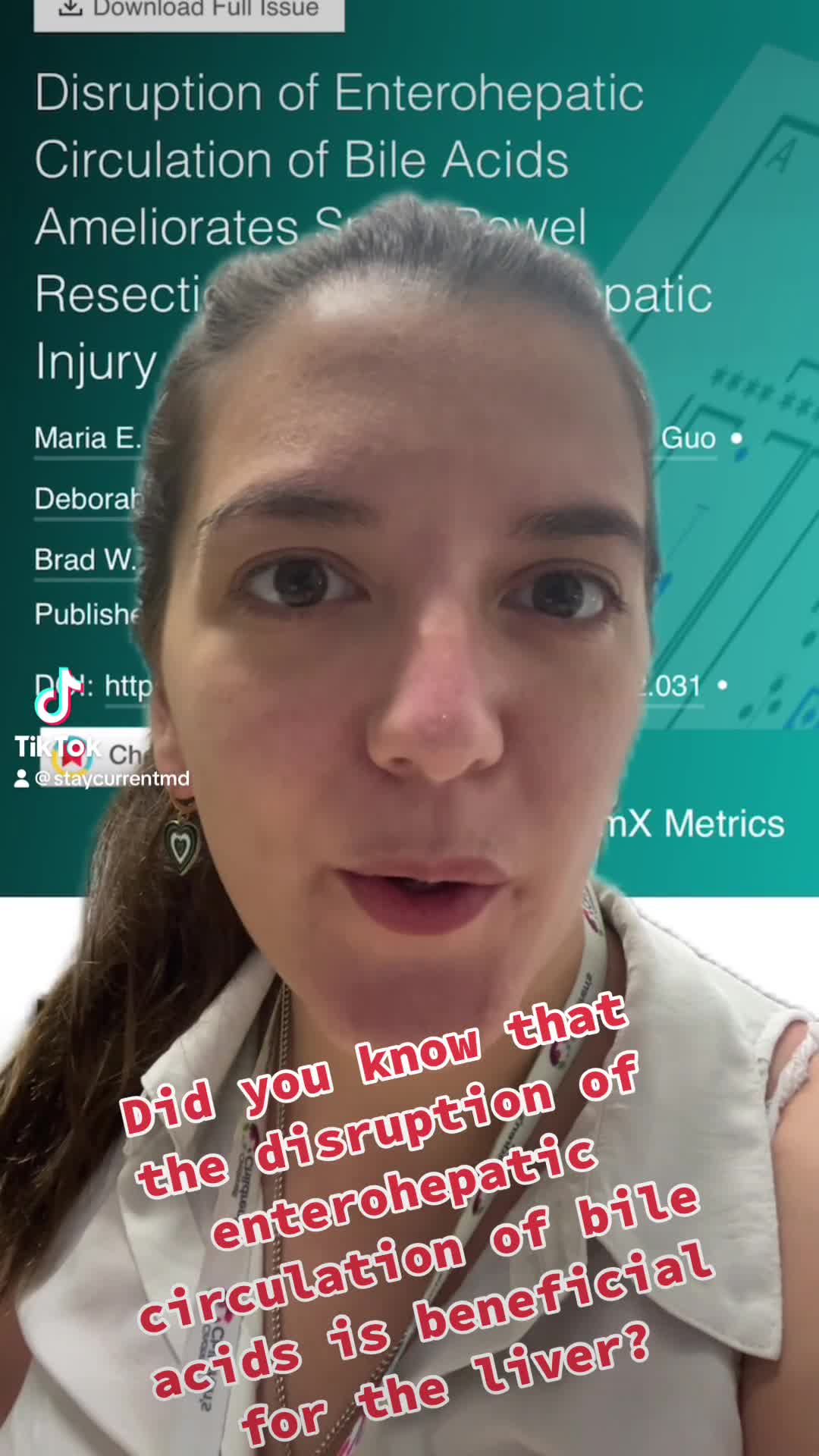 ▶
Ep 77 · 0:00
▶
Ep 77 · 0:00
host summary
Cecilia Gigena summarizing a resource: Disruption of the enterohepatic circulation of bile acids is beneficial for the liver
↗
▶
Ep 77 · 0:00
host summary
Cecilia Gigena summarizing a resource: Did you know that the disruption of the enterohepatic circulation of bilasses is beneficial for the liver?
↗
▶
Ep 77 · 0:13
host summary
Cecilia Gigena summarizing a resource: The study was conducted at Saint Louis Children's Hospital and aimed to elucidate the driving force behind hepatic injury following bowel resection
↗
▶
Ep 77 · 0:22
host summary
Cecilia Gigena summarizing a resource: The study used three groups of mice: sham, 50% with proximal or duodenal resection, and 50% with distal resection or resection of the ileocecal valve
↗
▶
Ep 77 · 0:34
host summary
Cecilia Gigena summarizing a resource: Tissue samples were taken at the second and tenth post-operative weeks
↗
▶
Ep 77 · 0:41
host summary
Cecilia Gigena summarizing a resource: Mice with distal resection showed less hepatic oxidative stress compared to proximal resection
↗
▶
Ep 77 · 0:41
host summary
Cecilia Gigena summarizing a resource: They find that mice with distal resection show less hepatic oxidative stress and more hydrophilic bile acid profile, meaning that the ilisal resection could lead to less hepatic injury.
↗
▶
Ep 77 · 0:41
host summary
Cecilia Gigena summarizing a resource: Ileal resection could lead to less hepatic injury
↗
▶
Ep 77 · 0:41
host summary
Cecilia Gigena summarizing a resource: Mice with distal resection showed a more hydrophilic bile acid profile compared to proximal resection
↗
Expectant Management or Early Ibuprofen for Patent Ductus Arteriosus
▶
Ep 77 · 0:09
host summary
Cecilia Gigena summarizing a resource: A multi-center non-inferiority trial compared preterm infants treated with expectant management versus early ibuprofen for PDA
↗
▶
Ep 77 · 0:22
host summary
Cecilia Gigena summarizing a resource: The trial enrolled 273 infants total
↗
▶
Ep 77 · 0:25
host summary
Cecilia Gigena summarizing a resource: 136 infants were treated with expectant management and 137 with early ibuprofen
↗
▶
Ep 77 · 0:31
host summary
Cecilia Gigena summarizing a resource: In the expectant management group, the death rate was 14%
↗
▶
Ep 77 · 0:31
host summary
Cecilia Gigena summarizing a resource: In the expectant management group, 33% developed bronchopulmonary dysplasia
↗
▶
Ep 77 · 0:31
host summary
Cecilia Gigena summarizing a resource: In the expectant management group, 17.6% developed necrotizing enterocolitis
↗
▶
Ep 77 · 0:43
host summary
Cecilia Gigena summarizing a resource: In the ibuprofen group, 15.4% developed necrotizing enterocolitis
↗
▶
Ep 77 · 0:43
host summary
Cecilia Gigena summarizing a resource: In the ibuprofen group, the death rate was 80%
↗
▶
Ep 77 · 0:43
host summary
Cecilia Gigena summarizing a resource: In the ibuprofen group, 50% developed bronchopulmonary dysplasia
↗
▶
Ep 77 · 1:01
host summary
Cecilia Gigena summarizing a resource: So it seems that expectant management is not inferiority that early ibuprofen in preterm patients with PDA.
↗
▶
Ep 77 · 1:01
host summary
Cecilia Gigena summarizing a resource: Expectant management is non-inferior to early ibuprofen in preterm patients with PDA
↗
Intestinal Rehabilitation, Episode 7: Refeeding in a neonatal patient
▶
Ep 79 · 4:21
host summary
Cecilia Gigena summarizing the discussion: Breast milk has lower protein levels than desired and likely requires supplementation.
↗
Intestinal Rehabilitation Episode 8: Refeeding of an Older Patient
▶
Ep 80 · 1:30
host summary
Cecilia Gigena summarizing the discussion: In older children, normal feeding behavior is important in many social aspects of life, not just nutrition.
↗
Quick Literature Updates Episode 16
▶
Ep 90 · 3:08
host summary
Cecilia Gigena summarizes what Dr. Alex Halpern said: The Phoenix study by Lie et al. was a retrospective single institution study from 2017 to 2021 comparing patients who underwent Nuss procedure with cryoanalgesia in the first quarter versus the fourth quarter of their experience.
↗
▶
Ep 90 · 3:27
host summary
Cecilia Gigena summarizes what Dr. Alex Halpern said: The Phoenix study included 350 patients who underwent Nuss procedure with cryoanalgesia.
↗
▶
Ep 90 · 3:32
host summary
Cecilia Gigena summarizes what Dr. Alex Halpern said: Patients in the last quarter of the Phoenix cryoablation experience required 74% less opioids than those in the first quarter.
↗
▶
Ep 90 · 3:32
host summary
Cecilia Gigena summarizes what Dr. Alex Halpern said: Patients in the last quarter of the Phoenix cryoablation experience were discharged 1.3 days earlier than patients in the first quarter.
↗
▶
Ep 90 · 3:44
host summary
Cecilia Gigena summarizes what Dr. Alex Halpern said: So it seems that experience really plays a role talking about cryoatissia.
↗
▶
Ep 90 · 3:44
host summary
Cecilia Gigena summarizes what Dr. Alex Halpern said: Experience plays a role in outcomes when using cryoanalgesia for Nuss procedures.
↗
Quick Literature Updates Ep 22
▶
Ep 98 · 3:16
host summary
Cecilia Gigena summarizing a resource: The Pefer et al. study is a retrospective study done in Texas using a state hospital database examining CDH outcomes by center volume.
↗
▶
Ep 98 · 3:32
host summary
Cecilia Gigena summarizing a resource: The Pefer study identified 1,314 CDH patients: 728 from high volume centers, 9 from mid-volume centers, and 79 from low volume centers.
↗
▶
Ep 98 · 3:46
host summary
Cecilia Gigena summarizing a resource: High volume centers had significantly shorter length of stay for CDH patients.
↗
▶
Ep 98 · 3:46
host summary
Cecilia Gigena summarizing a resource: High volume centers had significantly lower mortality rates for CDH, even though they have significantly sicker patients.
↗
▶
Ep 98 · 4:00
host summary
Cecilia Gigena summarizing a resource: High volume centers had better outcomes for patients with CDH.
↗
Quick Literature Updates Ep 27
▶
Ep 99 · 3:04
host summary
Cecilia Gigena summarizes what Dr. Alex Halpern said: Huncheid et al. conducted a multi-center non-inferiority trial that compared preterm infants treated with expectant management versus early ibuprofen for patent ductus arteriosus.
↗
▶
Ep 99 · 3:14
host summary
Cecilia Gigena summarizes what Dr. Alex Halpern said: The trial included 273 infants: 136 treated with expectant management and 137 with early ibuprofen.
↗
▶
Ep 99 · 3:24
host summary
Cecilia Gigena summarizes what Dr. Alex Halpern said: In the expectant management group for PDA, there was 17.6% necrotizing enterocolitis, 33% bronchopulmonary dysplasia, and 14% death rates.
↗
▶
Ep 99 · 3:36
host summary
Cecilia Gigena summarizes what Dr. Alex Halpern said: In the ibuprofen group for PDA, there was 15.4% necrotizing enterocolitis, 50% bronchopulmonary dysplasia, and 80% death rates.
↗
▶
Ep 99 · 3:53
host summary
Cecilia Gigena summarizes what Dr. Alex Halpern said: So it seems that expectant management is not inferiority that early ibuprofen in preterm patients with PDA.
↗
▶
Ep 99 · 3:53
host summary
Cecilia Gigena summarizes what Dr. Alex Halpern said: Expectant management is not inferior to early ibuprofen in preterm patients with patent ductus arteriosus.
↗
Summaries Cecilia gave as host · Jaundice
11 summaries
Open the Jaundice collection →
Clinical Characteristics and Prognosis of Biliary Atresia with Low Serum Matrix Metalloproteinase-7 Levels
▶
Ep 3 · 0:11
host summary
Cecilia Gigena summarizing a resource: The study was a retrospective cohort study conducted in China
↗
▶
Ep 3 · 0:11
host summary
Cecilia Gigena summarizing a resource: This is a retrospective cohort study done in China that aimed to evaluate the characteristics and prognosis of patients with biliary atresia and low MMP 7.
↗
▶
Ep 3 · 0:21
host summary
Cecilia Gigena summarizing a resource: 40 of the 329 patients had low MMP-7 levels
↗
▶
Ep 3 · 0:21
host summary
Cecilia Gigena summarizing a resource: The study included 329 patients with biliary atresia
↗
▶
Ep 3 · 0:21
host summary
Cecilia Gigena summarizing a resource: They had 329 patients, and 40 of them had low MMP7.
↗
▶
Ep 3 · 0:27
host summary
Cecilia Gigena summarizing a resource: Patients with low MMP-7 had significantly lower 6-month jaundice clearance
↗
▶
Ep 3 · 0:27
host summary
Cecilia Gigena summarizing a resource: And what they found is that these patients had significantly lower 3 month and 6 month jaundice clearance and significantly lower 1 year native liver survival.
↗
▶
Ep 3 · 0:27
host summary
Cecilia Gigena summarizing a resource: Patients with low MMP-7 had significantly lower 3-month jaundice clearance
↗
▶
Ep 3 · 0:27
host summary
Cecilia Gigena summarizing a resource: Patients with low MMP-7 had significantly lower 1-year native liver survival
↗
▶
Ep 3 · 0:40
host summary
Cecilia Gigena summarizing a resource: MMP-7 measurement may in the future help with treatment of biliary atresia patients
↗
▶
Ep 3 · 0:40
host summary
Cecilia Gigena summarizing a resource: Measuring MMP-7 can help with prognosis in biliary atresia patients
↗
Summaries Cecilia gave as host · Liver Tumors (Hepatoblastoma/HCC)
8 summaries
Open the Liver Tumors (Hepatoblastoma/HCC) collection →
Aggressive Pursuit of No Evidence of Disease Status in Hepatoblastoma Improves Survival
▶
Ep 9 · 0:00
host summary
Cecilia Gigena summarizing a resource: Do you pursue no evidence of disease status in hepatoblastoma?
↗
▶
Ep 9 · 0:00
host summary
Cecilia Gigena summarizing a resource: The study was a retrospective observational study conducted at Cincinnati Children's Hospital from 2005 to 2021
↗
▶
Ep 9 · 0:20
host summary
Cecilia Gigena summarizing a resource: The study aim was to examine the effect of aggressive pursuit of no evidence of disease status on overall survival and event free status
↗
▶
Ep 9 · 0:35
host summary
Cecilia Gigena summarizing a resource: The study included 50 patients with hepatoblastoma
↗
▶
Ep 9 · 0:42
host summary
Cecilia Gigena summarizing a resource: 41 patients were rendered to no evidence of disease status
↗
▶
Ep 9 · 0:48
host summary
Cecilia Gigena summarizing a resource: Overall survival and event free status were significantly improved in both high risk and non-high risk patients who achieved no evidence of disease status
↗
▶
Ep 9 · 0:58
host summary
Cecilia Gigena summarizing a resource: it seems that pursuing no evidence of disease status is better for overall survival in hepatoblastoma patients
↗
▶
Ep 9 · 0:58
host summary
Cecilia Gigena summarizing a resource: Pursuing no evidence of disease status is better for overall survival in hepatoblastoma patients
↗
Summaries Cecilia gave as host · Long-gap Esophageal Atresia
3 summaries
Open the Long-gap Esophageal Atresia collection →
Journal of Pediatric Surgery Article Review: February 2023, BAPS issue
▶
Ep 4 · 9:23
host summary
Cecilia Gigena summarizing the discussion: The Tanzania soap bathing study included 252 patients, with 114 receiving a preoperative bath with plain soap
↗
▶
Ep 4 · 9:26
host summary
Cecilia Gigena summarizing the discussion: In the soap bathing group, 11.4% developed surgical site infections compared to 40.6% in the control group
↗
▶
Ep 4 · 9:43
host summary
Cecilia Gigena summarizing the discussion: Preoperative soap bathing reduced the odds of surgical site infections by 80%
↗
Summaries Cecilia gave as host · Long Gap Esophageal Atresia
15 summaries
Open the Long Gap Esophageal Atresia collection →
Journal of Pediatric Surgery Article Review: February 2023, BAPS issue
▶
Ep 5 · 9:23
host summary
Cecilia Gigena summarizing the discussion: The Tanzania soap bathing study included 252 patients, with 114 receiving a preoperative bath with plain soap
↗
▶
Ep 5 · 9:26
host summary
Cecilia Gigena summarizing the discussion: In the soap bathing group, 11.4% developed surgical site infections compared to 40.6% in the control group
↗
▶
Ep 5 · 9:43
host summary
Cecilia Gigena summarizing the discussion: Preoperative soap bathing reduced the odds of surgical site infections by 80%
↗
Update Course Rewind: Management of Esophageal Leaks 2022
▶
Ep 9 · 0:07
host summary
Cecilia Gigena summarizing the discussion: Hello everyone, I'm Cecilia Jigena from Cincinnati Children's Hospital.
↗
▶
Ep 9 · 1:16
host summary
Cecilia Gigena summarizing the discussion: Every small or moderate leak that is contained can be managed by observation with no need for new intervention
↗
▶
Ep 9 · 1:29
host summary
Cecilia Gigena summarizing the discussion: New intervention for esophageal leaks is only considered when leaks create huge pneumothorax that are not well drained, or if the patient is unstable
↗
▶
Ep 9 · 1:41
host summary
Cecilia Gigena summarizing the discussion: Botulinum toxin can be used to block the secretion of saliva in management of esophageal leaks
↗
▶
Ep 9 · 1:55
host summary
Cecilia Gigena summarizing the discussion: Glycopyrrolate is a medicine available in the US that blocks the secretion of saliva
↗
▶
Ep 9 · 2:50
host summary
Cecilia Gigena summarizing the discussion: Retrograde endoscopy via gastrostomy tube can be used to dilate esophageal strictures when antegrade visualization is inadequate
↗
▶
Ep 9 · 5:24
host summary
Cecilia Gigena summarizing the discussion: Endoscopic vacuum closure (endo-bag) consists of an NG tube with a hose covered by a surgical sponge, which is covered by a perforated transparent adhesive, connected to suction
↗
▶
Ep 9 · 5:38
host summary
Cecilia Gigena summarizing the discussion: Endoscopic vacuum closure helps granulation tissue form by negative pressure and makes the patient heal faster
↗
▶
Ep 9 · 7:22
host summary
Cecilia Gigena summarizing the discussion: Most esophageal leaks can be treated by observation or chest drain
↗
▶
Ep 9 · 7:28
host summary
Cecilia Gigena summarizing the discussion: If there is an external leak like in the neck or a fistula that is not healing well, an endovac can be a great solution
↗
▶
Ep 9 · 7:37
host summary
Cecilia Gigena summarizing the discussion: For some patients with deteriorated status or great leaks, a re-anastomosis can be attempted
↗
▶
Ep 9 · 7:45
host summary
Cecilia Gigena summarizing the discussion: After a leak, a stricture is more common, so the patient must be followed more thoroughly
↗
Summaries Cecilia gave as host · Midgut Volvulus
1 summary
Open the Midgut Volvulus collection →
Intestinal Rehabilitation Episode 8: Refeeding of an Older Patient
▶
Ep 4 · 1:30
host summary
Cecilia Gigena summarizing the discussion: In older children, normal feeding behavior is important in many social aspects of life, not just nutrition.
↗
Summaries Cecilia gave as host · Midgut Volvulus
1 summary
Open the Midgut Volvulus collection →
Intestinal Rehabilitation Episode 8: Refeeding of an Older Patient
▶
Ep 5 · 1:30
host summary
Cecilia Gigena summarizing the discussion: In older children, normal feeding behavior is important in many social aspects of life, not just nutrition.
↗
Summaries Cecilia gave as host · Necrotizing Enterocolitis
10 summaries
Open the Necrotizing Enterocolitis collection →
Routine contrast enema prior to stoma reversal seems only required following treatment for necrotizing enterocolitis: An evaluation of the diagnostic accuracy of the contrast enema
▶
Ep 6 · 0:00
host summary
Cecilia Gigena summarizing a resource: Do you always do a contrast enema prior to stoma reversal?
↗
▶
Ep 6 · 0:13
host summary
Cecilia Gigena summarizing a resource: A retrospective study was conducted in the Netherlands between 1998 and 2018 examining contrast enema use prior to stoma reversal.
↗
▶
Ep 6 · 0:24
host summary
Cecilia Gigena summarizing a resource: The study included patients under three years old who underwent stoma reversal.
↗
▶
Ep 6 · 0:38
host summary
Cecilia Gigena summarizing a resource: The study gathered 244 patients.
↗
▶
Ep 6 · 0:40
host summary
Cecilia Gigena summarizing a resource: 10% of patients developed strictures.
↗
▶
Ep 6 · 0:43
host summary
Cecilia Gigena summarizing a resource: 95% of patients with strictures had necrotizing enterocolitis.
↗
▶
Ep 6 · 0:47
host summary
Cecilia Gigena summarizing a resource: Only 68% of all patients had a contrast enema prior to stoma reversal.
↗
▶
Ep 6 · 0:51
host summary
Cecilia Gigena summarizing a resource: Contrast enema was able to detect 92% of strictures.
↗
▶
Ep 6 · 0:54
host summary
Cecilia Gigena summarizing a resource: Contrast enema prior to stoma reversal is only useful if patients had necrotizing enterocolitis.
↗
▶
Ep 6 · 0:54
host summary
Cecilia Gigena summarizing a resource: So it seems that contrast enema prior to stoma reversal is only useful if patients had NEC.
↗
Summaries Cecilia gave as host · Necrotizing Enterocolitis
21 summaries
Open the Necrotizing Enterocolitis collection →
Routine contrast enema prior to stoma reversal seems only required following treatment for necrotizing enterocolitis: An evaluation of the diagnostic accuracy of the contrast enema
▶
Ep 14 · 0:00
host summary
Cecilia Gigena summarizing a resource: Do you always do a contrast enema prior to stoma reversal?
↗
▶
Ep 14 · 0:13
host summary
Cecilia Gigena summarizing a resource: A retrospective study was conducted in the Netherlands between 1998 and 2018 examining contrast enema use prior to stoma reversal.
↗
▶
Ep 14 · 0:24
host summary
Cecilia Gigena summarizing a resource: The study included patients under three years old who underwent stoma reversal.
↗
▶
Ep 14 · 0:38
host summary
Cecilia Gigena summarizing a resource: The study gathered 244 patients.
↗
▶
Ep 14 · 0:40
host summary
Cecilia Gigena summarizing a resource: 10% of patients developed strictures.
↗
▶
Ep 14 · 0:43
host summary
Cecilia Gigena summarizing a resource: 95% of patients with strictures had necrotizing enterocolitis.
↗
▶
Ep 14 · 0:47
host summary
Cecilia Gigena summarizing a resource: Only 68% of all patients had a contrast enema prior to stoma reversal.
↗
▶
Ep 14 · 0:51
host summary
Cecilia Gigena summarizing a resource: Contrast enema was able to detect 92% of strictures.
↗
▶
Ep 14 · 0:54
host summary
Cecilia Gigena summarizing a resource: So it seems that contrast enema prior to stoma reversal is only useful if patients had NEC.
↗
▶
Ep 14 · 0:54
host summary
Cecilia Gigena summarizing a resource: Contrast enema prior to stoma reversal is only useful if patients had necrotizing enterocolitis.
↗
Expectant Management or Early Ibuprofen for Patent Ductus Arteriosus
▶
Ep 15 · 0:09
host summary
Cecilia Gigena summarizing a resource: A multi-center non-inferiority trial compared preterm infants treated with expectant management versus early ibuprofen for PDA
↗
▶
Ep 15 · 0:22
host summary
Cecilia Gigena summarizing a resource: The trial enrolled 273 infants total
↗
▶
Ep 15 · 0:25
host summary
Cecilia Gigena summarizing a resource: 136 infants were treated with expectant management and 137 with early ibuprofen
↗
▶
Ep 15 · 0:31
host summary
Cecilia Gigena summarizing a resource: In the expectant management group, the death rate was 14%
↗
▶
Ep 15 · 0:31
host summary
Cecilia Gigena summarizing a resource: In the expectant management group, 33% developed bronchopulmonary dysplasia
↗
▶
Ep 15 · 0:31
host summary
Cecilia Gigena summarizing a resource: In the expectant management group, 17.6% developed necrotizing enterocolitis
↗
▶
Ep 15 · 0:43
host summary
Cecilia Gigena summarizing a resource: In the ibuprofen group, the death rate was 80%
↗
▶
Ep 15 · 0:43
host summary
Cecilia Gigena summarizing a resource: In the ibuprofen group, 15.4% developed necrotizing enterocolitis
↗
▶
Ep 15 · 0:43
host summary
Cecilia Gigena summarizing a resource: In the ibuprofen group, 50% developed bronchopulmonary dysplasia
↗
▶
Ep 15 · 1:01
host summary
Cecilia Gigena summarizing a resource: Expectant management is non-inferior to early ibuprofen in preterm patients with PDA
↗
▶
Ep 15 · 1:01
host summary
Cecilia Gigena summarizing a resource: So it seems that expectant management is not inferiority that early ibuprofen in preterm patients with PDA.
↗
Summaries Cecilia gave as host · Necrotizing Enterocolitis
29 summaries
Open the Necrotizing Enterocolitis collection →
Routine contrast enema prior to stoma reversal seems only required following treatment for necrotizing enterocolitis: An evaluation of the diagnostic accuracy of the contrast enema
▶
Ep 16 · 0:00
host summary
Cecilia Gigena summarizing a resource: Do you always do a contrast enema prior to stoma reversal?
↗
▶
Ep 16 · 0:13
host summary
Cecilia Gigena summarizing a resource: A retrospective study was conducted in the Netherlands between 1998 and 2018 examining contrast enema use prior to stoma reversal.
↗
▶
Ep 16 · 0:24
host summary
Cecilia Gigena summarizing a resource: The study included patients under three years old who underwent stoma reversal.
↗
▶
Ep 16 · 0:38
host summary
Cecilia Gigena summarizing a resource: The study gathered 244 patients.
↗
▶
Ep 16 · 0:40
host summary
Cecilia Gigena summarizing a resource: 10% of patients developed strictures.
↗
▶
Ep 16 · 0:43
host summary
Cecilia Gigena summarizing a resource: 95% of patients with strictures had necrotizing enterocolitis.
↗
▶
Ep 16 · 0:47
host summary
Cecilia Gigena summarizing a resource: Only 68% of all patients had a contrast enema prior to stoma reversal.
↗
▶
Ep 16 · 0:51
host summary
Cecilia Gigena summarizing a resource: Contrast enema was able to detect 92% of strictures.
↗
▶
Ep 16 · 0:54
host summary
Cecilia Gigena summarizing a resource: Contrast enema prior to stoma reversal is only useful if patients had necrotizing enterocolitis.
↗
▶
Ep 16 · 0:54
host summary
Cecilia Gigena summarizing a resource: So it seems that contrast enema prior to stoma reversal is only useful if patients had NEC.
↗
Expectant Management or Early Ibuprofen for Patent Ductus Arteriosus
▶
Ep 18 · 0:09
host summary
Cecilia Gigena summarizing a resource: A multi-center non-inferiority trial compared preterm infants treated with expectant management versus early ibuprofen for PDA
↗
▶
Ep 18 · 0:22
host summary
Cecilia Gigena summarizing a resource: The trial enrolled 273 infants total
↗
▶
Ep 18 · 0:25
host summary
Cecilia Gigena summarizing a resource: 136 infants were treated with expectant management and 137 with early ibuprofen
↗
▶
Ep 18 · 0:31
host summary
Cecilia Gigena summarizing a resource: In the expectant management group, the death rate was 14%
↗
▶
Ep 18 · 0:31
host summary
Cecilia Gigena summarizing a resource: In the expectant management group, 33% developed bronchopulmonary dysplasia
↗
▶
Ep 18 · 0:31
host summary
Cecilia Gigena summarizing a resource: In the expectant management group, 17.6% developed necrotizing enterocolitis
↗
▶
Ep 18 · 0:43
host summary
Cecilia Gigena summarizing a resource: In the ibuprofen group, 50% developed bronchopulmonary dysplasia
↗
▶
Ep 18 · 0:43
host summary
Cecilia Gigena summarizing a resource: In the ibuprofen group, the death rate was 80%
↗
▶
Ep 18 · 0:43
host summary
Cecilia Gigena summarizing a resource: In the ibuprofen group, 15.4% developed necrotizing enterocolitis
↗
▶
Ep 18 · 1:01
host summary
Cecilia Gigena summarizing a resource: So it seems that expectant management is not inferiority that early ibuprofen in preterm patients with PDA.
↗
▶
Ep 18 · 1:01
host summary
Cecilia Gigena summarizing a resource: Expectant management is non-inferior to early ibuprofen in preterm patients with PDA
↗
Manejo expectante o ibuprofeno temprano para el tratamiento del conducto arterioso persistente
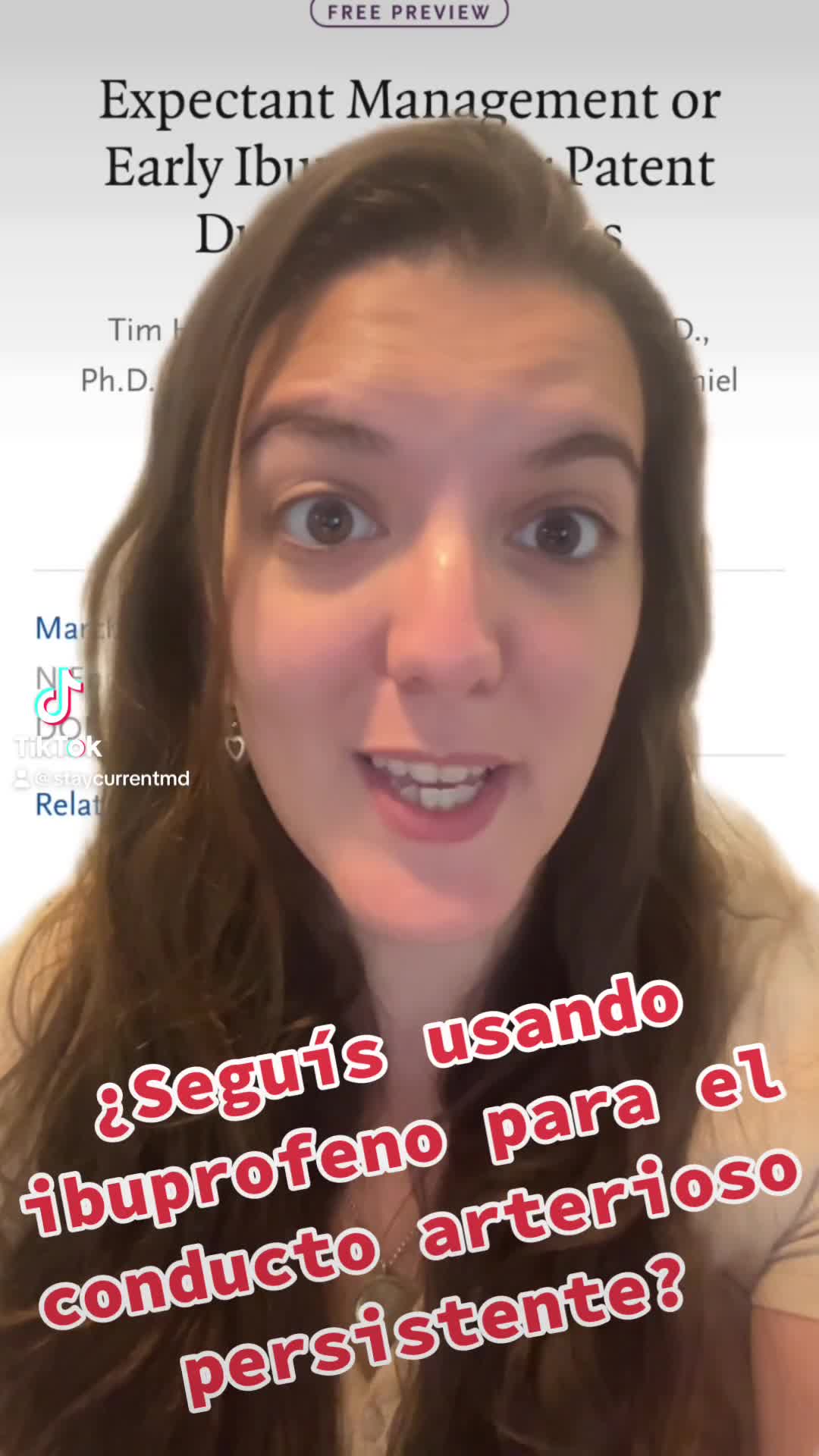 ▶
Ep 19 · 0:00
▶
Ep 19 · 0:00
host summary
Cecilia Gigena summarizing a resource: ¿Y vos? ¿Seguís usando ibuprofeno para el tratamiento del conducto arterioso persistente?
↗
▶
Ep 19 · 0:00
host summary
Cecilia Gigena summarizing a resource: This is a multicenter non-inferiority study comparing extremely premature patients with persistent ductus arteriosus who received expectant management versus ibuprofen treatment.
↗
▶
Ep 19 · 0:10
host summary
Cecilia Gigena summarizing a resource: Hola, soy Cecilia Gigena del Hospital de Niños de Cincinnati y creo que este es un artículo que tenés que conocer.
↗
▶
Ep 19 · 1:00
host summary
Cecilia Gigena summarizing a resource: The study enrolled 273 patients: 136 with expectant management and 137 with ibuprofen treatment.
↗
▶
Ep 19 · 1:20
host summary
Cecilia Gigena summarizing a resource: Patients receiving expectant management had 17.6% necrotizing enterocolitis, 33.3% bronchopulmonary dysplasia, and 14% mortality.
↗
▶
Ep 19 · 1:50
host summary
Cecilia Gigena summarizing a resource: Patients receiving ibuprofen treatment had 15.4% necrotizing enterocolitis, 50.9% bronchopulmonary dysplasia, and 18.6% mortality.
↗
▶
Ep 19 · 2:20
host summary
Cecilia Gigena summarizing a resource: Expectant management appears to be non-inferior to ibuprofen treatment in extremely premature patients with persistent ductus arteriosus.
↗
▶
Ep 19 · 2:20
host summary
Cecilia Gigena summarizing a resource: Así que parece que el tratamiento expectante no es inferior al tratamiento con ibuprofeno en pacientes con conducto arterioso persistente prematuros extremos.
↗
Summaries Cecilia gave as host · Neonatal & Pediatric Minimally Invasive Surgery
12 summaries
Open the Neonatal & Pediatric Minimally Invasive Surgery collection →
Update Course Rewind: Management of Esophageal Leaks 2022
▶
Ep 21 · 0:07
host summary
Cecilia Gigena summarizing the discussion: Hello everyone, I'm Cecilia Jigena from Cincinnati Children's Hospital.
↗
▶
Ep 21 · 1:16
host summary
Cecilia Gigena summarizing the discussion: Every small or moderate leak that is contained can be managed by observation with no need for new intervention
↗
▶
Ep 21 · 1:29
host summary
Cecilia Gigena summarizing the discussion: New intervention for esophageal leaks is only considered when leaks create huge pneumothorax that are not well drained, or if the patient is unstable
↗
▶
Ep 21 · 1:41
host summary
Cecilia Gigena summarizing the discussion: Botulinum toxin can be used to block the secretion of saliva in management of esophageal leaks
↗
▶
Ep 21 · 1:55
host summary
Cecilia Gigena summarizing the discussion: Glycopyrrolate is a medicine available in the US that blocks the secretion of saliva
↗
▶
Ep 21 · 2:50
host summary
Cecilia Gigena summarizing the discussion: Retrograde endoscopy via gastrostomy tube can be used to dilate esophageal strictures when antegrade visualization is inadequate
↗
▶
Ep 21 · 5:24
host summary
Cecilia Gigena summarizing the discussion: Endoscopic vacuum closure (endo-bag) consists of an NG tube with a hose covered by a surgical sponge, which is covered by a perforated transparent adhesive, connected to suction
↗
▶
Ep 21 · 5:38
host summary
Cecilia Gigena summarizing the discussion: Endoscopic vacuum closure helps granulation tissue form by negative pressure and makes the patient heal faster
↗
▶
Ep 21 · 7:22
host summary
Cecilia Gigena summarizing the discussion: Most esophageal leaks can be treated by observation or chest drain
↗
▶
Ep 21 · 7:28
host summary
Cecilia Gigena summarizing the discussion: If there is an external leak like in the neck or a fistula that is not healing well, an endovac can be a great solution
↗
▶
Ep 21 · 7:37
host summary
Cecilia Gigena summarizing the discussion: For some patients with deteriorated status or great leaks, a re-anastomosis can be attempted
↗
▶
Ep 21 · 7:45
host summary
Cecilia Gigena summarizing the discussion: After a leak, a stricture is more common, so the patient must be followed more thoroughly
↗
Summaries Cecilia gave as host · Neuroblastoma
13 summaries
Open the Neuroblastoma collection →
Image-guided core-needle or surgical biopsy for neuroblastoma diagnosis in children
 ▶
Ep 13 · 0:09
▶
Ep 13 · 0:09
host summary
Cecilia Gigena summarizing a resource: The review analyzed the accuracy and safety of image-guided core needle biopsy for neuroblastoma
↗
▶
Ep 13 · 0:09
host summary
Cecilia Gigena summarizing a resource: The systematic review and meta-analysis was conducted by IPSO
↗
▶
Ep 13 · 0:23
host summary
Cecilia Gigena summarizing a resource: Tissue adequacy was not significantly different between image-guided core needle biopsy and surgical biopsy groups
↗
▶
Ep 13 · 0:23
host summary
Cecilia Gigena summarizing a resource: Intraoperative transfusions were higher in the surgical biopsy group compared to image-guided core needle biopsy
↗
▶
Ep 13 · 0:23
host summary
Cecilia Gigena summarizing a resource: Biological characterization of the biopsy was not significantly different between image-guided core needle biopsy and surgical biopsy groups
↗
▶
Ep 13 · 0:23
host summary
Cecilia Gigena summarizing a resource: The review included 8 retrospective studies with 490 patients
↗
▶
Ep 13 · 0:23
host summary
Cecilia Gigena summarizing a resource: Complications were higher in the surgical biopsy group compared to image-guided core needle biopsy
↗
▶
Ep 13 · 0:43
host summary
Cecilia Gigena summarizing a resource: So it seems that image-guided core needle biopsy is safe and effective for diagnosed neuroblastoma.
↗
▶
Ep 13 · 0:43
host summary
Cecilia Gigena summarizing a resource: Image-guided core needle biopsy is safe and effective for diagnosing neuroblastoma
↗
Quick Literature Updates Ep 19
▶
Ep 21 · 3:27
host summary
Cecilia Gigena summarizes what Dr. Carlos Colunga said: The IPSO systematic review and meta-analysis gathered 8 retrospective studies with 490 patients comparing image-guided core needle biopsy to surgical biopsy for neuroblastoma.
↗
▶
Ep 21 · 3:40
host summary
Cecilia Gigena summarizes what Dr. Carlos Colunga said: Tissue adequacy and biological characterization of the biopsy was not significantly different between image-guided core needle biopsy and surgical biopsy groups for neuroblastoma.
↗
▶
Ep 21 · 3:54
host summary
Cecilia Gigena summarizes what Dr. Carlos Colunga said: Intraoperative transfusions and complications were higher in the surgical biopsy group compared to image-guided core needle biopsy for neuroblastoma.
↗
▶
Ep 21 · 4:00
host summary
Cecilia Gigena summarizes what Dr. Carlos Colunga said: Image-guided core needle biopsy is safe and effective for diagnosing neuroblastoma.
↗
Summaries Cecilia gave as host · Non-perforated Appendicitis
7 summaries
Open the Non-perforated Appendicitis collection →
Quick Literature Updates Ep 26
▶
Ep 4 · 3:20
host summary
Cecilia Gigena summarizes what Dr. Alex Halpern said: The Schlapbach et al. study is a worldwide study with a Delphi consensus process that aimed to update the definitions of sepsis and septic shock
↗
▶
Ep 4 · 3:29
host summary
Cecilia Gigena summarizes what Dr. Alex Halpern said: The Phoenix sepsis score includes variables in cardiovascular function, respiratory function, coagulation, and neurological function
↗
▶
Ep 4 · 3:42
host summary
Cecilia Gigena summarizes what Dr. Alex Halpern said: The Phoenix sepsis score helped correlate the definition of sepsis with an actual mortality rate
↗
▶
Ep 4 · 3:48
host summary
Cecilia Gigena summarizes what Dr. Alex Halpern said: The definition of sepsis is suspected infection plus 2 points in the Phoenix sepsis score
↗
▶
Ep 4 · 3:48
host summary
Cecilia Gigena summarizes what Dr. Alex Halpern said: Septic shock is defined as sepsis plus cardiovascular dysfunction that is seen when there is 1 point in the cardiovascular variable of the Phoenix sepsis score
↗
▶
Ep 4 · 4:06
host summary
Cecilia Gigena summarizes what Dr. Alex Halpern said: Sepsis has a mortality rate of 7.1%
↗
▶
Ep 4 · 4:06
host summary
Cecilia Gigena summarizes what Dr. Alex Halpern said: Septic shock has a mortality rate of 10.8 to 33.5% according to the research settings
↗
Summaries Cecilia gave as host · Pancreatitis
28 summaries
Open the Pancreatitis collection →
Update Course Rewind: Management of Acute Pancreatitis 2023
▶
Ep 14 · 5:55
host summary
Cecilia Gigena summarizing the discussion: Fluid resuscitation is key in pancreatitis management
↗
▶
Ep 14 · 5:57
host summary
Cecilia Gigena summarizing the discussion: Patients should be reassessed at the 12 and 24 hour mark to avoid fluid overload
↗
Transcystic Laparoscopic Common Bile Duct Exploration for Pediatric Patients with Choledocholithiasis
▶
Ep 16 · 0:09
host summary
Cecilia Gigena summarizing a resource: The study was a multi-center retrospective study conducted in the US from 2018 to 2022
↗
▶
Ep 16 · 0:09
host summary
Cecilia Gigena summarizing a resource: The study aim was to compare patients with suspected choledocholithiasis who underwent transcystic laparoscopic common bile duct exploration versus those who underwent ERCP first
↗
▶
Ep 16 · 0:09
host summary
Cecilia Gigena summarizing a resource: This is a multi-center retrospective study done in the US from 2018 to 2022, and their aim was to compare patients with suspected.
↗
▶
Ep 16 · 0:28
host summary
Cecilia Gigena summarizing a resource: The study included 252 patients total
↗
▶
Ep 16 · 0:28
host summary
Cecilia Gigena summarizing a resource: 156 patients were in group one (transcystic laparoscopic common bile duct exploration)
↗
▶
Ep 16 · 0:38
host summary
Cecilia Gigena summarizing a resource: Patients in group one (transcystic laparoscopic approach) had lower length of stay compared to group two
↗
▶
Ep 16 · 0:38
host summary
Cecilia Gigena summarizing a resource: 96 patients were in group two (ERCP first)
↗
▶
Ep 16 · 0:38
host summary
Cecilia Gigena summarizing a resource: Patients in group one (transcystic laparoscopic approach) had significantly less complication rates compared to group two
↗
▶
Ep 16 · 0:52
host summary
Cecilia Gigena summarizing a resource: So it seems that attempting a transcystic laparoscopic common bile duct exploration may benefit our patients.
↗
▶
Ep 16 · 0:52
host summary
Cecilia Gigena summarizing a resource: Attempting a transcystic laparoscopic common bile duct exploration may benefit pediatric patients with choledocholithiasis
↗
Update Course Rewind: Management of Recurrent Pancreatitis
▶
Ep 17 · 2:26
host summary
Cecilia Gigena summarizes what Dr. Juan Gurria said: If a patient has more than one episode of acute pancreatitis or a first severe episode, an MRCP and genetic panel should be performed to rule out genetic anomalies.
↗
▶
Ep 17 · 3:37
host summary
Cecilia Gigena summarizes what Dr. Juan Gurria said: Genetics are very important before any resection procedure to avoid losing pancreatic cells in pathologies that will not benefit from resection and drainage but instead from islet cell transplant.
↗
▶
Ep 17 · 4:37
host summary
Cecilia Gigena summarizes what Dr. Juan Gurria said: Endoscopic treatment should be attempted first, but if it fails, transfer to a specialized center that performs TPIAT (total pancreatectomy with islet autotransplantation).
↗
▶
Ep 17 · 5:11
host summary
Cecilia Gigena summarizes what Dr. Juan Gurria said: For pancreatic imaging, start with ultrasound, then CT, and for better visualization of pancreatic anatomy, use MRCP with T2 sequences.
↗
▶
Ep 17 · 5:40
host summary
Cecilia Gigena summarizes what Dr. Juan Gurria said: Recurrent pancreatitis is a rare pathology that can lead to chronic pancreatitis and is associated with genetic mutations.
↗
▶
Ep 17 · 5:50
host summary
Cecilia Gigena summarizes what Dr. Juan Gurria said: If genetic mutations are confirmed, partial resection (e.g., Frey procedure) should be avoided to preserve pancreatic cells, and TPIAT should be considered sooner rather than later if endoscopic treatment fails.
↗
Case-Based Journal Review: Cholelithiasis 2024
▶
Ep 18 · 3:11
host summary
Cecilia Gigena summarizes what Dr. Jose Campos said: In a multi-center study of 167 early cholecystectomy patients versus 79 delayed, early cholecystectomy had 2% recurrence of pancreatitis compared to 22% in delayed surgery
↗
▶
Ep 18 · 3:11
host summary
Cecilia Gigena summarizes what Dr. Jose Campos said: In a multi-center study of 167 early cholecystectomy patients versus 79 delayed, early cholecystectomy had 2% recurrence of pancreatitis compared to 22% in delayed surgery
↗
▶
Ep 18 · 3:36
host summary
Cecilia Gigena summarizes what Dr. Jose Campos said: When cholecystectomy was delayed more than 6 weeks after gallstone pancreatitis, recurrence rate increased to 60%
↗
▶
Ep 18 · 3:36
host summary
Cecilia Gigena summarizes what Dr. Jose Campos said: When cholecystectomy was delayed more than 6 weeks after gallstone pancreatitis, recurrence rate increased to 60%
↗
▶
Ep 18 · 4:27
host summary
Cecilia Gigena summarizes what Dr. Jose Campos said: Patients who underwent early cholecystectomy did not have more biliary complications than delayed surgery patients
↗
▶
Ep 18 · 4:27
host summary
Cecilia Gigena summarizes what Dr. Jose Campos said: Patients who underwent early cholecystectomy did not have more biliary complications than delayed surgery patients
↗
▶
Ep 18 · 11:27
host summary
Cecilia Gigena summarizes what Dr. Jose Campos said: In a multi-center study of 252 patients with choledocholithiasis, 156 underwent OR-first approach (laparoscopic cholecystectomy with intraoperative cholangiogram) and 96 underwent ERCP-first approach
↗
▶
Ep 18 · 11:27
host summary
Cecilia Gigena summarizes what Dr. Jose Campos said: In a multi-center study of 252 patients with choledocholithiasis, 156 underwent OR-first approach (laparoscopic cholecystectomy with intraoperative cholangiogram) and 96 underwent ERCP-first approach
↗
▶
Ep 18 · 11:41
host summary
Cecilia Gigena summarizes what Dr. Jose Campos said: Patients who underwent intraoperative cholangiogram first had fewer complications and shorter length of stay than ERCP-first patients, and 86% needed only the surgery without subsequent ERCP
↗
▶
Ep 18 · 11:41
host summary
Cecilia Gigena summarizes what Dr. Jose Campos said: Patients who underwent intraoperative cholangiogram first had fewer complications and shorter length of stay than ERCP-first patients, and 86% needed only the surgery without subsequent ERCP
↗
Summaries Cecilia gave as host · Patent Ductus Arteriosus
19 summaries
Open the Patent Ductus Arteriosus collection →
Expectant Management or Early Ibuprofen for Patent Ductus Arteriosus
▶
Ep 1 · 0:09
host summary
Cecilia Gigena summarizing a resource: A multi-center non-inferiority trial compared preterm infants treated with expectant management versus early ibuprofen for PDA
↗
▶
Ep 1 · 0:22
host summary
Cecilia Gigena summarizing a resource: The trial enrolled 273 infants total
↗
▶
Ep 1 · 0:25
host summary
Cecilia Gigena summarizing a resource: 136 infants were treated with expectant management and 137 with early ibuprofen
↗
▶
Ep 1 · 0:31
host summary
Cecilia Gigena summarizing a resource: In the expectant management group, 17.6% developed necrotizing enterocolitis
↗
▶
Ep 1 · 0:31
host summary
Cecilia Gigena summarizing a resource: In the expectant management group, 33% developed bronchopulmonary dysplasia
↗
▶
Ep 1 · 0:31
host summary
Cecilia Gigena summarizing a resource: In the expectant management group, the death rate was 14%
↗
▶
Ep 1 · 0:43
host summary
Cecilia Gigena summarizing a resource: In the ibuprofen group, 50% developed bronchopulmonary dysplasia
↗
▶
Ep 1 · 0:43
host summary
Cecilia Gigena summarizing a resource: In the ibuprofen group, the death rate was 80%
↗
▶
Ep 1 · 0:43
host summary
Cecilia Gigena summarizing a resource: In the ibuprofen group, 15.4% developed necrotizing enterocolitis
↗
▶
Ep 1 · 1:01
host summary
Cecilia Gigena summarizing a resource: Expectant management is non-inferior to early ibuprofen in preterm patients with PDA
↗
▶
Ep 1 · 1:01
host summary
Cecilia Gigena summarizing a resource: So it seems that expectant management is not inferiority that early ibuprofen in preterm patients with PDA.
↗
Manejo expectante o ibuprofeno temprano para el tratamiento del conducto arterioso persistente
▶
Ep 2 · 0:00
host summary
Cecilia Gigena summarizing a resource: ¿Y vos? ¿Seguís usando ibuprofeno para el tratamiento del conducto arterioso persistente?
↗
▶
Ep 2 · 0:00
host summary
Cecilia Gigena summarizing a resource: This is a multicenter non-inferiority study comparing extremely premature patients with persistent ductus arteriosus who received expectant management versus ibuprofen treatment.
↗
▶
Ep 2 · 0:10
host summary
Cecilia Gigena summarizing a resource: Hola, soy Cecilia Gigena del Hospital de Niños de Cincinnati y creo que este es un artículo que tenés que conocer.
↗
▶
Ep 2 · 1:00
host summary
Cecilia Gigena summarizing a resource: The study enrolled 273 patients: 136 with expectant management and 137 with ibuprofen treatment.
↗
▶
Ep 2 · 1:20
host summary
Cecilia Gigena summarizing a resource: Patients receiving expectant management had 17.6% necrotizing enterocolitis, 33.3% bronchopulmonary dysplasia, and 14% mortality.
↗
▶
Ep 2 · 1:50
host summary
Cecilia Gigena summarizing a resource: Patients receiving ibuprofen treatment had 15.4% necrotizing enterocolitis, 50.9% bronchopulmonary dysplasia, and 18.6% mortality.
↗
▶
Ep 2 · 2:20
host summary
Cecilia Gigena summarizing a resource: Así que parece que el tratamiento expectante no es inferior al tratamiento con ibuprofeno en pacientes con conducto arterioso persistente prematuros extremos.
↗
▶
Ep 2 · 2:20
host summary
Cecilia Gigena summarizing a resource: Expectant management appears to be non-inferior to ibuprofen treatment in extremely premature patients with persistent ductus arteriosus.
↗
Summaries Cecilia gave as host · Pectus Carinatum
17 summaries
Open the Pectus Carinatum collection →
Quick Literature Updates Episode 5
 ▶
Ep 12 · 4:05
▶
Ep 12 · 4:05
host summary
Cecilia Gigena summarizing a resource: The study analyzed 347 patients under 19 years old with renal blunt trauma between 2005 and 2020, of whom 44 had urinary leak.
↗
▶
Ep 12 · 4:05
host summary
Cecilia Gigena summarizing a resource: The injury patterns associated with urinary leak were isolated renal trauma, lesion in the upper lateral quadrant, and a grade three or higher injury.
↗
▶
Ep 12 · 4:05
host summary
Cecilia Gigena summarizing a resource: For trauma patients the mean age is 16, but for urinary leaks the mean age is 13.
↗
▶
Ep 12 · 4:05
host summary
Cecilia Gigena summarizing a resource: The most frequent symptoms at arrival for urinary leak patients are hematuria and fever.
↗
Pectus Arcuatum a Pectus Unlike any Other
 ▶
Ep 13 · 0:00
▶
Ep 13 · 0:00
host summary
Cecilia Gigena summarizing a resource: Have you ever treated a pectussarquatum like a pectus carinatum?
↗
▶
Ep 13 · 0:11
host summary
Cecilia Gigena summarizing a resource: The study is a multi-center retrospective study conducted in France describing pectus arcuatum
↗
▶
Ep 13 · 0:20
host summary
Cecilia Gigena summarizing a resource: The study included 34 patients with pectus arcuatum
↗
▶
Ep 13 · 0:20
host summary
Cecilia Gigena summarizing a resource: 47% of patients needed chest x-ray or CT scan to confirm the diagnosis of pectus arcuatum
↗
▶
Ep 13 · 0:29
host summary
Cecilia Gigena summarizing a resource: The best treatment for pectus arcuatum was surgical correction that included a sternotomy
↗
▶
Ep 13 · 0:29
host summary
Cecilia Gigena summarizing a resource: Noonan syndrome is an associated malformation seen with pectus arcuatum
↗
▶
Ep 13 · 0:29
host summary
Cecilia Gigena summarizing a resource: 35% of pectus arcuatum patients were associated with a malformation
↗
▶
Ep 13 · 0:29
host summary
Cecilia Gigena summarizing a resource: Scoliosis is an associated malformation seen with pectus arcuatum
↗
▶
Ep 13 · 0:41
host summary
Cecilia Gigena summarizing a resource: Pectus arcuatum should not be confused with pectus carinatum as they are different conditions
↗
▶
Ep 13 · 0:43
host summary
Cecilia Gigena summarizing a resource: Do not confusefectus or quatum with thefectus carinatum.
↗
Journal of Pediatric Surgery Article Review: September 2023
▶
Ep 14 · 1:43
host summary
Cecilia Gigena summarizing the discussion: In the pectus arcuatum study, 34 patients were reviewed with a mean age of 10 years, and 47% required X-ray or CT scan for diagnosis.
↗
▶
Ep 14 · 7:41
host summary
Cecilia Gigena summarizing the discussion: ERAS protocols significantly reduce intraoperative fluids needed and postoperative opiate use in pediatric colorectal surgery.
↗
▶
Ep 14 · 7:55
host summary
Cecilia Gigena summarizing the discussion: Time to first oral intake and time for complete nutrition was less in patients managed with ERAS protocols.
↗
Summaries Cecilia gave as host · Pectus Excavatum
220 summaries
Open the Pectus Excavatum collection →
Update Course Rewind: Pectus Excavatum 2021
 ▶
Ep 25 · 1:57
▶
Ep 25 · 1:57
host summary
Cecilia Gigena summarizing the discussion: Cryoanalgesia uses cold temperatures to cause a conduction block that interrupts pain impulses to the brain.
↗
▶
Ep 25 · 1:57
host summary
Cecilia Gigena summarizing the discussion: Cryoanalgesia uses cold temperatures to cause a conduction block that interrupts pain impulses to the brain.
↗
▶
Ep 25 · 3:36
host summary
Cecilia Gigena summarizing the discussion: For medications, the FDA requires clinical trials with long-term clinical results before approval, but this is not required for medical devices and techniques like cryoanalgesia.
↗
▶
Ep 25 · 3:36
host summary
Cecilia Gigena summarizing the discussion: For medications, the FDA requires clinical trials with long-term clinical results before approval, but this is not required for medical devices and techniques like cryoanalgesia.
↗
▶
Ep 25 · 9:41
host summary
Cecilia Gigena summarizing the discussion: Dr. Slater has always performed the Nuss procedure right to left and had not previously considered left to right.
↗
▶
Ep 25 · 9:41
host summary
Cecilia Gigena summarizing the discussion: I've always done right to left. Um, I never even thought about doing left to right, I must admit.
↗
▶
Ep 25 · 9:41
host summary
Cecilia Gigena summarizing the discussion: I've always done right to left. Um, I never even thought about doing left to right, I must admit.
↗
▶
Ep 25 · 9:41
host summary
Cecilia Gigena summarizing the discussion: Dr. Slater has always performed the Nuss procedure right to left and had not previously considered left to right.
↗
Update Course Rewind: Pectus Excavatum 2021
 ▶
Ep 26 · 1:57
▶
Ep 26 · 1:57
host summary
Cecilia Gigena summarizing the discussion: Cryoanalgesia uses cold temperatures to cause a conduction block, interrupting pain impulses to the brain.
↗
▶
Ep 26 · 1:57
host summary
Cecilia Gigena summarizing the discussion: Cryoanalgesia uses cold temperatures to cause a conduction block, interrupting pain impulses to the brain.
↗
▶
Ep 26 · 3:36
host summary
Cecilia Gigena summarizing the discussion: The FDA requires clinical trials with long-term results for medications before approval, but not for medical devices and techniques.
↗
▶
Ep 26 · 3:36
host summary
Cecilia Gigena summarizing the discussion: The FDA requires clinical trials with long-term results for medications before approval, but not for medical devices and techniques.
↗
▶
Ep 26 · 9:41
host summary
Cecilia Gigena summarizing the discussion: I've always done right to left. Um, I never even thought about doing left to right, I must admit.
↗
▶
Ep 26 · 9:41
host summary
Cecilia Gigena summarizing the discussion: I've always done right to left. Um, I never even thought about doing left to right, I must admit.
↗
Cryoablation in 350 Nuss procedures
 ▶
Ep 33 · 0:10
▶
Ep 33 · 0:10
host summary
Cecilia Gigena summarizing a resource: The study was a retrospective single institution study conducted in Phoenix from 2017 to 2021
↗
▶
Ep 33 · 0:16
host summary
Cecilia Gigena summarizing a resource: The study compared patients who underwent Nuss procedure with cryoanalgesia in the first quarter of institutional experience versus the fourth quarter
↗
▶
Ep 33 · 0:29
host summary
Cecilia Gigena summarizing a resource: 350 patients underwent Nuss procedure with cryoanalgesia in the study period
↗
▶
Ep 33 · 0:34
host summary
Cecilia Gigena summarizing a resource: Patients in the last quarter were discharged 1.3 days earlier than patients in the first quarter
↗
▶
Ep 33 · 0:34
host summary
Cecilia Gigena summarizing a resource: Patients in the last quarter required 74% less opioids compared to the first quarter
↗
▶
Ep 33 · 0:46
host summary
Cecilia Gigena summarizing a resource: So it seems that experience really plays a role talking about cryoathesia.
↗
▶
Ep 33 · 0:46
host summary
Cecilia Gigena summarizing a resource: Experience plays a role in cryoanalgesia outcomes for Nuss procedures
↗
Initial Outcomes Using Cryoablation in Surgical Management of Slipping Rib Syndrome
 ▶
Ep 35 · 0:00
▶
Ep 35 · 0:00
host summary
Cecilia Gigena summarizing a resource: Do you use cryo for resecting cartilage in the slipping ribs syndrome?
↗
▶
Ep 35 · 0:11
host summary
Cecilia Gigena summarizing a resource: The study was a retrospective review conducted in Phoenix between 2018 and 2022
↗
▶
Ep 35 · 0:16
host summary
Cecilia Gigena summarizing a resource: The study compared length of stay and opiate use in patients undergoing cartilaginous rib excision with and without cryo
↗
▶
Ep 35 · 0:27
host summary
Cecilia Gigena summarizing a resource: 68 patients underwent resection without cryo
↗
▶
Ep 35 · 0:27
host summary
Cecilia Gigena summarizing a resource: 22 patients underwent resection with cryo
↗
▶
Ep 35 · 0:27
host summary
Cecilia Gigena summarizing a resource: 8 patients underwent a NAS procedure plus cartilaginous resection with cryoalgesia
↗
▶
Ep 35 · 0:27
host summary
Cecilia Gigena summarizing a resource: The study included 98 patients total
↗
▶
Ep 35 · 0:43
host summary
Cecilia Gigena summarizing a resource: Patients who underwent resection with cryo had significantly less opiate use
↗
▶
Ep 35 · 0:43
host summary
Cecilia Gigena summarizing a resource: Patients who underwent resection with cryo stayed one day less than patients without cryo, though this difference was not statistically significant
↗
Quick Literature Updates Episode 13
 ▶
Ep 37 · 3:16
▶
Ep 37 · 3:16
host summary
Cecilia Gigena summarizes what Dr. Alex Halpern said: In a Boston Children's Hospital study of 143 button battery ingestion patients from 2008 to 2021, 24 had severe outcomes.
↗
▶
Ep 37 · 3:37
host summary
Cecilia Gigena summarizes what Dr. Alex Halpern said: Location of the button battery in the esophagus is an independent predictor for severe outcomes in button battery ingestion.
↗
▶
Ep 37 · 3:45
host summary
Cecilia Gigena summarizes what Dr. Alex Halpern said: A button battery larger than 2 centimeters is an independent predictor for severe outcomes in button battery ingestion.
↗
▶
Ep 37 · 3:49
host summary
Cecilia Gigena summarizes what Dr. Alex Halpern said: Having symptoms at presentation is an independent predictor for severe outcomes in button battery ingestion.
↗
Impact of Cryoanalgesia Use During Minimally Invasive Pectus Excavatum Repair on Hospital Days and Total Hospital Costs Among Pediatric Patients
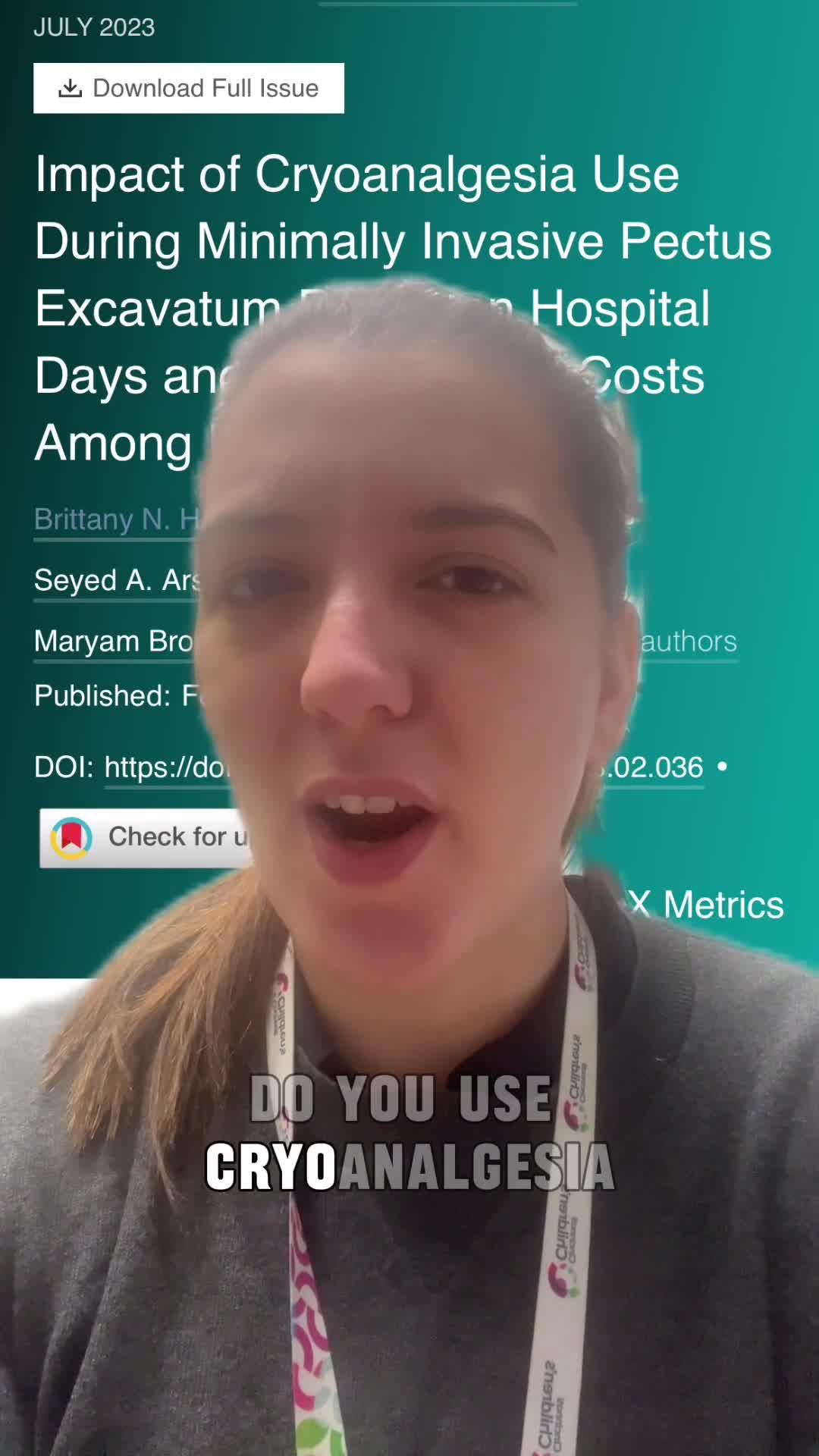 ▶
Ep 38 · 0:00
▶
Ep 38 · 0:00
host summary
Cecilia Gigena summarizing a resource: Do you use cryoalgesia for the NAS procedure in pectus excavatum repair?
↗
▶
Ep 38 · 0:11
host summary
Cecilia Gigena summarizing a resource: The study aimed to evaluate hospital cost and length of stay for patients undergoing minimally invasive repair of pectus excavatum plus cryoanalgesia
↗
▶
Ep 38 · 0:11
host summary
Cecilia Gigena summarizing a resource: The study was a retrospective review conducted in Texas
↗
▶
Ep 38 · 0:26
host summary
Cecilia Gigena summarizing a resource: Patients who underwent cryoanalgesia had significantly less length of stay compared to those without cryoanalgesia
↗
▶
Ep 38 · 0:26
host summary
Cecilia Gigena summarizing a resource: The study included 44 patients total, with 29 undergoing cryoanalgesia
↗
▶
Ep 38 · 0:26
host summary
Cecilia Gigena summarizing a resource: Patients who underwent cryoanalgesia had significantly lower complication rates compared to those without cryoanalgesia
↗
▶
Ep 38 · 0:39
host summary
Cecilia Gigena summarizing a resource: Patients who underwent cryoanalgesia had lower hospital costs than those without cryoanalgesia, though this difference was not statistically significant
↗
▶
Ep 38 · 0:48
host summary
Cecilia Gigena summarizing a resource: So it seems that cryo not only helps with pain management, but also can help with hospital cost.
↗
▶
Ep 38 · 0:48
host summary
Cecilia Gigena summarizing a resource: Cryoanalgesia helps with pain management in pectus excavatum repair
↗
▶
Ep 38 · 0:48
host summary
Cecilia Gigena summarizing a resource: Cryoanalgesia can help with hospital cost reduction in pectus excavatum repair
↗
Pectus Arcuatum a Pectus Unlike any Other
▶
Ep 40 · 0:00
host summary
Cecilia Gigena summarizing a resource: Have you ever treated a pectussarquatum like a pectus carinatum?
↗
▶
Ep 40 · 0:11
host summary
Cecilia Gigena summarizing a resource: The study is a multi-center retrospective study conducted in France describing pectus arcuatum
↗
▶
Ep 40 · 0:20
host summary
Cecilia Gigena summarizing a resource: The study included 34 patients with pectus arcuatum
↗
▶
Ep 40 · 0:20
host summary
Cecilia Gigena summarizing a resource: 47% of patients needed chest x-ray or CT scan to confirm the diagnosis of pectus arcuatum
↗
▶
Ep 40 · 0:29
host summary
Cecilia Gigena summarizing a resource: Scoliosis is an associated malformation seen with pectus arcuatum
↗
▶
Ep 40 · 0:29
host summary
Cecilia Gigena summarizing a resource: Noonan syndrome is an associated malformation seen with pectus arcuatum
↗
▶
Ep 40 · 0:29
host summary
Cecilia Gigena summarizing a resource: 35% of pectus arcuatum patients were associated with a malformation
↗
▶
Ep 40 · 0:29
host summary
Cecilia Gigena summarizing a resource: The best treatment for pectus arcuatum was surgical correction that included a sternotomy
↗
▶
Ep 40 · 0:41
host summary
Cecilia Gigena summarizing a resource: Pectus arcuatum should not be confused with pectus carinatum as they are different conditions
↗
▶
Ep 40 · 0:43
host summary
Cecilia Gigena summarizing a resource: Do not confusefectus or quatum with thefectus carinatum.
↗
Journal of Pediatric Surgery Article Review: July 2023, PAPS Issue
 ▶
Ep 41 · 1:39
▶
Ep 41 · 1:39
host summary
Cecilia Gigena summarizing the discussion: The cryoanalgesia study compared patients from 2011 to 2021, with 29 patients receiving cryoanalgesia and 15 not receiving it.
↗
▶
Ep 41 · 1:39
host summary
Cecilia Gigena summarizing the discussion: The cryoanalgesia study compared patients from 2011 to 2021, with 29 patients receiving cryoanalgesia and 15 not receiving it.
↗
▶
Ep 41 · 1:48
host summary
Cecilia Gigena summarizing the discussion: Patients who received cryoanalgesia had shorter hospital stays: 3.0 days versus 5.4 days for those without cryoanalgesia.
↗
▶
Ep 41 · 1:48
host summary
Cecilia Gigena summarizing the discussion: Patients who received cryoanalgesia had shorter hospital stays: 3.0 days versus 5.4 days for those without cryoanalgesia.
↗
▶
Ep 41 · 2:00
host summary
Cecilia Gigena summarizing the discussion: Hospital costs were slightly lower (less than $1000 difference) in patients who received cryoanalgesia despite the expensive equipment.
↗
▶
Ep 41 · 2:00
host summary
Cecilia Gigena summarizing the discussion: Hospital costs were slightly lower (less than $1000 difference) in patients who received cryoanalgesia despite the expensive equipment.
↗
▶
Ep 41 · 6:51
host summary
Cecilia Gigena summarizing the discussion: The pilonidal disease cohort included 21 patients with skin types 1-2, 156 with skin types 3-4, and 21 with skin types 5-6, with approximately 151 having dark colored hair.
↗
▶
Ep 41 · 6:51
host summary
Cecilia Gigena summarizing the discussion: The pilonidal disease cohort included 21 patients with skin types 1-2, 156 with skin types 3-4, and 21 with skin types 5-6, with approximately 151 having dark colored hair.
↗
▶
Ep 41 · 7:34
host summary
Cecilia Gigena summarizing the discussion: To reach 75% hair reduction requires a mean of 4.8 to 6.8 laser ablation sessions depending on skin and hair characteristics.
↗
▶
Ep 41 · 7:34
host summary
Cecilia Gigena summarizing the discussion: To reach 75% hair reduction requires a mean of 4.8 to 6.8 laser ablation sessions depending on skin and hair characteristics.
↗
▶
Ep 41 · 7:47
host summary
Cecilia Gigena summarizing the discussion: Dark hair and skin types 5-6 were associated with higher recurrence rates in pilonidal disease after laser hair reduction.
↗
▶
Ep 41 · 7:47
host summary
Cecilia Gigena summarizing the discussion: The overall recurrence rate for pilonidal disease after laser hair reduction was 6%.
↗
▶
Ep 41 · 7:47
host summary
Cecilia Gigena summarizing the discussion: The overall recurrence rate for pilonidal disease after laser hair reduction was 6%.
↗
▶
Ep 41 · 7:47
host summary
Cecilia Gigena summarizing the discussion: Dark hair and skin types 5-6 were associated with higher recurrence rates in pilonidal disease after laser hair reduction.
↗
Journal of Pediatric Surgery Article Review: September 2023
▶
Ep 42 · 1:43
host summary
Cecilia Gigena summarizing the discussion: In the pectus arcuatum study, 34 patients were reviewed with a mean age of 10 years, and 47% required X-ray or CT scan for diagnosis.
↗
▶
Ep 42 · 7:41
host summary
Cecilia Gigena summarizing the discussion: ERAS protocols significantly reduce intraoperative fluids needed and postoperative opiate use in pediatric colorectal surgery.
↗
▶
Ep 42 · 7:55
host summary
Cecilia Gigena summarizing the discussion: Time to first oral intake and time for complete nutrition was less in patients managed with ERAS protocols.
↗
Journal of Pediatric Surgery Article Review: Q1 (Jan-Mar) 2024
▶
Ep 44 · 2:45
host summary
Cecilia Gigena summarizing the discussion: The appendicitis study had 185 patients in the home antibiotic group and 121 patients in the no home antibiotic group.
↗
▶
Ep 44 · 2:45
host summary
Cecilia Gigena summarizing the discussion: The appendicitis study had 185 patients in the home antibiotic group and 121 patients in the no home antibiotic group.
↗
▶
Ep 44 · 2:55
host summary
Cecilia Gigena summarizing the discussion: There was no significant difference in deep organ space infection requiring intervention between home antibiotic and no home antibiotic groups for complicated appendicitis.
↗
▶
Ep 44 · 2:55
host summary
Cecilia Gigena summarizing the discussion: There was no significant difference in deep organ space infection requiring intervention between home antibiotic and no home antibiotic groups for complicated appendicitis.
↗
▶
Ep 44 · 3:03
host summary
Cecilia Gigena summarizing the discussion: There was no difference in length of stay between home antibiotic and no home antibiotic groups for complicated appendicitis.
↗
▶
Ep 44 · 3:03
host summary
Cecilia Gigena summarizing the discussion: There was no difference in length of stay between home antibiotic and no home antibiotic groups for complicated appendicitis.
↗
▶
Ep 44 · 5:43
host summary
Cecilia Gigena summarizing the discussion: Type C esophageal atresia is the most common type and means esophageal atresia with a distal fistula; type A means pure esophageal atresia with no fistula to the trachea.
↗
▶
Ep 44 · 5:43
host summary
Cecilia Gigena summarizing the discussion: Type C esophageal atresia is the most common type and means esophageal atresia with a distal fistula; type A means pure esophageal atresia with no fistula to the trachea.
↗
▶
Ep 44 · 8:47
host summary
Cecilia Gigena summarizing the discussion: The pectus study is a prospective cohort study from a single center in Phoenix aiming to quantify long-term hyperesthesia and neuropathic pain after minimally invasive repair of pectus excavatum with cryoablation.
↗
▶
Ep 44 · 8:47
host summary
Cecilia Gigena summarizing the discussion: The pectus study is a prospective cohort study from a single center in Phoenix aiming to quantify long-term hyperesthesia and neuropathic pain after minimally invasive repair of pectus excavatum with cryoablation.
↗
▶
Ep 44 · 9:04
host summary
Cecilia Gigena summarizing the discussion: The pectus study selected patients under 21 years of age who presented for bar removal between November 2021 and May 2023.
↗
▶
Ep 44 · 9:04
host summary
Cecilia Gigena summarizing the discussion: The pectus study selected patients under 21 years of age who presented for bar removal between November 2021 and May 2023.
↗
▶
Ep 44 · 9:15
host summary
Cecilia Gigena summarizing the discussion: Testing for cold and soft touch and pinprick was performed just before bar removal.
↗
▶
Ep 44 · 9:15
host summary
Cecilia Gigena summarizing the discussion: Testing for cold and soft touch and pinprick was performed just before bar removal.
↗
▶
Ep 44 · 9:25
host summary
Cecilia Gigena summarizing the discussion: The pectus study enrolled 47 patients with a median bar dwell time of approximately 2.9 years.
↗
▶
Ep 44 · 9:25
host summary
Cecilia Gigena summarizing the discussion: The pectus study enrolled 47 patients with a median bar dwell time of approximately 2.9 years.
↗
▶
Ep 44 · 9:41
host summary
Cecilia Gigena summarizing the discussion: Patients had a median of 2 bars placed, and almost 81% were secured with pericostal sutures.
↗
▶
Ep 44 · 9:41
host summary
Cecilia Gigena summarizing the discussion: Patients had a median of 2 bars placed, and almost 81% were secured with pericostal sutures.
↗
▶
Ep 44 · 9:51
host summary
Cecilia Gigena summarizing the discussion: Almost half of the pectus patients had some degree of hypoesthesia, with T5 being the most common dermatome affected.
↗
▶
Ep 44 · 9:51
host summary
Cecilia Gigena summarizing the discussion: Almost half of the pectus patients had some degree of hypoesthesia, with T5 being the most common dermatome affected.
↗
▶
Ep 44 · 10:00
host summary
Cecilia Gigena summarizing the discussion: The area with hypoesthesia was less than 5% of the entire surface that was treated with cryo.
↗
▶
Ep 44 · 10:00
host summary
Cecilia Gigena summarizing the discussion: The area with hypoesthesia was less than 5% of the entire surface that was treated with cryo.
↗
▶
Ep 44 · 10:18
host summary
Cecilia Gigena summarizing the discussion: Neuropathic symptoms were identified by only 13% of pectus patients, and none required treatment.
↗
▶
Ep 44 · 10:18
host summary
Cecilia Gigena summarizing the discussion: Neuropathic symptoms were identified by only 13% of pectus patients, and none required treatment.
↗
▶
Ep 44 · 10:26
host summary
Cecilia Gigena summarizing the discussion: In the long term after minimally invasive repair of pectus excavatum with cryo, many patients will experience some chest wall hypoesthesia limited to one or two dermatomes, and chronic symptomatic neuropathic pain is very rare.
↗
▶
Ep 44 · 10:26
host summary
Cecilia Gigena summarizing the discussion: In the long term after minimally invasive repair of pectus excavatum with cryo, many patients will experience some chest wall hypoesthesia limited to one or two dermatomes, and chronic symptomatic neuropathic pain is very rare.
↗
▶
Ep 44 · 11:00
host summary
Cecilia Gigena summarizing the discussion: Pericostal sutures used to secure bars can damage nerves.
↗
▶
Ep 44 · 11:00
host summary
Cecilia Gigena summarizing the discussion: Pericostal sutures used to secure bars can damage nerves.
↗
Quick Literature Updates Ep 24
▶
Ep 54 · 3:34
host summary
Cecilia Gigena summarizes what Dr. Carlos Colunga said: The Rao et al. study is a multi-center retrospective study done in the US from 2018 to 2022.
↗
▶
Ep 54 · 3:34
host summary
Cecilia Gigena summarizes what Dr. Carlos Colunga said: The Rao study compared patients with suspected choledocholithiasis who underwent transcystic laparoscopic common bile duct exploration versus those who underwent ERCP first.
↗
▶
Ep 54 · 3:53
host summary
Cecilia Gigena summarizes what Dr. Carlos Colunga said: The Rao study included 252 patients total: 156 in the transcystic laparoscopic common bile duct exploration group and 96 in the ERCP-first group.
↗
▶
Ep 54 · 4:02
host summary
Cecilia Gigena summarizes what Dr. Carlos Colunga said: Patients who underwent transcystic laparoscopic common bile duct exploration had significantly less complication rates compared to ERCP-first patients.
↗
▶
Ep 54 · 4:02
host summary
Cecilia Gigena summarizes what Dr. Carlos Colunga said: Patients who underwent transcystic laparoscopic common bile duct exploration had lower length of stay compared to ERCP-first patients.
↗
▶
Ep 54 · 4:16
host summary
Cecilia Gigena summarizes what Dr. Carlos Colunga said: Attempting a transcystic laparoscopic common bile duct exploration may benefit pediatric choledocholithiasis patients.
↗
Update Course Rewind: Pectus Excavatum 2021
 ▶
Ep 55 · 1:21
▶
Ep 55 · 1:21
host summary
Cecilia Gigena summarizing a resource: We were enrolling in this study. We had about 30 patients in each group when we tried the first cryotherapy. And when that patient went home on post-op day one, equipoise was lost. Once you see it, it's sort of a different game.
↗
▶
Ep 55 · 1:21
host summary
Cecilia Gigena summarizing a resource: After implementing cryoanalgesia, the first patient went home on post-operative day one, leading Dr. St. Peter to discontinue enrollment in the epidural/PCA comparison trial
↗
▶
Ep 55 · 2:33
host summary
Cecilia Gigena summarizing a resource: With cryoanalgesia, length of stay decreased from four days (baseline) to one day
↗
▶
Ep 55 · 2:33
host summary
Cecilia Gigena summarizing a resource: What we saw there is the length of stay where we just couldn't get below four days. All of a sudden became one.
↗
▶
Ep 55 · 2:52
host summary
Cecilia Gigena summarizing a resource: I agree with Sean. It works. I mean, it is great. One day. Yeah, no. So what I'm concerned about is that there are no long-term studies. But I believe we just don't know. We don't have the long-term data.
↗
▶
Ep 55 · 2:52
host summary
Cecilia Gigena summarizing a resource: Dr. Garcia expressed concern that there are no long-term studies of cryoanalgesia and potential for chronic neuropathic pain
↗
▶
Ep 55 · 3:50
host summary
Cecilia Gigena summarizing a resource: Dr. Garcia's hospital uses erector spinae catheters placed by the pain team with ultrasound guidance, positioned juxtaposed to but not in the vertebral space
↗
▶
Ep 55 · 4:08
host summary
Cecilia Gigena summarizing a resource: With erector spinae catheters, hospital stay is two days, catheters remain in place for five days total (three days at home on automated pump), and families remove catheters at home on day five
↗
▶
Ep 55 · 4:52
host summary
Cecilia Gigena summarizing a resource: I was a cryo skeptic. My biggest issues with it were the added time. The other is concerned about the neuralgia and the complications that I'd heard about. And I will tell you that it took me about four cases to realize, because most of our patients went home on day two or three. But it's not just when they go home. It's how they feel when they go home. And the cryo has been unbelievable. I mean, I feel bad that I waited so long.
↗
▶
Ep 55 · 4:52
host summary
Cecilia Gigena summarizing a resource: Dr. Rothenberg initially had concerns about cryoanalgesia including added operative time and risk of neuralgia, but after four cases observed that patients not only went home earlier but felt significantly better at discharge
↗
▶
Ep 55 · 5:34
host summary
Cecilia Gigena summarizing a resource: Dr. Ponsky's multimodal regimen includes preoperative counseling, gabapentin pre and postoperatively, methadone, clonidine, bowel regimen medications, and antiemetics
↗
▶
Ep 55 · 6:15
host summary
Cecilia Gigena summarizing a resource: At Nebraska where Dr. Rayner practices, length of stay is under two days and patients are off opioids by one week using multimodal pain control
↗
▶
Ep 55 · 7:35
host summary
Cecilia Gigena summarizing a resource: Computational modeling by physics-minded surgeons showed that shorter flat bars create more pressure on the sternum compared to traditional U-shaped bars, potentially increasing stability
↗
▶
Ep 55 · 8:58
host summary
Cecilia Gigena summarizing a resource: Techniques to avoid cardiac injury during introducer passage include thoracoscopy, sternal elevator, vacuum bell in the operating room, and sub-xiphoid incision
↗
▶
Ep 55 · 8:58
host summary
Cecilia Gigena summarizing a resource: Thoracoscopy or sternal elevator or vacuum bell in the operating room or sub-xiphoid incision, the idea is to not injure the heart. So whatever technique helps you do that, I think is the technique you ought to use.
↗
Update Course Rewind: Pectus Excavatum 2021
 ▶
Ep 57 · 1:21
▶
Ep 57 · 1:21
host summary
Cecilia Gigena summarizing a resource: Once you see it, it's sort of a different game.
↗
▶
Ep 57 · 1:21
host summary
Cecilia Gigena summarizing a resource: Once you see it, it's sort of a different game.
↗
▶
Ep 57 · 2:07
host summary
Cecilia Gigena summarizing a resource: The cryoanalgesia technique involves two minutes of freezing per rib, applied to ribs four through seven; ribs eight and below should not be treated due to risk of abdominal wall paralysis.
↗
▶
Ep 57 · 2:07
host summary
Cecilia Gigena summarizing a resource: The cryoanalgesia technique involves two minutes of freezing per rib, applied to ribs four through seven; ribs eight and below should not be treated due to risk of abdominal wall paralysis.
↗
▶
Ep 57 · 2:43
host summary
Cecilia Gigena summarizing a resource: Cryoanalgesia dramatically reduced median morphine equivalents compared to epidural/PCA approaches.
↗
▶
Ep 57 · 2:43
host summary
Cecilia Gigena summarizing a resource: Cryoanalgesia dramatically reduced median morphine equivalents compared to epidural/PCA approaches.
↗
▶
Ep 57 · 3:14
host summary
Cecilia Gigena summarizing a resource: Medical devices and implants are not required to undergo clinical trials before market introduction, unlike medications which require FDA clinical trials with long-term results.
↗
▶
Ep 57 · 3:14
host summary
Cecilia Gigena summarizing a resource: Medical devices and implants are not required to undergo clinical trials before market introduction, unlike medications which require FDA clinical trials with long-term results.
↗
▶
Ep 57 · 4:08
host summary
Cecilia Gigena summarizing a resource: With erector spinae catheters, hospital stay is two days, catheters remain in place for five days on an automated pump, and families remove the catheters at home on the third day.
↗
▶
Ep 57 · 4:08
host summary
Cecilia Gigena summarizing a resource: Erector spinae catheters are placed by the pain team with ultrasound guidance in a position juxtaposed to but not within the vertebral space.
↗
▶
Ep 57 · 4:08
host summary
Cecilia Gigena summarizing a resource: Erector spinae catheters are placed by the pain team with ultrasound guidance in a position juxtaposed to but not within the vertebral space.
↗
▶
Ep 57 · 4:08
host summary
Cecilia Gigena summarizing a resource: With erector spinae catheters, hospital stay is two days, catheters remain in place for five days on an automated pump, and families remove the catheters at home on the third day.
↗
▶
Ep 57 · 4:30
host summary
Cecilia Gigena summarizing a resource: It's not just when they go home. It's how they feel when they go home. And the cryo has been unbelievable. I mean, I feel bad that I waited so long.
↗
▶
Ep 57 · 4:30
host summary
Cecilia Gigena summarizing a resource: Cryoanalgesia changed not just discharge timing but how patients feel at discharge, with a qualitatively different recovery experience.
↗
▶
Ep 57 · 4:30
host summary
Cecilia Gigena summarizing a resource: I accept Vic's concerns and criticisms. And I agree, perhaps, you know, that we do need to have a registry for this. But it has totally changed the management of these patients.
↗
▶
Ep 57 · 4:30
host summary
Cecilia Gigena summarizing a resource: Cryoanalgesia changed not just discharge timing but how patients feel at discharge, with a qualitatively different recovery experience.
↗
▶
Ep 57 · 4:30
host summary
Cecilia Gigena summarizing a resource: I accept Vic's concerns and criticisms. And I agree, perhaps, you know, that we do need to have a registry for this. But it has totally changed the management of these patients.
↗
▶
Ep 57 · 4:30
host summary
Cecilia Gigena summarizing a resource: It's not just when they go home. It's how they feel when they go home. And the cryo has been unbelievable. I mean, I feel bad that I waited so long.
↗
▶
Ep 57 · 5:34
host summary
Cecilia Gigena summarizing a resource: Multimodal pain therapy components include Tylenol, NSAIDs, precedex for gentle wake-up, dexamethasone for post-anesthetic nausea, ketamine when used by experienced practitioners, and support from child life specialists and physical therapists.
↗
▶
Ep 57 · 5:34
host summary
Cecilia Gigena summarizing a resource: Multimodal pain therapy components include Tylenol, NSAIDs, precedex for gentle wake-up, dexamethasone for post-anesthetic nausea, ketamine when used by experienced practitioners, and support from child life specialists and physical therapists.
↗
▶
Ep 57 · 6:26
host summary
Cecilia Gigena summarizing a resource: Bar flippage typically occurs early and results from the bar sitting in an incorrect intercostal space, poor positioning, inadequate wrapping, or insufficient securing; proper initial bar positioning is more important than securing technique.
↗
▶
Ep 57 · 6:26
host summary
Cecilia Gigena summarizing a resource: Bar flippage typically occurs early and results from the bar sitting in an incorrect intercostal space, poor positioning, inadequate wrapping, or insufficient securing; proper initial bar positioning is more important than securing technique.
↗
▶
Ep 57 · 8:01
host summary
Cecilia Gigena summarizing a resource: Sternal elevator use varies by case complexity; one center uses it in approximately 10% of cases (younger patients with adequate thoracoscopic visualization), while it is particularly valuable in deep, stiff pectus cases to reduce tissue damage.
↗
▶
Ep 57 · 8:01
host summary
Cecilia Gigena summarizing a resource: Some centers use sternal elevator in every pectus case to eliminate guesswork and ensure consistent entry and exit at the same intercostal space.
↗
▶
Ep 57 · 8:01
host summary
Cecilia Gigena summarizing a resource: I think one of the things that Steve mentioned is being able to go in and out at the same inner space, I think is important.
↗
▶
Ep 57 · 8:01
host summary
Cecilia Gigena summarizing a resource: I think one of the things that Steve mentioned is being able to go in and out at the same inner space, I think is important.
↗
▶
Ep 57 · 8:01
host summary
Cecilia Gigena summarizing a resource: Sternal elevator use varies by case complexity; one center uses it in approximately 10% of cases (younger patients with adequate thoracoscopic visualization), while it is particularly valuable in deep, stiff pectus cases to reduce tissue damage.
↗
▶
Ep 57 · 8:01
host summary
Cecilia Gigena summarizing a resource: Some centers use sternal elevator in every pectus case to eliminate guesswork and ensure consistent entry and exit at the same intercostal space.
↗
▶
Ep 57 · 9:20
host summary
Cecilia Gigena summarizing a resource: Introducer passage direction (left-to-right versus right-to-left) is likely surgeon preference and does not make significant difference when the substernal space is well dissected and visualization is clear.
↗
▶
Ep 57 · 9:20
host summary
Cecilia Gigena summarizing a resource: Passing the introducer from left chest to right chest is preferred by some surgeons because right-to-left passage directs the instrument toward the ventricle during the crossing maneuver.
↗
▶
Ep 57 · 9:20
host summary
Cecilia Gigena summarizing a resource: Passing the introducer from left chest to right chest is preferred by some surgeons because right-to-left passage directs the instrument toward the ventricle during the crossing maneuver.
↗
▶
Ep 57 · 9:20
host summary
Cecilia Gigena summarizing a resource: Introducer passage direction (left-to-right versus right-to-left) is likely surgeon preference and does not make significant difference when the substernal space is well dissected and visualization is clear.
↗
Update Course Rewind: Pectus Excavatum 2021
 ▶
Ep 58 · 1:02
▶
Ep 58 · 1:02
host summary
Cecilia Gigena summarizes what Dr. Todd Ponsky said: Dr. St. Peter's hospital completed a randomized trial of 110 patients comparing epidural and PCA for pectus pain control, and epidurals did not show superior results.
↗
▶
Ep 58 · 1:02
host summary
Cecilia Gigena summarizes what Dr. Todd Ponsky said: We of course struggled with postoperative pain management as everybody did. And we had completed a randomized trial, 110 patients, to epidural and PCA. And in that study, the epidurals didn't really drop off.
↗
▶
Ep 58 · 1:02
host summary
Cecilia Gigena summarizes what Dr. Todd Ponsky said: We of course struggled with postoperative pain management as everybody did. And we had completed a randomized trial, 110 patients, to epidural and PCA. And in that study, the epidurals didn't really drop off.
↗
▶
Ep 58 · 1:02
host summary
Cecilia Gigena summarizes what Dr. Todd Ponsky said: Dr. St. Peter's hospital completed a randomized trial of 110 patients comparing epidural and PCA for pectus pain control, and epidurals did not show superior results.
↗
▶
Ep 58 · 1:21
host summary
Cecilia Gigena summarizes what Dr. Todd Ponsky said: We were enrolling in this study. We had about 30 patients in each group when we tried the first cryotherapy. And when that patient went home on post-op day one, equipoise was lost. Once you see it, it's sort of a different game.
↗
▶
Ep 58 · 1:21
host summary
Cecilia Gigena summarizes what Dr. Todd Ponsky said: After trying cryoanalgesia with the first patient who went home on post-op day one, Dr. St. Peter's team lost equipoise and stopped enrolling patients in the epidural/PCA comparison study.
↗
▶
Ep 58 · 1:21
host summary
Cecilia Gigena summarizes what Dr. Todd Ponsky said: After trying cryoanalgesia with the first patient who went home on post-op day one, Dr. St. Peter's team lost equipoise and stopped enrolling patients in the epidural/PCA comparison study.
↗
▶
Ep 58 · 1:21
host summary
Cecilia Gigena summarizes what Dr. Todd Ponsky said: We were enrolling in this study. We had about 30 patients in each group when we tried the first cryotherapy. And when that patient went home on post-op day one, equipoise was lost. Once you see it, it's sort of a different game.
↗
▶
Ep 58 · 1:56
host summary
Cecilia Gigena summarizes what Dr. Todd Ponsky said: Cryoanalgesia uses cold temperatures to cause a conduction block that interrupts pain impulses to the brain.
↗
▶
Ep 58 · 1:56
host summary
Cecilia Gigena summarizes what Dr. Todd Ponsky said: Cryoanalgesia uses cold temperatures to cause a conduction block that interrupts pain impulses to the brain.
↗
▶
Ep 58 · 2:09
host summary
Cecilia Gigena summarizes what Dr. Todd Ponsky said: We currently put the camera on the top and the probe through the bottom. But you can see how they're separated. One's an inner space above. That just keeps them out of each other's way. And you literally just count down to the fourth rib and then freeze underneath it. It's two minutes per rib. We do four through seven. You're not supposed to go eight or below because you can get some abdominal wall paralysis.
↗
▶
Ep 58 · 2:09
host summary
Cecilia Gigena summarizes what Dr. Todd Ponsky said: The cryoanalgesia technique involves freezing underneath ribs four through seven for two minutes per rib; ribs eight and below should not be treated due to risk of abdominal wall paralysis.
↗
▶
Ep 58 · 2:09
host summary
Cecilia Gigena summarizes what Dr. Todd Ponsky said: We currently put the camera on the top and the probe through the bottom. But you can see how they're separated. One's an inner space above. That just keeps them out of each other's way. And you literally just count down to the fourth rib and then freeze underneath it. It's two minutes per rib. We do four through seven. You're not supposed to go eight or below because you can get some abdominal wall paralysis.
↗
▶
Ep 58 · 2:09
host summary
Cecilia Gigena summarizes what Dr. Todd Ponsky said: The cryoanalgesia technique involves freezing underneath ribs four through seven for two minutes per rib; ribs eight and below should not be treated due to risk of abdominal wall paralysis.
↗
▶
Ep 58 · 2:33
host summary
Cecilia Gigena summarizes what Dr. Todd Ponsky said: After implementing cryoanalgesia, Dr. St. Peter's length of stay decreased from four days (which they could not get below previously) to one day.
↗
▶
Ep 58 · 2:33
host summary
Cecilia Gigena summarizes what Dr. Todd Ponsky said: What we saw there is the length of stay where we just couldn't get below four days. All of a sudden became one.
↗
▶
Ep 58 · 2:33
host summary
Cecilia Gigena summarizes what Dr. Todd Ponsky said: What we saw there is the length of stay where we just couldn't get below four days. All of a sudden became one.
↗
▶
Ep 58 · 2:33
host summary
Cecilia Gigena summarizes what Dr. Todd Ponsky said: After implementing cryoanalgesia, Dr. St. Peter's length of stay decreased from four days (which they could not get below previously) to one day.
↗
▶
Ep 58 · 2:43
host summary
Cecilia Gigena summarizes what Dr. Todd Ponsky said: Cryoanalgesia dramatically reduced median morphine equivalents compared to previous pain control methods at Dr. St. Peter's hospital.
↗
▶
Ep 58 · 2:43
host summary
Cecilia Gigena summarizes what Dr. Todd Ponsky said: Cryoanalgesia dramatically reduced median morphine equivalents compared to previous pain control methods at Dr. St. Peter's hospital.
↗
▶
Ep 58 · 2:52
host summary
Cecilia Gigena summarizes what Dr. Todd Ponsky said: I agree with Sean. It works. I mean, it is great. One day. Yeah, no. So what I'm concerned about is that there are no long-term studies. But I believe we just don't know. We don't have the long-term data.
↗
▶
Ep 58 · 2:52
host summary
Cecilia Gigena summarizes what Dr. Todd Ponsky said: Dr. Garcia acknowledges cryoanalgesia works but is concerned about lack of long-term studies and unknown potential for chronic neuropathic pain.
↗
▶
Ep 58 · 2:52
host summary
Cecilia Gigena summarizes what Dr. Todd Ponsky said: Dr. Garcia acknowledges cryoanalgesia works but is concerned about lack of long-term studies and unknown potential for chronic neuropathic pain.
↗
▶
Ep 58 · 2:52
host summary
Cecilia Gigena summarizes what Dr. Todd Ponsky said: I agree with Sean. It works. I mean, it is great. One day. Yeah, no. So what I'm concerned about is that there are no long-term studies. But I believe we just don't know. We don't have the long-term data.
↗
▶
Ep 58 · 3:14
host summary
Cecilia Gigena summarizes what Dr. Todd Ponsky said: Medical devices and techniques are not required to undergo clinical trials before introduction to market, unlike medications which require FDA clinical trials with long-term results.
↗
▶
Ep 58 · 3:14
host summary
Cecilia Gigena summarizes what Dr. Todd Ponsky said: Medical devices and techniques are not required to undergo clinical trials before introduction to market, unlike medications which require FDA clinical trials with long-term results.
↗
▶
Ep 58 · 3:50
host summary
Cecilia Gigena summarizes what Dr. Todd Ponsky said: About 100 patients. Looking to Sean's point, as far as, and this was a comparison between epidurals as well as, not perivertebral, but erector spinae catheter.
↗
▶
Ep 58 · 3:50
host summary
Cecilia Gigena summarizes what Dr. Todd Ponsky said: About 100 patients. Looking to Sean's point, as far as, and this was a comparison between epidurals as well as, not perivertebral, but erector spinae catheter.
↗
▶
Ep 58 · 3:50
host summary
Cecilia Gigena summarizes what Dr. Todd Ponsky said: Dr. Garcia's hospital uses erector spinae catheters placed by the pain team with ultrasound guidance, which stay in for five days with hospital stay of two days and catheter removal by family on day three at home.
↗
▶
Ep 58 · 3:50
host summary
Cecilia Gigena summarizes what Dr. Todd Ponsky said: Dr. Garcia's hospital uses erector spinae catheters placed by the pain team with ultrasound guidance, which stay in for five days with hospital stay of two days and catheter removal by family on day three at home.
↗
▶
Ep 58 · 4:08
host summary
Cecilia Gigena summarizes what Dr. Todd Ponsky said: Erectospinae catheters, they are placed by the pain team with ultrasound guidance. They're not in the vertebral space, but they are juxtaposed to it. Those catheters stay in for five days. The hospital stays two days. Third day, while they're outside, the catheters are pulled out by the family. It is on a pump. It's automated.
↗
▶
Ep 58 · 4:08
host summary
Cecilia Gigena summarizes what Dr. Todd Ponsky said: Erectospinae catheters, they are placed by the pain team with ultrasound guidance. They're not in the vertebral space, but they are juxtaposed to it. Those catheters stay in for five days. The hospital stays two days. Third day, while they're outside, the catheters are pulled out by the family. It is on a pump. It's automated.
↗
▶
Ep 58 · 4:30
host summary
Cecilia Gigena summarizes what Dr. Todd Ponsky said: Our hospital stays are two days. We've been able to reduce the opioid requirements, not only in the hospital, but also outside of the hospital. So, I'm, from the perspective, at least with our experience, that we do have an alternative. Is it going to be one day? No. But is it certainly much less than the four or five days that we saw with epidurals? Absolutely, yes.
↗
▶
Ep 58 · 4:30
host summary
Cecilia Gigena summarizes what Dr. Todd Ponsky said: Dr. Garcia's hospital achieved two-day hospital stays and reduced opioid requirements both in-hospital and post-discharge using erector spinae catheters.
↗
▶
Ep 58 · 4:30
host summary
Cecilia Gigena summarizes what Dr. Todd Ponsky said: Dr. Garcia's hospital achieved two-day hospital stays and reduced opioid requirements both in-hospital and post-discharge using erector spinae catheters.
↗
▶
Ep 58 · 4:30
host summary
Cecilia Gigena summarizes what Dr. Todd Ponsky said: Our hospital stays are two days. We've been able to reduce the opioid requirements, not only in the hospital, but also outside of the hospital. So, I'm, from the perspective, at least with our experience, that we do have an alternative. Is it going to be one day? No. But is it certainly much less than the four or five days that we saw with epidurals? Absolutely, yes.
↗
▶
Ep 58 · 4:55
host summary
Cecilia Gigena summarizes what Dr. Todd Ponsky said: I was a cryo skeptic. My biggest issues with it were the added time. The other is concerned about the neuralgia and the complications that I'd heard about. And I will tell you that it took me about four cases to realize, because most of our patients went home on day two or three. But it's not just when they go home. It's how they feel when they go home. And the cryo has been unbelievable. I mean, I feel bad that I waited so long.
↗
▶
Ep 58 · 4:55
host summary
Cecilia Gigena summarizes what Dr. Todd Ponsky said: Dr. Rothenberg was initially a cryo skeptic due to concerns about added time and neuralgia complications, but after four cases realized the benefit was not just early discharge but how patients feel at discharge.
↗
▶
Ep 58 · 4:55
host summary
Cecilia Gigena summarizes what Dr. Todd Ponsky said: Dr. Rothenberg was initially a cryo skeptic due to concerns about added time and neuralgia complications, but after four cases realized the benefit was not just early discharge but how patients feel at discharge.
↗
▶
Ep 58 · 4:55
host summary
Cecilia Gigena summarizes what Dr. Todd Ponsky said: I was a cryo skeptic. My biggest issues with it were the added time. The other is concerned about the neuralgia and the complications that I'd heard about. And I will tell you that it took me about four cases to realize, because most of our patients went home on day two or three. But it's not just when they go home. It's how they feel when they go home. And the cryo has been unbelievable. I mean, I feel bad that I waited so long.
↗
▶
Ep 58 · 5:40
host summary
Cecilia Gigena summarizes what Dr. Todd Ponsky said: Dr. Wagner recommends multimodal pain control including Tylenol, NSAIDs, precedex for gentle wake-up, dexamethasone for post-anesthetic nausea, ketamine to avoid opioids, and support from child life specialists and physical therapists.
↗
▶
Ep 58 · 5:40
host summary
Cecilia Gigena summarizes what Dr. Todd Ponsky said: I accept Vic's concerns and criticisms. And I agree, perhaps, you know, that we do need to have a registry for this. But it has totally changed the management of these patients.
↗
▶
Ep 58 · 5:40
host summary
Cecilia Gigena summarizes what Dr. Todd Ponsky said: I accept Vic's concerns and criticisms. And I agree, perhaps, you know, that we do need to have a registry for this. But it has totally changed the management of these patients.
↗
▶
Ep 58 · 5:40
host summary
Cecilia Gigena summarizes what Dr. Todd Ponsky said: Dr. Wagner recommends multimodal pain control including Tylenol, NSAIDs, precedex for gentle wake-up, dexamethasone for post-anesthetic nausea, ketamine to avoid opioids, and support from child life specialists and physical therapists.
↗
▶
Ep 58 · 6:10
host summary
Cecilia Gigena summarizes what Dr. Todd Ponsky said: Dr. Ponsky's multimodal therapy regimen includes preoperative counseling, gabapentin pre and postoperatively, methadone, clonidine, bowel regimen medications, and antiemetics.
↗
▶
Ep 58 · 6:10
host summary
Cecilia Gigena summarizes what Dr. Todd Ponsky said: Dr. Ponsky's multimodal therapy regimen includes preoperative counseling, gabapentin pre and postoperatively, methadone, clonidine, bowel regimen medications, and antiemetics.
↗
▶
Ep 58 · 6:20
host summary
Cecilia Gigena summarizes what Dr. Todd Ponsky said: At the Nebraska program where Dr. Rayner trained, length of stay is under two days and patients are off opioids by one week using multimodal pain control.
↗
▶
Ep 58 · 6:20
host summary
Cecilia Gigena summarizes what Dr. Todd Ponsky said: At the Nebraska program where Dr. Rayner trained, length of stay is under two days and patients are off opioids by one week using multimodal pain control.
↗
▶
Ep 58 · 6:35
host summary
Cecilia Gigena summarizes what Dr. Todd Ponsky said: Bar flipping typically occurs early and is due to surgical factors: bar sitting in wrong intercostal space, bad positioning, insufficient wrapping, or inadequate securing.
↗
▶
Ep 58 · 6:35
host summary
Cecilia Gigena summarizes what Dr. Todd Ponsky said: Bar flipping typically occurs early and is due to surgical factors: bar sitting in wrong intercostal space, bad positioning, insufficient wrapping, or inadequate securing.
↗
▶
Ep 58 · 7:30
host summary
Cecilia Gigena summarizes what Dr. Todd Ponsky said: Computational modeling by physics-minded surgeons showed that shorter flat bars create more pressure on the sternum compared to traditional U-shaped bars, making them more stable.
↗
▶
Ep 58 · 7:30
host summary
Cecilia Gigena summarizes what Dr. Todd Ponsky said: Computational modeling by physics-minded surgeons showed that shorter flat bars create more pressure on the sternum compared to traditional U-shaped bars, making them more stable.
↗
▶
Ep 58 · 8:20
host summary
Cecilia Gigena summarizes what Dr. Todd Ponsky said: Dr. Wolkine uses sternal elevator in about 10% of cases at Akron Children's, primarily in younger patients where thoracoscopy provides adequate visualization.
↗
▶
Ep 58 · 8:20
host summary
Cecilia Gigena summarizes what Dr. Todd Ponsky said: Dr. Wolkine uses sternal elevator in about 10% of cases at Akron Children's, primarily in younger patients where thoracoscopy provides adequate visualization.
↗
▶
Ep 58 · 8:40
host summary
Cecilia Gigena summarizes what Dr. Todd Ponsky said: Sternal elevation in deep stiff pectus cases allows less tissue damage and better repair.
↗
▶
Ep 58 · 8:40
host summary
Cecilia Gigena summarizes what Dr. Todd Ponsky said: Sternal elevation in deep stiff pectus cases allows less tissue damage and better repair.
↗
▶
Ep 58 · 8:55
host summary
Cecilia Gigena summarizes what Dr. Todd Ponsky said: Dr. St. Peter uses sternal elevator in every case because it eliminates guesswork and allows consistent entry and exit at the same intercostal space.
↗
▶
Ep 58 · 8:55
host summary
Cecilia Gigena summarizes what Dr. Todd Ponsky said: Dr. St. Peter uses sternal elevator in every case because it eliminates guesswork and allows consistent entry and exit at the same intercostal space.
↗
▶
Ep 58 · 9:25
host summary
Cecilia Gigena summarizes what Dr. Todd Ponsky said: Techniques including thoracoscopy, sternal elevator, vacuum bell in the operating room, and sub-xiphoid incision all serve the same purpose: avoiding cardiac injury during introducer passage.
↗
▶
Ep 58 · 9:25
host summary
Cecilia Gigena summarizes what Dr. Todd Ponsky said: Techniques including thoracoscopy, sternal elevator, vacuum bell in the operating room, and sub-xiphoid incision all serve the same purpose: avoiding cardiac injury during introducer passage.
↗
▶
Ep 58 · 9:50
host summary
Cecilia Gigena summarizes what Dr. Todd Ponsky said: Dr. Holcomb passes the bar from left chest to right chest because passing right to left directs the instrument toward the ventricle.
↗
▶
Ep 58 · 9:50
host summary
Cecilia Gigena summarizes what Dr. Todd Ponsky said: Dr. Holcomb passes the bar from left chest to right chest because passing right to left directs the instrument toward the ventricle.
↗
▶
Ep 58 · 10:05
host summary
Cecilia Gigena summarizes what Dr. Todd Ponsky said: Dr. Slater has always performed the procedure right to left and had not considered left to right direction.
↗
▶
Ep 58 · 10:05
host summary
Cecilia Gigena summarizes what Dr. Todd Ponsky said: Dr. Slater has always performed the procedure right to left and had not considered left to right direction.
↗
▶
Ep 58 · 10:15
host summary
Cecilia Gigena summarizes what Dr. Todd Ponsky said: Bar passage direction (left-to-right versus right-to-left) is surgeon preference and probably does not make significant difference as long as the sub-sternal space is well dissected and visualization is clear.
↗
▶
Ep 58 · 10:15
host summary
Cecilia Gigena summarizes what Dr. Todd Ponsky said: Bar passage direction (left-to-right versus right-to-left) is surgeon preference and probably does not make significant difference as long as the sub-sternal space is well dissected and visualization is clear.
↗
▶
Ep 58 · 11:52
host summary
Cecilia Gigena summarizes what Dr. Todd Ponsky said: knowledge should be free
↗
▶
Ep 58 · 11:52
host summary
Cecilia Gigena summarizes what Dr. Todd Ponsky said: knowledge should be free
↗
Summaries Cecilia gave as host · Pediatric Oncology
67 summaries
Open the Pediatric Oncology collection →
Aggressive Pursuit of No Evidence of Disease Status in Hepatoblastoma Improves Survival
▶
Ep 443 · 0:00
host summary
Cecilia Gigena summarizing a resource: The study was a retrospective observational study conducted at Cincinnati Children's Hospital from 2005 to 2021
↗
▶
Ep 443 · 0:00
host summary
Cecilia Gigena summarizing a resource: Do you pursue no evidence of disease status in hepatoblastoma?
↗
▶
Ep 443 · 0:20
host summary
Cecilia Gigena summarizing a resource: The study aim was to examine the effect of aggressive pursuit of no evidence of disease status on overall survival and event free status
↗
▶
Ep 443 · 0:35
host summary
Cecilia Gigena summarizing a resource: The study included 50 patients with hepatoblastoma
↗
▶
Ep 443 · 0:42
host summary
Cecilia Gigena summarizing a resource: 41 patients were rendered to no evidence of disease status
↗
▶
Ep 443 · 0:48
host summary
Cecilia Gigena summarizing a resource: Overall survival and event free status were significantly improved in both high risk and non-high risk patients who achieved no evidence of disease status
↗
▶
Ep 443 · 0:58
host summary
Cecilia Gigena summarizing a resource: Pursuing no evidence of disease status is better for overall survival in hepatoblastoma patients
↗
▶
Ep 443 · 0:58
host summary
Cecilia Gigena summarizing a resource: it seems that pursuing no evidence of disease status is better for overall survival in hepatoblastoma patients
↗
Image-guided core-needle or surgical biopsy for neuroblastoma diagnosis in children
▶
Ep 458 · 0:09
host summary
Cecilia Gigena summarizing a resource: The systematic review and meta-analysis was conducted by IPSO
↗
▶
Ep 458 · 0:09
host summary
Cecilia Gigena summarizing a resource: The review analyzed the accuracy and safety of image-guided core needle biopsy for neuroblastoma
↗
▶
Ep 458 · 0:23
host summary
Cecilia Gigena summarizing a resource: Tissue adequacy was not significantly different between image-guided core needle biopsy and surgical biopsy groups
↗
▶
Ep 458 · 0:23
host summary
Cecilia Gigena summarizing a resource: Intraoperative transfusions were higher in the surgical biopsy group compared to image-guided core needle biopsy
↗
▶
Ep 458 · 0:23
host summary
Cecilia Gigena summarizing a resource: Complications were higher in the surgical biopsy group compared to image-guided core needle biopsy
↗
▶
Ep 458 · 0:23
host summary
Cecilia Gigena summarizing a resource: Biological characterization of the biopsy was not significantly different between image-guided core needle biopsy and surgical biopsy groups
↗
▶
Ep 458 · 0:23
host summary
Cecilia Gigena summarizing a resource: The review included 8 retrospective studies with 490 patients
↗
▶
Ep 458 · 0:43
host summary
Cecilia Gigena summarizing a resource: So it seems that image-guided core needle biopsy is safe and effective for diagnosed neuroblastoma.
↗
▶
Ep 458 · 0:43
host summary
Cecilia Gigena summarizing a resource: Image-guided core needle biopsy is safe and effective for diagnosing neuroblastoma
↗
Update Course Rewind: Updates in Indocyanine Green (ICG) 2023
▶
Ep 461 · 1:31
host summary
Cecilia Gigena summarizes what Dr. Seth Goldstein said: Using radio tracer requires coordination between oncologists and surgeons to purchase machines and coordinate tracer injection with same-day operations.
↗
▶
Ep 461 · 1:31
host summary
Cecilia Gigena summarizes what Dr. Seth Goldstein said: Technetium-99 radio tracer is normally used for sentinel node location and can be detected with a special detector.
↗
▶
Ep 461 · 2:53
host summary
Cecilia Gigena summarizes what Dr. Seth Goldstein said: ICG is being used as the primary localizer of the sentinel node while still confirming with Technetium.
↗
▶
Ep 461 · 2:53
host summary
Cecilia Gigena summarizes what Dr. Seth Goldstein said: Most new laparoscopic towers have an integrated system with a specific mode that can detect ICG.
↗
▶
Ep 461 · 3:20
host summary
Cecilia Gigena summarizes what Dr. Seth Goldstein said: For liver transplant due to hepatic carcinomas, zero metastasis is required, which often necessitates bilateral lung metastasectomies.
↗
▶
Ep 461 · 5:38
host summary
Cecilia Gigena summarizes what Dr. Seth Goldstein said: ICG is excreted by the biliary tract.
↗
▶
Ep 461 · 5:38
host summary
Cecilia Gigena summarizes what Dr. Seth Goldstein said: ICG can be used to detect sentinel nodes in many types of cancer using either laparoscopic or open instruments.
↗
▶
Ep 461 · 5:38
host summary
Cecilia Gigena summarizes what Dr. Seth Goldstein said: Given 24 hours in advance, ICG can be useful to detect hepatocarcinoma lung metastasis because it is primarily excreted through hepatic cells.
↗
Efficacy and late kidney effects of nephron-sparing surgery in the management of unilateral Wilms tumor
▶
Ep 469 · 0:00
host summary
Cecilia Gigena summarizing a resource: Do you do nephrine sparing surgery or radical nephrectomy when you're treating a unilateral wounds tumor?
↗
▶
Ep 469 · 0:12
host summary
Cecilia Gigena summarizing a resource: The systematic review and meta-analysis was conducted in Chongqing, China
↗
▶
Ep 469 · 0:12
host summary
Cecilia Gigena summarizing a resource: The study aimed to evaluate efficacy and long-term renal function after nephron-sparing surgery in patients with unilateral Wilms tumor
↗
▶
Ep 469 · 0:27
host summary
Cecilia Gigena summarizing a resource: There were no significant differences in hypertension rates between nephron-sparing surgery and radical nephrectomy
↗
▶
Ep 469 · 0:27
host summary
Cecilia Gigena summarizing a resource: There were no significant differences in overall survival between nephron-sparing surgery and radical nephrectomy
↗
▶
Ep 469 · 0:27
host summary
Cecilia Gigena summarizing a resource: The analysis included 26 studies
↗
▶
Ep 469 · 0:27
host summary
Cecilia Gigena summarizing a resource: Nephron-sparing surgery increased glomerular filtration rate after surgery
↗
▶
Ep 469 · 0:27
host summary
Cecilia Gigena summarizing a resource: There were no significant differences in renal dysfunction rates between nephron-sparing surgery and radical nephrectomy
↗
▶
Ep 469 · 0:27
host summary
Cecilia Gigena summarizing a resource: There were no significant differences in recurrence rates between nephron-sparing surgery and radical nephrectomy
↗
Liver transplant with Dr. Jonathan Merola
 ▶
Ep 506 · 0:04
▶
Ep 506 · 0:04
host summary
Cecilia Gigena summarizing a resource: Up until the 1980s, the vast majority of children on the transplant wait lists passed away due to the lack of available organs.
↗
▶
Ep 506 · 0:04
host summary
Cecilia Gigena summarizing a resource: Up until the 1980s, the vast majority of children on the transplant wait lists passed away due to the lack of available organs
↗
▶
Ep 506 · 1:00
host summary
Cecilia Gigena summarizing a resource: In the 1990s, techniques that took advantage of the liver's segmental anatomy and ability to regenerate greatly increased organ availability, with segmental transplants (Baron graphs or segmental grafts) decreasing waitlist mortality from 80% to just 10%.
↗
▶
Ep 506 · 1:40
host summary
Cecilia Gigena summarizing a resource: the mortality of the waitlist decreased from 80% to just 10%
↗
▶
Ep 506 · 2:00
host summary
Cecilia Gigena summarizing a resource: For children under 1 year of age, mortality remains at about 30% due to size constraints.
↗
▶
Ep 506 · 2:20
host summary
Cecilia Gigena summarizing a resource: The most common indication for pediatric liver transplant is biliary atresia.
↗
▶
Ep 506 · 2:35
host summary
Cecilia Gigena summarizing a resource: the old dogma of a third get better, 1/3 stayed the same, and a third get worse is really out the window
↗
▶
Ep 506 · 2:35
host summary
Cecilia Gigena summarizing a resource: Native liver survival after a Kasai procedure can be as high as 80%, with keys being early diagnosis and selective use of antibiotics and steroids.
↗
▶
Ep 506 · 2:45
host summary
Cecilia Gigena summarizing a resource: the native liver survival after a cassai can be as high as 80%
↗
▶
Ep 506 · 2:55
host summary
Cecilia Gigena summarizing a resource: In adults, organ allocation is based on the MELD score, which estimates a patient's chances of survival in the next 3 months, ranging from 6 to 40 (higher is worse), based on creatinine, bilirubin, serum sodium, and INR.
↗
▶
Ep 506 · 3:40
host summary
Cecilia Gigena summarizing a resource: In children, the PELD score is used for those under 12 years of age, calculated using albumin, bilirubin, INR, and degree of growth failure without creatinine, with special designations of 1A for acute liver failure and 1B for hepatoblastoma.
↗
▶
Ep 506 · 4:20
host summary
Cecilia Gigena summarizing a resource: Only about 25% of kids with acute liver failure survive their condition without a transplant or death.
↗
▶
Ep 506 · 4:40
host summary
Cecilia Gigena summarizing a resource: A study from a major liver center in Denmark used high volume plasmapheresis for 16 children when bilirubin exceeded 20 or if they had a toxic ingestion as a cause.
↗
▶
Ep 506 · 5:09
host summary
Cecilia Gigena summarizing a resource: it turns out that a native liver with over 90% necrosis will eventually recover
↗
▶
Ep 506 · 5:09
host summary
Cecilia Gigena summarizing a resource: A native liver with over 90% necrosis will eventually recover, taking advantage of the liver's regenerative capacity.
↗
▶
Ep 506 · 5:27
host summary
Cecilia Gigena summarizing a resource: In auxiliary liver transplant, the native left liver can be resected leaving the right lobe behind, then transplanted with a new left lobe maintained with immunosuppression for 6 months while the native liver recovers.
↗
▶
Ep 506 · 5:35
host summary
Cecilia Gigena summarizing a resource: the transplanted left lobe graft can be maintained for a period of 6 months. At which time the native liver is able to recover
↗
▶
Ep 506 · 5:46
host summary
Cecilia Gigena summarizing a resource: Hepatoblastoma is the most common liver tumor for kids under 5, and for tumors too extensive to be resected, transplant is the only treatment of choice.
↗
▶
Ep 506 · 6:12
host summary
Cecilia Gigena summarizing a resource: About 60% of hepatoblastomas are unresectable at the time of diagnosis, and about 20% of patients remain unresectable after chemotherapy.
↗
▶
Ep 506 · 6:32
host summary
Cecilia Gigena summarizing a resource: The second most common indication for pediatric liver transplant is metabolic liver disease, most caused by single gene mutations affecting enzymes principally harbored in the liver.
↗
▶
Ep 506 · 7:00
host summary
Cecilia Gigena summarizing a resource: Dr. Merola explained that in the future, many metabolic liver diseases may be cured with cellular therapies using isolated pluripotent stem cells with corrected deficient genes, expanded as liver organoids and infused back into the patient.
↗
▶
Ep 506 · 7:30
host summary
Cecilia Gigena summarizing a resource: I think, and I'm hopeful that in the future, many of these metabolic liver diseases can be cured with these cellular therapies
↗
▶
Ep 506 · 7:46
host summary
Cecilia Gigena summarizing a resource: Living donor liver transplant offers the advantage of hastening organ access and a faster recipient recovery, with recipients having much shorter length of stay and requiring fewer transfusions because they don't have to wait until extremely sick.
↗
▶
Ep 506 · 8:40
host summary
Cecilia Gigena summarizing a resource: At Cincinnati Children's Hospital, they make liberal use of infrarenal aortic conduits where a piece of donor iliac artery is placed end to side on the aorta and the other end anastomosed end to end to the recipient hepatic artery, giving excellent arterial flow when the small native hepatic artery is inadequate.
↗
▶
Ep 506 · 8:50
host summary
Cecilia Gigena summarizing a resource: we make pretty liberal use here of infrarenal aortic conduits where a piece of the donor iliac artery is placed end to side on the aorta and then the other end is anastomos end to end to the recipient, and that really gives excellent arterial flow to the transplanted liver
↗
▶
Ep 506 · 9:15
host summary
Cecilia Gigena summarizing a resource: Graft survival after pediatric liver transplant routinely exceeds 30 to 40 years, especially for living and partial donor grafts.
↗
▶
Ep 506 · 9:20
host summary
Cecilia Gigena summarizing a resource: graft survival routinely exceeds 30 to 40 years
↗
▶
Ep 506 · 9:34
host summary
Cecilia Gigena summarizing a resource: Primary nonfunction results from severe ischemic injury and possibly preformed antibodies, but fortunately happens in less than 1% of transplants.
↗
▶
Ep 506 · 10:00
host summary
Cecilia Gigena summarizing a resource: Vascular complications are much more common in pediatric transplant and usually occur within the first 30 days.
↗
▶
Ep 506 · 10:20
host summary
Cecilia Gigena summarizing a resource: Hepatic artery thrombosis is the most common vascular complication, and when it happens within the first week and revascularization is not possible, it receives a special designation since urgent retransplant is the only treatment.
↗
▶
Ep 506 · 10:50
host summary
Cecilia Gigena summarizing a resource: the Achilles' heel has always been biliary strictures, but thankfully, most of these can be managed with endoscopic dilation
↗
▶
Ep 506 · 10:50
host summary
Cecilia Gigena summarizing a resource: Biliary strictures are the Achilles' heel of liver transplant, but thankfully most can be managed with endoscopic dilation.
↗
▶
Ep 506 · 11:10
host summary
Cecilia Gigena summarizing a resource: Acute rejection in children is about 20% in the first year, but does not affect survival of the liver transplant if treated early with steroids.
↗

