
Non-perforated Appendicitis
Everything in the library about non-perforated appendicitis — built automatically from the recorded discussions that name it
Educational content from recorded physician discussions — not medical advice. Always talk to your child's care team about your child's situation.
Content of this collection
Surgical Management
1 item
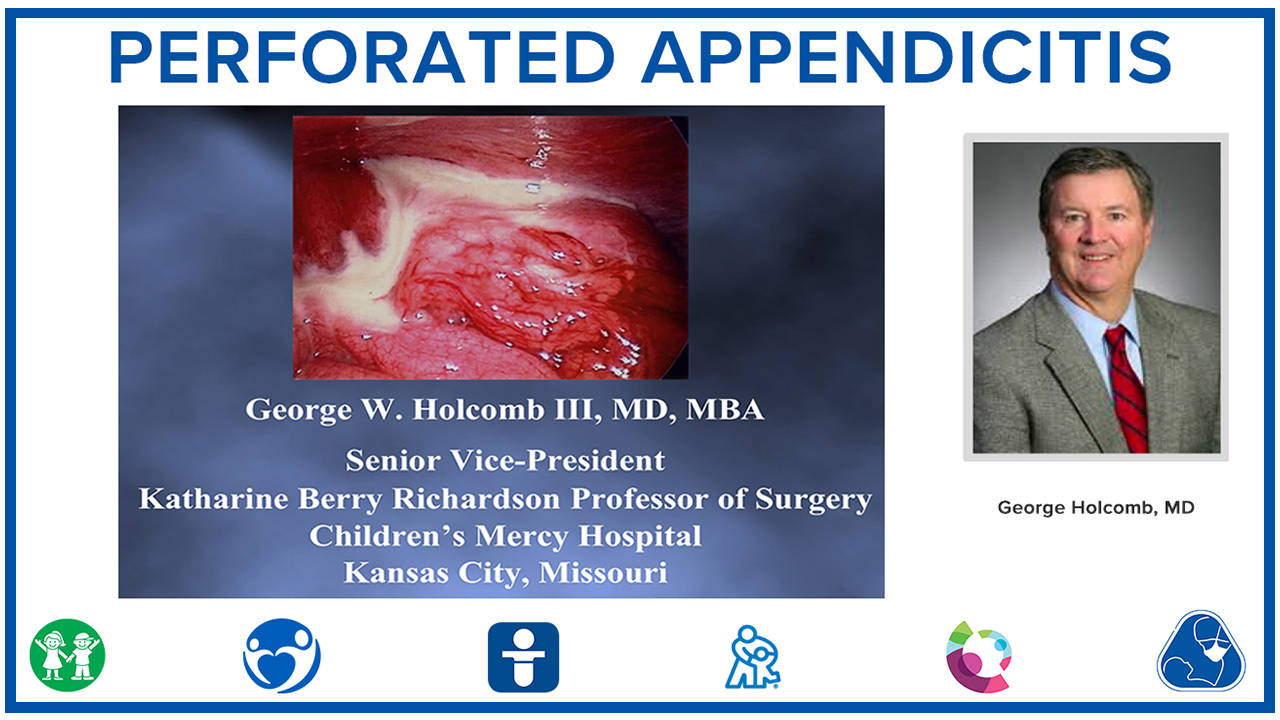
Perforated Appendicitis
Watch →
At the 7th Annual Pediatric Surgery Update Course, Dr. George "Whit" Holcomb discusses management of perforated appendicitis.
video18:22 · Mar 2020
Evidence & Research
2 items


Appendicitis Management & APPY Trial: Update Course 2016
Watch →
Dr. Shawn St. Peter gives an update on appendicitis management techniques. His presentation includes topics of appendectomy vs. antibiotics for non-perforated appendicitis, the APPY trial, acute appendicitis in adults, and non-operative man
video31:55 · Oct 2018
Quick Literature Updates Ep 26
Watch →
We’re back with 26th episode of "Quick Literature Updates" the podcast series that delivers the latest updates in pediatric surgery literature in a quick and digestible format. In each episode, we review articles covering the most interesti
video4:40 · Jan 2026
In-Depth Reviews
1 item

Journal Club: Appendicitis in 2021
Listen →
We all know how commonly pediatric surgeons see patients with appendicitis and how frequently new literature is published on its management. Dr. Jose Campos helped us find some of the latest publications on appendicitis management and we di
podcast15:06 · Aug 2021
Summaries and takeaways+ Show
The doctors in this collection+ Show
All expert statements+ Show
Every expert statement below comes from the recorded discussions, with its speaker and moment.
Quick Literature Updates Ep 26
Recent literature has been supporting treating appendicitis with antibiotics rather than surgery
host_summaryLizzie Lee1:07 ↗
The Saint Peter et al. study was a multi-center randomized trial in Canada, the US, Finland, Sweden, and Singapore investigating whether antibiotic treatment is inferior to appendicectomy
host_summaryLizzie Lee1:12 ↗
34% of children treated with antibiotics for appendicitis eventually required surgery within a year compared to only 7% in the surgery group
host_summaryLizzie Lee1:24 ↗
There were no deaths in either the antibiotic or surgery group for appendicitis treatment
host_summaryLizzie Lee1:32 ↗
Children in the antibiotic group had a higher risk of mild to moderate adverse events compared to the surgery group
host_summaryLizzie Lee1:32 ↗
Antibiotics were not as effective as surgery for treating non-perforated appendicitis in children, as it did not meet the threshold for non-inferiority
host_summaryLizzie Lee1:39 ↗
Zoo et al. used the PHIS database and performed a multi-institutional cohort study of all ARM patients between 2016 and 2022
host_summaryAlex Halpern2:16 ↗
In ARM patients, the rates of actual diagnoses across all hospital encounters were 45.4% vertebral spinal, 77.4% cardiac, 10.2% TEF, 39.9% renal and 15.7% limb
host_summaryAlex Halpern2:25 ↗
25.8% of female patients with anorectal malformations had a congenital gynecologic malformation diagnosed
host_summaryAlex Halpern2:40 ↗
The most common anomalies associated with ARMs are cardiac, vertebrospinal, renal, and gynecologic
host_summaryAlex Halpern2:45 ↗
The authors of the ARM screening study suggest changing the VACTERL acronym to VACTERL-GS
host_summaryAlex Halpern2:53 ↗
The Schlapbach et al. study is a worldwide study with a Delphi consensus process that aimed to update the definitions of sepsis and septic shock
host_summaryCecilia Gigena3:20 ↗
The Phoenix sepsis score includes variables in cardiovascular function, respiratory function, coagulation, and neurological function
host_summaryCecilia Gigena3:29 ↗
The Phoenix sepsis score helped correlate the definition of sepsis with an actual mortality rate
host_summaryCecilia Gigena3:42 ↗
The definition of sepsis is suspected infection plus 2 points in the Phoenix sepsis score
host_summaryCecilia Gigena3:48 ↗
Septic shock is defined as sepsis plus cardiovascular dysfunction that is seen when there is 1 point in the cardiovascular variable of the Phoenix sepsis score
host_summaryCecilia Gigena3:48 ↗
Sepsis has a mortality rate of 7.1%
host_summaryCecilia Gigena4:06 ↗
Septic shock has a mortality rate of 10.8 to 33.5% according to the research settings
host_summaryCecilia Gigena4:06 ↗
Appendicitis Management & APPY Trial: Update Course 2016
The APPY trial is a multi-center randomized trial comparing appendectomy to non-operative treatment for non-perforated appendicitis.
clinical0:09 ↗
The initial working group included Agostino Piero, Nigel Hall, Simon Eaton, Thomas Wester, and several others, with the current group joining about 2.5 years ago.
clinical1:20 ↗
The first two rounds of funding failed, requiring modifications to sample size calculation and study design to make it more pragmatic.
clinical2:00 ↗
Appendicitis can be treated without surgery, as demonstrated by experience with complicated appendicitis where patients are treated to completion regardless of perforation severity.
clinical3:20 ↗
Bob Parry developed appendicitis in Ireland, was treated with antibiotics, and went a full year before having a recurrent bout requiring appendectomy.
clinical4:00 ↗
In adult studies reviewing approximately 300 patients managed non-operatively versus 500 managed operatively, treatment failure trended toward favoring surgical approach, but complications favored non-operative management.
host_summary5:50 ↗
Adult estimates of non-operative management success revolve around 80%, which was integral in developing the sample size for the randomized trial.
host_summary7:00 ↗
Thomas Wester's pilot randomized trial in Sweden enrolled 50 patients, with 24 receiving antibiotics. 22 of 24 (92%) had initial resolution of symptoms, and one patient had recurrent appendicitis.
host_summary8:00 ↗
In the preference trial, any appendix that has to come out—even if due to parental preference after symptom resolution—must be considered a treatment failure because that reflects real-world practice.
clinical8:50 ↗
In the preference trial, parents of sicker-appearing children are less likely to choose non-operative management, even if objective measures like white count are similar.
clinical10:00 ↗
At 77 patients in the preference trial, 30 chose non-operative treatment (about one-third), with 90% success at 30 days and fewer disability days, earlier return to school, and improved quality of life versus surgery.
host_summary10:50 ↗
Patients who respond to antibiotics are literally normal the next day, going to school on Wednesday after discharge on Tuesday, whereas laparoscopic appendectomy patients restrict themselves for several days despite no formal restrictions.
clinical11:40 ↗
What's new+ Show