
Educational content from recorded physician discussions — not medical advice. Always talk to your child's care team about your child's situation.
Content of this collection
Resources
5 items
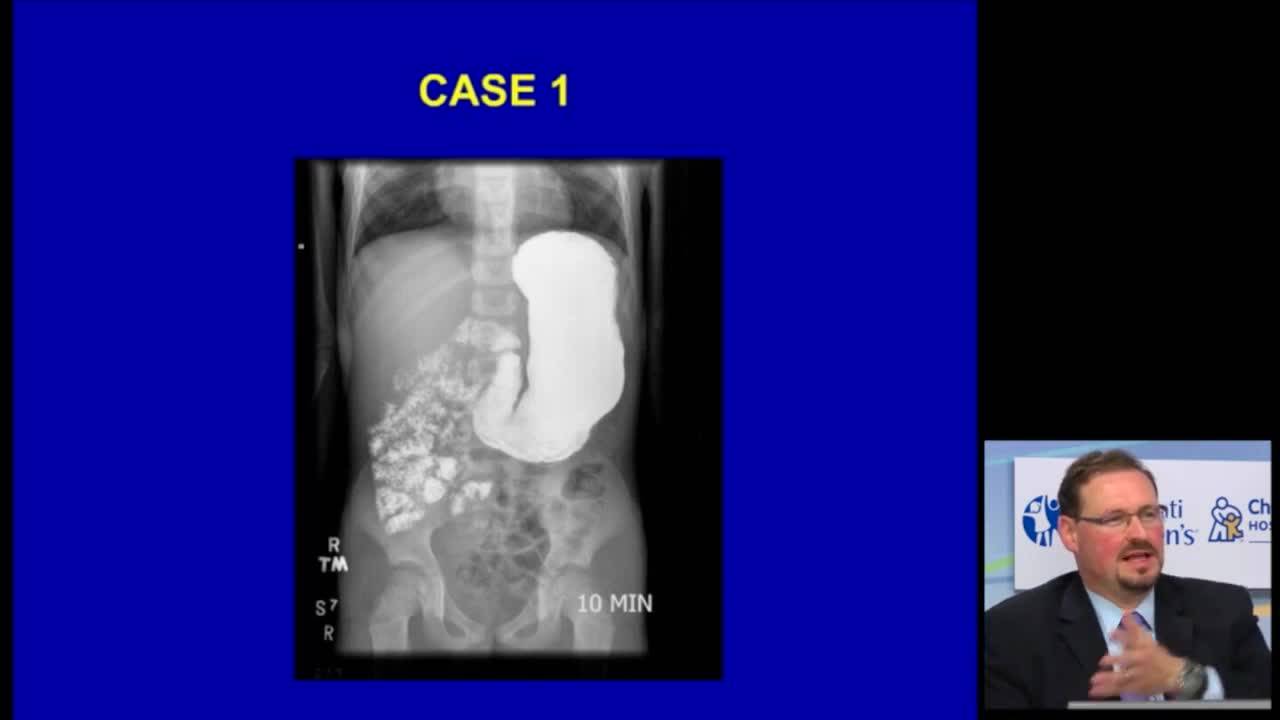


Malrotation
Watch →
Dr. Soldes discusses the classifications of malrotation through the presentation of case presentations. Discussion topics include Ladd's procedure, volvulus, non-bilious emesis, redundant duodenum, gastroesophageal reflux, and laparoscopy.
video42:31 · Nov 2018
Intestinal Rehabilitation Episode 8: Refeeding of an Older Patient
Listen →
We’re back with a new episode from the intestinal rehabilitation center at Cincinnati Children’s Hospital.
This time we’re talking about Refeeding in older patients with Drs. Helmrath and Wales.
If you are looking for refeeding a Neon
podcast12:05 · Oct 2023
Update Course 2021: TOP PUBLICATIONS IN NON - PED SURG JOURNALS
Watch →
Dr. Jose Campos and his team, Sociedad Chilena Cirugia Pediatrica curate the best pediatric surgical articles in non-core pediatric surgery journals and in this session, they describe their 5 favorites from the past year. The conversation i
video22:13 · May 2022
Malrotation with Dr. Meera Kotagal
Listen →
In this podcast, we cover the basics of malrotation including embryology, presentation, differentiation, diagnosis, surgical approach, and post operative management with Dr. Meera Kotagal.
Host: Em Tombash
Animations to understand the
podcast13:25 · May 2023
Malrotation and Volvulus with Trinity
Watch →
Surgical technique video demonstrating laparoscopic reduction of midgut volvulus with Ladd procedure in a 12-year-old with chronic symptoms and acute obstruction. Shows systematic band division, bowel derotation, mesenteric widening, and ap
video8:02 · May 2026
Summaries and takeaways+ Show
Summary of this collection+ Show
Key points, with the moment each was said+ Show
Featured picks for families are being prepared — the summaries above are written for you.
Takeaways+ Show
Midgut volvulus arises from malrotation, which occurs in approximately 1 in 200–500 live births, though only 1 in 30 of those with malrotation will develop volvulus [e6621-c1, e6621-c9]. Seventy percent of volvulus cases present in the first two months of life, and 90% by age two . Bilious emesis in a neonate is the critical presenting symptom and mandates urgent evaluation, as volvulus is considered the number one surgical emergency in pediatric surgery [e6621-c14, e6621-c22]. Upper GI series remains the diagnostic gold standard; ultrasound is operator-dependent and cannot reliably exclude volvulus, and a normal study does not rule out the diagnosis [e629-c3, e5404-c2, e5404-c3]. Surgical management involves detorsion (typically 270-degree counterclockwise rotation), assessment of bowel viability, and the Ladd procedure: division of Ladd bands, duodenal straightening, appendectomy, and placement of bowel in non-rotation configuration to widen the mesenteric base [e6621-c23, e6621-c26]. Laparoscopic approaches are feasible but remain controversial regarding adequacy of mesenteric widening [e6621-c29, e6621-c33]. Prophylactic Ladd for asymptomatic malrotation is debated, particularly in heterotaxy patients, where complication rates approach 30–50% and volvulus risk is low if asymptomatic [e629-c8, e629-c11]. Ladd bands themselves do not cause volvulus; the critical factor is mesenteric pedicle narrowing [e629-c4, e629-c23].
- Seventy percent of midgut volvulus cases occur in the first two months of life; bilious emesis in a neonate is volvulus until proven otherwise.
- Upper GI series is the diagnostic standard; ultrasound and contrast enema are unreliable, and a normal study does not exclude volvulus.
- Ladd procedure involves detorsion, division of bands, duodenal straightening, appendectomy, and non-rotation positioning to widen the mesenteric base and prevent recurrence.
- Laparoscopic Ladd is feasible but controversial; adequacy of mesenteric widening and reduced adhesion formation may affect long-term volvulus prevention.
- Prophylactic Ladd in asymptomatic heterotaxy patients is controversial; complication rates are 30–50%, and volvulus risk is very low if asymptomatic.
For patients & families
Midgut volvulus is a serious condition where the intestines twist around themselves, cutting off blood supply. It happens most often in babies and young children — about 70% of cases occur in the first year of life. The condition is linked to malrotation, an abnormality in how the intestines formed and positioned themselves before birth. While malrotation affects roughly 1 in 200 to 500 babies, only about 1 in 30 of those children will actually develop a volvulus. The most important warning sign is green (bilious) vomiting, especially in newborns and infants. Doctors take this symptom very seriously because volvulus is considered the number one surgical emergency in pediatric surgery. Other signs can include feeding problems, belly pain, swelling, and in severe cases, bloody stools or changes in the belly's appearance. The main test doctors use is an upper GI series, a special X-ray study where your child drinks contrast liquid so doctors can watch how it moves through the intestines. Treatment requires emergency surgery to untwist the bowel and widen the base of the intestine's attachment to prevent it from twisting again.
Midgut volvulus is a serious condition where the intestines twist around themselves, cutting off blood supply. It happens most often in babies and young children — about 70% of cases occur in the first year of life. The condition is linked to malrotation, an abnormality in how the intestines formed and positioned themselves before birth. While malrotation affects roughly 1 in 200 to 500 babies, only about 1 in 30 of those children will actually develop a volvulus. The most important warning sign is green (bilious) vomiting, especially in newborns and infants. Doctors take this symptom very seriously because volvulus is considered the number one surgical emergency in pediatric surgery. Other signs can include feeding problems, belly pain, swelling, and in severe cases, bloody stools or changes in the belly's appearance. The main test doctors use is an upper GI series, a special X-ray study where your child drinks contrast liquid so doctors can watch how it moves through the intestines. Treatment requires emergency surgery to untwist the bowel and widen the base of the intestine's attachment to prevent it from twisting again.
The doctors in this collection+ Show
All expert statements+ Show
Every expert statement below comes from the recorded discussions, with its speaker and moment.
Malrotation
In the first two months of life, about 70% of volvulus cases occur, and by the first two years of life, 90% of volvulus cases that are going to occur do occur
epidemiological27:23 ↗
In 20% of cases with true malrotations of the fore and mid-gut, you have a normal barium enema
clinical19:27 ↗
A normal ultrasound does not rule out volvulus, supported by multiple studies
clinical19:44 ↗
Ladd's bands do not cause midgut volvulus
clinicalJack4:02 ↗
Ladd's bands are thought to be an attempt of the body to fuse the cecum to the lateral peritoneal wall
clinicalWit37:16 ↗
The key reason to operate on an asymptomatic patient is to avoid midgut volvulus
clinicalJack3:52 ↗
The critical measurement is the distance between the ligament of Treitz and the ileocecal junction to prevent volvulus, though nobody knows the exact distance required
clinicalJack4:56 ↗
In patients with heterotaxy syndromes who have asymptomatic malrotations and undergo operations, the complication rate is remarkably high, between 30 and 50%
epidemiological16:13 ↗
In a study from Edmonton on heterotaxy patients who underwent procedures for malrotation, the complication rate was about 50%
Host summaryThe host summarizing the discussion — not the host's own clinical position24:59 ↗
In a study by Papillon from Children's LA of about 200 heterotaxy patients, a quarter got screening upper GIs and three quarters did nothing; in 4 years there was only one case of volvulus, and in patients without bilious emesis and symptoms, no cases of volvulus
Host summaryThe host summarizing the discussion — not the host's own clinical position25:12 ↗
In the heterotaxy subgroup, the risk of volvulus in the early period (4-5 years) is actually very low if patients are not symptomatic
epidemiological25:53 ↗
When bowel loops are dilated, this will always give you a low-lying ligament of Treitz
clinicalTodd Ponsky11:53 ↗
Atypical malrotation with a low-lying ligament of Treitz has some data showing lower risk of volvulus, though the data is not strong
clinical16:35 ↗
In patients with rotation abnormalities, reversed mesenteric vessels may or may not be seen; it doesn't definitively indicate malrotation
clinicalJack41:01 ↗
In Jack's series of several hundred patients, there was never a case where the vessels were normal in a patient who had risk for volvulus (narrow base mesentery), so they use it as a screening test in sick patients
clinicalJack41:15 ↗
Upper GI is clearly better than ultrasound for diagnosing malrotation, but in a sick patient who can't get to radiology, ultrasound can be useful
clinicalJack41:54 ↗
Laparoscopic Ladd's procedure can be very effective even in a newborn, though if there's too much twist and no room, conversion to open may be necessary
clinicalTim Kane8:18 ↗
In cardiac patients between first stage and Glenn procedure who get G-tubes, Nissen fundoplication is often requested because they vomit and are too small for PEGs
clinicalTim Kane14:42 ↗
A 45-minute Nissen at pressures of 8 is tolerated by cardiac patients between stages
clinicalTim Kane14:56 ↗
In a published study combining experience with Kansas City, the cardiac risk group did not stratify out to be at higher risk for reflux complications; neurologically impaired CP kids maybe, but not cardiac kids
Host summaryTodd Ponsky summarizing the discussion — not the host's own clinical position15:15 ↗
Yama does not operate on asymptomatic malrotation as long as the patient has non-bilious vomiting, is gaining weight, and is clinically well
Host summaryTodd Ponsky summarizing the discussion — not the host's own clinical position35:20 ↗
If a patient has a narrow pedicle, the patient always has vomiting and is symptomatic
Host summaryTodd Ponsky summarizing a resource — not the host's own clinical position36:16 ↗
Ladd's bands themselves are not risky; the risk is bilious vomiting and narrowing of the pedicle
Host summaryTodd Ponsky summarizing a resource — not the host's own clinical position36:39 ↗
In situs inversus or ambiguous cases, measuring the distance between ligament of Treitz and ileocecal junction matters regardless of where the bowels are; if less than half the diameter of the abdominal cavity, intervention is needed
clinicalJack39:27 ↗
Malrotation with Dr. Meera Kotagal
Malrotation occurs in about 1 in 200 to 500 live births.
Host summaryEm Tombash summarizes what Dr. Meera Kotagal said — not the host's own clinical position0:28 ↗
In the fourth week of gestation, bowel development begins, and as the bowel grows in length it herniates into the yolk sac along the umbilical cord and SMA axis.
clinicalMeera Kotagal1:17 ↗
Normal rotation involves a 90-degree rotation of the duodenal-jejunal loop, then return of bowel with 270-degree rotation of cecum and colon, resulting in duodenal-jejunal junction to the left of midline at ligament of Treitz and cecum in right lower quadrant.
clinicalMeera Kotagal1:44 ↗
Intestinal rotation abnormalities fall along a spectrum rather than being simply normal or abnormal, including both non-rotation and malrotation.
clinicalMeera Kotagal2:22 ↗
In non-rotation, the gut returns without rotating, resulting in colon on the left and small bowel on the right, without the problematic Ladd bands that cause obstruction in malrotation.
clinicalMeera Kotagal2:22 ↗
Non-rotation anatomy looks similar to the anatomy of a malrotated patient post-Ladd procedure.
clinicalMeera Kotagal2:22 ↗
What's new+ Show