
Educational content from recorded physician discussions — not medical advice. Always talk to your child's care team about your child's situation.
Content of this collection
Resources
3 items
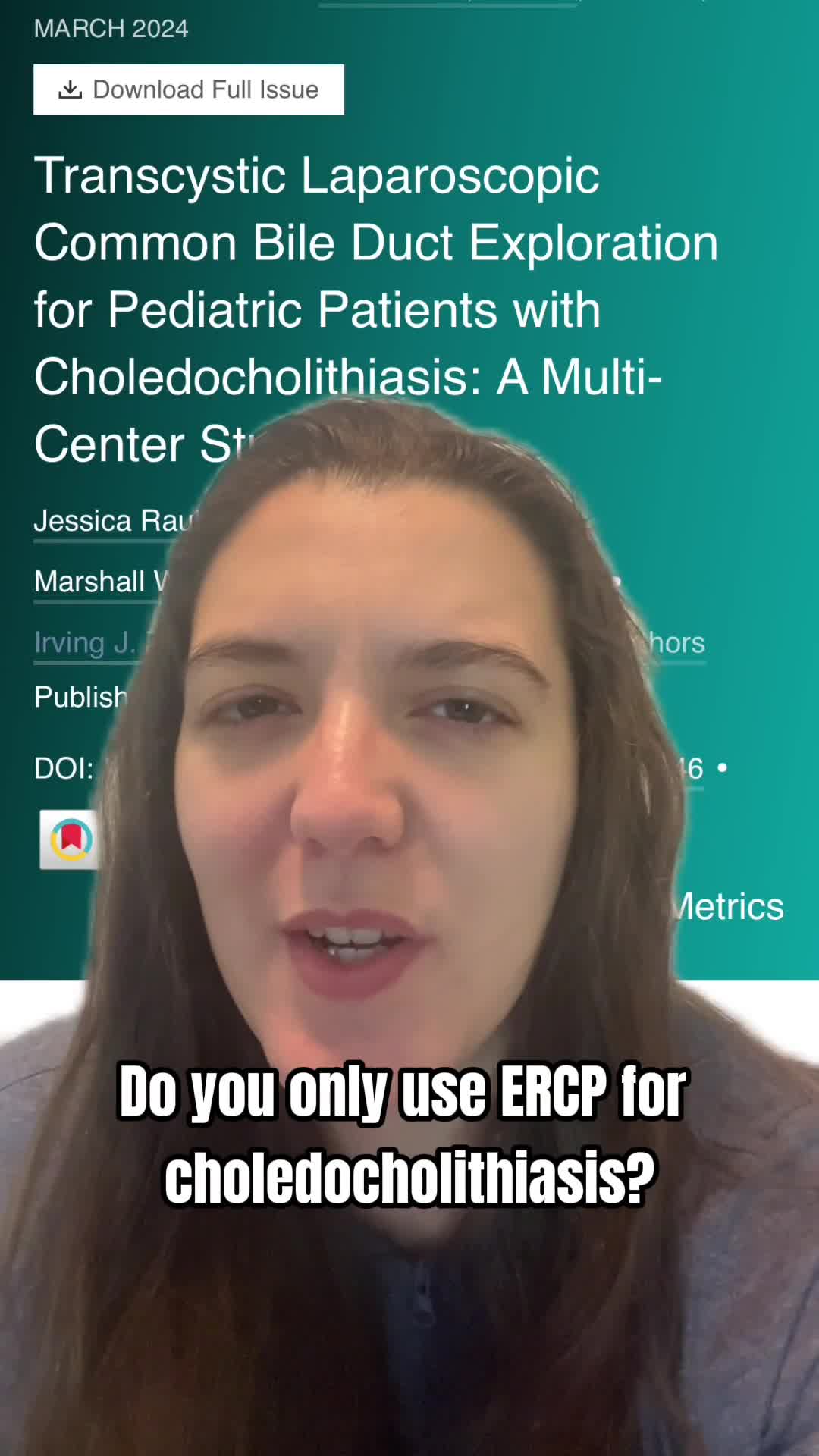

Transcystic Laparoscopic Common Bile Duct Exploration for Pediatric Patients with Choledocholithiasis
Watch →
New article you should know by Cecilia Gigena from Journal of Pediatric Surgery
"Transcystic Laparoscopic Common Bile Duct Exploration for Pediatric Patients with Choledocholithiasis: A multi-center study"
Authors: Jessica Rauh, Goeto
video1:04 · May 2024
Choledocholithiasis with Drs. David Vitale & Lucas Neff
Listen →
In this episode, we're reviewing the management of choledocholithiasis with with Drs. David Vitale from Cincinnati Children's Hospital & Lucas Neff from Wake Forest Baptist.
Host: Dr. Cecilia Gigena
podcast15:27 · Jul 2024
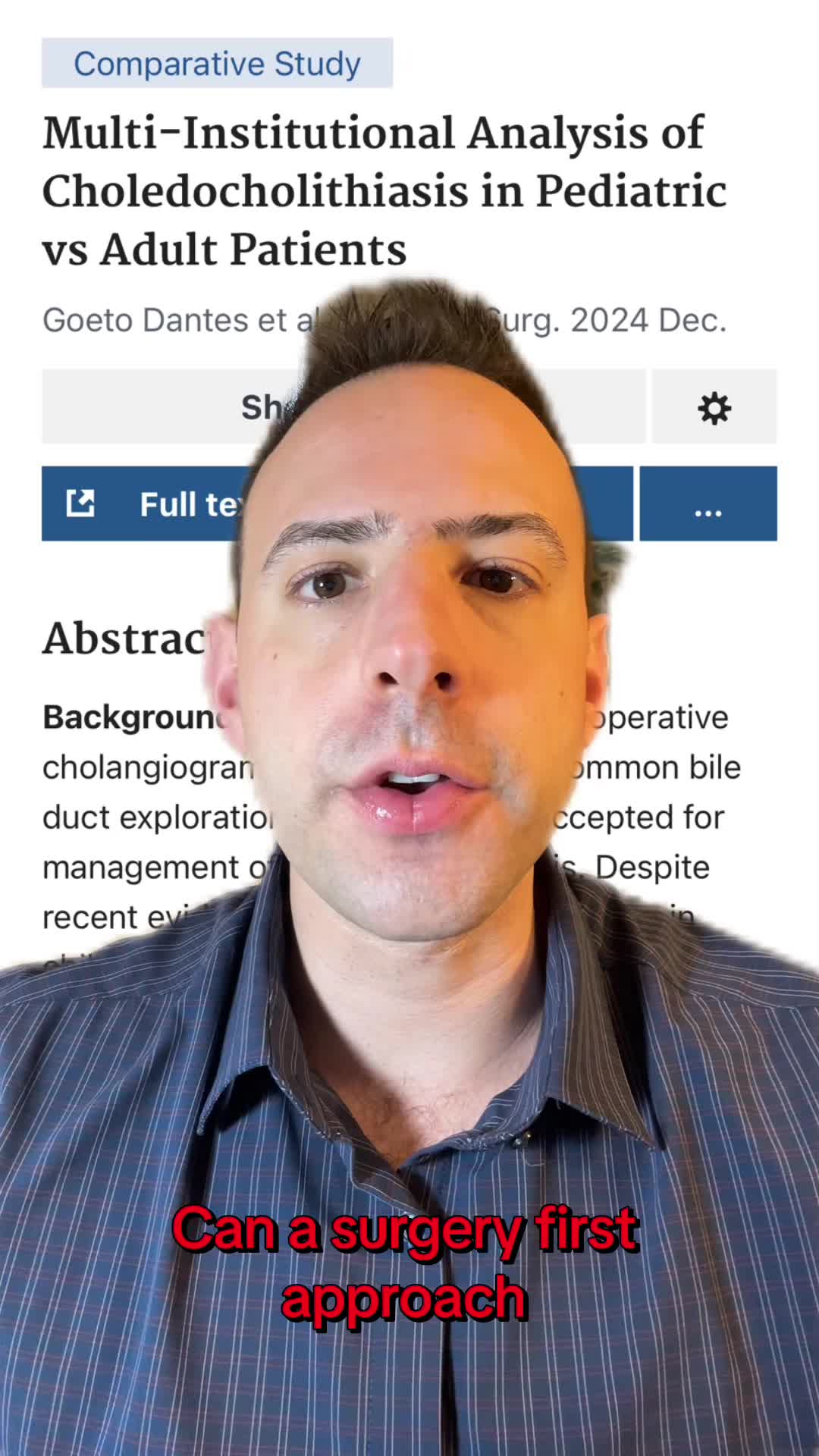
Multi-Institutional Analysis of Choledocholithiasis in Pediatric vs Adult Patients
Watch →
Goeto Dantes, Jessica L. Rauh, Savannah Smith, Eunice Aworanti, Marshall W. Wallace, Irving J. Zamora, Derek Krinock, Sabina Siddiqui, Amanda Witte, Katherine Flynn-O-Brien, Utsav M. Patwardhan, Romeo C. Ignacio, Eric Knauer, Lucas Neff, Ha
video0:59 · Mar 2025
Summaries and takeaways+ Show
Summary of this collection+ Show
Key points, with the moment each was said+ Show
Featured picks for families are being prepared — the summaries above are written for you.
Takeaways+ Show
For patients & families
Choledocholithiasis means stones in the bile duct — the tube that carries digestive fluid from the liver to the intestine. Doctors explained that these stones can be made of bile pigments, calcium, or cholesterol . Children with certain blood conditions like sickle cell disease, metabolic problems, or structural differences in their bile ducts have higher risk . The condition is more common in older children, those with higher weight, and Hispanic patients . Physicians discussed two main treatment approaches: a camera-guided procedure through small incisions (laparoscopic exploration) or a scope passed through the mouth (ERCP) . Recent studies comparing these methods found that the surgical approach resulted in fewer complications and shorter hospital stays in children [e8558-c6, e8558-c7]. However, doctors emphasized that the best choice depends on what expertise is available at each hospital, since many children's hospitals don't have ERCP capabilities [e8884-c13, e8884-c14]. Both approaches can be safe and effective when performed by experienced teams .
Choledocholithiasis means stones in the bile duct — the tube that carries digestive fluid from the liver to the intestine. Doctors explained that these stones can be made of bile pigments, calcium, or cholesterol . Children with certain blood conditions like sickle cell disease, metabolic problems, or structural differences in their bile ducts have higher risk . The condition is more common in older children, those with higher weight, and Hispanic patients . Physicians discussed two main treatment approaches: a camera-guided procedure through small incisions (laparoscopic exploration) or a scope passed through the mouth (ERCP) . Recent studies comparing these methods found that the surgical approach resulted in fewer complications and shorter hospital stays in children [e8558-c6, e8558-c7]. However, doctors emphasized that the best choice depends on what expertise is available at each hospital, since many children's hospitals don't have ERCP capabilities [e8884-c13, e8884-c14]. Both approaches can be safe and effective when performed by experienced teams .
The doctors in this collection+ Show
All expert statements+ Show
Every expert statement below comes from the recorded discussions, with its speaker and moment.
Multi-Institutional Analysis of Choledocholithiasis in Pediatric vs Adult Patients
Dantes et al. performed a multi-center retrospective review of pediatric and adult patients treated for choledocholithiasis between 2018 and 2024
epidemiologicalAlex Halpern0:11 ↗
724 patients were included in the study
epidemiologicalAlex Halpern0:22 ↗
Surgery first approach with upfront laparoscopic cholecystectomy with intraoperative cholangiogram was performed in 201 pediatric patients and 169 adult patients
clinicalAlex Halpern0:25 ↗
Laparoscopic common bile duct exploration was attempted in 84 children and 140 adults in the surgery first group
clinicalAlex Halpern0:35 ↗
Common bile duct exploration success was higher in pediatric than adult patients
clinicalAlex Halpern0:43 ↗
Complication rates were similar between pediatric and adult patients in the surgery first approach
clinicalAlex Halpern0:43 ↗
A surgery first approach can be a safe and effective tool for managing choledocholithiasis in pediatric patients
opinionAlex Halpern0:49 ↗
Transcystic Laparoscopic Common Bile Duct Exploration for Pediatric Patients with Choledocholithiasis
The study was a multi-center retrospective study conducted in the US from 2018 to 2022
Host summaryCecilia Gigena summarizing a resource — not the host's own clinical position0:09 ↗
The study aim was to compare patients with suspected choledocholithiasis who underwent transcystic laparoscopic common bile duct exploration versus those who underwent ERCP first
Host summaryCecilia Gigena summarizing a resource — not the host's own clinical position0:09 ↗
The study included 252 patients total
Host summaryCecilia Gigena summarizing a resource — not the host's own clinical position0:28 ↗
156 patients were in group one (transcystic laparoscopic common bile duct exploration)
Host summaryCecilia Gigena summarizing a resource — not the host's own clinical position0:28 ↗
96 patients were in group two (ERCP first)
Host summaryCecilia Gigena summarizing a resource — not the host's own clinical position0:38 ↗
Patients in group one (transcystic laparoscopic approach) had significantly less complication rates compared to group two
Host summaryCecilia Gigena summarizing a resource — not the host's own clinical position0:38 ↗
Patients in group one (transcystic laparoscopic approach) had lower length of stay compared to group two
Host summaryCecilia Gigena summarizing a resource — not the host's own clinical position0:38 ↗
Attempting a transcystic laparoscopic common bile duct exploration may benefit pediatric patients with choledocholithiasis
Host summaryCecilia Gigena summarizing a resource — not the host's own clinical position0:52 ↗
Choledocholithiasis with Drs. David Vitale & Lucas Neff
Choledocholithiasis stones may be made up of bile pigments or calcium and cholesterol salts.
Host summaryCecilia Gigena summarizing the discussion — not the host's own clinical position0:43 ↗
Risk factors for choledocholithiasis include metabolic diseases, hemolysis such as sickle cell, and congenital biliary anomalies like choledochal cysts.
clinicalDavid Vitale0:55 ↗
Choledocholithiasis is more common in older children, children with higher BMI, and patients of Hispanic ethnicity.
epidemiologicalDavid Vitale1:03 ↗
According to ASGE guidelines, patients with high probability of common bile duct stones (common bile duct stones seen on ultrasound, ascending cholangitis, or quite high bilirubin) should go straight to ERCP.
Host summaryDavid Vitale summarizes what Dr. Luke Neff said — not the host's own clinical position1:52 ↗
Patients with intermediate risk (abnormal liver biochemical tests or dilated common bile ducts) can undergo endoscopic ultrasound, MRCP, laparoscopic cholangiogram, or intraoperative ultrasound.
Host summaryCecilia Gigena summarizing the discussion — not the host's own clinical position2:11 ↗
In pediatric literature, direct (conjugated) bilirubin more than 2 mg/dL was the most predictive factor for common bile duct stones.
Host summaryDavid Vitale summarizes what Dr. Luke Neff said — not the host's own clinical position2:40 ↗
Common bile duct diameter greater than 6 millimeters was most sensitive for predicting common bile duct stones in children, although without statistical significance.
Host summaryCecilia Gigena summarizing the discussion — not the host's own clinical position2:50 ↗
The pediatric duct score (published in Journal of American College of Surgeons with 10 centers) identified three most predictive risk factors: ducts greater than 6 mm, common bile duct stones on ultrasound, or total bilirubin greater than 1.8 mg/dL.
Host summaryDavid Vitale summarizes what Dr. Luke Neff said — not the host's own clinical position3:03 ↗
Pediatric literature with small sample size shows that same-anesthesia laparoscopic cholecystectomy with ERCP in stone disease led to less anesthesia time and lower length of stay.
Host summaryDavid Vitale summarizes what Dr. Luke Neff said — not the host's own clinical position3:41 ↗
Retrospective data comparing ERCP versus laparoscopic common bile duct exploration is conflicted and the choice is institution-dependent and provider-dependent based on expertise.
opinionDavid Vitale4:03 ↗
Randomized trials from 2013 show no significant difference in morbidity, mortality, retained stones, or failure rates between ERCP and laparoscopic common bile duct exploration.
Host summaryCecilia Gigena summarizing the discussion — not the host's own clinical position4:18 ↗
Stones above the cystic duct pose a problem because they can float up during attempted laparoscopic removal, making a straightforward procedure much more difficult.
clinicalDavid Vitale4:39 ↗
Local expertise and availability is the most important factor in the decision tree between ERCP and laparoscopic common bile duct exploration.
opinionDavid Vitale5:00 ↗
Most free-standing children's hospitals do not have ERCP capabilities.
Host summaryCecilia Gigena summarizing the discussion — not the host's own clinical position8:59 ↗
Dr. Neff uses a 12-gauge angiocath for access, which may be hard to find in pediatric hospitals but can be ordered.
clinicalLuke Neff9:37 ↗
What's new+ Show