
Cancer
Everything in the library about cancer — built automatically from the recorded discussions that name it
Educational content from recorded physician discussions — not medical advice. Always talk to your child's care team about your child's situation.
Content of this collection
Fundamentals
1 item

Unconscious Bias
Listen →
This episode is an interactive discussion about Unconscious Bias between Dr. Todd Ponsky, Dr. Julie Freischlag, Dr. Mary Brandt, Dr. Quinn Capers IV, Dr. Alejandra (Alex) Casar Berazaluce, Dr. Rachel (Rae) Hanke, and Dr. Alexander Gibbons.
podcast58:27 · Dec 2020
Evidence & Research
2 items
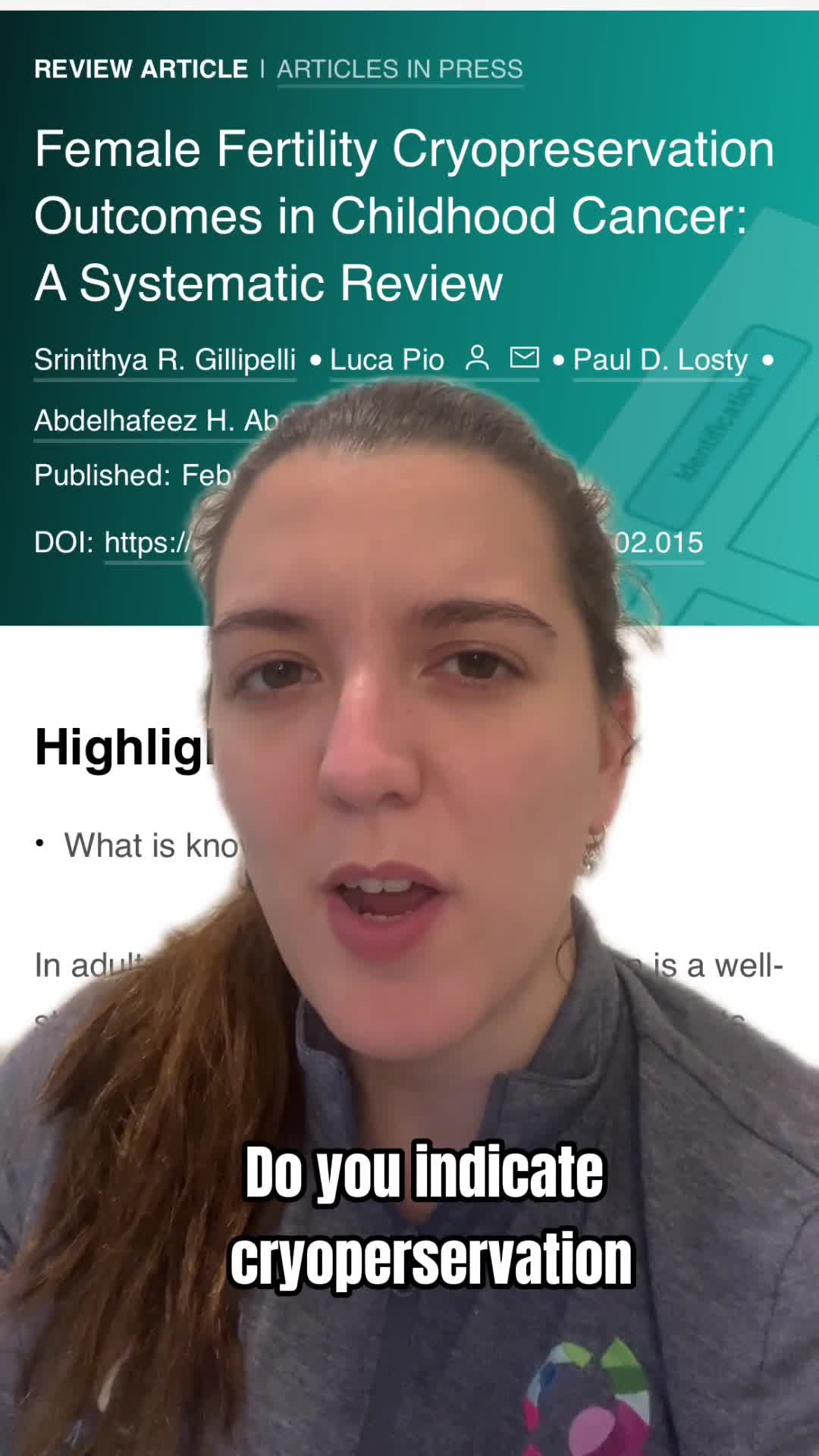
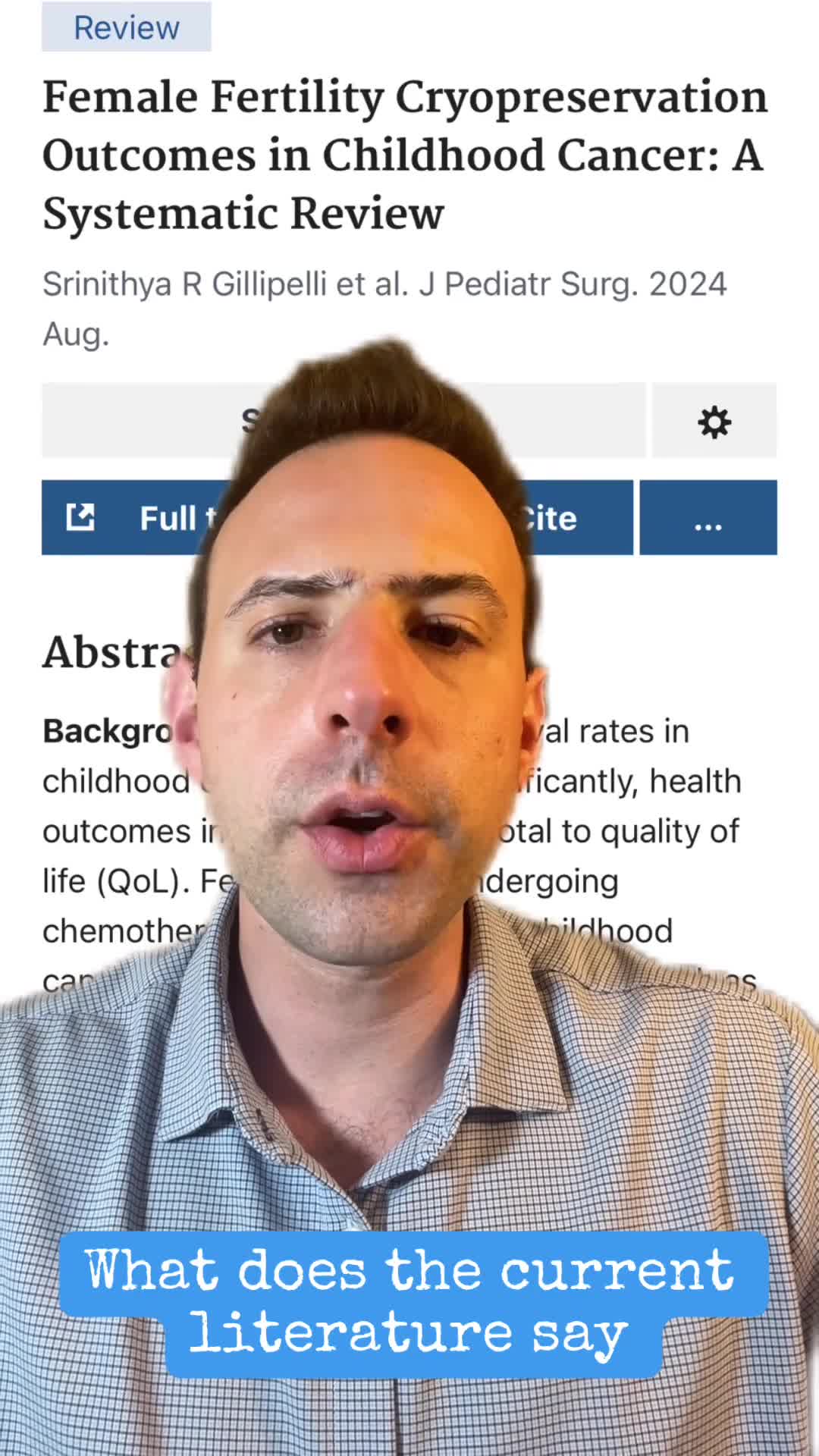
Female Fertility Cryopreservation Outcomes in Childhood Cancer: A Systematic Review
Watch →
New article you should know by Dr. Cecilia Gigena. Selected by Dr. Jose Campos & the Chilean Society of pediatric Surgery
"Female Fertility Cryopreservation Outcomes in Childhood Cancer: A Systematic Review"
Authors: Srinithya R. Gil
video0:59 · May 2024
Female Fertility Cryopreservation Outcomes in Childhood Cancer: A Systematic Review
Watch →
Srinithya R. Gillipelli, Luca Pio, Paul D. Losty, Abdelhafeez H. Abdelhafeez
Background and aims: As survival rates in childhood cancer progress significantly, health outcomes in adulthood are pivotal to quality of life (QoL). Female pat
video0:56 · Dec 2024
Patient & Family Education
1 item

Ethical Considerations in Pediatric Fertility Preservation: Pediatric...
Watch →
During the Pediatric Oncofertility: A Comprehensive Review Course in 2017, course faculty discuss the strategies in preserving fertility in pediatric oncology patients and other at-risk children. In this session, Dr. Michelle McGowan discus
video32:54 · Jan 2019
Long-Term Care
1 item

Keys to Building a Successful Interdisciplinary Program-Creating the...
Watch →
During the Pediatric Oncofertility: A Comprehensive Review Course in 2017, course faculty discuss the strategies in preserving fertility in pediatric oncology patients and other at-risk children. In this session, Dr. Holly Hoefgen discusses
video10:12 · Jan 2019
Summaries and takeaways+ Show
The doctors in this collection+ Show
All expert statements+ Show
Every expert statement below comes from the recorded discussions, with its speaker and moment.
Female Fertility Cryopreservation Outcomes in Childhood Cancer: A Systematic Review
Gillippelli et al. performed a systematic retrospective review of female fertility cryopreservation outcomes in children with cancer
clinicalAlex Halpern0:13 ↗
The review initially examined 104 abstracts and 34 full text articles
clinicalAlex Halpern0:19 ↗
12 studies were included in the final systematic review
clinicalAlex Halpern0:19 ↗
Ovarian tissue cryopreservation was performed in 501 patients across the included studies
epidemiologicalAlex Halpern0:27 ↗
5.9% of patients who underwent ovarian tissue cryopreservation later received ovarian tissue transplantation
epidemiologicalAlex Halpern0:27 ↗
33% of patients who underwent ovarian tissue transplantation were able to become pregnant
clinicalAlex Halpern0:38 ↗
Ovarian tissue cryopreservation has great advantages for pediatric cancer patients but needs to be studied further
opinionAlex Halpern0:44 ↗
The systematic review aimed to highlight outcomes of cryopreservation in pediatric female patients with cancer
epidemiologicalCecilia Gigena0:11 ↗
The review included 12 studies with 612 patients total
epidemiologicalCecilia Gigena0:20 ↗
501 patients underwent ovarian tissue cryopreservation
epidemiologicalCecilia Gigena0:26 ↗
Only 30 of the 501 patients received ovarian tissue transplantation
epidemiologicalCecilia Gigena0:31 ↗
Of the 30 patients who received transplantation, 9 got pregnant
clinicalCecilia Gigena0:36 ↗
Only 6 of the 9 pregnancies resulted in live birth
clinicalCecilia Gigena0:40 ↗
More high quality studies are needed to understand cryopreservation better and improve its outcomes
opinionCecilia Gigena0:43 ↗
Ethical Considerations in Pediatric Fertility Preservation: Pediatric...
The first live birth with in vitro fertilization was in 1978, approaching 40 years ago at the time of this discussion.
epidemiologicalMcGowan1:30 ↗
The field of bioethics emerged in the post-Nuremberg era and gained footing in the 1960s and 1970s, founded by philosophers and theologians grappling with new technologies including transplantation, life support, and assisted reproduction.
clinicalMcGowan1:45 ↗
Some religious traditions, particularly Catholicism, are opposed to any form of assisted reproduction.
clinicalMcGowan3:40 ↗
There are gendered moral burdens in fertility preservation: suggesting fertility preservation for a post-pubertal male is qualitatively different than for a female of any age due to differences in invasiveness of procedures.
opinionMcGowan5:40 ↗
There is very little tracking of offspring of fertility treatments nationally, though data collection is increasingly starting for children born from in vitro fertilization.
epidemiologicalMcGowan9:20 ↗
Connecticut recently changed its definition of infertility from 6-12 months of inability to conceive to anyone with medical necessity.
guidelineMcGowan12:10 ↗
Some patients undergoing fertility preservation today are anticipated to keep tissues or cells in storage for 20 to 30 years, but there is no data on success rates for tissues stored that long.
clinicalMcGowan13:40 ↗
There are no clear national guidelines on disposition of gametes for reproductive purposes after patient death, and court decisions on posthumous reproduction vary widely by state.
guidelineMcGowan15:20 ↗
In pediatric decision-making, there is a gradation of consent: informed consent (typically age 18+), pediatric assent (typically ages 11-13), and best-interest standard for younger or less mature patients.
guidelineMcGowan17:00 ↗
Embryo cryopreservation has a 33-52% success rate.
clinicalMcGowan19:10 ↗
Oocyte cryopreservation transitioned from experimental to established standard of care in the last five years (prior to this discussion), so success rates are not as well established as for embryo cryopreservation.
clinicalMcGowan19:20 ↗
Testicular tissue cryopreservation currently has no live birth rates in humans.
clinicalMcGowan20:00 ↗
Fair equality of opportunity theory argues that fertility preservation ought to be made equally available to all who could benefit, requiring changes to institutional and societal practices around healthcare access.
opinionMcGowan21:20 ↗
Reproductive justice scholars describe 'stratified reproduction' as distribution between haves and have-nots in reproductive terms; assisted reproduction is already stratified by privilege.
opinionMcGowan22:00 ↗
A hub-and-spoke model is proposed where large centers with fertility preservation programs provide consultation and resources to smaller centers, with patients traveling to the hub for experimental procedures requiring specialized expertise.
opinionHefkin23:00 ↗
Most adult gynecologists are comfortable doing adolescent gynecology, but the discomfort comes with how young a patient they are comfortable operating on; ovarian tissue cryopreservation may require oophorectomy on a 1-2 month old infant.
clinicalHefkin25:22 ↗
What's new+ Show