
 StayCurrentMD
Blunt Abdominal Trauma
Everything in the library about blunt abdominal trauma — built automatically from the recorded discussions that name it
Educational content from recorded physician discussions — not medical advice. Always talk to your child's care team about your child's situation.
Content of this collection
Diagnosis & Workup
1 item

Indications for CT Scan for Blunt Abdominal Trauma: Update Course 2017
Watch →
At the 5th Annual Stay Current Pediatric Surgery Update Course in 2017, Dr. Christian Streck discusses indications for CT scan for blunt abdominal trauma. He includes discussion on routine labs or imaging for each level of trauma versus inj
video34:38 · Sep 2018
Acute Management
1 item
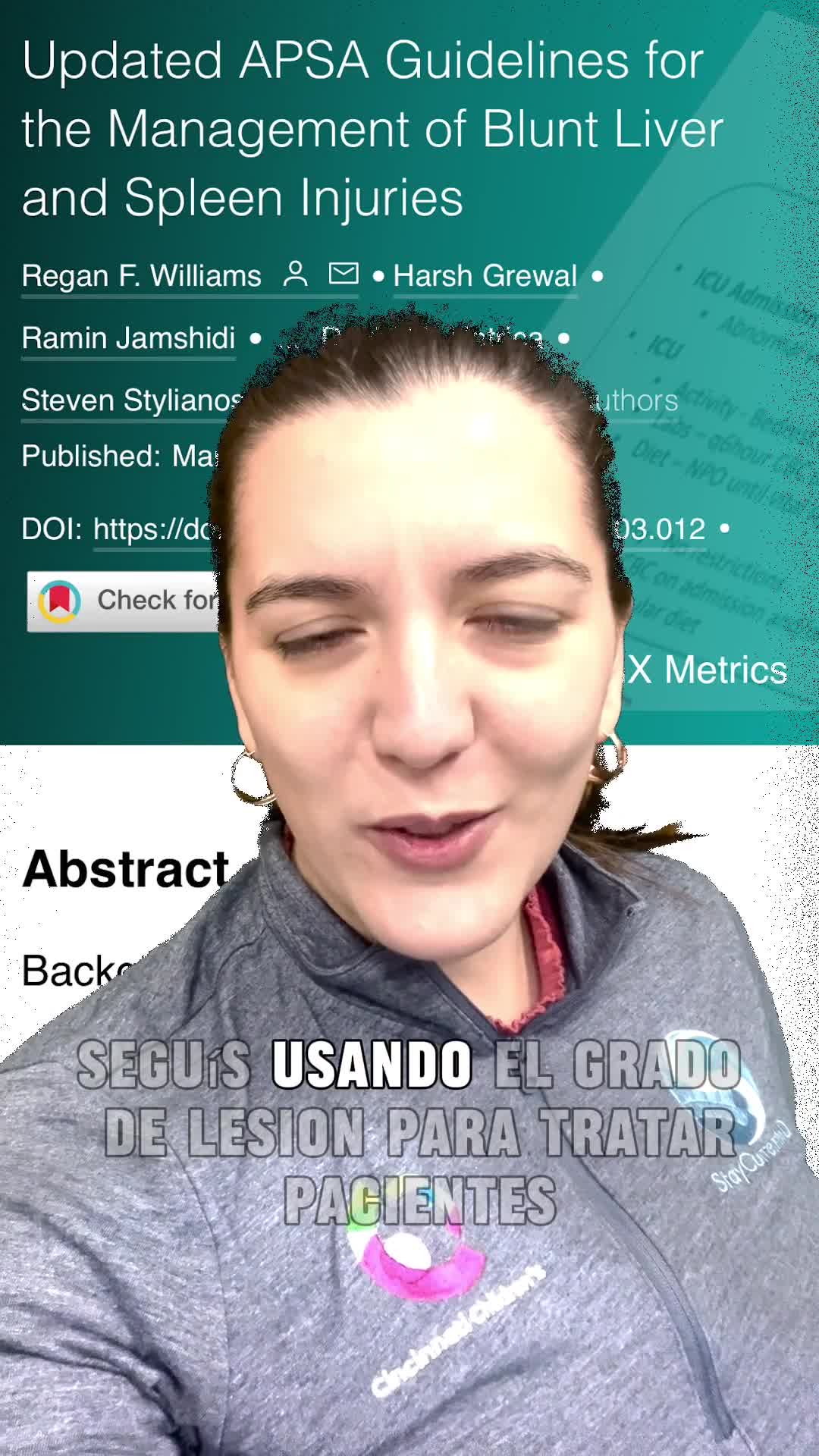
Guías APSA actualizadas para el tratamiento de lesiones contusas del hígado y del bazo
Watch →
Nuevo artículo que debes conocer del Journal of Pediatric Surgery de la Dra. Cecilia Gigena
"Guías APSA actualizadas para el tratamiento de lesiones contusas del hígado y del bazo"
Autores: Regan F. Williams, Harsh Grewal, Ramin Jamsh
video · Nov 2023
Surgical Management
1 item

Laparoscopic Distal Pancreatectomy for Traumatic Transection
Watch →
This video appears in a new pediatric surgery textbook, Clinical Pediatric Surgery: A Case-Based Interactive Approach," by Dr. Sherif Emil. The book is an innovative educational resource that focuses on judgment and decision-making in pedia
video4:58 · Nov 2019
Evidence & Research
3 items

Trauma Talk Summary: Update Course 2017
Watch →
Dr. Christian Streck and David Notrica provide a summary of the"take-home" points from the trauma talks at the 5th annual Stay Current Pediatric Surgery Annual Update Course in 2017.
video · Sep 2018
Isolated low-grade solid organ injuries in children following blunt abdominal trauma
Watch →
New article you should know by Dr. Cecilia Gigena
"Isolated low-grade solid organ injuries in children following blunt abdominal trauma: Is it time to consider discharge from the emergency department?"
Authors: Leah Plumblee 1, Regan
video · May 2023
Lesiones de órgano sólido aisladas de bajo grado luego de un trauma abdominal cerrado…
Watch →
Nuevo articulo que tenes que conocer por la Dra Gigena Cecilia
“Lesiones de órgano sólido aisladas de bajo grado luego de un trauma abdominal cerrado: ¿Es tiempo de considerar el alta desde el departamento de urgencias?"
Leah Plumblee
video · May 2023
In-Depth Reviews
1 item
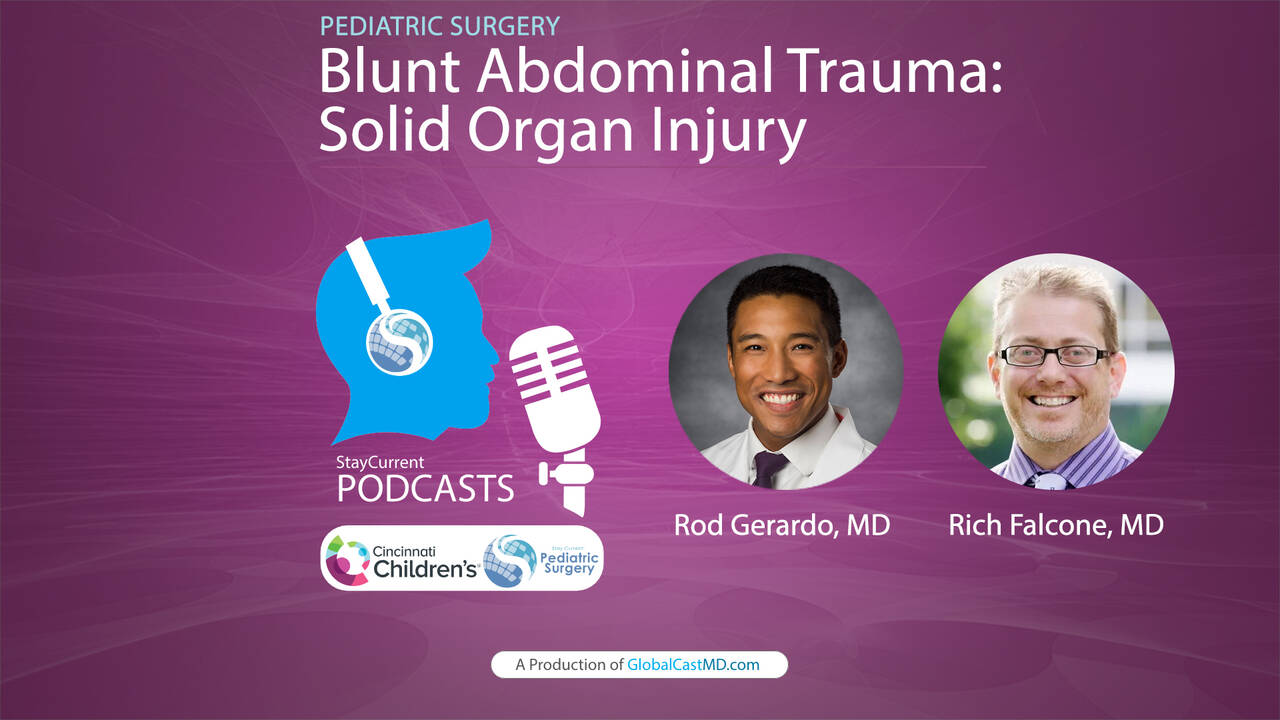
Abdominal Trauma with Dr. Richard Falcone
Watch →
Pediatric trauma is the number one cause of death in kids over 1 year old. Blunt abdominal trauma makes up 80% of those cases. Join Dr. Richard Falcone for a review of work up and management algorithms for pediatric abdominal trauma
video · Jul 2022
Summaries and takeaways+ Show
The doctors in this collection+ Show
All expert statements+ Show
Every expert statement below comes from the recorded discussions, with its speaker and moment.
Indications for CT Scan for Blunt Abdominal Trauma: Update Course 2017
97% of pediatric blunt trauma patients presenting to trauma centers are hemodynamically stable
epidemiological0:00 ↗
Seatbelt contusion indicates tremendous force and should be a red flag for underlying abdominal injury, particularly bowel injury which is difficult to assess on CT
clinical2:26 ↗
FAST ultrasound is not sensitive or specific for pediatric abdominal trauma and will not be useful until IV contrast for ultrasound becomes available
opinion4:16 ↗
AST or ALT over 200 is used as a threshold for CT scanning in blunt abdominal trauma
host_summary5:23 ↗
Seatbelt sign over the anterior superior iliac spine in the correct anatomic position may be observed, but seatbelt sign in the wrong location (higher on abdomen) requires more aggressive evaluation
clinical8:02 ↗
Less than 12% of pediatric blunt trauma patients have an injury on abdominal CT
epidemiological10:30 ↗
90% of pediatric trauma patients present to non-pediatric centers where pan-CT is standard practice
epidemiological11:40 ↗
Adult trauma literature suggests pan-CT is safer, has fewer missed injuries, and is more cost-effective
host_summary12:10 ↗
The PECARN study (2012) used only history and physical exam findings to predict injuries requiring acute intervention, defined as urgent surgery, angiography, transfusion, or 48-hour admission for IV fluids
host_summary12:40 ↗
The PECARN model was very sensitive for injuries requiring acute intervention but missed many clinically relevant solid organ injuries
clinical13:40 ↗
In the multi-center study, CT scan ordering rates ranged from 4% to 96% across four centers, indicating substantial opportunity for practice improvement
epidemiological14:20 ↗
Five variables predict intra-abdominal injury: AST >200, abnormal abdominal physical exam, abnormal chest X-ray, complaint of abdominal pain, and elevated amylase or lipase
clinical15:00 ↗
When all five predictor variables are negative, the risk of intra-abdominal injury is 0.6% and risk of injury requiring acute intervention is 0%
clinical15:35 ↗
At least one-third of pediatric blunt trauma patients with severe mechanisms do not need abdominal CT based on the five-variable prediction model
clinical16:22 ↗
The negative predictive value of the five-variable model is 100% for injury requiring intervention and 99.4% for all injuries
clinical17:00 ↗
Risk of injury increases with the number of abnormal predictor variables present
clinical15:51 ↗
A low-risk group (55% of population) can be identified with less than 5% risk of any injury and less than 0.3% risk of injury requiring acute intervention
clinical17:30 ↗
Waiting one hour for lab results in stable patients with reliable exams is acceptable before deciding on abdominal CT
opinion18:05 ↗
Multi-slice CT scanners can identify subtle findings of small bowel or hollow viscus injury even without oral contrast
clinical19:40 ↗
Serial abdominal exams over time can help determine need for further evaluation even when CT findings are equivocal
clinical20:28 ↗
A missed bowel injury, if caught within 24 hours, usually causes no increased morbidity
host_summary21:02 ↗
Laparoscopy is extremely helpful for evaluating moderate free fluid in males with no hard signs of small bowel perforation
clinical21:13 ↗
It is very rare to miss an injury during laparoscopic exploration in the current era
opinion21:49 ↗
There is huge variability across institutions in which labs are ordered for trauma evaluation (amylase vs lipase vs both)
epidemiological22:04 ↗
FAST ultrasound had 27.8% sensitivity for any intra-abdominal injury and 44% sensitivity for injury requiring intervention in the study cohort
clinical24:10 ↗
FAST ultrasound detected only 9 of 42 liver injuries (approximately 1 in 4) in the study
clinical24:50 ↗
FAST ultrasound detected 13 of 30 spleen injuries in the study
clinical25:20 ↗
FAST may be helpful in hemodynamically unstable patients to identify hemoperitoneum and determine which body cavity is contributing to instability
host_summary25:40 ↗
Of 14 centers in the study, only one used negative FAST to reduce CT rates, and two centers actually performed more CTs after FAST
epidemiological26:20 ↗
FAST is not being used effectively to determine which patients can avoid CT
opinion26:50 ↗
What's new+ Show