


From
Live Event Content
Update Course 2023 - Updates in Pancreatitis
With Dr. Juan Gurria · hosted by Dr. Shawn St. Peter
Chapter 4 of 6 · Surgical Management
Surgical planning
Surgical Decision-Making in Genetic Chronic Pancreatitis
Cued at 21:12 · stops at 21:24 · press play
Expert statements on this page
No expert statements were drawn from this page.
Host summaries · secondary, not cited in answers
Educational content from recorded physician discussions — not medical advice. Talk to your (or your child's) care team about your situation.
Video
Overview of the Surgical Management of Acute and Chronic Pancreatitis in Children with Dr. Juan Gurria
66 min · Published Apr 2026
Video
Pancreas Care Updates 2020 - FULL SHOW
124 min · Published Dec 2020
Video
Endoscopic & Surgical Interventions: Pancreatic Disease
55 min · Published Sep 2016
Video
Chronic Pancreatitis, Function Tests, & Pain Management: Pancreatic Disease
51 min · Published Sep 2016
Podcast
Acute Pancreatitis
45 min · Published Jul 2017
Video
Acute and Acute Recurrent Pancreatitis: Pancreatic Disease
56 min · Published Sep 2016
Video
Pancreatitis in pediatric patients with pancreatic solid pseudopapillary neoplasms- a single center experience
59 s · Published Apr 2026
Podcast
Update Course Rewind: Pediatric Biliary Stones - Preventing Gallstone Pancreatitis 2024
Jeffrey Ponsky · 3 min · Published Aug 2025
Video
Update Course Rewind: Pediatric Biliary Stones - Surgery First Mindset 2024
Dr. Todd Ponsky · 7 min · Published Jul 2025
Video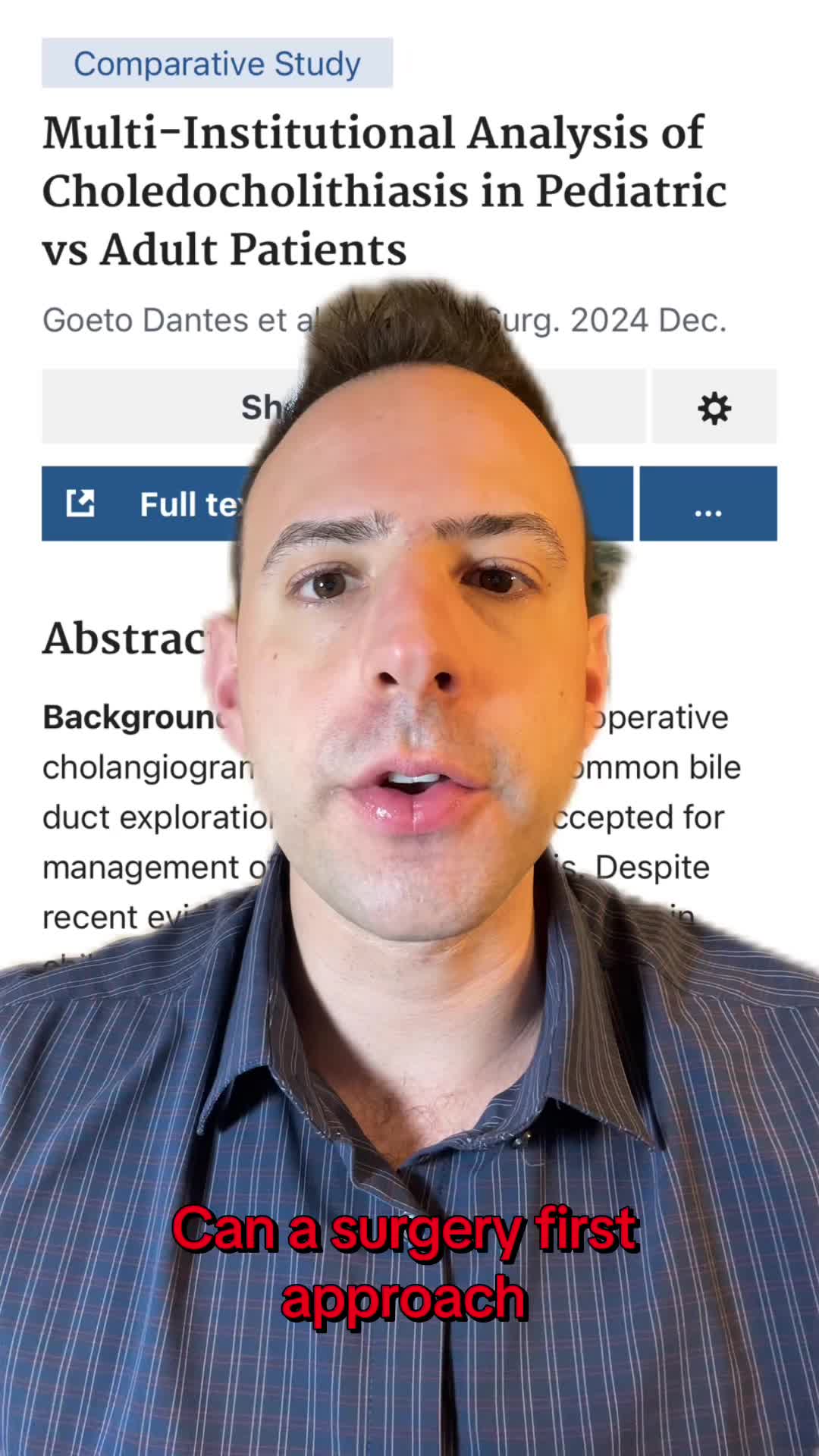
Multi-Institutional Analysis of Choledocholithiasis in Pediatric vs Adult Patients
59 s · Published Mar 2025
Video
Total pancreatectomy with islet autotransplantation (TPIAT) - Cincinnati Children's Pancreas Care Center
CCHMC Pediatric Surgery · 10 min · Published Dec 2024
Video
Chronic Pancreatitis - Pancreatic Pathologies by Cincinnati Children's Pancreas Care Center
CCHMC Pediatric Surgery · 8 min · Published Nov 2024
Video
Activating extracorporeal cardiopulmonary resuscitation
Dr. Juan Gurria · Published Nov 2026
Podcast
Preparing for successful ECPR: team coordination and early activation strategies
2 min · Published Nov 2026
Podcast
Surgical Decision-Making in Necrotizing Enterocolitis: Imaging, Timing, and Operative Strategies
11 min · Published Nov 2026
Podcast
Pediatric pancreatitis: diagnosis, causes, and genetic insights with Dr. Juan Gurria
3 min · Published Nov 2026
Podcast
Surgical management of chronic pancreatitis in children: when and how to intervene
4 min · Published Nov 2026
Video
Robotics in Pediatric Surgery: Which indications benefit the most? w/ Dr. Juan Gurria
18 min · Published Oct 2026
Video
Clinical & Research Update: Renal Tumors with Drs. Ethan Smith, Lindsay Haacker, Michael Daugherty, and Meera Kotagal
71 min · Published Sep 2026
Video
Clinical & Research Update: Neuroblastoma with Drs. Katherine Somers, Cara Morin, Juan Gurria, and Meera Kotagal
67 min · Published Sep 2026
Video
Clinical & Research Update: Sarcoma w/ Drs. Roshni Dasgupta, Joseph Pressey, Arthur Meyer, Luke Pater
66 min · Published Sep 2026
Video
2026 Laparoscopic Pediatric Hernia Repair
123 min · Published Jun 2026
Video
Beyond the Spectrum: Diagnosis, Myths & Management - Caitlin Couch & Leslie Lopez - APP Conference 2026
50 min · Published May 2026
Video
Dysautonomia: Navigating the Journey - Martha Willis - APP Conference 2026
55 min · Published May 2026
What the experts said
Acute pancreatitis management has shifted from NPO and aggressive IV fluids causing pulmonary edema to early feeding and measured fluid resuscitation.
For acute pancreatitis with tachycardia (HR 160) and hypotension in a 9-year-old, appropriate management is ICU admission with bolus ×2, maintenance IV fluids 1.5×, no antibiotics, and pain control.
Early fluid resuscitation is key to re-establish intravascular flow to the pancreas and prevent hypoxia, necrosis, and atrophic pancreatic insufficiency.
Excessive fluid resuscitation in pancreatitis leads to worse outcomes including fluid overload and multi-system organ failure.
There is no indication for routine antibiotics in acute pancreatitis, even with necrosis or necrotizing pancreatitis, unless there are signs of sepsis or infected pancreatitis.
Maintenance fluids should be 1.5 to 2 times normal maintenance, with reassessment at 12-24 hour mark to avoid fluid overload.
Enteral nutrition as soon as the patient can tolerate PO is significantly better compared to TPN or NPO in acute pancreatitis.
Some vomiting can be tolerated when feeding pancreatitis patients, similar to gastroschisis management, because feeding the gut produces dramatically better outcomes.
No patient needs TPN in the first 7 days of acute illness.
The inflammatory head mass commonly seen in adult pancreatitis is rarely seen in children; pediatric patients typically have minimal duct change disease with small, usually non-dilated ducts.
With every attack of pancreatitis, islet cells are lost, so repeated ERCPs that fail to prevent attacks result in progressive loss of beta-cell mass.
ERCP does not change the islet yield available for transplantation, but pancreatitis attacks cause cell loss.
Genetic testing is key in pediatric pancreatitis and should be obtained for all patients with chronic or recurrent pancreatitis, and even considered after a first severe attack.
Cincinnati Children's has a running list of 800 pancreatitis patients and receives over 100 TPIAT referrals per year, but only performs 20-25 procedures annually because not all patients are candidates.
The most common cause of pancreatitis in children is medication-induced, but the most common risk factor is genetic factors.
PRSS1 (trypsinogen activator) is the most common genetic mutation in pediatric pancreatitis and the most aggressive, causing auto-attack by activating trypsin inside the pancreas.
Cincinnati Children's genetic panel tests 10 different genetic markers for pancreatitis including PRSS1, CTRC, CFTR, and CPA1.
Genetics have fundamentally changed the approach to pediatric chronic pancreatitis treatment.
In children with genetic mutations causing pancreatitis, conventional drainage procedures (Frey, Puestow) fail in up to 50% because the parenchyma continues to be attacked by the mutation despite duct drainage.
The main indication for TPIAT is chronic debilitating pain in children who have lost their quality of life—not attending school, withdrawn, unable to participate in activities.
The secondary goal of TPIAT is to prevent brittle diabetes by returning beta cells to the patient.
MRCP is the best non-invasive imaging study for the pancreas, superior to ultrasound and CT.
ERCP is more therapeutic than diagnostic in chronic pancreatitis.
Patients with chronic pancreatitis always have micronutrient and macronutrient deficiencies requiring nutritional support.
Patients with chronic pancreatitis lose exocrine function first, then endocrine function, requiring screening and often pancreatic enzyme replacement therapy.
Walled-off necrosis should be drained only if symptomatic (gastric outlet obstruction or pain) after the wall matures at 4-6 weeks; asymptomatic collections will self-resolve and do not require drainage or antibiotics.
Chronic pancreatitis increases the risk of pancreatic cancer up to thirteenfold.
Up to 50% of patients with chronic pancreatitis will eventually require surgery.
TPIAT requires a multidisciplinary team including surgery, GI pancreatologists, social workers, geneticists, psychology, and pain management.
Patients with chronic pain develop hyperalgesia and central sensitization—their brains learn to function in pain—so removing the organ may eliminate 90% of pain but 10% may linger, requiring behavioral therapy.
Islet equivalent per kilogram of body weight is used as a prognostic marker; at approximately 5000 islet equivalents/kg there is a 50% chance of insulin independence.
TPIAT outcomes: 50% of patients achieve insulin independence, 20% require small insulin doses, and 30% remain diabetic.
TPIAT exchanges chronic pancreatitis for potential diabetes, which must be clearly communicated to families.
TPIAT surgery takes an average of 8-10 hours: 3-4 hours for pancreatectomy, 4-4.5 hours for islet isolation in the lab, and 2 hours for reconstruction.
Pylorus-preserving resection with pyloric Botox injection is performed during TPIAT reconstruction to address gastroparesis that all pancreatitis patients have; Roux-en-Y reconstruction also helps with gastroparesis.
Routine splenectomy is performed with TPIAT because the pancreas and spleen share blood supply via tiny branches from the splenic vessels; preserving the spleen adds ischemia time and causes islet cell loss.
There are four critical points where islet cells can be lost: (1) recurrent pancreatitis causing cell death, (2) ischemia during surgical dissection, (3) cell death during processing and injection, and (4) post-operative stress if glucose is not carefully managed.
All TPIAT patients are kept on insulin in the ICU post-operatively to let the islet cells rest without working until they implant and establish new vascular supply from the liver.
The liver is the best site for islet cell implantation via portal vein injection; extrahepatic sites (omentum, retroperitoneum, rectus muscle, gastric submucosa) have been tried but work less well.
Portal vein thrombosis after islet injection occurs in less than 1% of cases; portal pressure is monitored during injection.
The duodenum is resected at D1 post-pyloric during TPIAT because of shared blood supply with the pancreas; attempting to preserve it adds ischemia time.
The North American Society of Pancreatitis, GI Pathology and Nutrition recommends bolus 10-20 mL/kg up to 3 L in the first 24 hours, with reassessment at 12 hours preferred.
Lactated Ringer's decreases the incidence of inflammatory response and C-reactive protein at 24 hours compared to normal saline in pancreatitis.
The WATERFALL trial by Enrique de Madaria is a multi-center, multi-country RCT comparing lactated Ringer's versus normal saline in pancreatitis, with results expected in 1-2 years.
Aggressive fluid resuscitation in the first 24 hours (better in first 12) is associated with shorter length of stay, less severe complications, and fewer ICU admissions.
Gastric feeding is preferred over jejunal feeding in pancreatitis when the patient can tolerate it.