
Pancreas Care Updates 2020 - FULL SHOW
With Dr. Maisam Abu El Haija & Dr. Jamie Nathan & Dr. Tom Lin & Dr. Andrew Trout · Live Event Content
Educational content from recorded physician discussions — not medical advice. Talk to your (or your child's) care team about your situation.
Video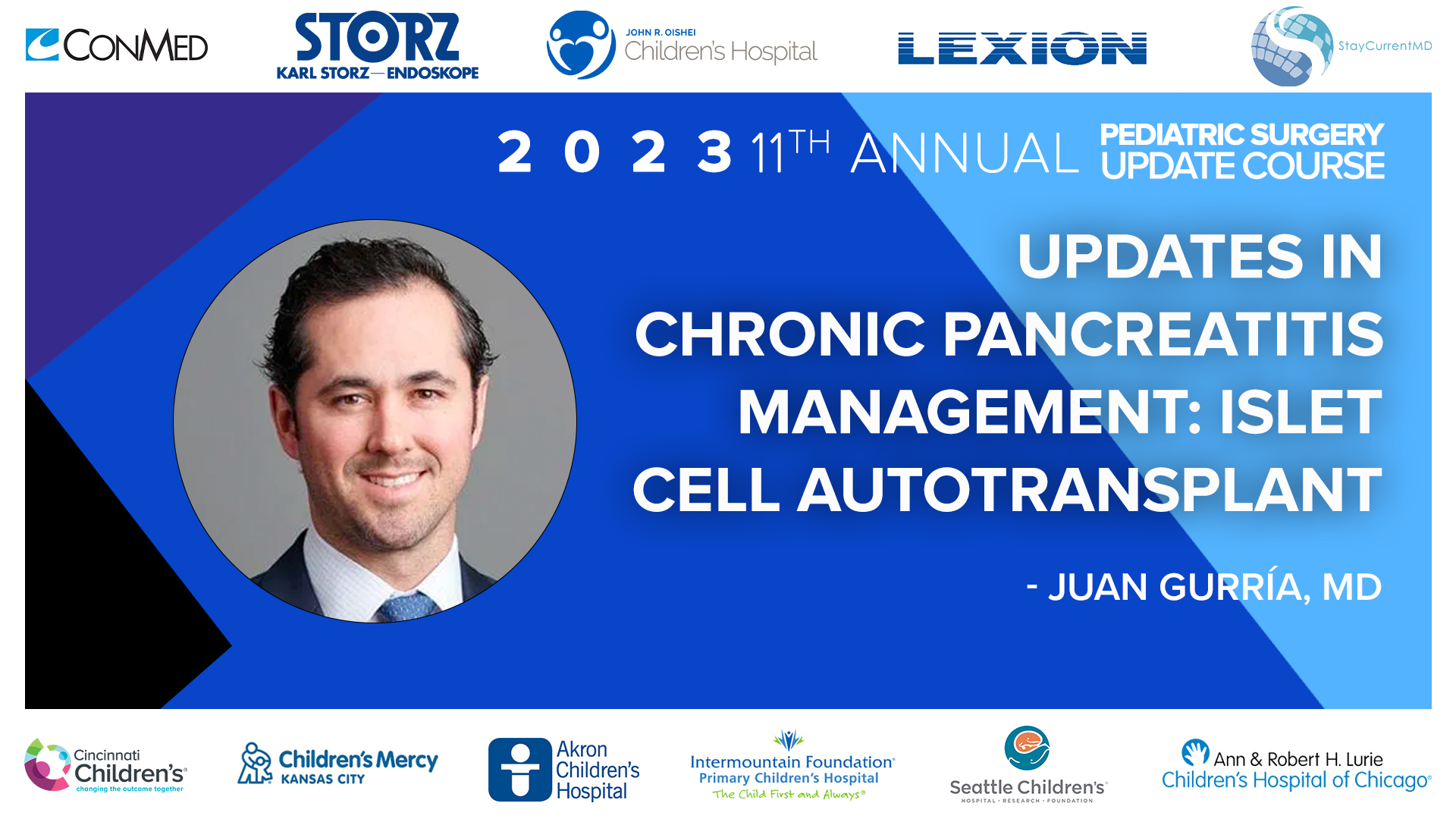
Update Course 2023 - Updates in Pancreatitis
32 min · Published Aug 2023
Video
Overview of the Surgical Management of Acute and Chronic Pancreatitis in Children with Dr. Juan Gurria
66 min · Published Apr 2026
Video
Acute and Acute Recurrent Pancreatitis: Pancreatic Disease
56 min · Published Sep 2016
Video
Chronic Pancreatitis, Function Tests, & Pain Management: Pancreatic Disease
51 min · Published Sep 2016
Video
Endoscopic & Surgical Interventions: Pancreatic Disease
55 min · Published Sep 2016
Podcast
Acute Pancreatitis
45 min · Published Jul 2017
Only a few other public items share this expert — go deeper there →
Video
Mental Health and Gun Safety in Pediatrics - Catherine Neyer - APP Conference 2026
48 min · Published May 2026
Video
Clinical & Research Update: Pediatric Liver Tumors - A Case-Based Discussion with Drs. Katherine Somers & Alex Bondoc
69 min · Published Apr 2026
Video
Beyond ChatGPT_ AI Tools You’re Not Using (But Should) - Vail, CO
Dr. Todd Ponsky · 97 min · Published Jan 2026
Video
Beyond ChatGPT: AI Tools You’re Not Using (But Should)
Dr. Todd Ponsky · 109 min · Published Oct 2025
Video
2025 Pediatric Surgery Update Course - Updates in Lap Chole and Cholecystitis Management
18 min · Published Aug 2025
Video
2025 Pediatric Surgery Update Course - Updates in Lap Chole and Cholecystitis Management
18 min · Published Aug 2025
What the experts said
Acute pancreatitis is diagnosed when the patient has 2 out of 3 criteria: classic epigastric pain, lipase or amylase 3 times the upper limit of normal, and imaging findings.
Acute recurrent pancreatitis is defined as having more than 1 attack, typically separated by a 1 month free interval, but could be less than 1 month if there is normalization of enzymes and a pain-free period.
Chronic pancreatitis requires imaging findings plus one of three: abdominal pain consistent with pancreatic origin, evidence of exocrine insufficiency, or endocrine insufficiency.
New cases of acute pancreatitis have an incidence in the United States of 1 in 10,000 cases, with up to a third developing recurrent attacks.
Chronic pancreatitis in the young population has an incidence of up to 2 per 100,000.
For CT of the pancreas in both chronic and acute pancreatitis, intravenous contrast should always be used because it provides the detail needed for imaging pancreatic parenchyma and vessels.
A single phase portal venous phase CT is almost always sufficient for pancreatic imaging; non-contrast phase is not needed as calcific pancreatitis is uncommon in pediatrics.
MRI provides the best combination of parenchymal and duct detail for pancreas imaging and is the cross-sectional test of choice.
Secretin administration during MRI improves conspicuity of pancreas divisum and is most helpful in patients with non-dilated ducts for characterizing ductal abnormalities.
Ultrasound is the first line test of choice in acute pancreatitis, but is only moderately sensitive; CT or MRI should be used when complications are suspected or diagnosis cannot be confirmed.
Cross-sectional imaging for suspected complications in acute pancreatitis is typically obtained several days to at least a week after initial presentation when a patient is not improving as expected.
In the International Study Group cohort of 300 pediatric pancreatitis patients, genetic causes were positive in 48% of acute recurrent pancreatitis patients and 33% of chronic pancreatitis patients when searching for one of 4 genes.
The Cincinnati Children's 10-gene pancreatic genetic testing panel uses next generation sequencing with more than 50x coverage at every targeted base, with all pathogenic and novel variants confirmed by Sanger sequencing.
Variants of unknown clinical significance are reported because what is a variant of unknown significance today might be reclassified as pathogenic or likely pathogenic later as more studies are done.
Genetic testing should ideally be ordered as directed by a genetic counselor after discussing implications for the patient's future, medical insurance, offspring, and family members.
Exocrine pancreatic insufficiency is characterized by reduction or deficiency of exocrine pancreatic enzyme activity and bicarbonate in the intestinal lumen below what is required to digest food, leading to maldigestion and malabsorption.
For fecal elastase, values less than 100 are consistent with severe pancreatic insufficiency, 100 to 200 are indeterminate, and greater than 200 are normal.
Fecal elastase values fluctuate through the first year of life, so an initial value in a younger patient can be very different from a value at 1 or 2 years of age.
At Cincinnati Children's, endoscopic pancreatic function testing involves IV bolus of secretin or CCK at time zero, then collecting 3 duodenal aspirates at 5-minute intervals, with point-of-care pH testing to ensure no gastric contamination.
Pancreatic enzyme concentrations peak at 5 minutes after secretin/CCK stimulation and then down-trend at 10 and 15 minute samples in both healthy patients and those with chronic pancreatitis.
Pancreatic function testing can be temporarily abnormal during acute pancreatitis, so results within 6 to 8 weeks of an episode should not be heavily relied upon; testing should be repeated later.
MRI with secretin can provide non-invasive measurement of exocrine function by quantifying duodenal and jejunal fluid secretion in response to secretin, compared to normative ranges established in 50 healthy children.
In a cross-sectional analysis of 52 chronic pancreatitis patients at Cincinnati Children's, 25% were diagnosed with either pre-diabetes or diabetes; 15% were diagnosed after the first attack of pancreatitis.
Mixed meal tolerance testing is the ideal diabetes screening method for pancreatic disease patients, similar to CF-related diabetes, involving fasting glucose followed by Boost stimulant and measuring insulin, glucose, and C-peptide every 30 minutes for 2 hours.
Despite multiple trials, there is no single medical or dietary intervention that can prevent recurrent episodes or treat pain effectively in chronic pancreatitis.
Low fat diet, pancreatic enzymes (if no exocrine insufficiency), antioxidant cocktail, steroids, leukotriene antagonists, and somatostatins have not been shown to be helpful in chronic pancreatitis pain management.
Cognitive behavioral therapy and physical therapy are effective in treating chronic pancreatitis pain when approached like other chronic pain conditions.
ERCP continues to be the gold standard for pancreatic duct imaging in children and is reserved for therapeutic interventions, with some exceptions for diagnostic purposes such as pancreatic trauma.
There is no age limitation for performing ERCP at Cincinnati Children's; even neonates can undergo successful and safe ERCP with appropriate equipment and accessories.
Altered surgical anatomy including Roux-en-Y is no longer a significant limitation for ERCP due to balloon enteroscopy techniques.
MRCP has false negative rates for pancreatic duct stones, chronic pancreatitis findings, and anomalous pancreaticobiliary junction (APBJ), which may be overlooked depending on stone size or patient size.
ERCP in children for chronic pancreatitis and pancreatic indications is more technically difficult and complex compared to performing similar procedures on adults, based on Cincinnati Children's experience with referrals from across the country.
Post-ERCP pancreatitis is the greatest risk factor from ERCP, with rates of 3 to 11% in larger pediatric cohort studies, equivalent to adult rates.
Other ERCP complications including perforation, bleeding, and infection occur at 1% or less in pediatric studies.
Pancreatic duct stents are temporary; there is no consideration for permanent stents in the pancreatic duct at the current time.
Serial stenting for pancreatic duct strictures should be performed for a maximum of one year; if strictures remain recalcitrant beyond one year, other interventions including surgical options should be considered.
In pediatric patients with chronic pancreatitis, the vast majority of pancreatic duct stones are soft and non-calcified, making them readily and easily removed with standard endoscopic therapies using baskets or retrieval balloons.
Lithotripsy options for calcified pancreatic duct stones include mechanical lithotripsy using a basket, electrohydraulic lithotripsy, laser therapy under direct visualization, and extracorporeal shock wave lithotripsy (ESWL).
Pancreas divisum is the most common congenital anomaly of the pancreas and is a known risk factor for acute recurrent pancreatitis and chronic pancreatitis.
Pancreas divisum has a prevalence of 7% in the general healthy population and 15% in the International Study Group cohort of children with acute recurrent and chronic pancreatitis.
At Cincinnati Children's, nearly two-thirds of pancreas divisum patients who underwent therapeutic ERCP with minor papilla sphincterotomy had either symptom improvement or complete symptom resolution.
For endoscopic ultrasound, the standard GI echo endoscopes have a weight limit of 15 kg; below that weight there is risk of upper esophageal perforation when inserting the scope.
An endobronchial echo endoscope at 6.5 millimeters can be used in smaller patients under 15 kg for diagnostic purposes and can perform fine needle aspiration up to 19 gauge.
Diagnostic endoscopic ultrasound is quite safe with perforation rates very similar to standard upper endoscopy and similar bacteremia rates.
Risk of pancreatitis increases when biopsying the pancreas during EUS, and there is also risk of bleeding after biopsy.
Therapeutic EUS procedures such as cyst gastrostomy, cyst duodenostomy, or rendezvous procedures have higher risks of bleeding, infection, and perforation compared to diagnostic EUS.
Endoscopic ultrasound is more sensitive than transabdominal ultrasound and even MRI for detecting microlithiasis in the gallbladder and choledocholithiasis.
Pancreatic fluid collections are defined by time course: acute fluid collections or acute necrotic collections occur in less than 4 weeks, while pseudocysts or walled-off necrosis that may require intervention occur after greater than 4 weeks and have an encapsulated wall.
The mainstay of therapy for pancreatic fluid collections is observation; even large pseudocysts and walled-off necrosis can often resolve with time if the patient is minimally symptomatic.
Endoscopic transgastric or transduodenal drainage of walled-off necrosis has been shown in multiple studies to have lower complication rates and decreased length of stay compared to surgical or percutaneous intervention.
Lumen-apposing metal stents for pancreatic fluid collection drainage are generally left in place for about 3 to 4 weeks at a time.
Endoscopic drainage of walled-off necrosis is 90% technically successful with 10 to 15% morbidity, 70 to 80% of patients have resolution of their collections, and about 10 to 15% have recurrence.
In pediatric patients with necrotizing pancreatitis, step-up therapy is required less frequently than in adults; pediatric patients tend to do really well once drained internally.
Well over 50% of patients with chronic pancreatitis eventually require some type of operation.
The most common indication for surgery in chronic pancreatitis is debilitating pain that fails to respond to medical and endoscopic treatment options.
Conventional operations for chronic pancreatitis result in initial pain relief in a number of patients, but pain recurs in approximately 50% of patients over the long term.
Large dilated duct and inflammatory head masses are fairly uncommon in pediatric chronic pancreatitis patients, as opposed to the adult population where these anatomic findings are more common.
The primary goal of total pancreatectomy with islet autotransplantation is to relieve pain and debilitation and impaired quality of life, not to preserve or save islets.
The goal of the islet autotransplant component is to preserve beta cell mass and alpha cell mass to make glycemic control more straightforward than without the islet autotransplant.
Children with genetic risk factors tend to fail conventional surgeries more often than those without genetic risk factors.