

From
StayCurrentMD
QUAD #10 Pt.3: Advantages of Thoracoscopic Repair of Esophageal Atresia with Dr. Steve Rothenberg
With Dr. Steven Rothenberg · hosted by Dr. M Goti
Educational content from recorded physician discussions — not medical advice. Talk to your (or your child's) care team about your situation.
Video
Esophageal Atresia/Tracheoesophageal Fistula Bronchoscopy and Surgical Technique
Dr. Todd Ponsky · 16 min · Published Nov 2021
Video
Update Course 2021: MAGNET THERAPY FOR ESOPHAGEAL ATRESIA
Dr. Steve Rothenberg · Published May 2022
Video
Thoracoscopic Repair of Tracheo-esophageal Fistula Tricks: Pediatric Surgery...
19 min · Published Jul 2017
Video
Esophageal Atresia in Brief: Presentation, Workup, Diagnosis, and Treatment
Dr. Todd Ponsky · Published Feb 2022
Video
Tips and Tricks: EA & TEF
Dr. Steve Rothenberg · 9 min · Published Dec 2012
Video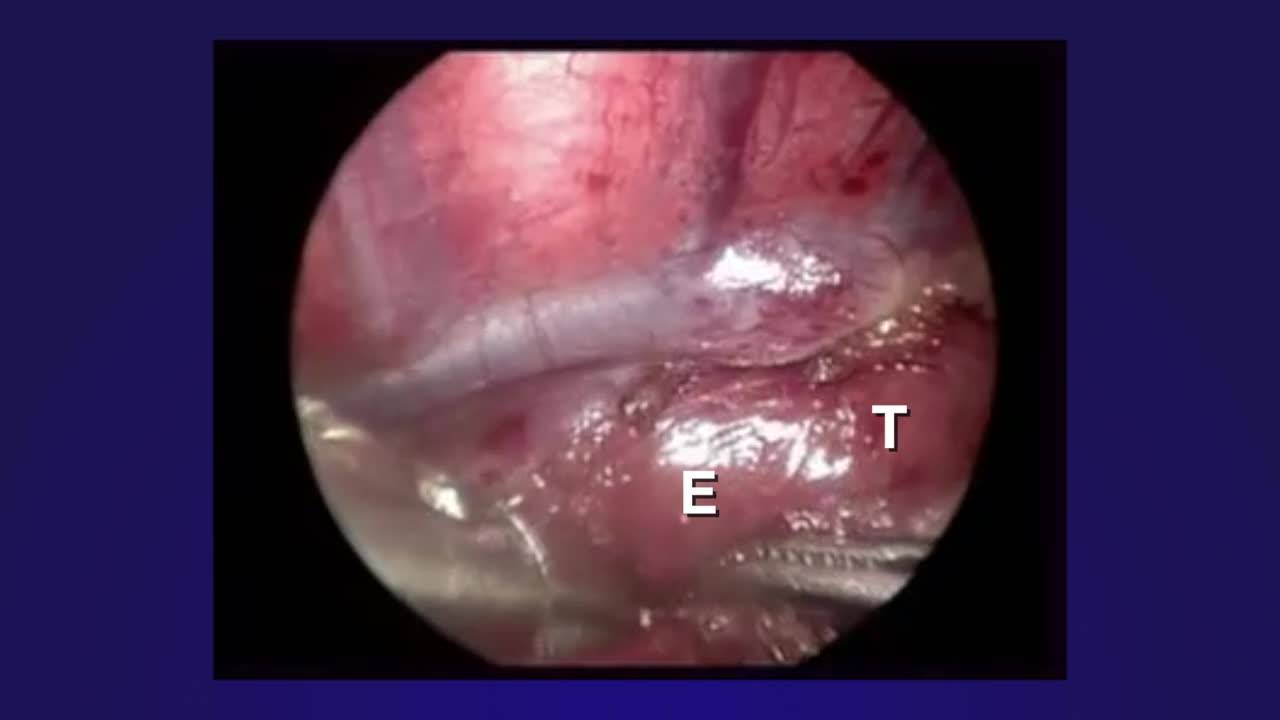
Thoracoscopic Repair of Esophageal Atresia with Distal Tracheo-esophageal...
5 min · Published Feb 2020
Video
Ladd Medal Award Presentation Honoring Dr. Steven Rothenberg's Pioneering Minimally Invasive Pediatric Surgery
Dr. Steve Rothenberg · 33 min · Published May 2026
Video
PDA ligation by Dr. Steven Rothenberg
Dr. Steve Rothenberg · 6 min · Published Jun 2023
Video
Update Course Rewind: Pectus Excavatum 2021
Dr. Todd Ponsky · 11 min · Published Aug 2022
Podcast
Update Course Rewind: Magnet Therapy for Esophageal Atresia
10 min · Published Dec 2021
Video
Update Course Rewind: Thoracotomy vs VATS for Lung Metastases
Dr. Todd Ponsky · 9 min · Published Dec 2021
Video
Thoracoscopic TEF Repair, Is It Really Better Than Open? Update Course 2018
18 min · Published Aug 2018
Video
Intestinal Atresia Types Explained: Grossfeld Classification for Pediatric Surgery
1 min · Published Sep 2026
Video
Derivation and validation of the Pediatric Community-Acquired Pneumonia Severity (PedCAPS) score: A prospective cohort study
50 s · Published Sep 2026
Video
FETO for Late-Diagnosed Severe Congenital Diaphragmatic Hernia (CDH) at Cincinnati Children's with Dr. Beth Rymeski
4 min · Published Sep 2026
Video
Severe Congenital Diaphragmatic Hernia (CDH) Case: FETO Management & Unexpected Findings with Dr. Beth Rymeski
3 min · Published Sep 2026
Video
Fetoscopic Endoluminal Tracheal Occlusion (FETO) Procedure: Step-by-Step Guide with Dr. Beth Rymeski
4 min · Published Sep 2026
Video
Choledochal Cyst Types Explained: Pediatric Surgery Fundamentals
1 min · Published Sep 2026
What the experts said
Open surgery for TEF creates some of the tracheomalacia that patients develop because surgeons crank on the trachea during dissection.
Residual esophageal pouches after open fistula ligation are more common than recognized, occurring when the fistula is ligated below the proper level.
Thoracoscopic repair allows elevation of the esophagus and direct visualization of where the fistula enters the membranous portion of the trachea.
Thoracoscopic dissection of residual esophageal pouches can be performed using a stapler.
According to Dr. Rothenberg, the key to achieving anastomosis in long-gap cases is gaining length through extensive upper pouch mobilization.
Thoracoscopic technique allows dissection all the way up to the posterior oropharynx under direct vision.
At Rocky Mountain Hospital for Children, they have never been unable to achieve primary repair of a type C fistula.
The staged repair technique involves gastrostomy tube placement, allowing growth for 3-8 weeks with bolus feeds to toughen up the lower pouch, obtaining a gap study, then performing thoracoscopic repair.
Extensive upper pouch mobilization can bring down a pouch that initially was at the thoracic inlet, allowing anastomosis in the lower third of the chest even with a six vertebral body gap.
Operative time for long-gap repairs ranges from 50 minutes to a little over 2 hours.
Documented anastomotic leaks after thoracoscopic repair were all treated successfully with conservative therapy.
All H-type fistulas are located in the same place, at the thoracic inlet.
Thoracoscopic approach to H-type fistulas allows direct visualization of the vagus and recurrent laryngeal nerves, potentially avoiding injury better than neck dissection.
Thoracoscopic approach avoids cranking on the trachea and retracting it out of the way, allowing dissection under direct vision.
A stapler can be used to divide H-type fistulas thoracoscopically, with tissue interposition placed between the divided ends.
Thoracoscopic approach causes less iatrogenic tracheomalacia compared to open surgery.
Thoracoscopic techniques offer significant advantages over open surgery in treating tracheoesophageal fistulas, including precise dissection and reduced complications like tracheomalacia.