


From
Live Event Content
Overview of the Surgical Management of Acute and Chronic Pancreatitis in Children with Dr. Juan Gurria
With Dr. Juan Gurria · hosted by Dr. Todd Ponsky
Chapter 1 of 7 · Fundamentals
Introduction
Introduction and Overview of Pediatric Pancreatitis
Expert statements on this page
No expert statements were drawn from this page.
Host summaries · secondary, not cited in answers
Educational content from recorded physician discussions — not medical advice. Talk to your (or your child's) care team about your situation.
Video
Update Course 2023 - Updates in Pancreatitis
32 min · Published Aug 2023
Video
Pancreas Care Updates 2020 - FULL SHOW
124 min · Published Dec 2020
Podcast
Managing pancreatic fluid collections and chronic pancreatitis complications in children
Dr. Juan Gurria · 2 min · Published Oct 2026
Video
Endoscopic & Surgical Interventions: Pancreatic Disease
55 min · Published Sep 2016
Video
Pancreatitis: Understanding Complications & Management of Fluid Collections w/ Dr. Juan Gurria
2 min · Published Oct 2026
Video
Chronic Pancreatitis, Function Tests, & Pain Management: Pancreatic Disease
51 min · Published Sep 2016
Video
Pancreatitis in pediatric patients with pancreatic solid pseudopapillary neoplasms- a single center experience
59 s · Published Apr 2026
Podcast
Update Course Rewind: Pediatric Biliary Stones - Preventing Gallstone Pancreatitis 2024
Jeffrey Ponsky · 3 min · Published Aug 2025
Video
Update Course Rewind: Pediatric Biliary Stones - Surgery First Mindset 2024
Dr. Todd Ponsky · 7 min · Published Jul 2025
Video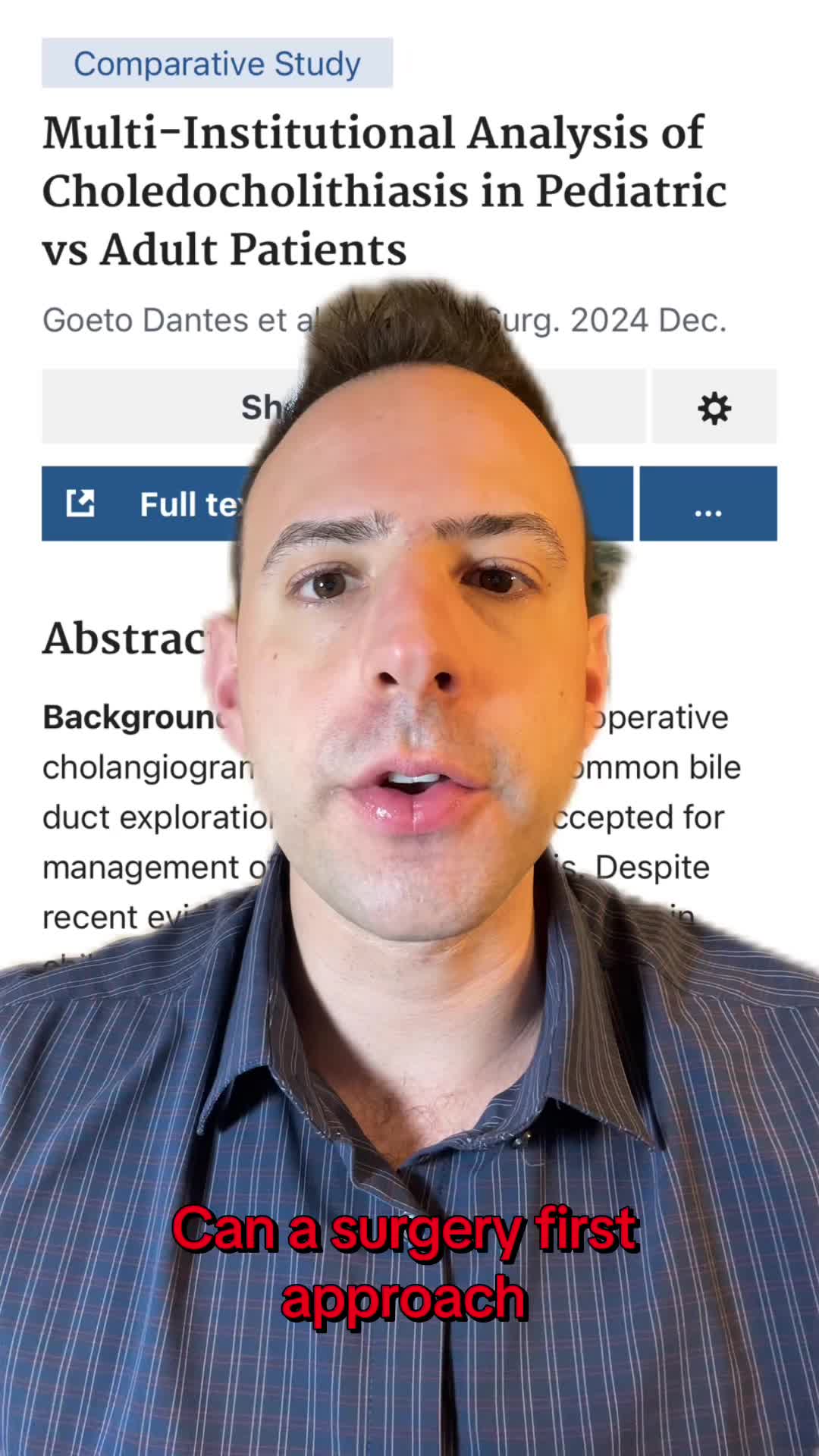
Multi-Institutional Analysis of Choledocholithiasis in Pediatric vs Adult Patients
59 s · Published Mar 2025
Video
Total pancreatectomy with islet autotransplantation (TPIAT) - Cincinnati Children's Pancreas Care Center
CCHMC Pediatric Surgery · 10 min · Published Dec 2024
Video
Chronic Pancreatitis - Pancreatic Pathologies by Cincinnati Children's Pancreas Care Center
CCHMC Pediatric Surgery · 8 min · Published Nov 2024
Video
Activating extracorporeal cardiopulmonary resuscitation
Dr. Juan Gurria · Published Nov 2026
Podcast
Preparing for successful ECPR: team coordination and early activation strategies
2 min · Published Nov 2026
Podcast
Surgical Decision-Making in Necrotizing Enterocolitis: Imaging, Timing, and Operative Strategies
11 min · Published Nov 2026
Podcast
Pediatric pancreatitis: diagnosis, causes, and genetic insights with Dr. Juan Gurria
3 min · Published Nov 2026
Podcast
Surgical management of chronic pancreatitis in children: when and how to intervene
4 min · Published Nov 2026
Video
Robotics in Pediatric Surgery: Which indications benefit the most? w/ Dr. Juan Gurria
18 min · Published Oct 2026
Video
Clinical & Research Update: Renal Tumors with Drs. Ethan Smith, Lindsay Haacker, Michael Daugherty, and Meera Kotagal
71 min · Published Sep 2026
Video
Clinical & Research Update: Neuroblastoma with Drs. Katherine Somers, Cara Morin, Juan Gurria, and Meera Kotagal
67 min · Published Sep 2026
Video
Clinical & Research Update: Sarcoma w/ Drs. Roshni Dasgupta, Joseph Pressey, Arthur Meyer, Luke Pater
66 min · Published Sep 2026
Video
2026 Laparoscopic Pediatric Hernia Repair
123 min · Published Jun 2026
Video
Beyond the Spectrum: Diagnosis, Myths & Management - Caitlin Couch & Leslie Lopez - APP Conference 2026
50 min · Published May 2026
Video
Dysautonomia: Navigating the Journey - Martha Willis - APP Conference 2026
55 min · Published May 2026
What the experts said
Diagnosis of acute pancreatitis requires serum lipase at least 3 times the upper limit of normal, plus imaging findings (ultrasound, MRI/MRCP, or CT).
In the Cincinnati Children's cohort of 1000 pediatric pancreatitis patients, 85% have genetic mutations.
PRSS1 mutation causes very aggressive attacks very early in life (ages 1–3 years) because it autoactivates trypsinogen inside the pancreas.
Medications including L-asparaginase, steroids, valproic acid, and diuretics (Lasix) can cause pancreatitis in children.
Hereditary pancreatitis increases the risk of pancreatic cancer by a huge fold, which is a major concern in children diagnosed at age 5–6 who may live 95 more years.
Most fluid collections in pediatric acute pancreatitis are self-limited and should not be touched unless absolutely necessary.
Early necrosectomies (before 4 weeks) usually increase mortality.
Following lipase levels tells you nothing about how the pancreas is behaving in acute pancreatitis; cross-sectional imaging is required.
Asymptomatic pseudocysts, regardless of size, do not require intervention.
Patients with acute pancreatitis should be fed as soon as possible (orally or via NG/NJ tube) because bacterial translocation from NPO status will complicate the disease.
In pediatric patients with hereditary pancreatitis or hereditary plus anatomic abnormalities, half will develop chronic pancreatitis.
Cincinnati Children's evaluates over 100 patients per year for chronic pancreatitis but only operates on 25–30, because medical and endoscopic options should be exhausted first.
Chronic pain in pancreatitis involves brain plasticity, hypertrophic nerve reactions, and peripheral nerve hypersensitization, not just organic retroperitoneal pain.
After total pancreatectomy, 95% of pain is resolved, but 5% may persist due to central sensitization and requires behavioral medicine and psychiatric support.
Pediatric chronic pancreatitis usually presents with minimal ductal changes, not the dilated ducts seen in adults, so drainage procedures are often not applicable.
In patients with genetic mutations, partial pancreatectomy (Whipple, distal pancreatectomy) discards islet mass and does not address the underlying defect, so the remaining pancreas continues to be affected.
TPIAT is indicated when patients have chronic pancreatitis findings, at least 6 months of disease, exocrine or endocrine insufficiency, and impaired quality of life despite maximal medical and endoscopic therapy.
The goal of islet autotransplantation is to replace beta cell mass and insulin secretory capacity, not to cure diabetes—pain control is the primary indication.
TPIAT used to be a 20-hour operation but is now down to an average of 8–9 hours at Cincinnati Children's.
Spleen-sparing TPIAT has equal glycemic outcomes to splenectomy TPIAT when islet equivalent per kilogram transplanted is matched.
Spleen-sparing TPIAT is now performed in 80% of cases (over the last 5 years), compared to none in the first 8 years of the program.
Intraoperative pyloric Botox injection reduces gastroparesis, decreases length of stay, and improves time to full oral intake and glycemic control after TPIAT.
Islet isolation takes about 3–3.5 hours, sometimes 4 hours depending on the degree of pancreatic injury.
TPIAT is performed under anticoagulation (heparin) to prevent portal vein thrombosis during islet infusion.
Portal vein thrombosis rate at Cincinnati Children's is less than 1% for TPIAT.
Cincinnati Children's has performed close to 200 TPIAT cases with no anastomotic leaks.
Patients are extubated in the operating room after TPIAT.
Younger children are more likely to achieve insulin independence and opioid independence after TPIAT.
Islet yield (IEQ/kg) is inversely related to pancreatic calcification, ductal dilation, fibrosis, duration of symptoms, and prior resections or drainage procedures.
Predictors of insulin independence after TPIAT include younger age at surgery, smaller body surface area, no pre-existing insulin dependence, and higher IEQ/kg transplanted.
TPIAT dramatically improves quality of life in appropriately selected children, with families reporting they have 'never met this kid before'—new person, happy, playing, eating normally.
Position papers from the European Pancreas Club and American Pancreas Association state there is no role for early pancreatectomies or early drainage procedures in acute pancreatitis.
The step-up approach for necrotizing pancreatitis—starting with transgastric endoscopic necrosectomy—reduces major complications compared to open surgery.
Lactated Ringer solution for initial resuscitation in acute pancreatitis is better than normal saline, per a paper from Cincinnati Children's by Dr. Farrell.
TPIAT results in over 80% reduction in opioid use at 1–2 months, with sustained effect for years.
Transplanting ≥5000 islet equivalents per kilogram into the portal vein predicts 92% insulin independence at 36 months (Minnesota data); Cincinnati Children's currently achieves 70% insulin independence.