


Chapter 6 of 11 · Evidence & Research
Residual BMI harm
Residual BMI and Metabolic Harm
Cued at 20:00 · stops at 23:00 · press play
Expert statements on this page
No expert statements were drawn from this page.
Host summaries · secondary, not cited in answers
Educational content from recorded physician discussions — not medical advice. Talk to your (or your child's) care team about your situation.
Video
Obesity: Advanced Practice Providers
36 min · Published Feb 2014
Video
Rapid Fire and Conclusion: Pediatric Obesity 2017
23 min · Published Feb 2018
Video
Pharmacology: Pediatric Obesity 2017
45 min · Published Feb 2018
Video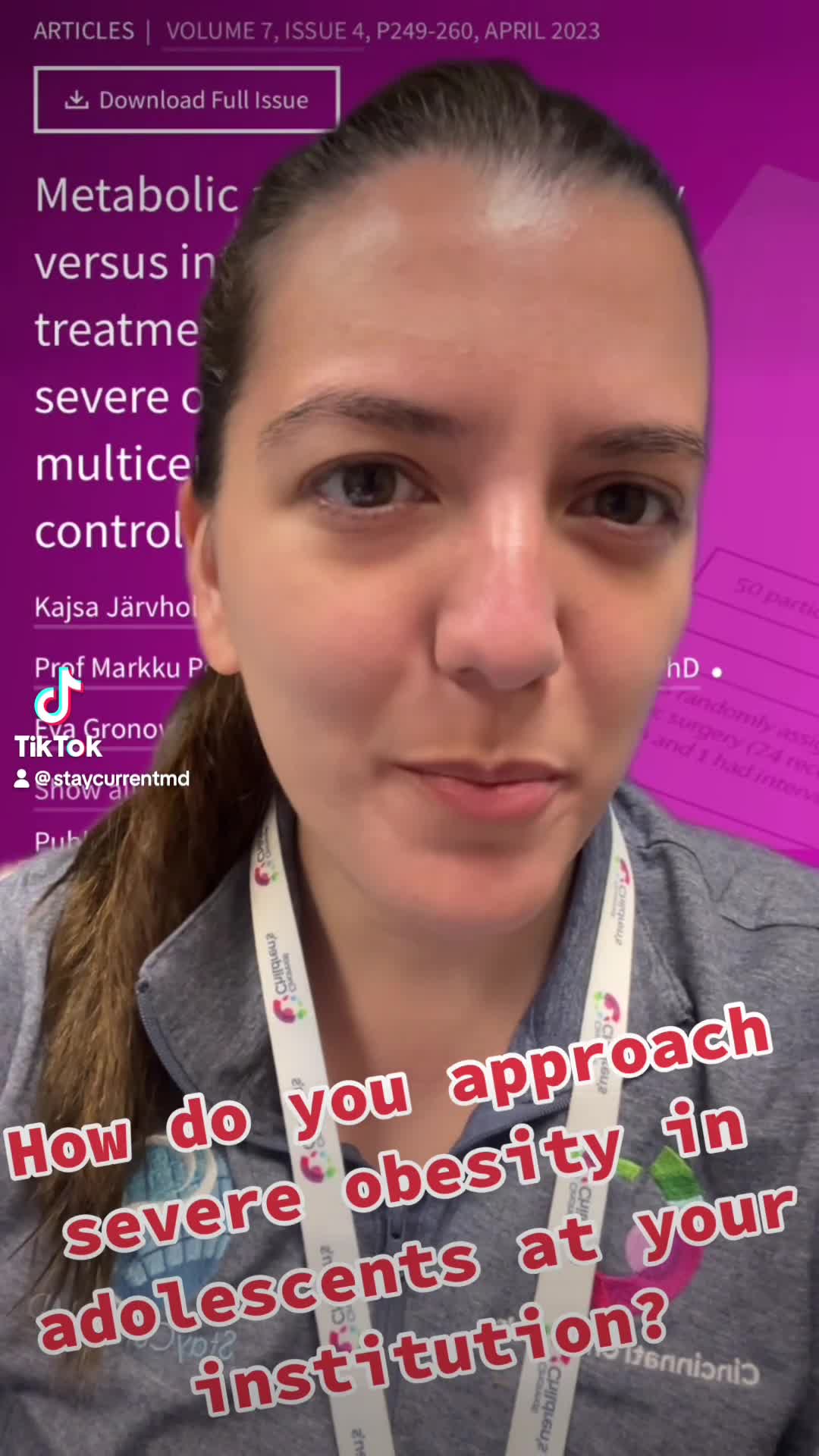
Metabolic and bariatric surgery versus intensive non-surgical treatment for adolescents with severe obesity (AMOS2)
Published Aug 2023
Video
AAP Policy for Adolescent Bariatric Surgery: Pediatric Obesity 2017
27 min · Published Feb 2018
Video
Update Course 2023 - Over and Under the Radar: Literature Updates in Pediatric Surgery
42 min · Published Aug 2023
Video
Update Course Rewind: Part 2 Non-Pectus Uses of Cryoanalgesia 2024
Lurie Children's Hospital · 4 min · Published Jun 2025
Video
Thomas Inge, MD - 2024 Pediatric Bariatric Surgery Update Course
Lurie Children's Hospital · 18 min · Published Feb 2024
Podcast
Bariatric Surgery in the Pediatric Patient
49 min · Published Jan 2018
Podcast
Diaphragm pacing as alternative to mechanical ventilation in pediatric respiratory failure
1 min · Published Nov 2026
Podcast
Fetoscopic endoluminal tracheal occlusion for congenital diaphragmatic hernia
4 min · Published Nov 2026
Podcast
FETO procedure for late-diagnosed severe CDH with liver herniation
4 min · Published Nov 2026
Podcast
Severe CDH case with FETO: unexpected anatomic findings and clinical outcome
3 min · Published Nov 2026
Podcast
Pediatric pancreatitis: diagnosis, causes, and genetic insights with Dr. Juan Gurria
3 min · Published Nov 2026
Podcast
Understanding craniosynostosis: skull sutures, growth patterns, and diagnosis in infants
10 min · Published Nov 2026
What the experts said
FAS-5 study achieved 81% participation (58 of 74 eligible) at 8-year follow-up, mostly with in-person research visits.
At 8-year mean follow-up, gastric bypass patients had a mean BMI decline of 29%.
Baseline BMI strongly correlates (R=0.75) with follow-up BMI: patients starting with BMI in the 60s end above 40, while those starting in the 40s reach near-normal BMI.
Remission rates at 8 years: 88% for diabetes, 64% for dyslipidemia, 75% for hypertension.
Among those without baseline comorbidities, incidence rates were 0% for diabetes, 50% for dyslipidemia (small denominator), and 3 of 29 developed hypertension.
Follow-up BMI predicts probability of hypertension, dyslipidemia, high CRP, high insulin, insulin resistance, and low HDL; higher residual BMI is metabolically harmful.
At 8 years, FAS-5 cohort showed low iron stores with anemia, elevated PTH, and low vitamin D in substantial numbers.
AMOS had high internal hernia rates due to unclosed mesenteric defects at laparoscopic gastric bypass; closing defects prevents this complication.
Teen Labs enrolled 242 adolescents (161 bypass, 67 sleeve, 14 band) at 5 centers; median age now 24, with 203 completing 5-year visits (72% in-clinic, 17% field).
Adding 33 sleeve gastrectomy patients to Teen Labs will provide 80% power to compare bypass vs. sleeve for outcomes including blood pressure, PTH, HDL, and BMI.
The 33 new sleeve patients can be enrolled within a year from consortium sites with ongoing clinical follow-up, enabling long-term comparisons.
Operating earlier after diagnosis of severe obesity may yield lower residual BMI and better long-term metabolic outcomes.
FAS-5 study had a residual mean BMI of 38 at 8 years, with many patients remaining severely obese; this residual obesity is metabolically harmful.
Severely obese patients have greater bone mineral density due to loading; rapid weight loss after bariatric surgery drops bone mass, raising the question of whether it stabilizes or continues to decline (bariatric bone disease).
Cardiovascular mortality begins to climb in the overweight range and increases definitively for adolescents at or above the 95th percentile BMI, leading to early cardiovascular death.
In AMOS study, non-surgical controls with severe obesity gained weight over 5 years (BMI 42→45).
AMOS gastric bypass patients had dramatic BMI reduction from 45 to 30, stable at 5 years, similar to adult controls and SOS cohort.
AMOS showed 83% dyslipidemia remission, 12 of 12 hypertension cases resolved, and 75% inflammation (CRP) resolved.
In AMOS, low vitamin D was found in >50% of gastric bypass patients and also in controls; low B12 and iron deficiency anemia were noted.