


From
Live Event Content
2026 Laparoscopic Pediatric Hernia Repair
With Dr. Todd Ponsky & Dr. Marcello Rombaldi
Chapter 8 of 8 · Surgical Management
Direct hernias
Direct Hernia Repair: Guest Presentation by Marcello Rombaldi
Cued at 1:44:34 · press play
Expert statements on this page
No expert statements were drawn from this page.
Host summaries · secondary, not cited in answers
Educational content from recorded physician discussions — not medical advice. Talk to your (or your child's) care team about your situation.
Video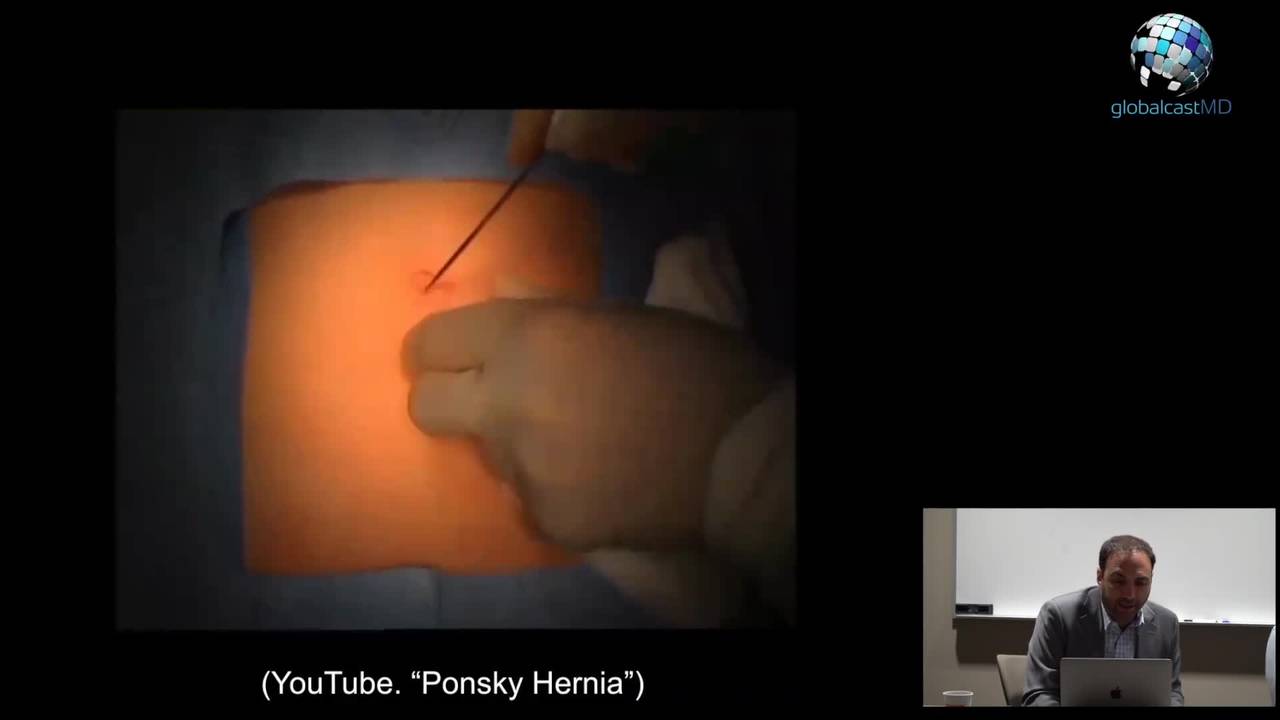
Laparoscopic Pediatric Hernia Repair: Online Course 2017
Dr. Todd Ponsky · 102 min · Published Aug 2017
Video
2024 Laparoscopic Hernia Event
102 min · Published Jun 2024
Video
Focus on Technique- Laparoscopic Pediatric Hernia Repair 2015
Dr. Todd Ponsky · 140 min · Published Mar 2014
Video
Laparoscopic Pediatric Hernia Repair 2025
140 min · Published Jun 2025
Video
Pediatric Hernia: Update Course 2013
52 min · Published Jul 2017
Video
Groin Controversies - Todd Ponsky: Update Course 2014
Dr. Todd Ponsky · 28 min · Published Nov 2018
Podcast
Surgical Decision-Making in Necrotizing Enterocolitis: Imaging, Timing, and Operative Strategies
11 min · Published Nov 2026
Video
AI applications in pediatric surgery and clinical transformation with Dr. Todd Ponsky
Dr. Todd Ponsky · 7 min · Published Oct 2026
Podcast
The Future of Surgical Education: A King, an Ox, & Elon Musk
Todd Ponsky · 26 min · Published Oct 2026
Podcast
Unconscious Bias
Todd Ponsky · 58 min · Published Oct 2026
Video
Storycasts in Pediatric Surgery: Interactive Storytelling to Transform Clinical Education
Todd Ponsky · Published Oct 2026
Podcast
Necrotizing Enterocolitis
Todd Ponsky · 46 min · Published Oct 2026
Video
Clinical & Research Update: Renal Tumors with Drs. Ethan Smith, Lindsay Haacker, Michael Daugherty, and Meera Kotagal
71 min · Published Sep 2026
Video
Clinical & Research Update: Neuroblastoma with Drs. Katherine Somers, Cara Morin, Juan Gurria, and Meera Kotagal
67 min · Published Sep 2026
Video
Clinical & Research Update: Sarcoma w/ Drs. Roshni Dasgupta, Joseph Pressey, Arthur Meyer, Luke Pater
66 min · Published Sep 2026
Video
Beyond the Spectrum: Diagnosis, Myths & Management - Caitlin Couch & Leslie Lopez - APP Conference 2026
50 min · Published May 2026
Video
Dysautonomia: Navigating the Journey - Martha Willis - APP Conference 2026
55 min · Published May 2026
Video
Everything You Ever Wanted to Know About G-tubes But Were Afraid to Ask - Betsy Gerrein - APP Conference 2026
30 min · Published May 2026
What the experts said
Patent processus vaginalis may close spontaneously - Ponsky reports having a patient with documented PPV on initial laparoscopy that was absent on second laparoscopy for unrelated indication
Risk of anesthesia is now so low that bringing a child back for delayed hernia repair after PPV discovery is acceptable
Laparoscopic hernia repair in adolescents may reduce pain compared to open repair because the groin is a very nerve-dense area
When insufflating a distended abdomen for bowel obstruction, waiting 5-10 minutes allows bowel loops to spread out and improve visualization
Open preemie hernia repairs may be causing floor injuries leading to direct hernias that present in adulthood
Ponsky reports never having re-operated on a hernia recurrence in 20 years except for his first seal technique case
Ponsky reports having had maybe 2 hydroceles after laparoscopic repair in 20 years, both of which resolved spontaneously
In rabbit model, suture repair alone showed 25% remained closed at 2 weeks after suture removal, while injury plus suture showed 90% closed at 2 weeks and 100% at 4 weeks
In rabbit suture material study, Vicryl had 80% failure rate, Prolene 75% failure, and silk 10% failure after suture removal
Braided suture works better than monofilament for hernia repair based on rabbit studies
In neonates, Ponsky uses single ligation rather than double because of risk of suture granuloma and spitting due to short distance from skin to knot
Ponsky uses 3-0 Ethibond (braided non-absorbable suture) for the final hernia repair after threading with Prolene
Study of adolescent high ligation (ages 13-18) showed 2% recurrence rate overall, only 0.9% confirmed recurrence at 2-year follow-up
Statistical analysis of adult and pediatric hernia types suggests age 40 may be inflection point where direct hernias become more common, though most remain indirect
Direct inguinal hernias in children are rare findings, making it difficult for pediatric surgeons to maintain proficiency in their repair
Rombaldi reports no hydroceles or scrotal complications from leaving the sac in place during laparoscopic repair
Contralateral PPV is present 30-40% of the time according to Witt's 1994 paper
Risk of metachronous hernia after unilateral repair is 3-11%
In rabbit studies, grabbing the vas deferens in a preemie-sized vessel just once can obliterate it and cause scarring
Ben Zendejas' 50-year follow-up study at Mayo showed some evidence of infertility after childhood inguinal hernia repair
In a study of 8500 patients at fertility clinic, 6% had prior inguinal hernioplasty and their semen quality was markedly reduced compared to fertile men
Risk of hernia incarceration is high in preemies but drops to 1-3% after 1 year of age and less than 1% each year thereafter
The most common recurrence after indirect inguinal hernia repair is a direct hernia, not another indirect hernia
Kaiser study of 1700 children showed recurrence rate of 0.9% for laparoscopic unilateral hernias, with 0.8% for open and 0.3% for laparoscopic
Montreal group published 10% recurrence rate with laparoscopic repair, significantly higher than other centers reporting less than 1%
Felix Shear's studies showed no impediment to cord blood flow after laparoscopic hernia repair
Norwegian mentorship program for adult laparoscopic high ligation reported zero recurrences
VA cooperative study showed chronic pain after mesh hernia repair as high as 30%
Incidence of chronic pain after mesh repair is substantial, and mesh can migrate
Recent adult surgery paper comparing huge scrotal hernias found no difference in complications between resecting versus abandoning the hernia sac