
Laparoscopic Pediatric Hernia Repair: Online Course 2017
With Dr. Ian Mitchell & Dr. Jeff Gander & Dr. Luis Zia Saya & Dr. Abby Schlager · hosted by Dr. Todd Ponsky · Live Event Content
Educational content from recorded physician discussions — not medical advice. Talk to your (or your child's) care team about your situation.
Video
2026 Laparoscopic Pediatric Hernia Repair
123 min · Published Jun 2026
Video
Focus on Technique- Laparoscopic Pediatric Hernia Repair 2015
Dr. Todd Ponsky · 140 min · Published Mar 2014
Video
Pediatric Hernia: Update Course 2013
52 min · Published Jul 2017
Video
Groin Controversies: Update Course 2016
Dr. Todd Ponsky · 28 min · Published Jul 2017
Video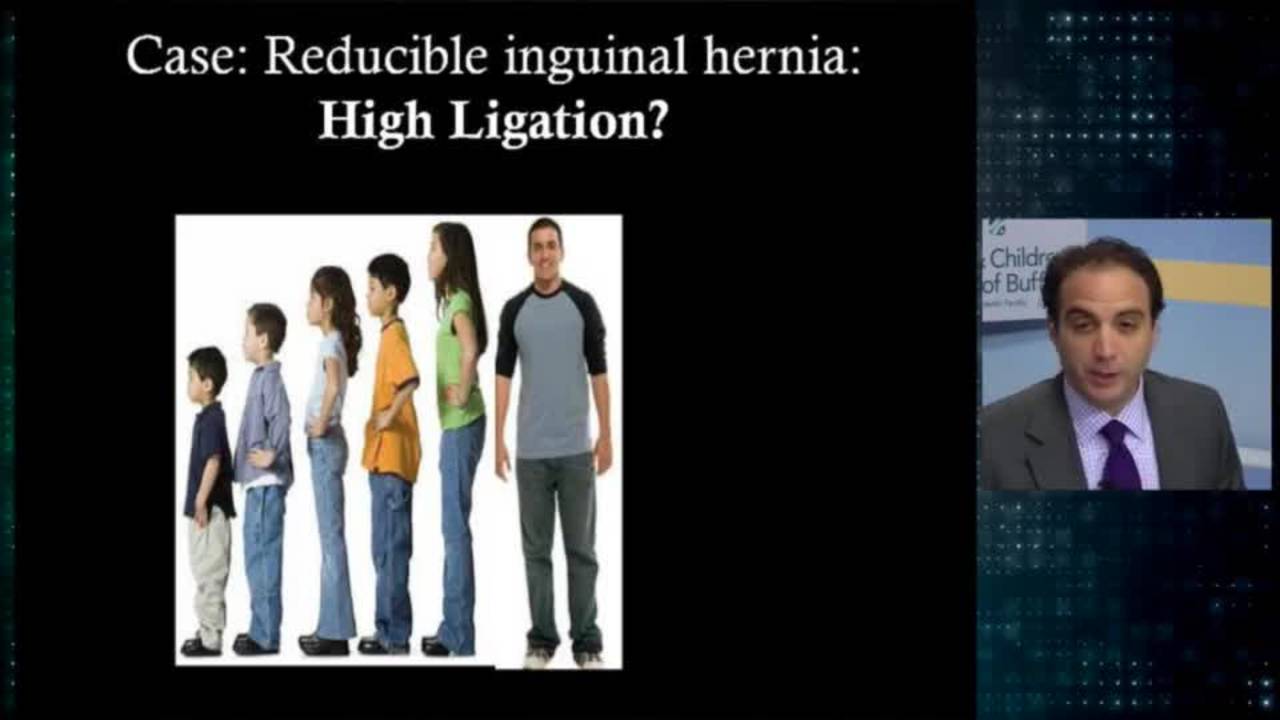
Groin Controversies - Todd Ponsky: Update Course 2014
Dr. Todd Ponsky · 28 min · Published Nov 2018
Podcast
Inguinal Hernia: Adult
31 min · Published Jan 2017
Only a few other public items share this expert — go deeper there →
Video
Mental Health and Gun Safety in Pediatrics - Catherine Neyer - APP Conference 2026
48 min · Published May 2026
Video
Overview of the Surgical Management of Acute and Chronic Pancreatitis in Children with Dr. Juan Gurria
66 min · Published Apr 2026
Video
Clinical & Research Update: Pediatric Liver Tumors - A Case-Based Discussion with Drs. Katherine Somers & Alex Bondoc
69 min · Published Apr 2026
Video
Beyond ChatGPT_ AI Tools You’re Not Using (But Should) - Vail, CO
Dr. Todd Ponsky · 97 min · Published Jan 2026
Video
Beyond ChatGPT: AI Tools You’re Not Using (But Should)
Dr. Todd Ponsky · 109 min · Published Oct 2025
Video
2025 Pediatric Surgery Update Course - Updates in Lap Chole and Cholecystitis Management
18 min · Published Aug 2025
What the experts said
In a rabbit model, grabbing the vas deferens once with pickups obliterates it.
The 'ocean argument': laparoscopic hernia repair difficulty remains constant regardless of external complexity (incarceration, prematurity, inflammation), unlike open repair where external factors significantly increase difficulty.
With laparoscopic approach, waiting 24-48 hours after reducing an incarcerated hernia may be unnecessary since inflammation does not complicate the laparoscopic repair as it does open surgery.
The most common cause of recurrence after open pediatric hernia repair is development of a direct hernia, not indirect recurrence.
Direct hernias after initial indirect repair may be iatrogenic: pulling up the cord during open dissection in premature infants with see-through thin floors may take fibers of the floor and cause a direct defect.
SEAL technique (Harrison/Albanese/Novahara, Stanford) uses large CT needle to capture substantial tissue in single pass; very fast (<1 minute) but Ponsky found high postoperative pain, possibly from capturing nerves or excessive tissue.
When performing laparoscopic hernia repair, if cord structures are visible between peritoneum and needle, the needle has passed under the cord—safe passage shows only peritoneum over the needle.
In rabbit hernia model, suture ligation alone without peritoneal injury resulted in 75% failure at 2 weeks and 83% failure at 4 weeks when suture was removed.
In rabbit model, anterior peritoneal injury plus suture resulted in 87% closure at 2 weeks and 100% reperitonealisation at 4 weeks even after suture removal.
Braided non-absorbable suture (Ethibond) performed best in rabbit hernia repair studies compared to absorbable (Vicryl) or monofilament non-absorbable (Prolene).
Repeat study comparing absorbable vs. non-absorbable suture with peritoneal injury showed equal failure rates on both sides, suggesting technical error rather than suture type determined outcome.
In babies, single knot ligation is preferred over double ligation to reduce suture granuloma risk from thin subcutaneous tissue; older children tolerate double ligation without granuloma formation.
Postoperative hydrocele after laparoscopic hernia repair is extremely rare; in 10+ years Ponsky has never required intervention for one.
Survey of pediatric vs. adult surgeons on same adolescent hernia case: 86% of pediatric surgeons chose high ligation, while adult surgeons predominantly chose muscle/mesh repair—same anatomy, different training.
Direct inguinal hernias begin appearing around age 29 in adults, suggesting a floor pathophysiology change at that age that may distinguish pediatric-type indirect hernias from adult-type requiring floor reinforcement.
Two-center retrospective study (Kansas City and Rainbow) of adolescents receiving open high ligation showed 1.9% recurrence rate.
At IPEG Hawaii ~10 years ago, ~90% of audience favored open hernia repair; at BAPS London recently, ~70-80% favored laparoscopic—represents major practice shift.
Patent processus vaginalis may close spontaneously even years after initial identification; one case showed complete closure 3 years after documented patent processus on prior laparoscopy.
Contralateral patent processus vaginalis presents in 30-40% of children with unilateral hernia (Holcomb 1994), with 4× greater risk of developing symptomatic hernia and 3-11% metachronous hernia rate.
Zendejas 50-year follow-up (Journal of American College of Surgeons) found 5% infertility rate after hernia repair, matching general population—no evidence of infertility problem from hernia surgery.
Andrologia study of 8500 fertility clinic patients showed markedly reduced semen quality and morphology problems in men with prior hernia repair compared to fertile controls.
Adult general surgeons performing Lichtenstein mesh repairs argue that pulling up the cord disrupts the floor even in indirect hernias, so they always reinforce with mesh or fascia repair.
Early laparoscopic hernia repairs using Z-stitch technique (Felix Shear era) had 6% or higher recurrence rates; modern techniques with modifications have reduced this substantially.
Current large studies from multiple countries (mostly China) report laparoscopic pediatric hernia recurrence rates of approximately 1% or less.
Bernia technique (Godoy/Varela/Guelfand, Chile): in girls, grasp and invert the patent processus sac, then cauterize extensively to obliterate it without suture; two-center study (with Navotny) reported no recurrences.
Munther Haddad (Leeds, UK) published series on open hernia repair with sac division but no ligation, achieving same recurrence rate as traditional ligation; argues ligation creates a smaller hernia sac rather than eliminating it.
Mario Raquelme performs complete laparoscopic sac excision without suture closure, relying on muscle layer apposition after sac removal; reports minimal recurrences.
Choi (Seoul, Korea) published comparison of totally laparoscopic hydrocelectomy vs. scrotal incision for pediatric cord hydrocele, demonstrating feasibility of laparoscopic approach.
NIH study reported 30% chronic groin pain rate after adult mesh hernia repairs, though expert hernia surgeons argue their rates are lower.
Felix Shear ultrasound study showed no deficiency in testicular blood flow after laparoscopic hernia repair in infants.