
Groin Controversies: Update Course 2016
With Dr. Dr. Corn · hosted by Dr. Todd Ponsky · StayCurrentMD
Educational content from recorded physician discussions — not medical advice. Talk to your (or your child's) care team about your situation.
More about patent processus vaginalis
same diagnosisDive deeper → Patent Processus Vaginalis (5 items)Video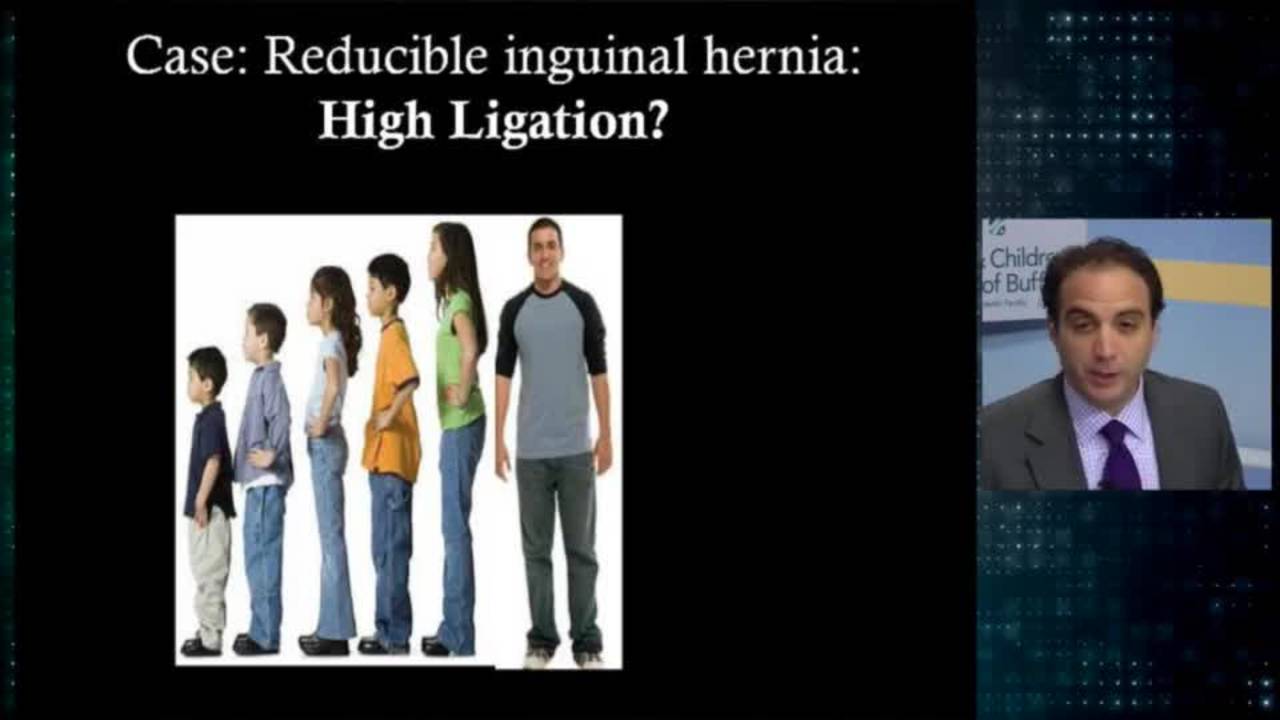
Groin Controversies - Todd Ponsky: Update Course 2014
Dr. Todd Ponsky · 28 min · Published Nov 2018
Video
Pediatric Hernia: Update Course 2013
52 min · Published Jul 2017
Video
2026 Laparoscopic Pediatric Hernia Repair
123 min · Published Jun 2026
Video
Laparoscopic Pediatric Hernia Repair: Online Course 2017
Dr. Todd Ponsky · 102 min · Published Aug 2017
Video
Focus on Technique- Laparoscopic Pediatric Hernia Repair 2015
Dr. Todd Ponsky · 140 min · Published Mar 2014
Podcast
Case-Based Journal Review: Inguinal Hernia 2025
19 min · Published Apr 2025
Only a few other public items share this expert — go deeper there →
Video
Pediatric Surgical Oncology Research Collaborative (PSORC): Studying Rare Pediatric Tumors
56 s · Published May 2026
Video
Update Course Rewind 2025: Hirschsprung + ARM: Rare but Real
1 min · Published May 2026
Video
Update Course Rewind 2025: Hirschsprung + ARM: Rare but Real
1 min · Published May 2026
Video
Pooling Patients to Study Rare Pediatric Tumors: An Introduction to PSORC
56 s · Published May 2026
Video
The fetal frontier: A review of current and emerging fetal therapies for genetic diseases
44 s · Published May 2026
Video
Indocyanine green assists with sentinel lymph node mapping in pediatric and adolescent patients
1 min · Published May 2026
What the experts said
A patent processus vaginalis confers a 4 times greater risk than the general population of developing a hernia at some point in life, but the patient may never have a problem.
For children under 5 years old, the argument is that a patent processus vaginalis hasn't been there long enough to show whether it will become symptomatic.
A patent processus vaginalis is the same pathology from day of life one to the end of life; if there's a muscle problem, that's a different type of hernia.
High ligation is the appropriate repair for indirect inguinal hernia at any age.
The finger-up-the-canal examination is worthless and just tortures kids; you can feel better with fingers over the area of the internal and external ring.
Adult surgeons at the SAGES hernia course do not use the finger-in-canal examination technique; they all palpate over the external ring area.
No study has been done showing clinicians can reliably differentiate direct from indirect inguinal hernias on physical examination.
In a rabbit study, when injury was caused to the peritoneum and then repair performed, the closure was much more durable; even if the stitch was cut out after 12 weeks, the closure remained intact.
The injury to the peritoneum really keeps the hernia closure intact.
When a braided non-absorbable suture is used for laparoscopic hernia repair, the repair is better, at least in rabbits.
There was a generation of surgeons who spent a lot of time picking out silk sutures spitting out of the groin or abscesses years after placement.
A retractile testicle is defined as one that can be pulled down and stays down after you let go.
A true retractile testis that can be pulled down has occasionally gone up and gotten trapped; it's a known phenomenon that has been reported.
Once a child has gone through puberty and the testicle is much larger, it cannot retract, so following them until post-pubertal ensures the testicle will stay in the scrotum.
If a testicle can be pulled down easily, even if it pulls back, it should be considered descended.
Post-operative ascent of a retractile testicle after hernia repair is likely due to getting cremasteric muscle or cord vessels stuck in the external oblique closure during open repair.
If there's an absent testicle that cannot be found on exam, you don't need an ultrasound; you go straight to laparoscopy.
Retrospective data and prospective pilot data presented at IPEG suggest that one-stage Fowler-Stevens is just as good as two-stage.
Witt's argument is that hernia repair is not the type of conversation to have quickly in the waiting room with a family because if there were some injury, that was a rushed conversation about something they may never have a problem with their entire lives.
Scott Bollinger said, 'Why eat tomorrow's lunch today?' regarding elective repair of asymptomatic patent processus vaginalis.
The first operation for hernia repair was herniotomy, which worked 70% of the time but had a 30% recurrence rate.
Ladd and Gross started doing high ligation, while adult surgeons thought it was a floor problem and started doing Bassini and McVay repairs, which have a 10% recurrence rate.
Lichtenstein mesh repair got the recurrence rate down to 1% in adults.
Dr. Ricketts would say that if a testicle was in the inguinal canal, you should have been able to find it on groin examination.