
 StayCurrentMD
Favorable Histology Wilms Tumor
Everything in the library about favorable histology Wilms tumor — built automatically from the recorded discussions that name it
Educational content from recorded physician discussions — not medical advice. Always talk to your child's care team about your child's situation.
Content of this collection
Evidence & Research
2 items


Impact of Pulmonary Tumor Burden in Favorable Histology Wilms Tumor Outcomes: A Report From the Children's Oncology Group Study AREN053
Watch →
David B Dix Geetika Khanna, Lindsay A Renfro, Ian C Tfirn, Ethan A Smith, Maddy Artunduaga, Meryle J Eklund, Jesse K Sandberg, Lauren N Parsons, John A Kalapurakal, Peter F Ehrlich, Jennifer H Aldrink, Richard D Glick, Daniel J Benedetti, C
video1:15 · Mar 2026
Updated Favorable histology Wilms tumor risk stratification: Rationale for future Children’s Oncology Group clinical trials
Watch →
Daniel J Benedetti, Nicholas G Cost, Peter F Ehrlich, Nicholas Evageliou, Elizabeth Fialkowski, Lauren N Parsons, Kelly L Vallance, Lindsay A Renfro, Andrew L Hong, Jennifer H Aldrink, Luke Pater, Arnold C Paulino, Jesse K Sandberg, Ethan A
video0:53 · Apr 2026
Case-Based Learning
1 item
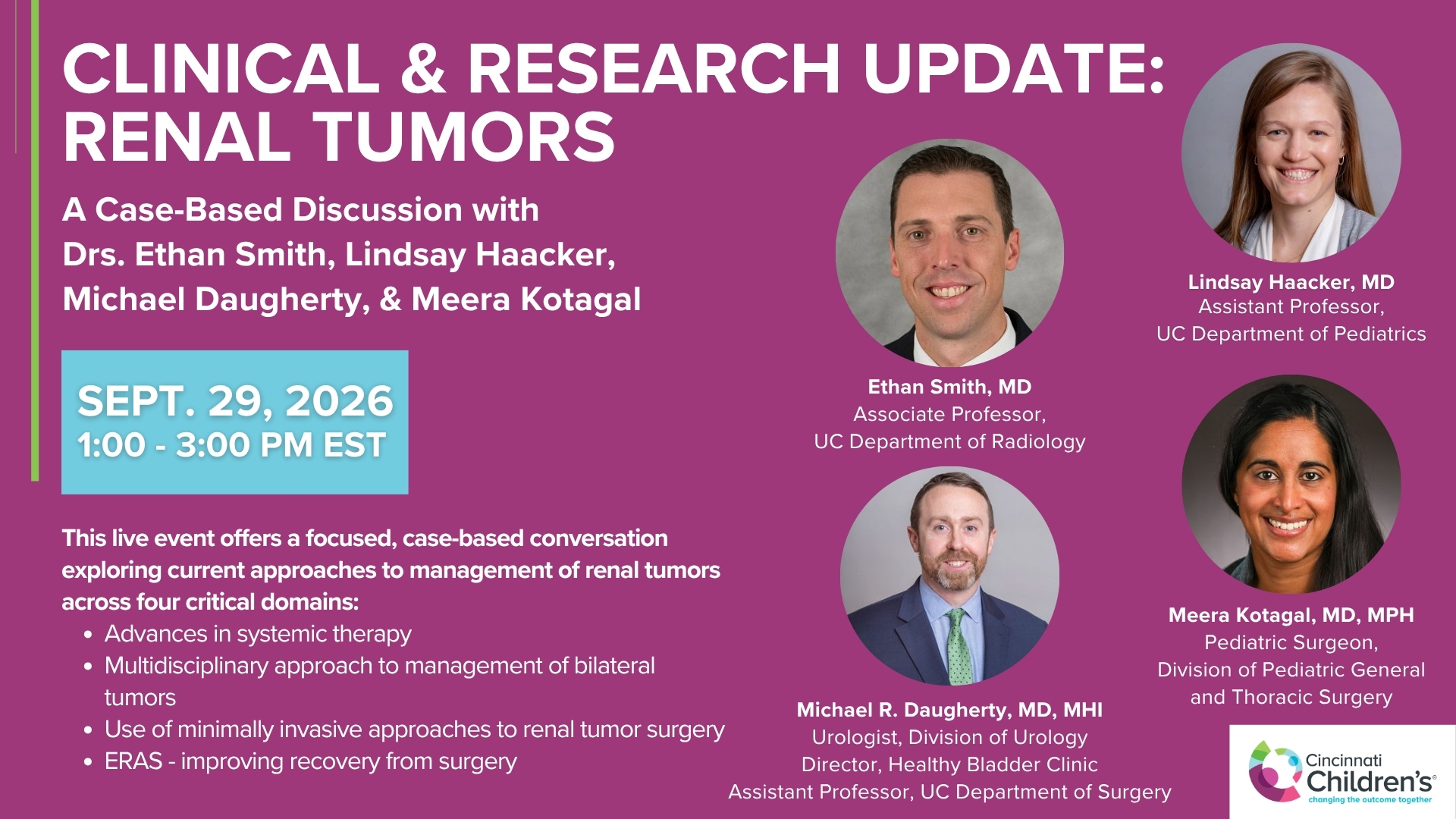
Clinical & Research Update: Renal Tumors with Drs. Ethan Smith, Lindsay Haacker, Michael Daugherty, and Meera Kotagal
Watch →
This video features a multidisciplinary panel from Cincinnati Children's, Drs. Ethan Smith, Lindsay Haacker, Michael Daugherty, & Meera Kotagal, discussing pediatric renal tumors, primarily Wilms tumor. Led by a pediatric oncology fellow, t
video1:11:52 · Sep 2026
Summaries and takeaways+ Show
The doctors in this collection+ Show
All expert statements+ Show
Every expert statement below comes from the recorded discussions, with its speaker and moment.
Impact of Pulmonary Tumor Burden in Favorable Histology Wilms Tumor Outcomes: A Report From the Children's Oncology Group Study AREN053
Dick et al. published a report from a Children's Oncology Group study in the Journal of Clinical Oncology in 2025
host_summaryJill Knepprath0:14 ↗
The study examined factors in patients with favorable histology Wilms tumor and pulmonary metastases and how those factors may affect outcomes
host_summaryJill Knepprath0:19 ↗
Factors studied included the number of metastases, the size of the metastases, and different biological markers
host_summaryJill Knepprath0:30 ↗
There was no difference in survival based on the number of metastases
host_summaryJill Knepprath0:36 ↗
Patients who had a rapid response to chemotherapy with larger nodules showed worse event-free survival
host_summaryJill Knepprath0:41 ↗
Patients with larger nodules and rapid response to chemotherapy showed no changes in overall survival
host_summaryJill Knepprath0:41 ↗
In multivariable models, neither the size nor the number of nodules had any effect on survival
host_summaryJill Knepprath0:49 ↗
1q gain was associated with worse event-free survival
host_summaryJill Knepprath0:55 ↗
1q gain was associated with worse overall survival
host_summaryJill Knepprath0:55 ↗
1q gain is the superior prognostic factor when compared to size and number of nodules in patients with favorable histology Wilms tumor and pulmonary metastases
host_summaryJill Knepprath1:04 ↗
Updated Favorable histology Wilms tumor risk stratification: Rationale for future Children’s Oncology Group clinical trials
Risk stratification for Wilms tumor has evolved many times over the years.
host_summaryJill Knera0:00 ↗
The Children's Oncology Group published updated risk stratification for patients with favorable histology Wilms tumor in Nature in June 2025.
host_summaryJill Knera0:09 ↗
The new risk stratification model includes biological and clinical features that were not in the first generation risk stratification.
host_summaryJill Knera0:19 ↗
The new model changes some of the older features or gets rid of them altogether.
host_summaryJill Knera0:27 ↗
Factors being added are loss of heterozygosity of 11P15, 1Q gain, and lymph node involvement.
host_summaryJill Knera0:32 ↗
Tumor nephrectomy weight is no longer included in the risk stratification.
host_summaryJill Knera0:41 ↗
The model modified how histology and age are used to stratify certain patients.
host_summaryJill Knera0:43 ↗
More changes are expected in the future as ongoing COG trials produce more results.
host_summaryJill Knera0:48 ↗
Clinical & Research Update: Renal Tumors with Drs. Ethan Smith, Lindsay Haacker, Michael Daugherty, and Meera Kotagal
Tumors larger than 12 centimeters have an increased risk of intraoperative spill.
clinicalMeera Kotagal8:27 ↗
Biopsy can upstage the patient and change treatment down the line, including radiation that may otherwise not have been necessary.
clinicalLindsay Hacker7:31 ↗
At least one lymph node must be sampled to be eligible for the current COG trial (AREN 2231).
guidelineMeera Kotagal10:18 ↗
The lymph node stations important for Wilms tumor include left renal hilar, periaortic, and aortic cable window.
clinicalMeera Kotagal9:55 ↗
AREN 2231 expands very low risk criteria to include any child less than 4 years old and eliminates the tumor weight threshold.
guidelineLindsay Hacker16:12 ↗
Patients with one copy number gain (1q gain) are considered to have adverse biology on AREN 2231 and require chemotherapy.
guidelineLindsay Hacker17:50 ↗
Enhanced recovery protocol includes preoperative carbohydrate load, regional anesthesia, no drains, early feeding (clears on post-op day 0, regular diet on post-op day 1), and IV fluids off on post-op day 1.
clinicalMeera Kotagal12:22 ↗
Length of stay with ERAS protocol is 3 to 4 days shorter than historical practice.
epidemiologicalMeera Kotagal13:20 ↗
NG tube placement post-operatively is rare with ERAS; only one or two patients required it over 4-5 years.
epidemiologicalMeera Kotagal13:40 ↗
Standard neoadjuvant chemotherapy for bilateral renal tumors is vincristine, dactinomycin, and doxorubicin (3-drug induction).
guidelineLindsay Hacker26:19 ↗
Patients with bilateral disease need definitive surgery by week 12 because no ongoing tumor shrinkage is expected from chemotherapy alone beyond that point.
clinicalLindsay Hacker27:21 ↗
In bilateral Wilms tumor, each side gets its own local stage, which impacts long-term management.
clinicalMeera Kotagal31:39 ↗
What's new+ Show