
 CCHMC Pediatric Surgery
Biliary Atresia
Also covered as: cholestasis · cirrhosis · choledochal cyst · jaundice · portal hypertension · Alagille syndrome · alpha-1 antitrypsin deficiency · ascites
Educational content from recorded physician discussions — not medical advice. Always talk to your child's care team about your child's situation.
Content of this collection
Fundamentals
3 items



Biliary Atresia: Where are we now? Advanced Practice Providers Pediatric...
Watch →
At the Advanced Practice Providers Pediatric Surgery Update Course in 2014, many distinguished advanced practice providers from around the world address the current evidence based management of the common pediatric surgical conditions. The
video48:21 · Jan 2019
Choledochal Cyst Podcast
Listen →
In this podcast, Dr. Alex Bondoc and Dr. Rae Hanke discuss the intricacies of choledochal cysts. Contributing editor: Dr. Rod Gerardo.Choledochal Cyst- Definition: Congenital cystic dilation of the biliary tree- Epidemiology: We
podcast22:07 · Dec 2020
Biliary Atresia with Dr. Greg Tiao
Watch →
Check out this week's episode with everything the surgical trainee needs to know about the work up, management, and types of biliary atresia with Dr. Greg Tiao from Cincinnati Children's Hospital.
video11:34 · Jun 2022
Diagnosis & Workup
3 items



Biliary Atresia Part I
Listen →
This podcast is a discussion of the international approach to diagnosis and management of biliary atresia, amongst Dr. Todd Ponsky, Dr. Yamataka Atsuyuki, Dr. Greg Tiao, Dr. Mark Davenport, and Dr. Jorge Bezerra.
In part one of this podcas
podcast31:15 · Oct 2022
BOB Ped Surg 2023 - Maria Soledad Jara Valdivia, CIPESUR - Presentation
Watch →
Watch Maria Soledad Jara Valdivia, MD, present her presentation on "The immunohistochemical staining CD56 is useful in the diagnosis of biliary atresia."
video · Feb 2023
Update Course Rewind: MMP-7 & Biliary Atresia Diagnosis 2024
Watch →
In this Update Course Rewind session, Dr. Greg Tiao, Surgical Director of the Liver Transplantation Program at Cincinnati Children’s, discusses the critical role of MMP-7 as a biomarker in the early diagnosis of biliary atresia. With data s
video6:24 · Mar 2025
Medical Management
1 item

Biliary Atresia Part II
Listen →
This podcast is a discussion of the international approach to diagnosis and management of biliary atresia, amongst Dr. Todd Ponsky, Dr. Yamataka Atsuyuki, Dr. Greg Tiao, Dr. Mark Davenport, and Dr. Jorge Bezerra. In part two of this podcast
podcast42:23 · Oct 2022
Surgical Management
3 items

Biliary Atresia: Update Course 2015
Watch →
During the 3rd Annual Stay Current in Pediatric Surgery Update Course in 2015, Dr. Greg M. Tiao, Chief of Pediatric Surgery at Cincinnati Children's Hospital, discusses biliary atresia. Dr. Tiao covers topics on cholestasis in infants, diag
video20:34 · Jan 2019
Error Traps and Culture of Safety in Biliary Atresia
Watch →
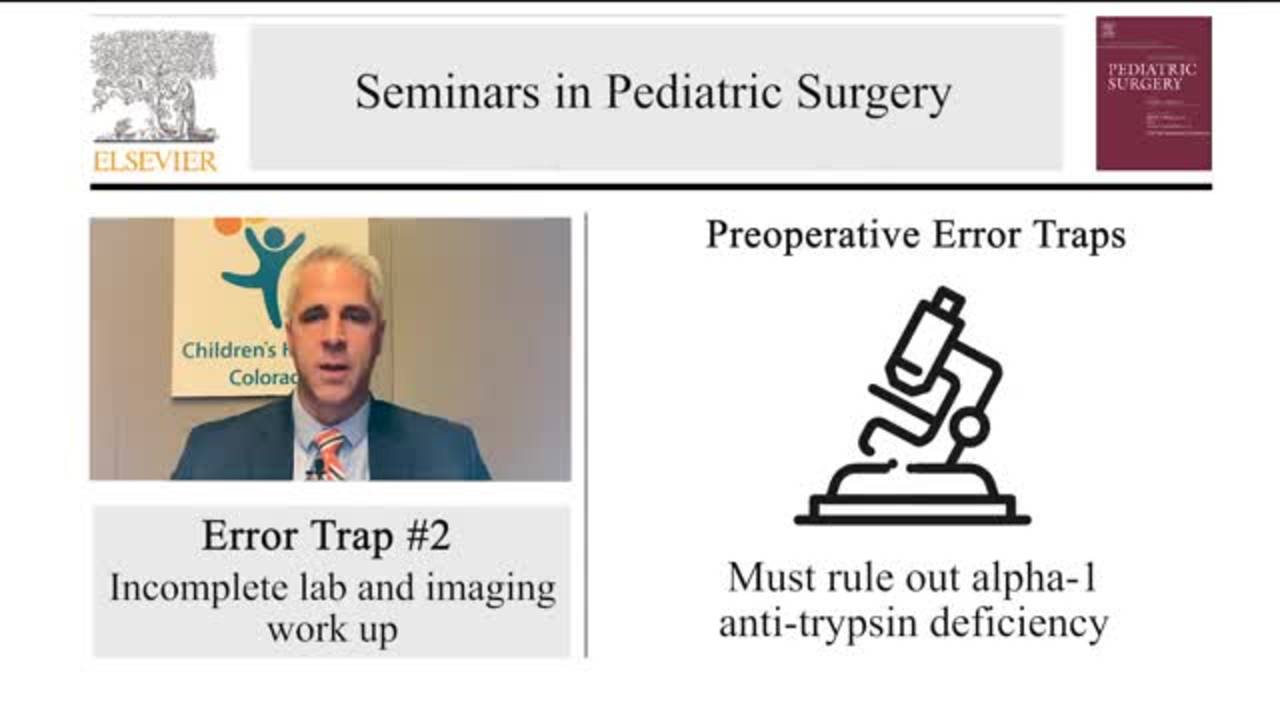
This video highlights a few key points from the "Error Traps and Culture of Safety in Biliary Atresia" article published in Seminars in Pediatric Surgery, provided by lead author Dr. Jonathan Roach. Find the full article at: www.sciencedire
video4:32 · Nov 2019
Heat 1 Winner: Dariusz Patkowski, MD, PhD - Best of the Best in Pediatric Surgery 2024
Watch →
Watch the voting from the first heat!
Presentations from heat one:
Prof. Shilpa Sharma: Exploring alternative pathway of stem cell proliferation for hepatic regeneration by partial liver resection in extra hepatic biliary atresia.
video2:30 · Feb 2024
Evidence & Research
10 items


Biliary Atresia, Appendicitis, Intestinal Failure, and Anesthetic...
Listen →
Audio Journal with Dr. Von Allmen about usingCorticosteroids After Hepatoportoenterostomy for Bile Drainage, Dr. Whit Holcomb aboutsurgical site infections (SSI) are an important source of morbidity and mortality.andfeasibility and safety o
podcast44:19 · Jan 2019
Biliary Atresia, Appendicitis, Intestinal Failure, and Anesthetic...
Listen →
Audio Journal with Dr. Von Allmen about using Corticosteroids After Hepatoportoenterostomy for Bile Drainage, Dr. Whit Holcomb about surgical site infections (SSI) are an important source of morbidity and mortality. and feasibility and safe
podcast44:19 · Dec 2020
Update Course 2021: UPDATE COURSE 2020: REVIEW OF LAST YEAR'S IMPORTANT T OPICS
Watch →
General surgery residentRodrigo Gerardo, MD reviews the highlights from the 2020 Update Course including MMP7 for diagnosing biliary atresia, complex gastroschisis, and so much more.
video23:20 · May 2022
Quick Literature Updates Episode 9
Watch →
We’re back with ninth episode of "Quick Literature Updates" the podcast series that delivers the latest updates in pediatric surgery literature in a quick and digestible format. In each episode, we review four articles covering the most int
video · Jun 2023
Heat 3 Winner: Shruthi Srinivas, MD - Best of the Best in Pediatric Surgery 2024
Watch →
Watch the voting from the third heat!
Presentations from heat three:
Mina Yeganeh, BSc: Lipid nanoparticle delivery of miRNA-148a attenuates intestinal inflammation during experimental.
Joseph Davidson, MA(Oxon), MBBS, MRCS(Eng)
video1:47 · Feb 2024
Jingying Jiang, MD - Best of the Best in Pediatric Surgery 2024
Watch →
Watch PAPS' Dr. Jingying Jiang’s presentation on “Clinical characteristics and prognosis of biliary atresia with low serum matrix metalloproteinase-7 levels.” at the 2024 Best of the Best in Pediatric Surgery event!
Moderators: Todd Pons
video6:58 · Feb 2024
Clinical Characteristics and Prognosis of Biliary Atresia with Low Serum Matrix Metalloproteinase-7 Levels
Watch →
New Article you should know by Dr. Cecilia Gigena from Journal of Pediatric Surgery.
"Clinical Characteristics and Prognosis of Biliary Atresia with Low Serum Matrix Metalloproteinase-7 Levels"
Authors: Jingying Jiang, Yifan Yang, Xue
video0:55 · Jul 2024
Características clínicas y pronóstico de la atresia de vías biliares con niveles bajos de metaloproteinasa 7 de la matriz sérica
Watch →
Nuevo artículo que tienes que conocer por la Dra. Cecilia Gigena del JPS
"Características clínicas y pronóstico de la atresia de vías biliares con niveles bajos de metaloproteinasa 7 de la matriz sérica"
Autores: Jingying Jiang, Yifa
video0:55 · Jul 2024
Journal of Pediatric Surgery Article Review: 2nd Quarter (Apr-Jun) 2024
Listen →
We are back with another episode of our Journal of Pediatric Surgery article review podcast. This time we have three publications from the second quarter of 2024, April, May, and June issues. This time we're talking to editors Drs. Mary Bri
podcast17:03 · Sep 2024
Update Course Rewind: 2024 Top Ten Key Takeaways
Watch →
Join us for a highlight reel of the Top 10 Key Takeaways from the 12th Annual Update Course in Pediatric Surgery. This session covers the latest advances, practical tools, and emerging trends that are shaping the future of pediatric surgica
video18:01 · Jun 2025
Case-Based Learning
3 items

Biliary Atresia - Robert Parry: Update Course 2014
Watch →
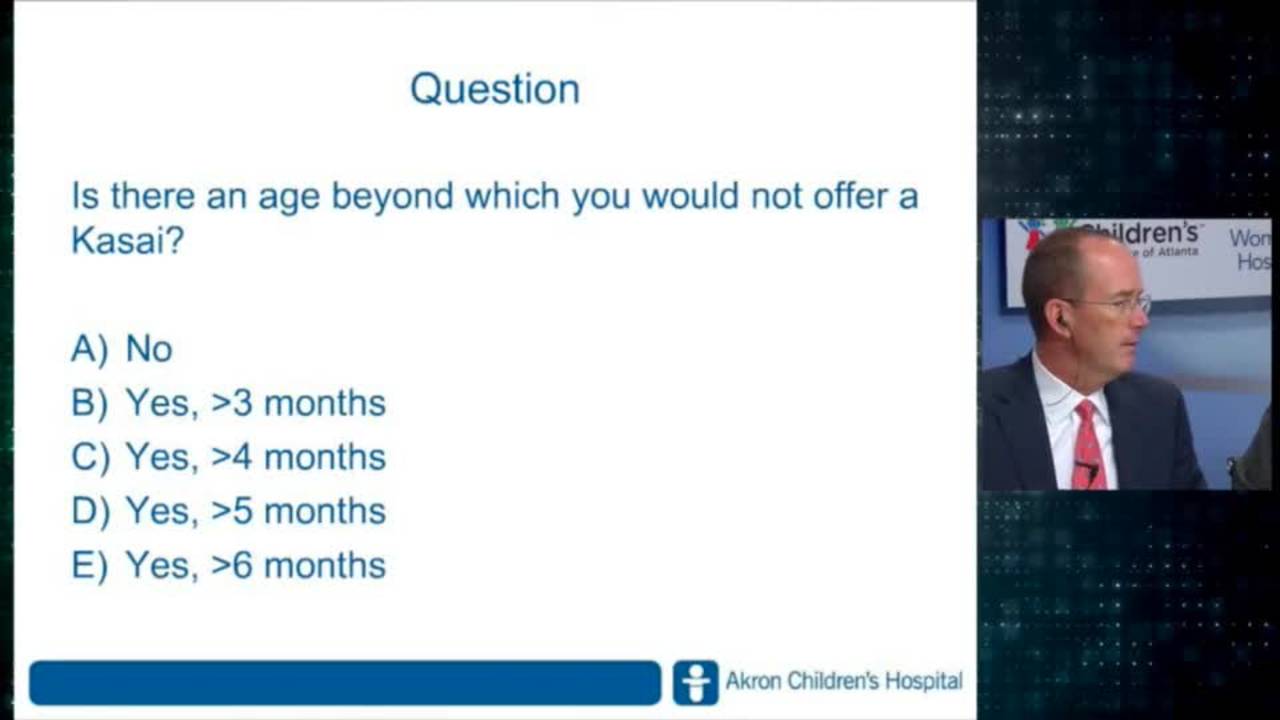
Dr. Robert Parry, Director of Pediatric Surgery, Akron Children's Hospital, presents a clinical case of biliary atresia diagnosis. Topics discussed include kasai procedure, HIDA scan for biliary atresia, postoperative corticosteroids, and r
video24:55 · Nov 2018
Biliary Atresia-Case Presentation and Panel Discussion: Update Course 2014
Watch →
During the 2ndAnnual Stay Current in Pediatric Surgery Update Course in 2014, Dr. Robert Parry, Director of Pediatric Surgery, Akron Children's Hospital, and Dr. Nick Bruns present a clinical case of biliary atresia diagnosis. Topics discus
video23:47 · Jan 2019
Biliary Atresia - Clinical Practice Updates
Watch →
This clip from the 2020 Pediatric Surgery Update Course features Alexander Bondoc, MD, presenting multiple cases and research conclusions from Atsuyuki Yamataka, MD; Greg Tiao, MD; Jorge Bezerra, MD; and Mark Davenport, MD, to our selected
video · Sep 2020
In-Depth Reviews
1 item
Biliary Atresia
Watch →
Dr. Greg M. Tiao, Chief of Pediatric Surgery at Cincinnati Children's Hospital, discusses biliary atresia. Dr. Tiao covers topics on cholestasis in infants, diagnosis imaging in cholestatic infant, liver biopsy, biliary atresia extended dis
video20:57 · Jan 2019
Emerging & Future Directions
1 item
Prof. Shilpa Sharma - Best of the Best in Pediatric Surgery 2024
Watch →
Watch WOFAPS' Prof. Shilpa Sharma's presentation on "Exploring alternative pathway of stem cell proliferation for hepatic regeneration by partial liver resection in extra hepatic biliary atresia" at the 2024 Best of the Best in Pediatric Su
video5:46 · Feb 2024
Summaries and takeaways+ Show
Summary of this collection+ Show
Key points, with the moment each was said+ Show
Featured picks for families are being prepared — the summaries above are written for you.
Takeaways+ Show
Biliary atresia is a progressive obliterative cholangiopathy affecting 1 in 15,000–20,000 North American live births, lethal without intervention.[e910-c3,e5518-c7,e7749-c1] The Kasai portoenterostomy remains first-line treatment, with timing critical: procedures before 45 days achieve 50% 12-year native-liver survival versus <20% after 75 days.[e662-c1,e7749-c6,e7754-c2] Success is defined by total bilirubin <2 mg/dL at 3 months, predicting 86% 2-year transplant-free survival.[e7753-c1,e7753-c2] The START trial definitively showed no benefit from routine high-dose corticosteroids post-Kasai, though selective protocols in younger cohorts (<45 days) may improve drainage rates from 40% to 84%.[e308-c2,e7753-c9,e7753-c13] Technical execution matters: optimal hilar transection at the fibrous plate–parenchyma junction yields 80%+ drainage success; extended dissection into liver substance reduces efficacy.[e7750-c9,e7750-c10] Kasai revision is indicated only for patients with initially successful drainage who develop recurrent cholangitis, not for primary failures. Biliary atresia remains the leading indication for pediatric liver transplantation, with 5-year survival now exceeding 90%, though only 30% achieve ideal long-term profiles free of immunosuppression sequelae.[e7750-c30,e7750-c33] Emerging biomarkers (MMP-7) and newborn screening protocols (direct bilirubin >1 mg/dL) promise earlier diagnosis, addressing persistent racial and socioeconomic disparities in referral timing.[e7749-c12,e7752-c13,e7752-c14,e9973-c14]
- Kasai before 45 days achieves 50% 12-year native-liver survival versus <20% after 75 days; bilirubin <2 at 3 months predicts 86% 2-year transplant-free survival.
- The START trial showed no benefit from routine high-dose steroids post-Kasai; selective protocols in <45-day cohorts may improve drainage from 40% to 84%.
- Optimal hilar transection at fibrous plate–parenchyma junction yields 80%+ drainage; extended dissection into liver reduces success. Kasai revision only for recurrent cholangitis after initial success.
- Non-white infants referred 30 days later than white infants; white infants 5× more likely to receive Kasai. Neighborhood deprivation independently predicts 50% reduced Kasai likelihood.
- MMP-7 and direct bilirubin >1 mg/dL screening reduce diagnosis age from 56 to 36 days. Low MMP-7 (<20 ng/mL) predicts worse outcomes despite BA diagnosis.
For patients & families
Biliary atresia is a rare condition where bile ducts outside the liver become blocked, preventing bile from draining properly. [e5518-c7, e7751-c1] If not treated, it leads to progressive liver damage and can be fatal by age two. [e5518-c7, e7750-c2] Doctors discussed two main treatment options: the Kasai procedure (a surgery to restore bile flow) and liver transplantation. Timing matters greatly. Physicians emphasized that performing the Kasai procedure before 45 days of life gives babies the best chance—about 50% can keep their own liver for 12 years. When surgery happens after 75 days, success drops to less than 20%. One French study showed that 23% of children who had early Kasai surgery still had their own liver 20 years later. Doctors measure success by checking bilirubin levels (a marker of liver function) three months after surgery. When bilirubin stays below 2, about 86% of children avoid transplant for at least two years. Even when Kasai doesn't provide a permanent solution, it can buy valuable time—allowing babies to grow bigger and stronger before transplant, which makes that surgery safer. The physicians stressed that both Kasai and transplant are established treatments, each with an important role in caring for children with this condition.
Biliary atresia is a rare condition where bile ducts outside the liver become blocked, preventing bile from draining properly. [e5518-c7, e7751-c1] If not treated, it leads to progressive liver damage and can be fatal by age two. [e5518-c7, e7750-c2] Doctors discussed two main treatment options: the Kasai procedure (a surgery to restore bile flow) and liver transplantation. Timing matters greatly. Physicians emphasized that performing the Kasai procedure before 45 days of life gives babies the best chance—about 50% can keep their own liver for 12 years. When surgery happens after 75 days, success drops to less than 20%. One French study showed that 23% of children who had early Kasai surgery still had their own liver 20 years later. Doctors measure success by checking bilirubin levels (a marker of liver function) three months after surgery. When bilirubin stays below 2, about 86% of children avoid transplant for at least two years. Even when Kasai doesn't provide a permanent solution, it can buy valuable time—allowing babies to grow bigger and stronger before transplant, which makes that surgery safer. The physicians stressed that both Kasai and transplant are established treatments, each with an important role in caring for children with this condition.
The doctors in this collection+ Show
All expert statements+ Show
Every expert statement below comes from the recorded discussions, with its speaker and moment.
Clinical Characteristics and Prognosis of Biliary Atresia with Low Serum Matrix Metalloproteinase-7 Levels
The study was a retrospective cohort study conducted in China
host_summaryCecilia Gigena0:11 ↗
The study included 329 patients with biliary atresia
host_summaryCecilia Gigena0:21 ↗
40 of the 329 patients had low MMP-7 levels
host_summaryCecilia Gigena0:21 ↗
Patients with low MMP-7 had significantly lower 3-month jaundice clearance
host_summaryCecilia Gigena0:27 ↗
Patients with low MMP-7 had significantly lower 6-month jaundice clearance
host_summaryCecilia Gigena0:27 ↗
Patients with low MMP-7 had significantly lower 1-year native liver survival
host_summaryCecilia Gigena0:27 ↗
Measuring MMP-7 can help with prognosis in biliary atresia patients
host_summaryCecilia Gigena0:40 ↗
MMP-7 measurement may in the future help with treatment of biliary atresia patients
host_summaryCecilia Gigena0:40 ↗
Biliary Atresia: Where are we now? Advanced Practice Providers Pediatric...
Pathologic jaundice occurs in 1 in 2500 live births
epidemiological2:24 ↗
Biliary atresia is a progressive, obliterative, idiopathic cholangiopathy with two forms: perinatal/postnatal (80-90%) and fetal/embryonic (10-20%)
clinical5:01 ↗
Biliary atresia incidence ranges from 1 in 5000 in Taiwan, 1 in 8-10,000 in Japan, and 1 in 18,000 in the United States and Europe
epidemiological5:42 ↗
More females than males are affected by biliary atresia
epidemiological6:05 ↗
Seasonal clustering of biliary atresia cases suggests viruses or infectious processes may be triggers
clinical6:09 ↗
Biliary atresia is lethal if untreated
clinical6:10 ↗
If conjugated or direct bilirubin is greater than or equal to 2, the child needs closer evaluation
guideline7:59 ↗
Some babies with biliary atresia have normal ultrasounds
clinical8:16 ↗
The gold standard for biliary atresia diagnosis is the intraoperative cholangiogram
guideline8:26 ↗
At Children's Hospital Los Angeles, babies are pre-treated with 5 days of phenobarbital before HIDA scan
clinical9:31 ↗
Timing of diagnosis and Kasai procedure is extremely important, with the sweet spot being 6 to 8 weeks of age
clinical15:14 ↗
A French study showed 23% of Kasai patients had their native liver 20 years post-Kasai
epidemiological15:50 ↗
Factors affecting survival with native liver include age at Kasai, type of biliary atresia, liver histology (bridging fibrosis), and center caseload
clinical16:24 ↗
In England, consolidating Kasai procedures to 3 centers increased success rates
epidemiological16:48 ↗
At Children's Hospital Los Angeles, 6 to 12 biliary atresia cases are seen per year, considered a high rate
epidemiological17:20 ↗
If cirrhosis is seen on liver biopsy or frozen section during intraoperative cholangiogram, the procedure is stopped and the patient is listed for transplant
clinical19:57 ↗
Kasai procedures in older babies (3.5-4 months) can bridge patients to transplant at one year of age, though with complications including ascending cholangitis and frequent hospitalizations
clinical20:20 ↗
Bigger babies at time of transplant have easier transplant procedures
opinion21:24 ↗
Children's Hospital Los Angeles has a very large, possibly the largest, living donor liver transplant center in the country, offering an alternative to cadaveric transplant
clinical22:27 ↗
Most centers put babies on antibiotic prophylaxis postoperatively until they are eating
clinical23:23 ↗
Post-operative steroids for biliary atresia are unproven
clinical23:48 ↗
At Children's Hospital Los Angeles, peripheral IV lines are used postoperatively rather than Broviacs, and babies are not sent home on IV antibiotics
clinical24:06 ↗
What's new+ Show