


From
StayCurrentMD
Biliary Atresia: Update Course 2015
With CCHMC Pediatric Surgery · hosted by Dr. Todd Ponsky
Chapter 1 of 7 · Case-Based Learning
Case presentation
Case Presentation and Initial Workup of Cholestatic Infant
Expert statements on this page
No expert statements were drawn from this page.
Host summaries · secondary, not cited in answers
Educational content from recorded physician discussions — not medical advice. Talk to your (or your child's) care team about your situation.
Video
Biliary Atresia
CCHMC Pediatric Surgery · 20 min · Published Nov 2018
Video
Biliary Atresia - Clinical Practice Updates
Published Dec 2020
Podcast
Biliary Atresia Part I
31 min · Published Jan 2022
Video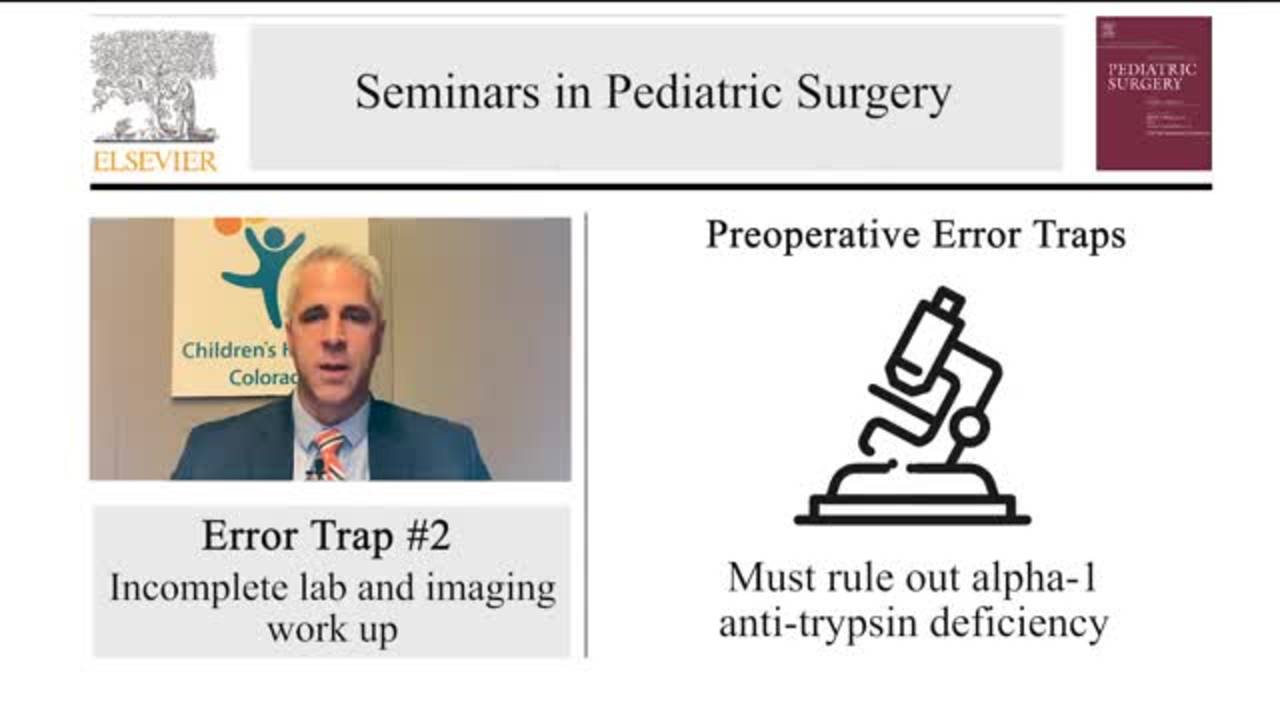
Error Traps and Culture of Safety in Biliary Atresia
CCHMC Pediatric Surgery · 4 min · Published Nov 2019
Podcast
Biliary Atresia Part II
42 min · Published Feb 2022
Podcast
Choledochal Cyst Podcast
22 min · Published Nov 2020
Video
Intestinal Atresia Types Explained: Grossfeld Classification for Pediatric Surgery
1 min · Published Sep 2026
Video
Derivation and validation of the Pediatric Community-Acquired Pneumonia Severity (PedCAPS) score: A prospective cohort study
50 s · Published Sep 2026
Video
FETO for Late-Diagnosed Severe Congenital Diaphragmatic Hernia (CDH) at Cincinnati Children's with Dr. Beth Rymeski
4 min · Published Sep 2026
Video
Severe Congenital Diaphragmatic Hernia (CDH) Case: FETO Management & Unexpected Findings with Dr. Beth Rymeski
3 min · Published Sep 2026
Video
Fetoscopic Endoluminal Tracheal Occlusion (FETO) Procedure: Step-by-Step Guide with Dr. Beth Rymeski
4 min · Published Sep 2026
Video
Choledochal Cyst Types Explained: Pediatric Surgery Fundamentals
1 min · Published Sep 2026
What the experts said
Idiopathic neonatal hepatitis has decreased from 70% of cholestatic infants in the 1970s-1980s to approximately 10% currently due to advances in diagnosing inborn errors of bile acid metabolism and genotyping of progressive familial intrahepatic cholestasis (PFIC).
The jaundice chip is a gene chip microarray analysis that tests for PFIC abnormalities (PFIC 1, 2, 3), alpha-1 antitrypsin deficiency, and JAG1 mutation, but takes 4-6 weeks to return results, too long to guide initial biliary atresia intervention decisions.
The absence of a gallbladder on ultrasound does not conclusively diagnose biliary atresia.
The presence of a gallbladder on ultrasound does not exclude biliary atresia because modern ultrasound probes can visualize even small shrunken gallbladders.
The triangular cord sign on ultrasound represents a fibrous plate above the portal vein where bile ducts were supposed to be, showing inflammatory fibrous scarring with distinct radiographic characteristics.
HIDA scans benefit from 3-5 days of phenobarbital loading, which can delay intervention into a time period potentially detrimental to Kasai outcomes.
Liver biopsy findings of bile duct proliferation in portal triads and bile plugs within bile ducts are pathognomonic for biliary atresia with >90% diagnostic accuracy.
When liver biopsy is highly consistent with biliary atresia, intraoperative cholangiography becomes less necessary; some centers perform it primarily for educational purposes.
Alagille syndrome patients do not have the same degree of bile duct proliferation as biliary atresia patients and will not have the pathognomonic finding of bile duct plugs.
Extended hilar dissection in biliary atresia goes beyond the portal vein bifurcation to the first bifurcation of the hepatic arteries, as originally described by Kasai.
Japanese centers uniformly perform extended hilar dissections, which may explain their superior outcomes compared to U.S. centers.
Polysplenia syndrome patients with biliary atresia often have pre-duodenal portal veins and frequently have no bile duct remnant, making Kasai portoenterostomy difficult or impossible.
Cystic variant biliary atresia can be differentiated from choledochal cyst clinically: choledochal cyst patients have pigmented stool while cystic variant patients develop acholic stool.
A Roux limb length of 20 cm is inadequate because 5-8 cm of length is typically lost during hilar dissection at the time of liver transplantation.
The recommended Roux limb length for Kasai portoenterostomy is 30-40 cm to preserve adequate length for future liver transplantation.
Anti-reflux valves in Kasai portoenterostomy have not been proven effective and are no longer recommended.
Some biliary atresia patients have an inflammatory gene profile in which corticosteroids might prove beneficial, despite overall trial results showing no benefit.
Performing Kasai portoenterostomy on Alagille syndrome patients will shorten the natural history of their native liver and lead to earlier transplantation.
For cholestatic infants where biliary atresia diagnosis is uncertain, workup for Alagille syndrome includes echocardiography to rule out pulmonic stenosis, spine X-rays to rule out butterfly vertebrae, and ophthalmologic examination.
A scoring system combining liver biopsy and clinical parameters achieves 99% accuracy in diagnosing biliary atresia.
For cystic variants of biliary atresia, intervention before 30 days of age yields better outcomes, based on data from England.
UK data from 15 years ago showed that centers performing more than 5 Kasai procedures per year had significantly better outcomes (approximately 20% difference) than lower-volume centers.
The British health service centralized all Kasai procedures to three high-volume centers based on outcome data, and only these centers receive payment for the procedure.
Two European studies (King's Group using 2 mg/kg steroids and German group using 10 mg/kg for 5 days) showed no benefit of postoperative corticosteroids in biliary atresia.
The Children's Network multi-center trial with approximately 70 patients in two arms showed no improvement in bile drainage with corticosteroid use and a slight increase in adverse events (primarily medical rather than surgical complications).