


From
StayCurrentMD
Update Course Rewind: Magnet Therapy for Esophageal Atresia
With Dr. Bethany Slater & Dr. Matt Harmon & Dr. Steven Rothenberg · hosted by Dr. Em Gootee & Dr. Ellen Encisco & Dr. Todd Ponsky
Part of
Esophageal Atresia 86 items
Chapter 1 of 4 · Case-Based Learning
Case presentation
Case presentation and traditional surgical approaches for 3cm gap esophageal atresia
Cued at 1:39 · stops at 1:50 · press play
Expert statements on this page
No expert statements were drawn from this page.
Host summaries · secondary, not cited in answers
Educational content from recorded physician discussions — not medical advice. Talk to your (or your child's) care team about your situation.
Video
Thoracoscopic Esophageal Atresia Repair Tips & Tricks: Update Course 2018
Dr. Steve Rothenberg · 23 min · Published Aug 2018
Video
QUAD #10 Pt.3: Advantages of Thoracoscopic Repair of Esophageal Atresia with Dr. Steve Rothenberg
Dr. Steve Rothenberg · Published Jun 2024
Video
QUAD #10 Pt.1: History of Thoracoscopic Repair of Esophageal Atresia (EA) & Tracheoesophageal Fistula (TEF) with Dr. Steve Rothenberg
Dr. Steve Rothenberg · 6 min · Published Jun 2024
Video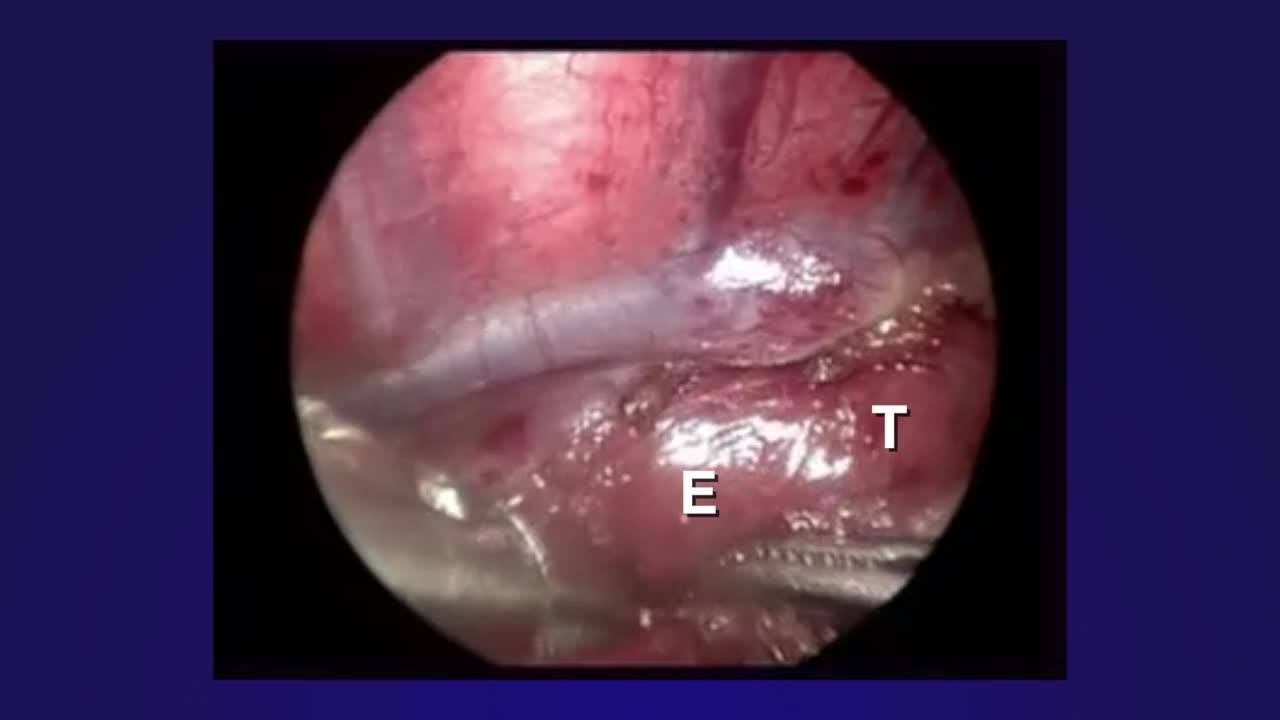
Thoracoscopic Repair of Esophageal Atresia with Distal Tracheo-esophageal...
5 min · Published Feb 2020
Video
Esophageal Atresia in Brief: Presentation, Workup, Diagnosis, and Treatment
Dr. Todd Ponsky · Published Feb 2022
Podcast
Tracheoesophageal Fistula
Todd Ponsky · 45 min · Published Oct 2026
Podcast
Diaphragm pacing as alternative to mechanical ventilation in pediatric respiratory failure
1 min · Published Nov 2026
Podcast
Fetoscopic endoluminal tracheal occlusion for congenital diaphragmatic hernia
4 min · Published Nov 2026
Podcast
FETO procedure for late-diagnosed severe CDH with liver herniation
4 min · Published Nov 2026
Podcast
Severe CDH case with FETO: unexpected anatomic findings and clinical outcome
3 min · Published Nov 2026
Podcast
Pediatric pancreatitis: diagnosis, causes, and genetic insights with Dr. Juan Gurria
3 min · Published Nov 2026
Podcast
Understanding craniosynostosis: skull sutures, growth patterns, and diagnosis in infants
10 min · Published Nov 2026
What the experts said
Dr. Ponsky would try to go in and do surgical repair for a 3cm gap, and if unable to get the two ends together after dissection, would then do an internal lengthening procedure like the Vanderzee procedure.
You don't lose anything by trying to go in and do the dissection to see if you can get the esophageal ends together.
Dr. Harmon considers 3 centimeters overcomeable and would try thoracoscopic repair to get the two ends together.
Magnets have been used for many years for esophageal atresia as a non-surgical alternative for esophageal anastomosis, promoting lengthening and approximation of the proximal and distal ends.
The Flourish device is an FDA-approved commercially available catheter-based magnet system for esophageal atresia.
Magnets placed in the proximal and distal esophagus attract one another and cause the esophagus to lengthen, then compression anastomosis occurs through ischemia in the tissue at the two ends once magnets are nearly together.
The Flourish device has esophageal and gastric catheters with inner bullet-shaped magnets on each end, tapering down to a 10 French luminal surface.
The proximal catheter has a suction port for suctioning saliva and the gastric port has a portion for feeds.
For Flourish device eligibility, gap length must be less than 4 centimeters because at greater lengths the magnets will not attract one another.
There should be no fistula for Flourish device use, or if there is a fistula it must be repaired first.
Patients require a gastrostomy that can accommodate an 18 French catheter, which is the diameter of the gastric portion of the Flourish catheter.
Magnet therapy is not to replace esophageal atresia repair but is another tool in the armamentarium, particularly for patients with cardiac disease or previous operations that make them higher risk for reoperative surgery or anesthesia.
One contraindication for using the Flourish device is the presence of a fistula.
Dr. Rothenberg ligates all upper pouch fistulas and H-type fistulas thoracoscopically because the view is excellent and provides good control.
By classification of the International Esophageal Atresia Group, a gap must be at least 4 centimeters to be considered a long gap.
The indications for the magnet require a gap of less than 4 centimeters, and there is an incredibly high stricture rate with multiple strictures.
A patient with less than a 4 centimeter gap should be amenable to a primary anastomosis, which Dr. Rothenberg would do thoracoscopically.
Magnets have been used sometimes for a staged repair rather than using internal traction sutures.
There is a possibility of trying to get the two ends together closer surgically and then using a magnet just for the anastomosis portion.