


From
StayCurrentMD
Update Course Rewind: Chest Wall Reconstruction 2024
With Dr. Margaret Mutch · hosted by Lizzy Lee, PA-C
Chapter 4 of 4 · Emerging & Future Directions
Summary
Summary and future directions
Cued at 4:52 · press play
Expert statements on this page
No expert statements were drawn from this page.
Host summaries · secondary, not cited in answers
Educational content from recorded physician discussions — not medical advice. Talk to your (or your child's) care team about your situation.
Video
Bailey Roberts, MD - Best of the Best in Pediatric Surgery 2024
Dr. Todd Ponsky · 8 min · Published Feb 2024
Video
Update Course Rewind: Lipiodol for Lung Metastases 2024
Published Jan 2025
Video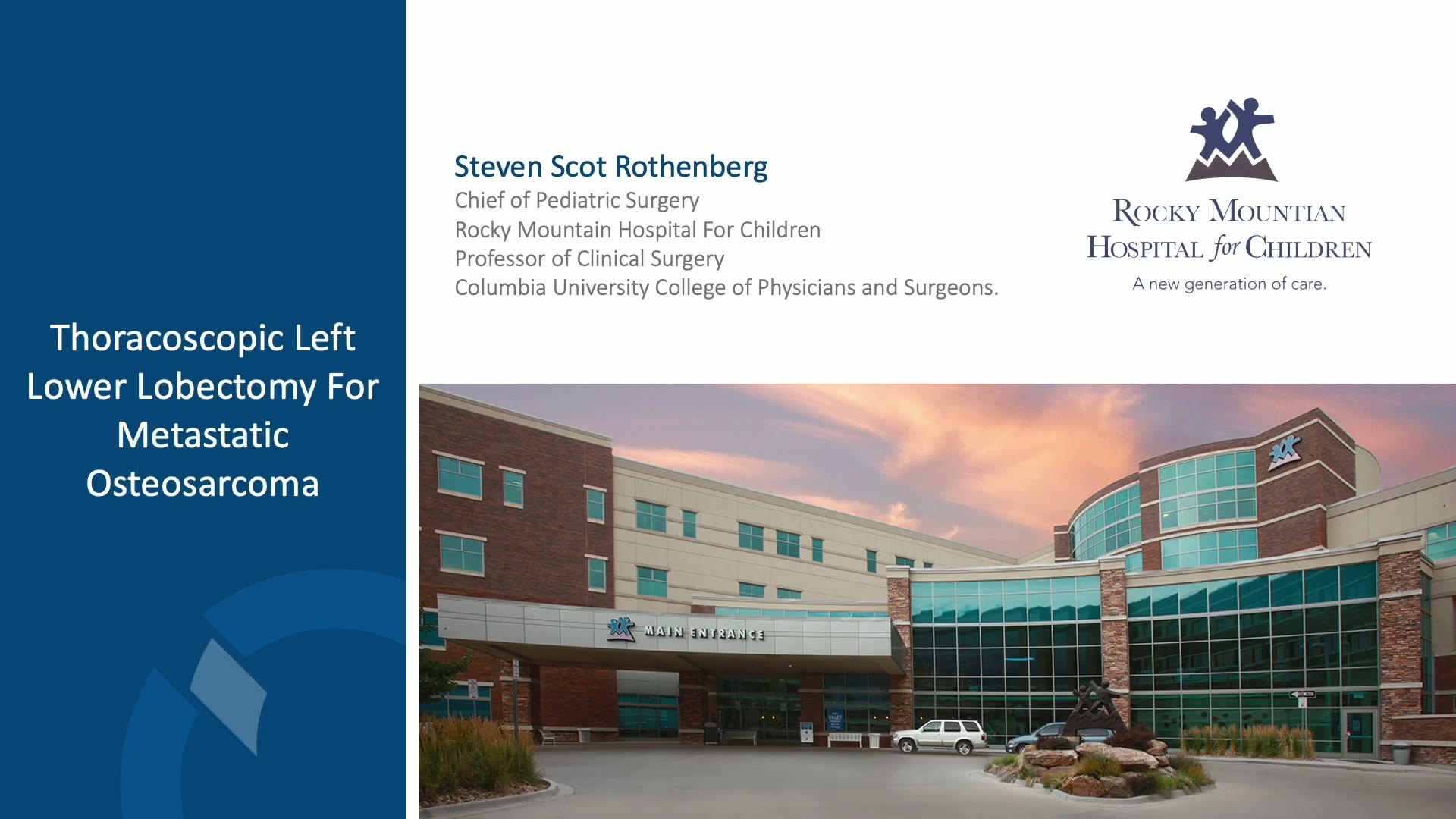
Thoracoscopic Left Lower Lobectomy for Metastatic Osteosarcoma in a 20-Year-Old
Dr. Steve Rothenberg · 6 min · Published May 2026
Video
Update Course Rewind: Thoracotomy vs VATS for Lung Metastases
Dr. Todd Ponsky · 9 min · Published Dec 2021
Video
Update Course 2021: THORACOTOMY VS VATS FOR OSTEO METS
Published May 2022
Podcast
Evolution of pediatric surgical oncology as a subspecialty
Roshni Dasgupta · 26 min · Published Jun 2021
Video
Rare Ovarian Tumor in Infants: Small Cell Carcinoma of Ovary, Hypercalcemic Type & SMARCA4 Mutation
21 s · Published Oct 2026
Video
Can Normal X-Rays Miss Metastatic Neuroblastoma? A Pediatric Radiology Case Study
26 s · Published Oct 2026
Video
Can Fractures Be a Sign of Hepatoblastoma in Children? Understanding Pediatric Liver Cancer Symptoms
37 s · Published Oct 2026
Video
Pancreas, Muscle, and Subcutaneous Fat Atrophy in Patients Undergoing Radiation for Neuroblastoma
47 s · Published Oct 2026
Podcast
Hepatoblastoma
Todd Ponsky · 54 min · Published Oct 2026
Podcast
Wilms Tumor
Todd Ponsky · 64 min · Published Oct 2026
Podcast
Diaphragm pacing as alternative to mechanical ventilation in pediatric respiratory failure
1 min · Published Nov 2026
Podcast
Fetoscopic endoluminal tracheal occlusion for congenital diaphragmatic hernia
4 min · Published Nov 2026
Podcast
FETO procedure for late-diagnosed severe CDH with liver herniation
4 min · Published Nov 2026
Podcast
Severe CDH case with FETO: unexpected anatomic findings and clinical outcome
3 min · Published Nov 2026
Podcast
Pediatric pancreatitis: diagnosis, causes, and genetic insights with Dr. Juan Gurria
3 min · Published Nov 2026
Podcast
Understanding craniosynostosis: skull sutures, growth patterns, and diagnosis in infants
10 min · Published Nov 2026
What the experts said
Doctor Margaret Mutch's team has about 10 years of experience with chest wall reconstructions.
Examination revealed an incomplete cord injury with absent lower limb reflexes and altered motor and sensation below the level of T6.
The patient underwent an emergency posterior laminectomy and partial tumor debulking initially for cord decompression between the levels of T3 and T7.
PET scan showed a PET avid lesion on the right-hand side just next to the sternum.
Radio guided occult lesion localization using technetium 99 was performed, followed by anterior thoracotomy to remove the lesion, which confirmed aggressive osteosarcoma replacing a lymph node.
Most of the reconstruction needs to be tailored to the needs of each individual, location and size of defects, and the particular type of material used.
A lot of the literature on chest wall reconstruction is coming from adults.
The spinal surgeons removed all of the vertebral bodies between T4 and T7 and inserted a cage, and the thoracic team resected ribs 4 to 7.
During surgery, a tumor thrombus was found in the azygos, which extended into the SVC.
Doctor Mutch's team tends to use resorbable and biosynthetic materials to do the reconstruction.
In Australia, two systems are used for chest wall reconstruction: one by Stryker and one by KLS, using resorbable plates that are molded in a water bath to reconstruct the rigid part of the chest wall.
Following plate placement, Permacol is placed on top of the implant, and subsequently a muscular flap, in this case the latissimus dorsi, is used to cover the Permacol.
The delta plates or the sonic weld system are polylactide and polyglycolide and polylactide plates with a strength of 78% at 2 months and 50% at 6 months.
The patient had a relapse 18 months following surgery close to his sternum.
The patient is currently having adjuvant chemotherapy.
In the team's 10-year experience, there was early postoperative wound infection in one patient, which was treated with IV antibiotics.
There were sterile seromas in two patients in the early stages, one at 2 months and one at 8 months, both treated with IR drainage.
The histopathology report confirmed an aggressive osteosarcoma.
There is a lack of clear evidence-based guidelines for reconstructive materials, but the priority is long-term durability, aesthetics, function, and accommodating future growth.
Instead of using screws that came packaged with the plates, they used a K-wire drill to drill through the remaining ribs and then used Prolene sutures to secure the implant.
Permacol is a surgical implant made of a porcine dermal collagen matrix that allows device placement.
Doctor Mutch performed a further chest wall reconstruction where they excised the entire sternum, costochondral cartilages, and anterior ribs and replaced it with a cement mesh.
There was one case of minor scoliosis on follow-up, which is being followed by the spinal team and so far has not needed intervention.
Bioengineering of tissue replacement and 3D printing may be the way of the future in chest wall reconstructions.