


From
StayCurrentMD
Tracheomalacia and tracheomegaly in infants and children with congenital diaphragmatic hernia managed with and without fetoscopic endoluminal tracheal occlusion (FETO): a multicentre, retrospective cohort study
hosted by Dr. Carlos Colunga
Chapter 2 of 3 · Evidence & Research
Key Findings
Cued at 0:22 · stops at 0:46 · press play
Expert statements on this page
No expert statements were drawn from this page.
Host summaries · secondary, not cited in answers
Educational content from recorded physician discussions — not medical advice. Talk to your (or your child's) care team about your situation.
Video
Quick Literature Updates Ep 19
4 min · Published May 2025
Podcast
Fetoscopic endoluminal tracheal occlusion for congenital diaphragmatic hernia
4 min · Published Nov 2026
Video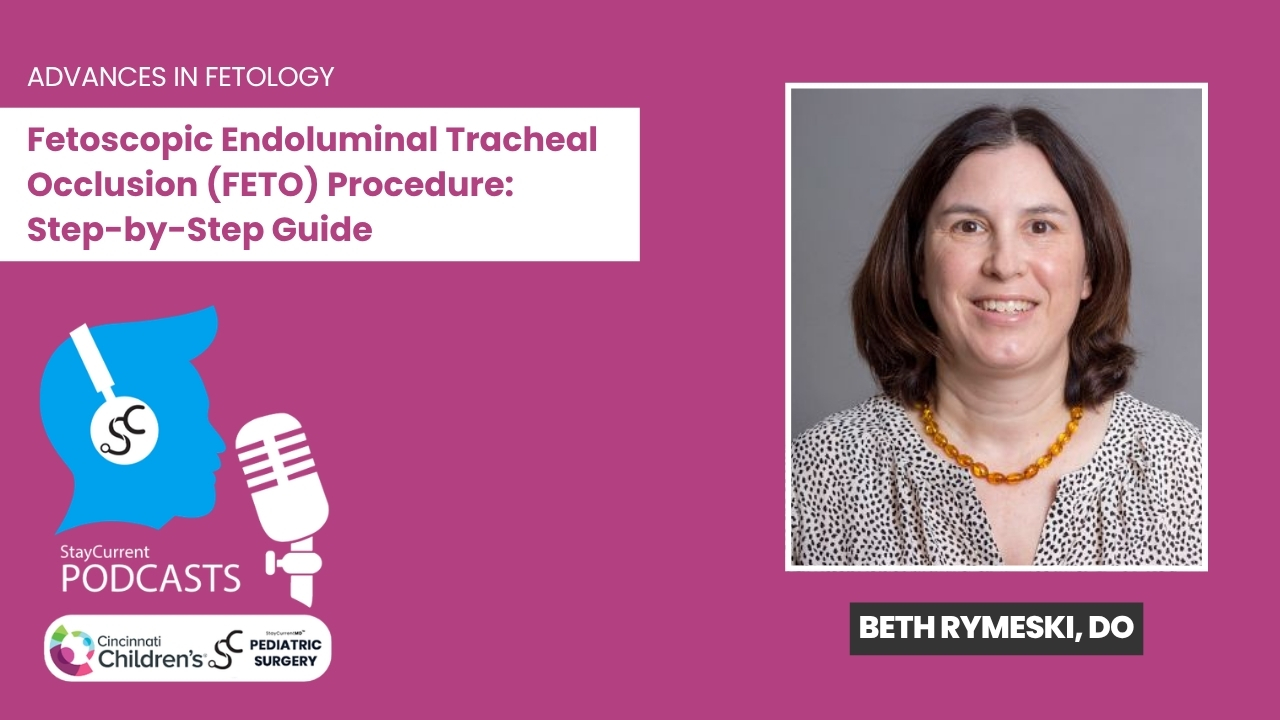
Fetoscopic Endoluminal Tracheal Occlusion (FETO) Procedure: Step-by-Step Guide with Dr. Beth Rymeski
4 min · Published Sep 2026
Video
Yuichiro Miyake, MD - Best of the Best in Pediatric Surgery 2024
Dr. Todd Ponsky · 7 min · Published Feb 2024
Podcast
Fetoscopic Endoluminal Tracheal Occlusion (FETO)
5 min · Published Jul 2021
Podcast
Fetoscopic Tracheal Occlusion for Congenital Diaphragmatic Hernia: Procedural Walkthrough
4 min · Published Nov 2026
Video
Inside a FETO Procedure: Fetoscopic Balloon Tracheal Occlusion with Dr. Beth Rymeski
4 min · Published Jul 2026
Video
Utility of Fluorescence In Situ Hybridization as a Fetal Surgery Eligibility Criterion for....
52 s · Published Jun 2026
Video
The fetal frontier: A review of current and emerging fetal therapies for genetic diseases
44 s · Published May 2026
Video
Myelomeningoceles (open spina bifida) -Fetoscopic Intrauterine Myelomeningocele Closure
Lurie Children's Hospital · 3 min · Published Dec 2025
Video
Open Fetal Surgery & EXIT Procedure with Dr. Jose Peiro
CCHMC Pediatric Surgery · 10 min · Published Oct 2024
Video
Update Course 2022 - APSA PDC UPDATES - Mary Edwards, Paul Jeziorczak, Craig Lillehei, and Charles Snyder,
64 min · Published Sep 2022
Podcast
Diaphragm pacing as alternative to mechanical ventilation in pediatric respiratory failure
1 min · Published Nov 2026
Podcast
FETO procedure for late-diagnosed severe CDH with liver herniation
4 min · Published Nov 2026
Podcast
Severe CDH case with FETO: unexpected anatomic findings and clinical outcome
3 min · Published Nov 2026
Podcast
Pediatric pancreatitis: diagnosis, causes, and genetic insights with Dr. Juan Gurria
3 min · Published Nov 2026
Podcast
Understanding craniosynostosis: skull sutures, growth patterns, and diagnosis in infants
10 min · Published Nov 2026
Podcast
Managing pancreatic fluid collections and chronic pancreatitis complications in children
2 min · Published Nov 2026
What the experts said
Tracheomalacia was 5% more common in tracheal occluded infants with 4% more cases
Tracheomalacia symptoms typically receded within 55 months in FETO-treated infants
FETO-treated infants showed a larger trachea, approximately 31% wider
37% of tracheally occluded cases retained metallic balloon components
No significant complications were reported from retained metallic balloon components
Tracheal occlusion is effective in promoting lung growth
FETO is associated with a higher risk of tracheomalacia
Most cases of FETO-associated tracheomalacia resolve and do not appear to have long-term effects