


From
StayCurrentMD
Thoracoscopic Upper Lobectomies for Symptomatic Congenital Pulmonary Airway...
Chapter 4 of 7 · Surgical Management
Bronchial division
Case 1: Bronchial Division and Completion
Cued at 3:20 · stops at 3:28 · press play
Expert statements on this page
No expert statements were drawn from this page.
Host summaries · secondary, not cited in answers
Educational content from recorded physician discussions — not medical advice. Talk to your (or your child's) care team about your situation.
Video
Thoracoscopic Right Lower Lobectomy in a 3-Month-Old with Prenatally Diagnosed CPAM
Dr. Steve Rothenberg · 16 min · Published May 2026
Podcast
Case Based Journal Review - CPAM in 2022
12 min · Published Apr 2022
Video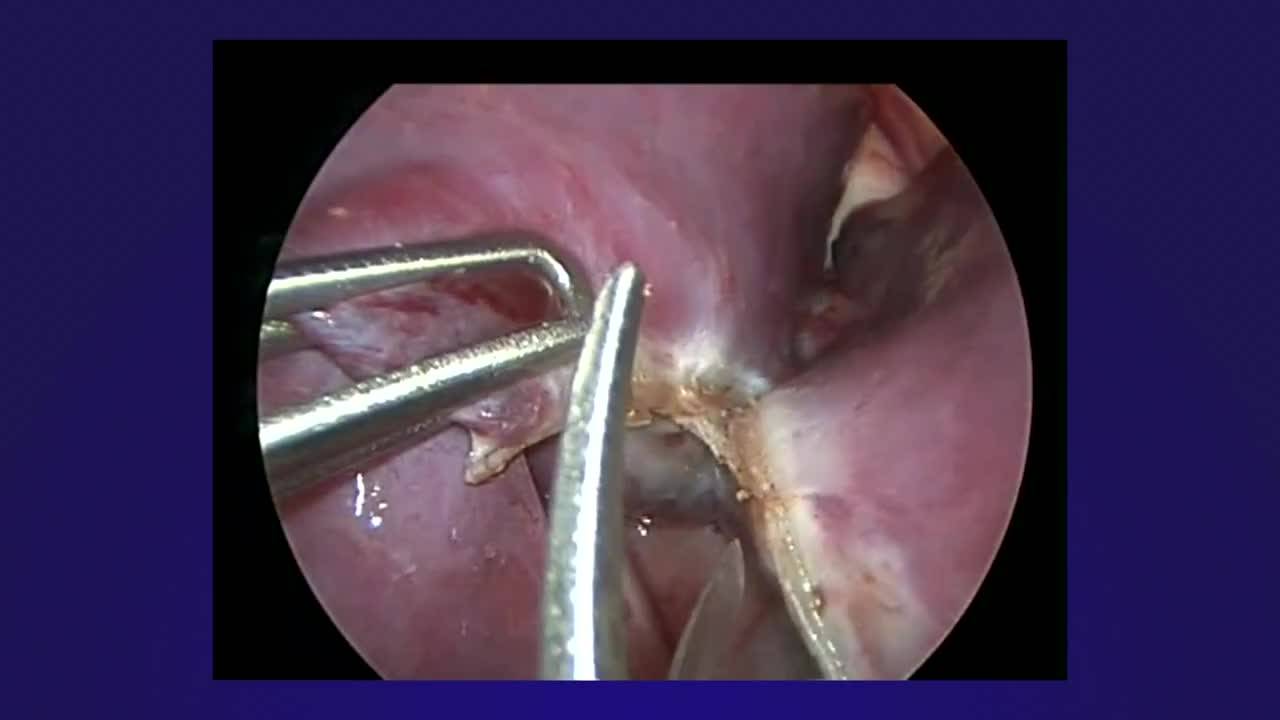
Thoracoscopic Left Lower Lobectomy for Congenital Pulmonary Airway Malformation
9 min · Published Feb 2020
Video
Thoracoscopic Left Lower Lobectomy for Intralobar Sequestration in a 4-Month-Old
Dr. Steve Rothenberg · 4 min · Published May 2026
Video
Clinical Symptoms Affect Treatment and Prognosis in Pediatric Patients with Congenital Pulmonary Airway Malformation
55 s · Published Dec 2023
Video
Congenital Lung Malformations: CPAM, BPS, CLE, and Bronchogenic Cyst Explained
3 min · Published Oct 2026
Video
Quick Literature Updates Episode 18
4 min · Published Mar 2025
Podcast
Journal of Pediatric Surgery Article Review: October 2023
12 min · Published Apr 2024
Video
Update Course Rewind: Congenital Lung Lesions 2022
4 min · Published Aug 2023
Video
Update Course 2022 - APSA PDC UPDATES - Mary Edwards, Paul Jeziorczak, Craig Lillehei, and Charles Snyder,
64 min · Published Sep 2022
Podcast
Journal of Pediatric Surgery Article Review: November 2021
11 min · Published Dec 2021
Podcast
The Full Story on CPAMs
56 min · Published Sep 2021
Podcast
Diaphragm pacing as alternative to mechanical ventilation in pediatric respiratory failure
1 min · Published Nov 2026
Podcast
Fetoscopic endoluminal tracheal occlusion for congenital diaphragmatic hernia
4 min · Published Nov 2026
Podcast
FETO procedure for late-diagnosed severe CDH with liver herniation
4 min · Published Nov 2026
Podcast
Severe CDH case with FETO: unexpected anatomic findings and clinical outcome
3 min · Published Nov 2026
Podcast
Pediatric pancreatitis: diagnosis, causes, and genetic insights with Dr. Juan Gurria
3 min · Published Nov 2026
Podcast
Understanding craniosynostosis: skull sutures, growth patterns, and diagnosis in infants
10 min · Published Nov 2026
What the experts said
Pulmonary upper lobectomies are more technically challenging than lower lobectomies, especially following infection.
A dual-lumen endotracheal tube and low flow chest insufflation were used to collapse the left lung during left upper lobectomy.
The fissure is completed by dividing the pulmonary tissue starting anteriorly and proceeding posteriorly.
Not dividing the superior pulmonary vein initially allows further cephalad retraction of the upper lobe.
A combination of clips and ligature is used to divide the segmental arteries.
Where distance allows, segmental vessels are clipped proximally prior to division with ligature.
10 millimeter clips are used to control each venous tributary separately when managing the superior pulmonary vein.
The segmental bronchus to the lingular segments is divided with an endo-GIA stapler.
The inferior pulmonary ligament is divided to allow the lower lobe to rise in the chest after upper lobectomy.
Left main-stem intubation was used to isolate the right lung during right upper lobectomy.
Segmental arteries are much smaller in younger children and can be taken with ligature after deliberate dissection.
The superior pulmonary vein is located in a slightly more superficial plane than the arteries.
A recurrent segmental artery to the upper lobe can arise from the main pulmonary trunk and is found in the fissure.
Both patients had excellent outcomes with complete expansion of the operated lung postoperatively.