

Neuroblastoma
With Dr. Daniel von Allmen & Dr. Erika Newman & Dr. Tony Sandler · hosted by Dr. Ray Hankey & Dr. Todd Ponsky
Chapter 6 of 8 · Surgical Management
Surgical timing
Timing and Extent of Surgical Resection in High-Risk Disease
Cued at 37:24 · stops at 47:40 · press play
Expert statements on this page
No expert statements were drawn from this page.
Host summaries · secondary, not cited in answers
Educational content from recorded physician discussions — not medical advice. Talk to your (or your child's) care team about your situation.
Podcast
Topics in 10: Neuroblastoma
10 min · Published Sep 2019
Video
Neuroblastoma: Update Course 2014
CCHMC Pediatric Surgery · 25 min · Published Nov 2018
Video
Clinical & Research Update: Neuroblastoma with Drs. Katherine Somers, Cara Morin, Juan Gurria, and Meera Kotagal
67 min · Published Sep 2026
Video
Neuroblastoma with Dr. Meera Kotagal
14 min · Published Sep 2024
Video
Neuroblastoma: Update Course 2016
CCHMC Pediatric Surgery · 25 min · Published Jul 2017
Video
Image-guided core-needle or surgical biopsy for neuroblastoma diagnosis in children
54 s · Published Feb 2024
Video
Rare Ovarian Tumor in Infants: Small Cell Carcinoma of Ovary, Hypercalcemic Type & SMARCA4 Mutation
21 s · Published Oct 2026
Video
Can Normal X-Rays Miss Metastatic Neuroblastoma? A Pediatric Radiology Case Study
26 s · Published Oct 2026
Video
Can Fractures Be a Sign of Hepatoblastoma in Children? Understanding Pediatric Liver Cancer Symptoms
37 s · Published Oct 2026
Video
Pancreas, Muscle, and Subcutaneous Fat Atrophy in Patients Undergoing Radiation for Neuroblastoma
47 s · Published Oct 2026
Podcast
Wilms Tumor
Todd Ponsky · 64 min · Published Oct 2026
Podcast
Hepatoblastoma
Todd Ponsky · 54 min · Published Oct 2026
Podcast
Treatment for Long Gap Esophageal Atresia: Esophageal Elongation and Replacement
10 min · Published Jan 2022
Video
7th Annual Pediatric Surgery Update Course 2019 - FULL SHOW
285 min · Published Jul 2020
Video
Aerodigestive & Esophageal Surgery - The Unsalvageable Esophagus & Cases
CCHMC Pediatric Surgery · 101 min · Published Nov 2018
Video
Aerodigestive & Esophageal Surgery - Difficult Tracheal Esophageal Fistula
Dr. Todd Ponsky · 120 min · Published Nov 2018
Video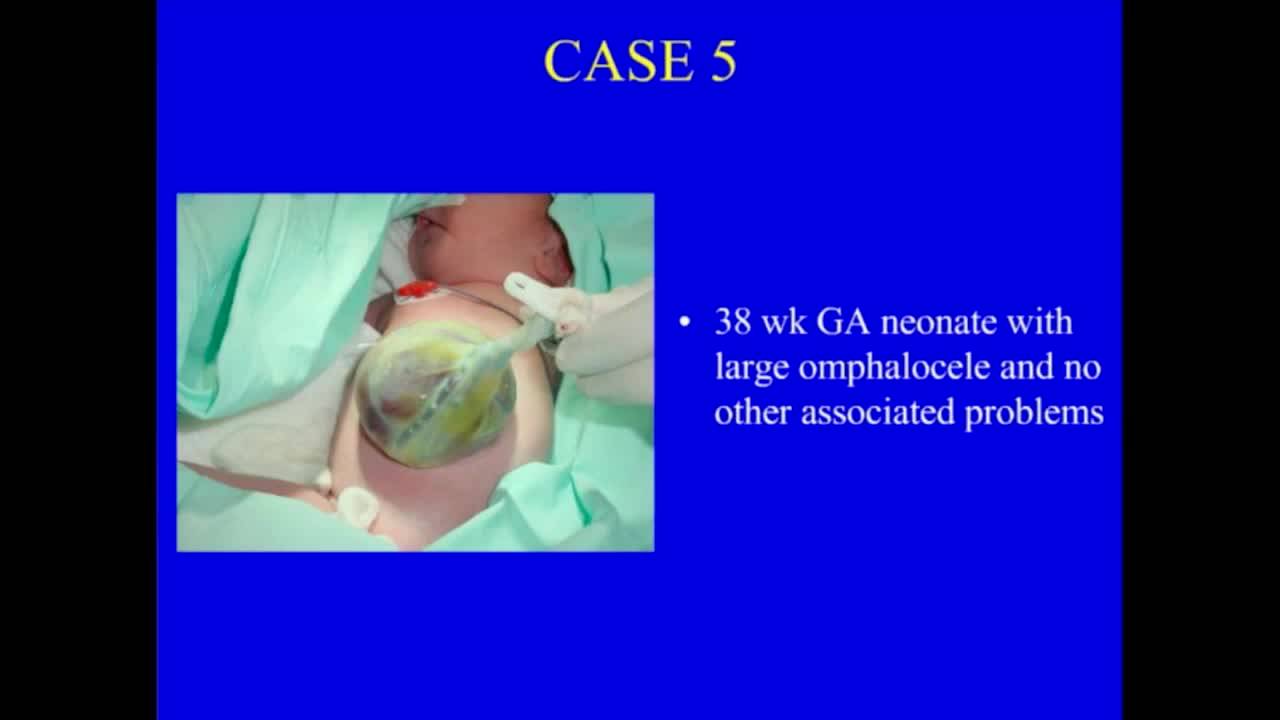
Abdominal Wall Defects
37 min · Published Nov 2018
Video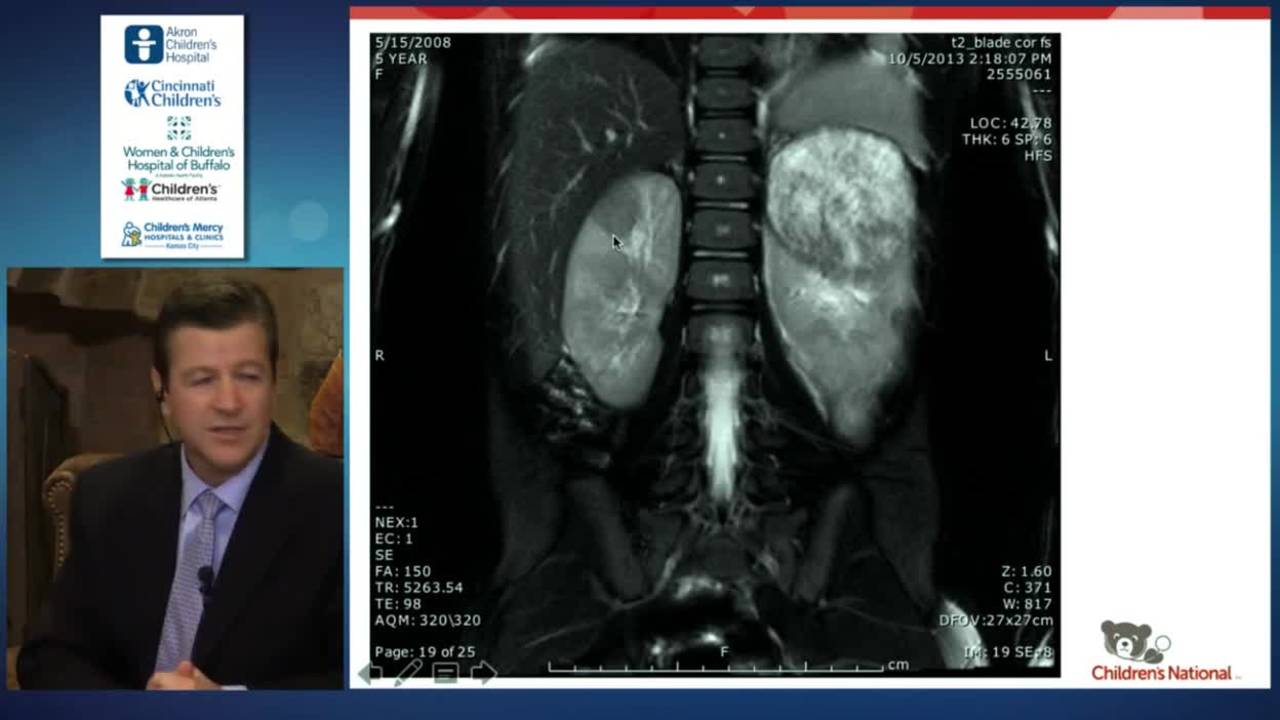
Bilateral Wilm's Tumor - Complex Gastroschisis - Complex Ileal Atresia:...
29 min · Published Nov 2018
What the experts said
The most common differential diagnoses for a prenatal suprarenal mass are adrenal hemorrhage (especially with fetal stress history), neuroblastoma if solid or cystic, pulmonary sequestration below the diaphragm, and renal anomaly misdiagnosed as suprarenal mass.
For prenatal suprarenal mass at 26 weeks gestation, no additional studies are obtained before delivery; after birth, ultrasound and urine catecholamines are the initial workup.
If urine catecholamines are elevated in a neonate with suprarenal mass, MIBG scan is the next step to characterize the primary lesion and identify other areas of disease.
In neonates and the perinatal phase, the most common sites of neuroblastoma metastasis are liver, bone, skin, and lymph nodes.
Jed Nocturne's study demonstrated that neonatal neuroblastoma with positive MIBG and urine catecholamines can be safely observed with serial ultrasound; many patients are spared surgery.
In Nocturne's study of 84 observed neonatal neuroblastoma patients, 16 (approximately 20%) underwent resection for growth or family preference, with 98% event-free survival and 100% overall survival.
Surveillance protocol for observed neonatal neuroblastoma includes intensive first-year monitoring: ultrasound and urine catecholamines at birth, 3 weeks, 6 weeks, 12 weeks, then every 6 months after 1 year if stable.
A cautionary case: a child with observed neonatal adrenal mass that resolved presented at age 3 with widely metastatic high-risk neuroblastoma.
Criteria for surgical intervention in observed neonatal neuroblastoma include tumor size reaching 5 cm, greater than 50% volume increase, or 50% increase in urine catecholamines (VMA or HVA).
Laparoscopic resection is appropriate for neonatal neuroblastoma less than 6 cm; one case of presumed neuroblastoma removed laparoscopically at 3.5 cm proved to be pulmonary sequestration.
Lymph node sampling is not necessary in neuroblastoma surgery because cross-sectional imaging provides adequate information and lymph node status does not change therapy, unlike Wilms tumor.
Stage MS neuroblastoma (formerly 4S) with skin lesions and liver metastases in neonates generally has good biology and can be managed with observation unless hepatic mass effect causes respiratory compromise.
The primary concern with liver-predominant stage MS neuroblastoma is mass effect causing respiratory compromise and increasing ventilatory requirements as the tumor enlarges.
Treatment options for stage MS neuroblastoma with respiratory compromise include chemotherapy, radiation if caught early, or emergent decompressive laparotomy for acute decompensation.
Biopsy is not always required for stage MS neuroblastoma with classic findings (high catecholamines, blue skin lesions, liver metastases, adrenal mass), but tissue should be obtained if MYCN amplification is found, as it changes staging from MS to M.
Initial workup for a 3-year-old with large abdominal mass includes ultrasound to assess solid vs cystic nature, CT with PO and IV contrast, CBC, comprehensive metabolic panel, amylase, lipase, LDH, and urine catecholamines.
VIP-secreting neuroblastoma can cause severe diarrhea, though this is a rare presentation.
A 10 cm mass with aortic and celiac axis encasement and microcalcifications represents L2 classification in the International Neuroblastoma Risk Group system.
Complete staging workup for suspected neuroblastoma includes CT chest to rule out metastases, MIBG scan, bone marrow biopsy, and head CT if clinically indicated, with final staging requiring tissue biopsy for pathology and biology.
MIBG scan is the primary imaging modality for neuroblastoma staging; PET scan may be useful in the 10% of neuroblastomas that are MIBG-negative to identify metastases.
Traditional open retroperitoneal biopsy approach uses a lateral incision at the predicted site of eventual exploration, allowing retroperitoneal access with compression to control bleeding; hemostasis is achieved with pledgeted sutures packed with Surgicel.
Approximately 50% of children's hospitals now use percutaneous biopsy for neuroblastoma; approximately 80% of patients at Michigan receive percutaneous biopsy upfront.
Percutaneous biopsy is equivalent to open biopsy for making the diagnosis, determining high vs low risk, and assessing MYCN amplification, but historically fails to provide adequate tissue for 11Q loss of heterozygosity determination.
Optimization strategies for percutaneous neuroblastoma biopsy include pathologist presence for frozen section to confirm viable tumor (not necrotic tissue), obtaining 10-12 cores, using higher gauge needles, and retroperitoneal approach.
Patients undergoing open biopsy have higher risk of blood transfusion, higher postoperative narcotic use, and more frequent hospital admission compared to percutaneous biopsy.
Interventional radiologists can embolize the biopsy track on withdrawal to limit bleeding risk in percutaneous neuroblastoma biopsy.
Neuroblastoma risk stratification is based on patient age, histologic category, tumor differentiation, MYCN status, ploidy, and 11Q aberration, yielding pre-treatment risk groups of very low, low, intermediate, or high.
MYCN amplification automatically confers high-risk status regardless of other factors; MYCN is an oncogene classically described for neuroblastoma.
Most MYCN non-amplified neuroblastomas are low or intermediate risk, except poorly differentiated tumors in older patients with metastatic disease and diploid status, which may be high risk.
11Q loss of heterozygosity is the most common segmental chromosomal alteration in neuroblastoma and is the only other factor that elevates MYCN non-amplified patients to high risk or from low to intermediate risk.
The age threshold for neuroblastoma risk stratification is 18 months (previously 12 months); patients less than 18 months have better outcomes.
MYCN non-amplified metastatic neuroblastoma is low risk if the tumor is hyperdiploid; if diploid and patient is less than 18 months old, it is intermediate risk; if greater than 18 months old, it is high risk.
High-risk neuroblastoma patients require double-lumen central venous access (Broviac or port) for chemotherapy and eventual bone marrow transplant.
Central line placement is typically performed at the same operative session as biopsy and bone marrow aspiration; for high-risk cases, a double-lumen line is placed first, then toweled off before tumor biopsy.
Optimal timing for primary tumor resection in high-risk neuroblastoma is after cycle 3-4 of induction chemotherapy; institutions have moved this up from the COG protocol recommendation of after cycle 5.
Neuroblastoma tumor shrinkage plateaus after 2-3 cycles of chemotherapy with minimal additional volume reduction after cycle 4, based on studies by Laquaglia and institutional data.
After 5-6 cycles of chemotherapy, neuroblastoma tumors become more fibrotic and hard, making surgical resection more technically difficult.
Isolated suprarenal neuroblastoma mass with no metastases should be resected upfront without neoadjuvant chemotherapy.
The goal for high-risk neuroblastoma resection is greater than 90% tumor removal, based on COG high-risk study (245 patients) showing statistically significant improvement in event-free survival but not overall survival.
A larger unpublished European Neuroblastoma Group study (approximately 1000 cases) demonstrated that greater than 90% resection improved both event-free survival and overall survival.
Approximately 70% of high-risk neuroblastoma patients achieve greater than 90% tumor resection.
Stem cell harvest in high-risk neuroblastoma is typically performed after the second cycle of chemotherapy.
High-risk neuroblastoma responds well to chemotherapy due to its highly proliferative rate and responsiveness to chemotherapeutic agents.
Residual tissue after neuroblastoma chemotherapy is often fibrous scar along vessels and abdominal structures; local disease is not usually the cause of death in high-risk patients—metastatic recurrence is.
A recent German publication analyzing European data stated that extent of local disease resection does not affect survival in neuroblastoma.
Aggressive neuroblastoma resection should be pursued only with safe technique, avoiding significant lymphatic leak, unnecessary nephrectomy, or vascular reconstruction; patients die of systemic disease, not local disease.
Combination of radiation and aggressive surgery provides excellent local control in neuroblastoma, but patients still have metastatic disease; any survival improvement from aggressive resection is incremental and difficult to demonstrate.
Surgical technique for neuroblastoma resection should start by identifying normal vascular anatomy away from the tumor and tracking vessels to stay on the adventitia; neuroblastoma theoretically does not invade vessels, though invasion has been observed.
There is zero correlation between surgeon operative note descriptions of extent of resection and postoperative imaging findings in neuroblastoma; surgeons frequently overestimate the amount of tumor removed.
Neuroblastoma surgery should not cause disability; nephrectomy should be avoided when possible because it requires chemotherapy dose reduction, and operations near brachial plexus or other critical structures require careful consideration of risk vs benefit.
Anti-GD2 (ganglioside) monoclonal antibody is now accepted therapy for high-risk neuroblastoma and has improved two-year survival from 46% to 60%, representing the first major immunotherapy breakthrough in childhood cancer.
Checkpoint inhibitors have not been successful in neuroblastoma because it is not an immunogenic tumor; the future goal is to make neuroblastoma immunogenic to enable effective immunotherapy.