


From
Live Event Content
Mina Yeganeh, BSc - Best of the Best in Pediatric Surgery 2024
With Dr. Mina Yeganeh
Chapter 5 of 6 · Evidence & Research
Results
Results: Delivery Success, Injury Reduction, and Mechanism
Cued at 4:30 · stops at 4:47 · press play
Expert statements on this page
No expert statements were drawn from this page.
Host summaries · secondary, not cited in answers
Educational content from recorded physician discussions — not medical advice. Talk to your (or your child's) care team about your situation.
Video
Heat 3 Winner: Shruthi Srinivas, MD - Best of the Best in Pediatric Surgery 2024
1 min · Published Feb 2024
Video
Availability, utilization, and barriers to bowel ultrasound for necrotizing enterocolitis...
55 s · Published Jul 2026
Video
Remote Ischemic Conditioning (RIC) Decreases the Incidence and Severity of Necrotizing Enterocolitis (NEC) - Validation in a Large Animal Model
59 s · Published Apr 2025
Video
Dr. Colleen Nofi - Best of the Best in Pediatric Surgery 2025
Dr. Todd Ponsky · 8 min · Published Mar 2025
Video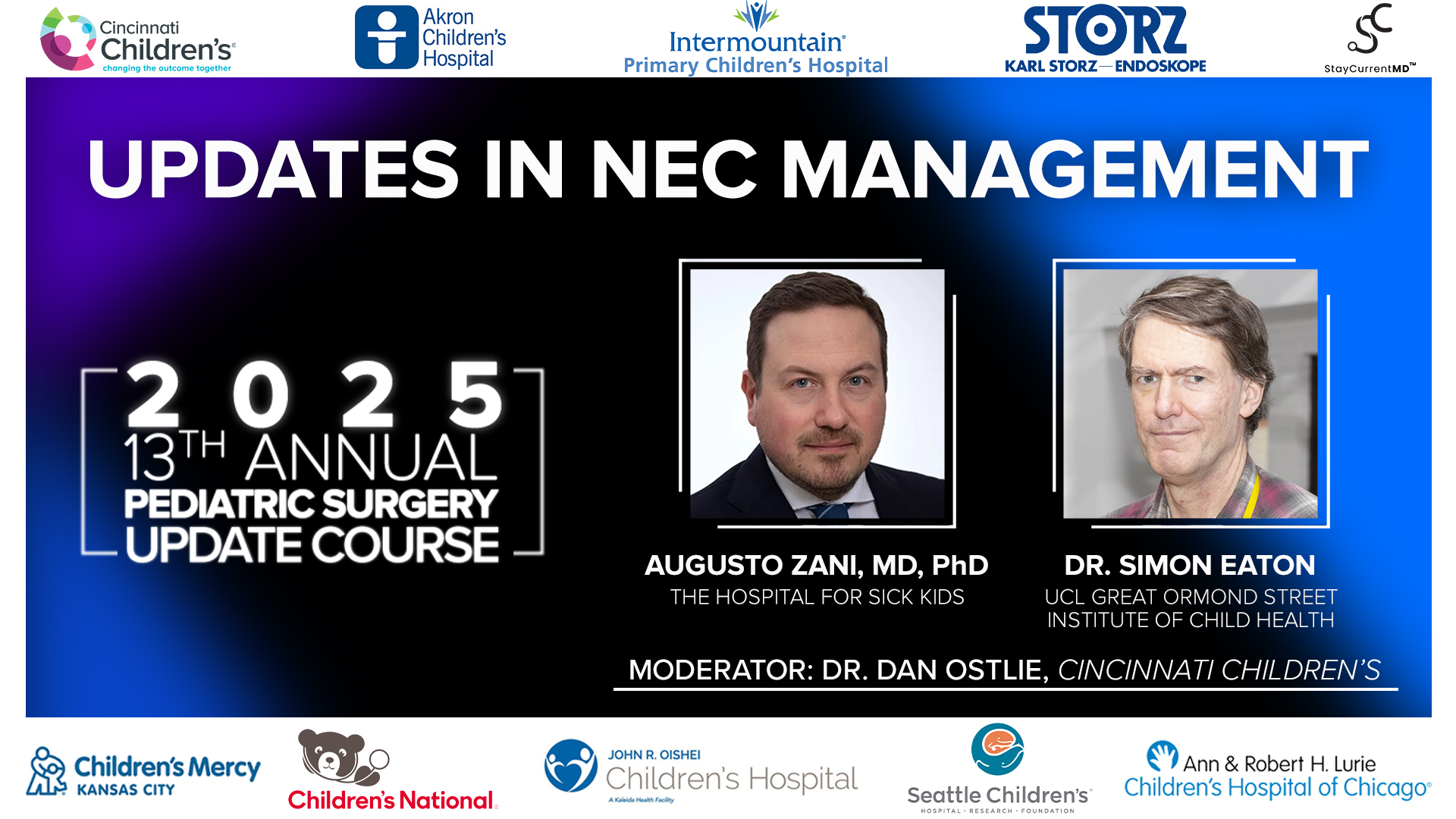
2025 Pediatric Surgery Update Course - Updates in NEC Management
26 min · Published Aug 2025
Podcast
Surgical Decision-Making in Necrotizing Enterocolitis: Imaging, Timing, and Operative Strategies
11 min · Published Nov 2026
Video
Clinical & Research Update: Renal Tumors with Drs. Ethan Smith, Lindsay Haacker, Michael Daugherty, and Meera Kotagal
71 min · Published Sep 2026
Video
Clinical & Research Update: Neuroblastoma with Drs. Katherine Somers, Cara Morin, Juan Gurria, and Meera Kotagal
67 min · Published Sep 2026
Video
Clinical & Research Update: Sarcoma w/ Drs. Roshni Dasgupta, Joseph Pressey, Arthur Meyer, Luke Pater
66 min · Published Sep 2026
Video
2026 Laparoscopic Pediatric Hernia Repair
123 min · Published Jun 2026
Video
Beyond the Spectrum: Diagnosis, Myths & Management - Caitlin Couch & Leslie Lopez - APP Conference 2026
50 min · Published May 2026
Video
Dysautonomia: Navigating the Journey - Martha Willis - APP Conference 2026
55 min · Published May 2026
What the experts said
Necrotizing enterocolitis starts with severe intestinal inflammation, which can lead to intestinal necrosis and perforation and ultimately multi-system organ failure.
MicroRNA-148a is the most abundant microRNA in milk extracellular vesicles.
TLR-4 is a pattern recognition receptor that is critical for the initiation of inflammatory response.
Lipid nanoparticles encapsulate nucleic acids and release them inside cells in a pH responsive manner.
Fluorescently tagged microRNA-148a was present in the cytosol of intestinal epithelial cells after LNP administration via enema in healthy neonatal mice, demonstrating successful delivery.
Administration of microRNA-148a and TLR-4 siRNA antagonist both significantly reduced intestinal injury in experimental NEC compared to untreated NEC mice.
NEC results in significant increase in gene expression of pro-inflammatory cytokines TNF-α and IL-6 in the intestine compared to control mice.
Administration of microRNA-148a and TLR-4 antagonists both result in significantly lower inflammation (reduced TNF-α and IL-6 expression) in the intestine during experimental NEC.
NF-κB is a transcription factor downstream of TLR-4.
Lipopolysaccharide activates the Toll-like receptor pathway and causes significant rise in NF-κB expression.
MicroRNA-148a and TLR-4 antagonist both significantly lower NF-κB expression at two different concentrations when administered with LPS.
In the experimental NEC model used (P5 to P9), the surge in intestinal injury and inflammation occurs around P6 and increases from P6 to P7.
Administration of human milk extracellular vesicles protects mice from developing NEC, with significantly lower intestinal injury scores and lower intestinal inflammation compared to untreated NEC.
MicroRNA-148a has shown to reduce the inflammatory response in other disease models.
The anti-inflammatory effect of microRNA-148a is mainly through the inhibition of Toll-like receptor 4 (TLR-4) pathway.
Dr. David Hackam's group has shown that TLR-4 signaling is required for the development of experimental NEC.