

From
Dr. Juan Gurria
Management of recurrent pancreatitis in pediatric patients with genetic mutations
With Dr. Juan Gurria · hosted by Dr. Cecilia Gigena
Chapter 1 of 5
Case presentation
Case presentation: 7-year-old with recurrent pancreatitis and pancreatic duct stricture
Expert statements on this page
No expert statements were drawn from this page.
Host summaries · secondary, not cited in answers
Educational content from recorded physician discussions — not medical advice. Talk to your (or your child's) care team about your situation.
Video
Update Course Rewind: Management of Recurrent Pancreatitis
CCHMC Pediatric Surgery · 6 min · Published May 2024
Video
Total pancreatectomy with islet autotransplantation (TPIAT) - Cincinnati Children's Pancreas Care Center
CCHMC Pediatric Surgery · 10 min · Published Dec 2024
Video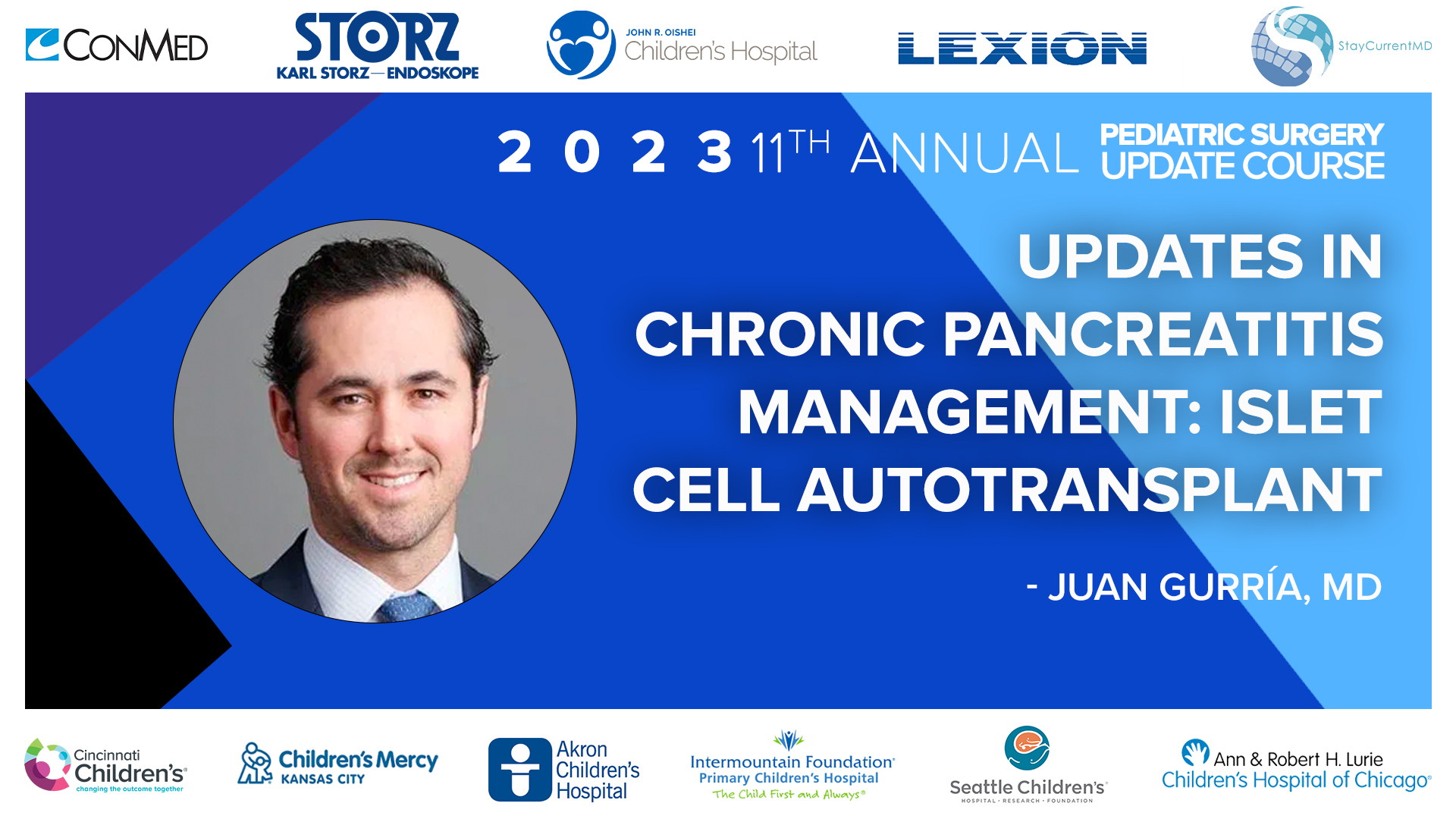
Update Course 2023 - Updates in Pancreatitis
32 min · Published Aug 2023
Podcast
Total Pancreatectomy with Islet Autotransplantation (TPIAT)
Juan Pablo Gurria · 10 min · Published Dec 2024
Video
Welcome and Introductions: Pancreatic Disease
Dr. Todd Ponsky · 6 min · Published Sep 2016
Video
Chronic Pancreatitis, Function Tests, & Pain Management: Pancreatic Disease
51 min · Published Sep 2016
Video
Activating extracorporeal cardiopulmonary resuscitation
Dr. Juan Gurria · Published Nov 2026
Podcast
Preparing for successful ECPR: team coordination and early activation strategies
2 min · Published Nov 2026
Podcast
Surgical Decision-Making in Necrotizing Enterocolitis: Imaging, Timing, and Operative Strategies
11 min · Published Nov 2026
Podcast
Pediatric pancreatitis: diagnosis, causes, and genetic insights with Dr. Juan Gurria
3 min · Published Nov 2026
Podcast
Surgical management of chronic pancreatitis in children: when and how to intervene
4 min · Published Nov 2026
Video
Robotics in Pediatric Surgery: Which indications benefit the most? w/ Dr. Juan Gurria
18 min · Published Oct 2026
What the experts said
The case involves a 7-year-old with acute recurrent pancreatitis, abdominal pain, referred with ERCP showing stricture in the head of the pancreas and dilated duct distally, who has had 7 ERCPs and a stent.
Every ERCP carries a risk of post-ERCP pancreatitis, and although the risk is low, you lose islet cells with every attack.
PRSS1 is the most common genetic mutation in pediatric pancreatitis and is a trypsinogen activator that activates trypsin inside the pancreas.
Other genetic mutations associated with pancreatitis include CTRC, CFTR, and CPA1.
The Cincinnati Children's genetic panel runs 10 different genetic markers for pancreatitis.
Genetic factors are changing the approach to pediatric chronic pancreatitis treatment.
There is currently no medication to mediate trypsin-activating mutations.
In patients with PRSS1 mutation, a Frey procedure (partial head pancreatectomy with drainage) results in loss of islet cells and the patient will most likely continue getting pancreatitis despite ductal drainage because the parenchyma continues to be attacked by the mutation.
A Frey procedure temporizes attacks by draining the duct but does not fix the underlying problem in genetic pancreatitis.
There is no set number of ERCPs that defines when to stop endoscopic management.
Surgical referral should occur sooner rather than later for evaluation, but surgery is not offered unless medical and endoscopic management have been maximized.
When the endoscopist reports there is nothing left to balloon dilate, open, or drain, and the patient continues getting pancreatitis even with a stent, there is no reason to continue ERCPs.
Imaging modalities used include endoscopic ultrasound, ultrasound, and CT scan as initial imaging of choice.
MRCP is the best non-invasive study for the pancreas, particularly with different T2 sequences.
ERCP is more therapeutic than diagnostic.
For pancreatic fluid collections, once the wall is mature in 4 to 6 weeks, drain only if there are symptoms; if asymptomatic, do not drain.
If the patient does not have gastric outlet obstruction or pain from a fluid collection, there is no need to drain it and it will self-resolve.
There is no need for antibiotics for pancreatic fluid collections.
If a patient has more than one episode of acute pancreatitis or a first severe episode, MRCP and genetic panel should be performed to rule out genetic anomalies.
Genetics testing is important before any resection procedure to avoid losing pancreatic cells in pathologies that will not benefit from resection and drainage but instead from islet cell transplant.
Endoscopic treatment should be attempted first, but if it fails, transfer to a specialized center that performs TPIAT (total pancreatectomy with islet autotransplantation).
Recurrent pancreatitis is a rare pathology that can lead to chronic pancreatitis and is associated with genetic mutations.
If genetic mutations are confirmed, partial resection of pancreatic tissue (as in a Frey procedure) should be avoided to prevent losing pancreatic cells.
Treatment should start with an endoscopic approach, but if it fails, TPIAT should be considered sooner rather than later.