


From
Grand Rounds
Malrotation with Dr. Meera Kotagal
With Dr. Meera Kotagal · hosted by Dr. Em Gootee
Chapter 5 of 5 · Fundamentals
Closing
Summary and Closing
Cued at 12:17 · press play
Expert statements on this page
No expert statements were drawn from this page.
Host summaries · secondary, not cited in answers
Educational content from recorded physician discussions — not medical advice. Talk to your (or your child's) care team about your situation.
Video
Laparoscopic Ladd Procedure for Malrotation in an Infant
Dr. Steve Rothenberg · 9 min · Published May 2026
Video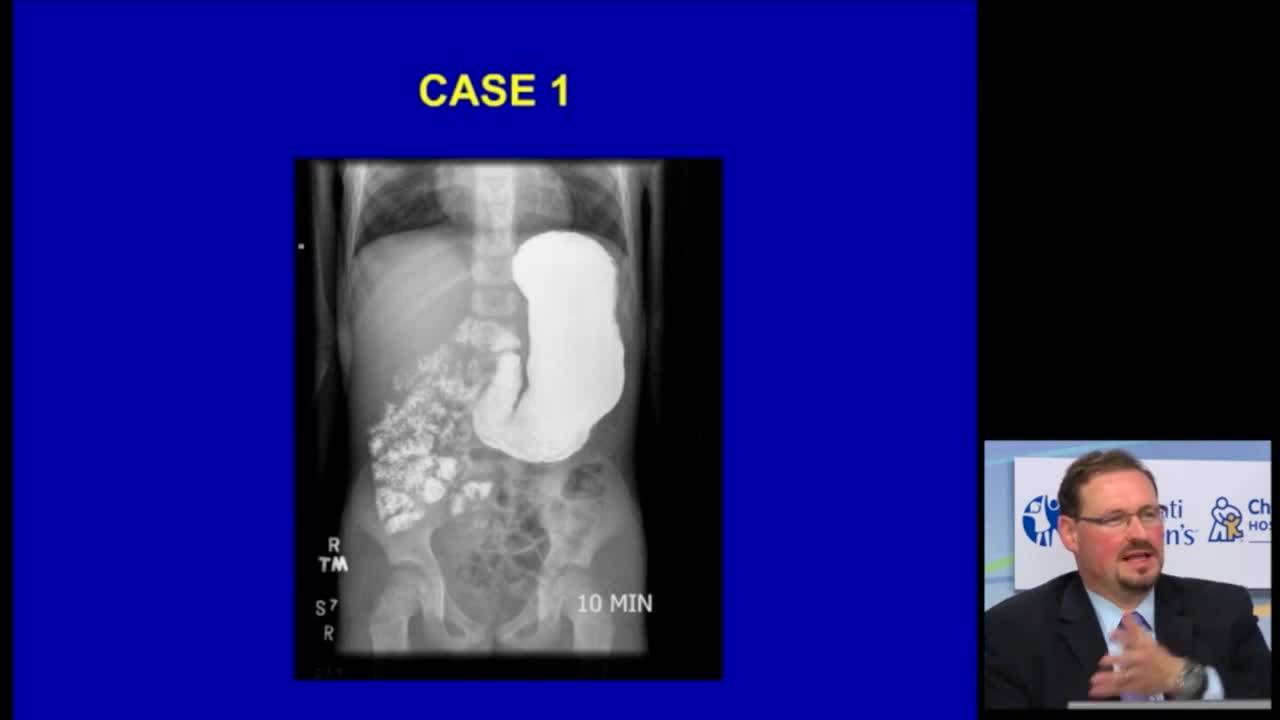
Malrotation
42 min · Published Nov 2018
Podcast
Abdominal Wall Defects with Dr. Jacob Langer
52 min · Published Dec 2016
Video
Gastroschisis - Clinical Practice Updates
Published Sep 2020
Podcast
Intestinal Rehabilitation, Episode 1: What is intestinal rehabilitation?
14 min · Published Dec 2021
Video
Intestinal rehabilitation: What is intestinal rehab? - Episode 1
Dr. Todd Ponsky · 14 min · Published Dec 2021
Video
Impact of social determinants of health on outcomes in pediatric short bowel syndrome...
43 s · Published Aug 2026
Video
Advancements in Pediatric Intestinal Failure: Innovative Therapies and Improved Outcomes
17 min · Published Aug 2026
Podcast
Update Course Rewind: Omphalocele & Gastroschisis 2020
Miguel Guelfand · 15 min · Published Jul 2026
Video
Update Course Rewind 2025: Updates in NEC Management
11 min · Published Jul 2026
Video
Availability, utilization, and barriers to bowel ultrasound for necrotizing enterocolitis...
55 s · Published Jul 2026
Video
Laparoscopic Ladd Procedure for Midgut Volvulus in a 12-Year-Old Using CoolSeal Trinity
Dr. Steve Rothenberg · 8 min · Published May 2026
Video
Clinical & Research Update: Renal Tumors with Drs. Ethan Smith, Lindsay Haacker, Michael Daugherty, and Meera Kotagal
71 min · Published Sep 2026
Video
Equity in pediatric trauma care: screening for social determinants of health
Meera Kotagal · 1 min · Published Jul 2025
Video
Early Enteral Nutrition and TPN Timing in Pediatric Trauma Patients
Meera Kotagal · 1 min · Published Jul 2025
Video
Neuroblastoma with Dr. Meera Kotagal
14 min · Published Sep 2024
Video
Update Course Rewind: 2023 Top Ten Key Takeaways
16 min · Published Jun 2024
Podcast
Understanding area-based socioeconomic deprivation indices in health research
Meera Kotagal · 25 min · Published Dec 2022
Video
GYN #4 Management of Tubal Torsion: When to Consider Salpingectomy with Dr. Lesley Breech
CCHMC Pediatric Surgery · Published Oct 2024
Podcast
Pyloric Stenosis with Dr. Alex Bondoc
16 min · Published Jun 2024
Video
GYN #3 Management of an Adnexal Torsion with a Healthy Appearing Ovary with Dr. Lesley Breech
CCHMC Pediatric Surgery · Published May 2024
Video
GYN #2 Oophoropexy in Adnexal Torsion with Dr. Lesley Breech
CCHMC Pediatric Surgery · Published May 2024
Video
GYN #1 Importance of Documenting Reproductive Anatomy with Dr. Lesley Breech
CCHMC Pediatric Surgery · Published Feb 2024
Podcast
Esophageal Replacement with Dr. Dan von Allmen
13 min · Published Nov 2023
What the experts said
In the fourth week of gestation, bowel development begins, and as the bowel grows in length it herniates into the yolk sac along the umbilical cord and SMA axis.
Normal rotation involves a 90-degree rotation of the duodenal-jejunal loop, then return of bowel with 270-degree rotation of cecum and colon, resulting in duodenal-jejunal junction to the left of midline at ligament of Treitz and cecum in right lower quadrant.
Intestinal rotation abnormalities fall along a spectrum rather than being simply normal or abnormal, including both non-rotation and malrotation.
In non-rotation, the gut returns without rotating, resulting in colon on the left and small bowel on the right, without the problematic Ladd bands that cause obstruction in malrotation.
Non-rotation anatomy looks similar to the anatomy of a malrotated patient post-Ladd procedure.
Malrotation involves incomplete rotation that fails to create a broad-based mesentery, which is important to reduce the risk of volvulus.
Complications of malrotation fall into two categories: obstructive symptoms (feeding intolerance from Ladd bands) and midgut volvulus (from narrow mesentery).
About 1 in 200 children have a risk of malrotation, but only about 1 in 30 of those children with malrotation will develop a volvulus.
About 70% of those who will have a midgut volvulus will present in the first year of life.
As children with malrotation get older without having had a volvulus, their likelihood of having a significant clinical event related to malrotation decreases.
Children with congenital cardiac disease and heterotaxy especially can have associated malrotation, but their likelihood of symptomatic events is much lower, so these children are not fixed with the same frequency in infancy.
Rotational abnormalities are associated with congenital diaphragmatic hernia, gastroschisis, and omphalocele due to the nature of the anatomy of those diagnoses.
In the neonatal period, bilious emesis is the most critical symptom and requires evaluation for midgut volvulus even if the x-ray appears normal.
Other symptoms of malrotation include feeding intolerance, abdominal pain, and abdominal distension.
Late signs associated with volvulus include bloody stools, peritoneal signs on exam, and abdominal wall erythema, which are suggestive of intestinal ischemia.
The differential diagnosis for bilious emesis includes all kinds of intestinal obstructions: atresia, Hirschsprung disease, meconium ileus or plugs, incarcerated hernia, anorectal malformations, and necrotizing enterocolitis.
Malrotation must be ruled out before pursuing other diagnoses in a child with bilious emesis because of the high risk of missing it.
Upper GI series is the most frequently used imaging for diagnosis of malrotation, looking at the position and course of the duodenum to determine if it is normally or abnormally positioned.
On upper GI, you want to see the total C-loop of the duodenum come back across the midline to the left, and from lateral view see it go posteriorly and cephalad to confirm normal position.
Contrast enema can sometimes be used if cecal position can be determined, but current sensitivity and specificity are not sufficient to rule out significant pathology, so it has not superseded upper GI as the definitive test.
Midgut volvulus is considered the number one surgical emergency in pediatric surgery.
Surgical treatment of volvulus requires exploratory laparotomy with evisceration of bowel to determine the situation, then detorsion/devolvulization of the bowel, usually requiring 270-degree counterclockwise rotation.
After detorsion, the bowel is given time to rest to assess viability and determine if ischemia has been prolonged enough to compromise intestinal viability.
The Ladd procedure involves widening the mesentery by removing Ladd bands, freeing and straightening the duodenum to avoid obstruction, performing appendectomy, and placing bowel in non-rotation configuration (small bowel right, large bowel left) to keep mesentery as broad as possible.
The reason for appendectomy during Ladd procedure is that the appendix will be in an abnormal anatomic position, and if left in place, families must be informed to tell providers about the abnormal location if the child presents with concerning symptoms.
Some believe part of the benefit of Ladd procedure is widening the mesentery plus causing scar tissue that helps bowel adhere in a configuration preventing midgut volvulus.
Laparoscopic Ladd procedure may have decreased adhesion rates, potentially losing the adhesive benefit that prevents volvulus.
About one quarter of patients who undergo Ladd procedure will have intestinal obstruction related to small bowel obstruction from adhesive disease.
Laparoscopic approach may reduce the risk of postoperative bowel obstruction.
Dr. Kotagal's approach in older children with symptomatic malrotation is to start laparoscopically and assess mesenteric width and duodenal anatomy; if mesentery is fairly broad with main problem being duodenal bands, she may complete it laparoscopically, but very narrow mesentery may be harder to address laparoscopically.
There is controversy about whether the mesentery can be successfully broadened as wide as needed by laparoscopic approach.
There is controversy about whether to perform prophylactic Ladd procedure in children with diagnosed malrotation or in conditions like congenital diaphragmatic hernia where malrotation is present by definition, due to long-term risks of bowel obstruction and complications.
In younger children with malrotation, the risk for volvulus or symptomatic malrotation is higher, so Ladd procedure is performed more commonly.
Decisions about prophylactic Ladd procedure require informed consent discussions with families about risks of both doing and not doing the operation, considering factors like access to care; families who are remote may opt for surgery accepting bowel obstruction risk, knowing acute volvulus would be harder to reach hospital for in timely fashion.
Malrotation occurs in about 1 in 200 to 500 live births.
You can have malrotation without midgut volvulus, but you cannot have midgut volvulus without malrotation.