


From
StayCurrentMD
Liver transplant with Dr. Jonathan Merola
hosted by Dr. Cecilia Gigena
Part of
Pediatric Oncology 716 items
Chapter 6 of 7 · Complications
Complications
Outcomes and Complications
Cued at 11:30 · stops at 12:10 · press play
Expert statements on this page
No expert statements were drawn from this page.
Host summaries · secondary, not cited in answers
Educational content from recorded physician discussions — not medical advice. Talk to your (or your child's) care team about your situation.
Video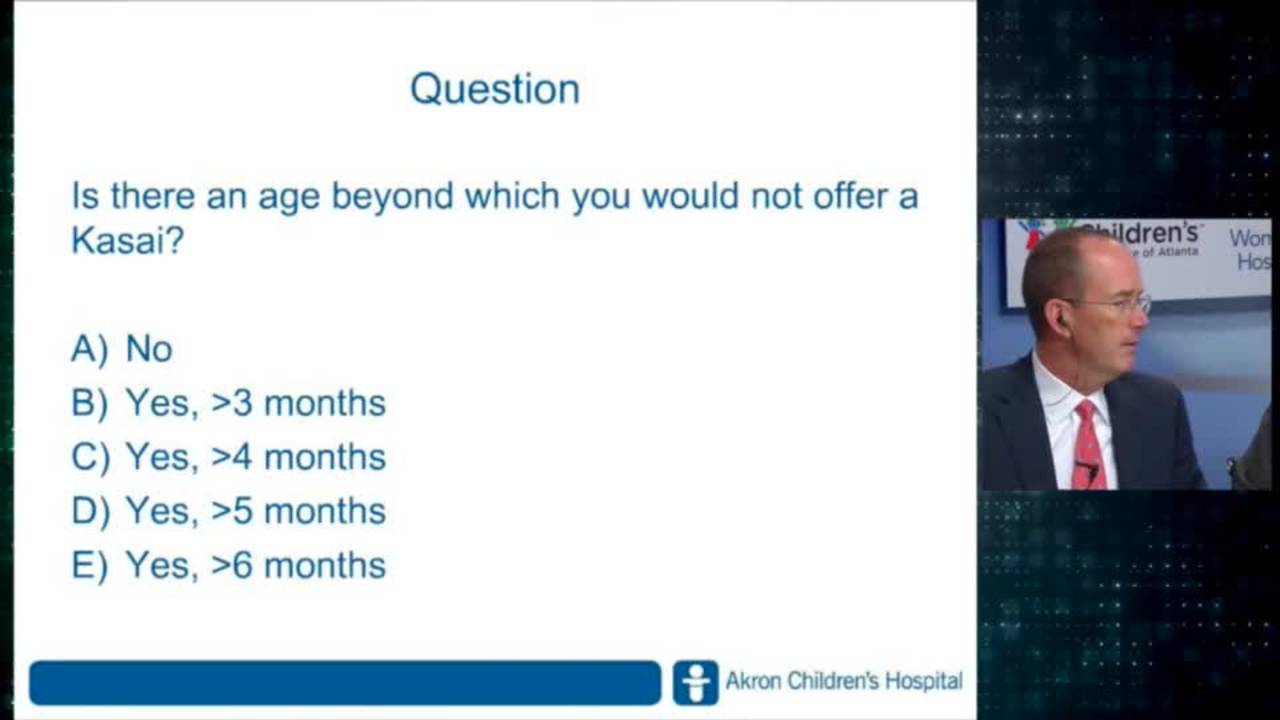
Biliary Atresia - Robert Parry: Update Course 2014
24 min · Published Nov 2018
Video
Biliary Atresia-Case Presentation and Panel Discussion: Update Course 2014
23 min · Published Jul 2017
Video
Biliary Atresia: Where are we now? Advanced Practice Providers Pediatric...
Dr. Todd Ponsky · 48 min · Published Jul 2017
Podcast
Journal of Pediatric Surgery Article Review: 2nd Quarter (Apr-Jun) 2024
17 min · Published Sep 2024
Podcast
Atresia de Vias Biliares - Resumen de la 5ta sesión Nacional de Residentes de Mexico
16 min · Published May 2023
Video
PFIC Family & Scientific Conference - Day 2
319 min · Published May 2024
Video
Rare Ovarian Tumor in Infants: Small Cell Carcinoma of Ovary, Hypercalcemic Type & SMARCA4 Mutation
21 s · Published Oct 2026
Video
Can Normal X-Rays Miss Metastatic Neuroblastoma? A Pediatric Radiology Case Study
26 s · Published Oct 2026
Video
Can Fractures Be a Sign of Hepatoblastoma in Children? Understanding Pediatric Liver Cancer Symptoms
37 s · Published Oct 2026
Video
Pancreas, Muscle, and Subcutaneous Fat Atrophy in Patients Undergoing Radiation for Neuroblastoma
47 s · Published Oct 2026
Podcast
Hepatoblastoma
Todd Ponsky · 54 min · Published Oct 2026
Podcast
Wilms Tumor
Todd Ponsky · 64 min · Published Oct 2026
Podcast
Diaphragm pacing as alternative to mechanical ventilation in pediatric respiratory failure
1 min · Published Nov 2026
Podcast
Fetoscopic endoluminal tracheal occlusion for congenital diaphragmatic hernia
4 min · Published Nov 2026
Podcast
FETO procedure for late-diagnosed severe CDH with liver herniation
4 min · Published Nov 2026
Podcast
Severe CDH case with FETO: unexpected anatomic findings and clinical outcome
3 min · Published Nov 2026
Podcast
Pediatric pancreatitis: diagnosis, causes, and genetic insights with Dr. Juan Gurria
3 min · Published Nov 2026
Podcast
Understanding craniosynostosis: skull sutures, growth patterns, and diagnosis in infants
10 min · Published Nov 2026
What the experts said
Up until the 1980s, the vast majority of children on the transplant wait lists passed away due to the lack of available organs.
In the 1990s, techniques that took advantage of the liver's segmental anatomy and ability to regenerate greatly increased organ availability, with segmental transplants (Baron graphs or segmental grafts) decreasing waitlist mortality from 80% to just 10%.
For children under 1 year of age, mortality remains at about 30% due to size constraints.
The most common indication for pediatric liver transplant is biliary atresia.
Native liver survival after a Kasai procedure can be as high as 80%, with keys being early diagnosis and selective use of antibiotics and steroids.
In adults, organ allocation is based on the MELD score, which estimates a patient's chances of survival in the next 3 months, ranging from 6 to 40 (higher is worse), based on creatinine, bilirubin, serum sodium, and INR.
In children, the PELD score is used for those under 12 years of age, calculated using albumin, bilirubin, INR, and degree of growth failure without creatinine, with special designations of 1A for acute liver failure and 1B for hepatoblastoma.
Only about 25% of kids with acute liver failure survive their condition without a transplant or death.
A study from a major liver center in Denmark used high volume plasmapheresis for 16 children when bilirubin exceeded 20 or if they had a toxic ingestion as a cause.
A native liver with over 90% necrosis will eventually recover, taking advantage of the liver's regenerative capacity.
In auxiliary liver transplant, the native left liver can be resected leaving the right lobe behind, then transplanted with a new left lobe maintained with immunosuppression for 6 months while the native liver recovers.
Hepatoblastoma is the most common liver tumor for kids under 5, and for tumors too extensive to be resected, transplant is the only treatment of choice.
About 60% of hepatoblastomas are unresectable at the time of diagnosis, and about 20% of patients remain unresectable after chemotherapy.
The second most common indication for pediatric liver transplant is metabolic liver disease, most caused by single gene mutations affecting enzymes principally harbored in the liver.
Dr. Merola explained that in the future, many metabolic liver diseases may be cured with cellular therapies using isolated pluripotent stem cells with corrected deficient genes, expanded as liver organoids and infused back into the patient.
Living donor liver transplant offers the advantage of hastening organ access and a faster recipient recovery, with recipients having much shorter length of stay and requiring fewer transfusions because they don't have to wait until extremely sick.
At Cincinnati Children's Hospital, they make liberal use of infrarenal aortic conduits where a piece of donor iliac artery is placed end to side on the aorta and the other end anastomosed end to end to the recipient hepatic artery, giving excellent arterial flow when the small native hepatic artery is inadequate.
Graft survival after pediatric liver transplant routinely exceeds 30 to 40 years, especially for living and partial donor grafts.
Primary nonfunction results from severe ischemic injury and possibly preformed antibodies, but fortunately happens in less than 1% of transplants.
Vascular complications are much more common in pediatric transplant and usually occur within the first 30 days.
Hepatic artery thrombosis is the most common vascular complication, and when it happens within the first week and revascularization is not possible, it receives a special designation since urgent retransplant is the only treatment.
Biliary strictures are the Achilles' heel of liver transplant, but thankfully most can be managed with endoscopic dilation.
Acute rejection in children is about 20% in the first year, but does not affect survival of the liver transplant if treated early with steroids.
Untreated rejection can lead to chronic injury, which is the most common cause for late graft loss.
There are two types of ex vivo perfusion platforms available: normothermic platform and cold perfusion pulsatile platform, both shown to help livers recover when they're high risk grafts.
Many transplant centers, particularly in the adult population, are using the pump, putting high risk livers on pump to assess if they perform adequately before transplant.
The next step in ex vivo organ perfusion technology is treatment of livers: making fatty livers less fatty, enhancing immune compatibility, and changing blood group antigens.