
Atresia de Vias Biliares - Resumen de la 5ta sesión Nacional de Residentes de Mexico
With Dr. Maria Jose Gonzalez & Dr. Sergio Adrian Trujillo · hosted by Dr. Alfredo Dominguez · StayCurrent Espanol
Part of
Cholestasis 6 items
Educational content from recorded physician discussions — not medical advice. Talk to your (or your child's) care team about your situation.
Video
Biliary Atresia-Case Presentation and Panel Discussion: Update Course 2014
23 min · Published Jul 2017
Video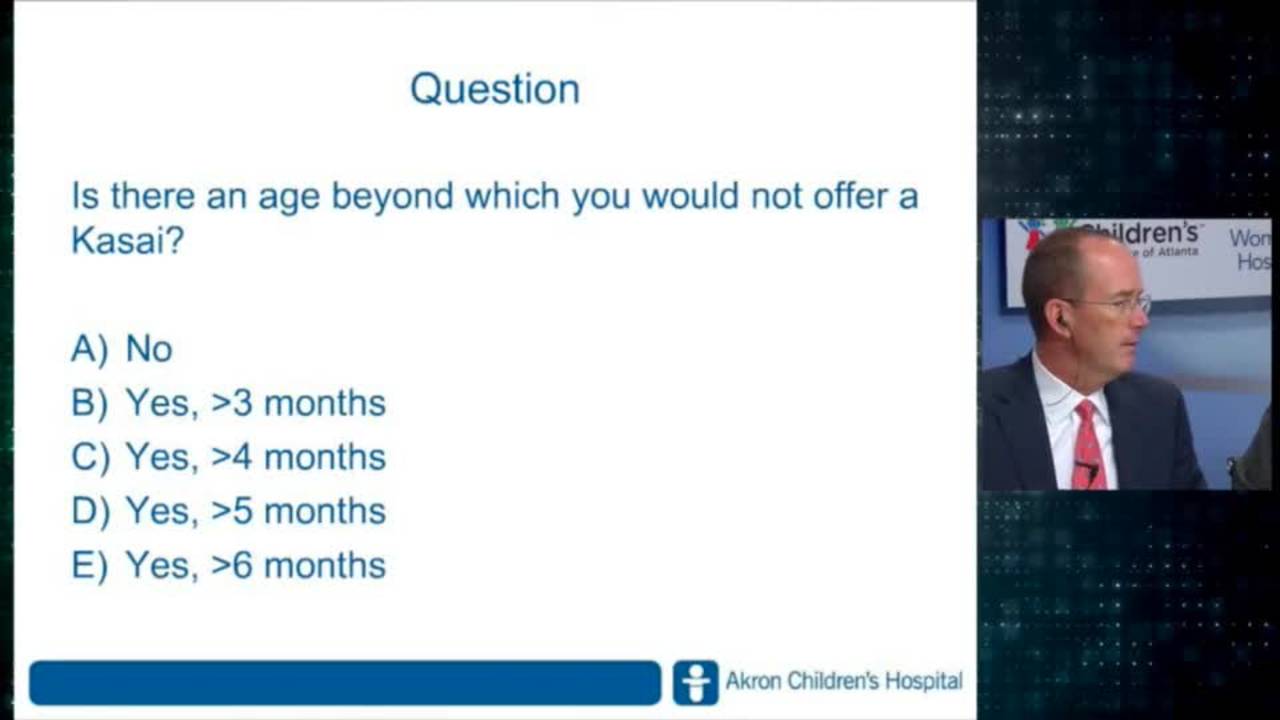
Biliary Atresia - Robert Parry: Update Course 2014
24 min · Published Nov 2018
Podcast
Biliary Atresia Part II
42 min · Published Feb 2022
Video
Prof. Shilpa Sharma - Best of the Best in Pediatric Surgery 2024
Dr. Todd Ponsky · 5 min · Published Feb 2024
Video
Biliary Atresia: Where are we now? Advanced Practice Providers Pediatric...
Dr. Todd Ponsky · 48 min · Published Jul 2017
Video
Biliary Atresia with Dr. Greg Tiao
CCHMC Pediatric Surgery · 11 min · Published Jun 2022
Only a few other public items share this expert — go deeper there →
Video
Volumen testicular en la pubertad en niños con criptorquidia congénita aleatorizados a tratamiento en diferentes edades
1 min · Published Jul 2024
Video
Cuidado de transición en malformación anorrectal y enfermedad de Hirschsprung
1 min · Published Jul 2024
Video
Exploración laparoscópica trancística del conducto biliar común en pacientes pediátricos con coledocolitiasis
1 min · Published Jul 2024
Video
Características clínicas y pronóstico de la atresia de vías biliares con niveles bajos de metaloproteinasa 7 de la matriz sérica
55 s · Published Jul 2024
Video
Reglas de predicción PECARN para imágenes por TC de niños que acuden al servicio de urgencias con traumatismo craneoencefálico menor o abdominal cerrado
58 s · Published Jul 2024
Video
El cese del tratamiento con antibióticos para la apendicitis complicada en el momento del alta no aumenta el riesgo de infección posoperatoria
55 s · Published Jul 2024
What the experts said
Biliary atresia is obstruction of the extrahepatic bile duct leading to cholestasis and hepatic fibrosis
Clinical manifestations include late jaundice (after two weeks of life), acholic stools, dark urine, and hepatomegaly
Surgical approach uses laparoscopic technique with specific positioning and prophylaxis
In Mexico and Argentina, low transplant availability necessitates performing Kasai surgery as early as possible, ideally before 120 days of life
A child's prognosis within the first year of life depends on whether they will be transplanted within that year
Laparoscopic approach requires an excellent pediatric laparoscopic surgeon; the technique is relatively simple with magnification but complete porta hepatis resection is complicated
There is no serious scientific publication with rigor demonstrating that laparoscopic approach is superior to open approach in any aspect
Four objectives of Kasai surgery: confirm diagnosis with good operative cholangiography, achieve permanent bile flow free of cholangitis, delay or avoid transplantation (especially important in countries with low transplant availability), and avoid portal vein injury
Key technical points for laparoscopic approach include meticulous dissection identifying hepatic artery and portal vein bifurcation, use of specific retractors or percutaneous sutures for traction, and careful division of vessels to avoid injury
Postoperative management includes antibiotics for at least 10 days IV if coagulation abnormalities present, otherwise oral antibiotics
Steroid protocol: IV methylprednisolone boluses for first 5 days (8-10 mg/kg/day), then oral prednisone starting day 6, tapering from 2 mg/kg/day to 1 mg/kg every other day over several weeks, then discontinuing after Kasai procedure
Cholangitis is the primary prognostic indicator for long-term Kasai success; a meta-analysis from Hong Kong showed repeated episodes of cholangitis are the principal prognostic factor for failure beyond 3 years
Important factors for preventing cholangitis include early clinical diagnosis and treatment with at least 21 days of IV antibiotics for severe infection
Kasai failure is defined as inadequate bile drainage requiring transplant in the first year post-Kasai; if patient deteriorates rapidly and needs transplant in first year, the Kasai has failed
Long-term outcomes: approximately one-third of patients need transplant in first year (Kasai failure), one-third have functioning Kasai allowing growth and delayed transplant, and one-third can live well with Kasai alone without transplant
Biliary atresia is the most common cause of neonatal cholestasis with predominance in females
Intraoperative cholangiography is most concordant when done laparoscopically
Surgery is not recommended if patient is less than 60 days old, as younger patients have better outcomes
Most common long-term complication is portal hypertension, which increases with larger portoenterostomy anastomosis, potentially leading to obstruction
Most experts agree on using high-dose steroids in postoperative management
Transplant is indicated for patients with cirrhosis
Laboratory findings show predominance of direct bilirubin
The Kasai portoenterostomy involves identifying the porta hepatis at the bifurcation of the hepatic artery, creating a Roux-en-Y limb of 40-45cm, and performing an end-to-side anastomosis
Younger patients at time of surgery have better prognosis