


Chapter 1 of 4 · Fundamentals
Introduction and Differential Diagnosis
Expert statements on this page
No expert statements were drawn from this page.
Host summaries · secondary, not cited in answers
Educational content from recorded physician discussions — not medical advice. Talk to your (or your child's) care team about your situation.
Video
Error Traps and Culture of Safety in Pediatric Surgical Oncology
CCHMC Pediatric Surgery · Published Sep 2019
Video
Social Determinants of Health Influence on Survival in Wilms Tumor, Neuroblastoma, and Hepatoblastoma
1 min · Published Jan 2026
Video
Update Course 2023 - Updates in the use of ICG
19 min · Published Aug 2023
Podcast
Hepatoblastoma
54 min · Published Nov 2017
Podcast
Evolution of pediatric surgical oncology as a subspecialty
Roshni Dasgupta · 26 min · Published Jun 2021
Video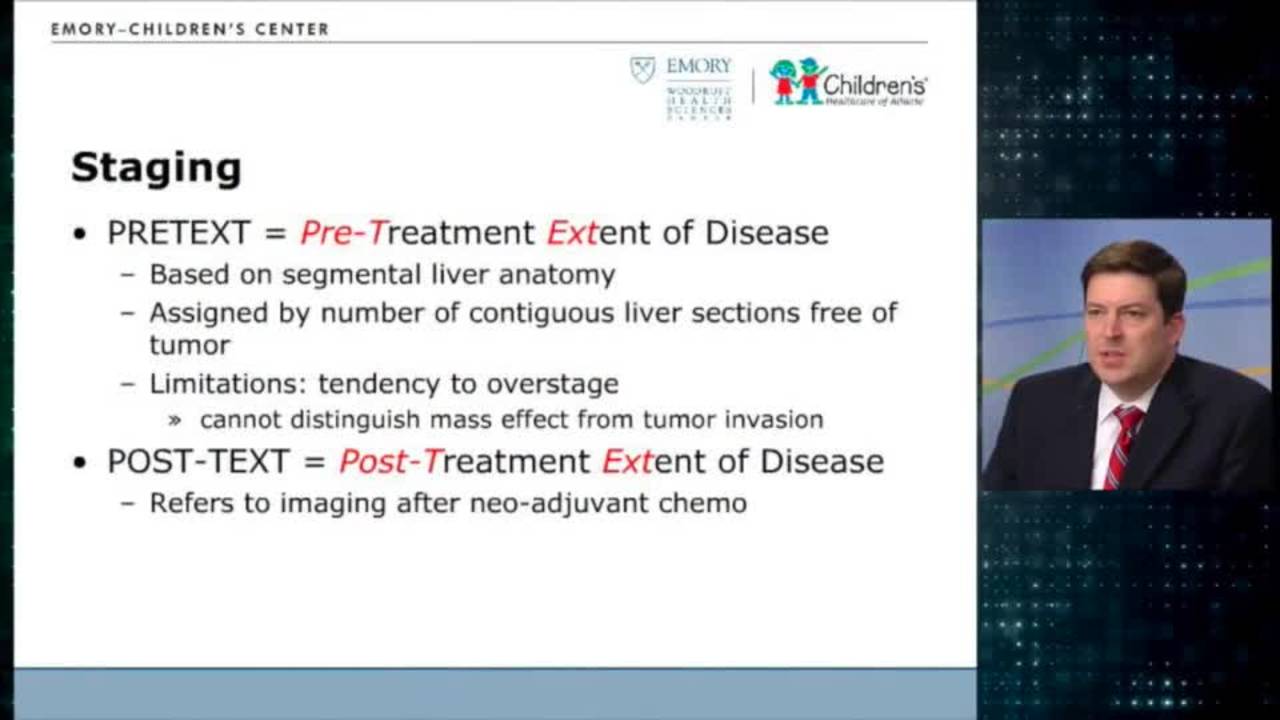
Hepatoblastoma: Update Course 2014
24 min · Published Nov 2018
Video
Rare Ovarian Tumor in Infants: Small Cell Carcinoma of Ovary, Hypercalcemic Type & SMARCA4 Mutation
21 s · Published Oct 2026
Video
Can Normal X-Rays Miss Metastatic Neuroblastoma? A Pediatric Radiology Case Study
26 s · Published Oct 2026
Video
Can Fractures Be a Sign of Hepatoblastoma in Children? Understanding Pediatric Liver Cancer Symptoms
37 s · Published Oct 2026
Video
Pancreas, Muscle, and Subcutaneous Fat Atrophy in Patients Undergoing Radiation for Neuroblastoma
47 s · Published Oct 2026
Podcast
Wilms Tumor
Todd Ponsky · 64 min · Published Oct 2026
Podcast
Neuroblastoma
Todd Ponsky · 56 min · Published Oct 2026
Video
Update Course Rewind: MMP-7 & Biliary Atresia Diagnosis 2024
CCHMC Pediatric Surgery · 6 min · Published Mar 2025
Video
Biliary Atresia with Dr. Greg Tiao
CCHMC Pediatric Surgery · 11 min · Published Jun 2022
Podcast
Biliary Atresia Part II
42 min · Published Feb 2022
Podcast
Biliary Atresia Part I
31 min · Published Jan 2022
Video
Biliary Atresia
CCHMC Pediatric Surgery · 20 min · Published Nov 2018
Video
Compiled Sandler Rapid Fire Sessions: Update Course 2015
29 min · Published Nov 2015
Video
GYN #4 Management of Tubal Torsion: When to Consider Salpingectomy with Dr. Lesley Breech
CCHMC Pediatric Surgery · Published Oct 2024
Podcast
Pyloric Stenosis with Dr. Alex Bondoc
16 min · Published Jun 2024
Video
GYN #3 Management of an Adnexal Torsion with a Healthy Appearing Ovary with Dr. Lesley Breech
CCHMC Pediatric Surgery · Published May 2024
Video
GYN #2 Oophoropexy in Adnexal Torsion with Dr. Lesley Breech
CCHMC Pediatric Surgery · Published May 2024
Video
GYN #1 Importance of Documenting Reproductive Anatomy with Dr. Lesley Breech
CCHMC Pediatric Surgery · Published Feb 2024
Podcast
Esophageal Replacement with Dr. Dan von Allmen
13 min · Published Nov 2023
What the experts said
Hepatoblastoma is the most common malignant liver tumor in the pediatric population
Treatment strategies for hepatoblastoma have changed dramatically over the past 25 years
There are around 250 new cases of hepatoblastoma per year
Hepatoblastoma is nowhere near the most common liver tumor or the most common abdominal tumor in children
Neuroblastoma is the most common solid malignancy in the pediatric population
Hemangioma is the most common liver lesion in children
Hepatoblastoma can present as an asymptomatic abdominal mass, tumor rupture, or respiratory distress due to tumor size
Hepatoblastoma can present as a paraneoplastic syndrome like precocious puberty
An elevated alpha fetoprotein (AFP) is a key component in the workup and is critical for the diagnostic algorithm and treatment response
Most experts rely on MRI to delineate anatomy and evaluate the extent of liver involvement in hepatoblastoma
Eovist is an MRI contrast agent taken up by hepatocytes and then excreted, providing the best definition when looking at the liver on imaging
To establish a diagnosis of hepatoblastoma, four things are needed: history, abdominal imaging, AFP check, and liver biopsy
The most important intervention for survival is to achieve complete resection
Aggressive resections include trisectionectomy, mesohepatectomy, resection with additional procedure in remnant liver, and liver transplantation
Couinaud labeled liver segments in a counterclockwise fashion by injecting portal vessels, similar to how districts of Paris are labeled
The right hepatic vein differentiates anterior and posterior sections of the right liver
The right portal vein separates superior and inferior segments of the right liver
The pre-text staging system classifies tumors based on the number of contiguous liver sections free of disease (minus four equals pre-text stage)
Pre-text 1 has three contiguous sections free of disease, pre-text 2 has two, pre-text 3 has one, and pre-text 4 has no free sections or diffuse tumor
Pre-text 1 and 2 tumors with greater than 1 cm margin from middle hepatic vein and portal bifurcation should be considered for resection at diagnosis
Pre-text 3 and 4 tumors represent a big game changer in practice that improved survival from less than 30% in the 1970s-80s to 80-90% today
Pre-text 3 tumors should generally be biopsied at diagnosis, started on neoadjuvant chemotherapy, then referred to transplant center or center with expertise in advanced liver resections
Indications for transplant in pre-text 3 or 4 disease include unresectable disease, unsafe resection, or inadequate liver remnant
It is important to consult a transplant center early for pre-text 3 and 4 tumors
The PHITT (Pediatric Hepatic International Tumor Trial) is an ongoing multinational trial to identify high and low risk features for each pre-text stage
The PHITT study has been ongoing for three years