

Hepatoblastoma
With Dr. Max Langham · hosted by Dr. Todd Ponsky
Chapter 3 of 7 · Diagnosis & Workup
Pretext system
Pretext Staging System
Cued at 12:08 · stops at 12:50 · press play
Expert statements on this page
No expert statements were drawn from this page.
Host summaries · secondary, not cited in answers
Educational content from recorded physician discussions — not medical advice. Talk to your (or your child's) care team about your situation.
Video
Hepatoblastoma with Dr. Greg Tiao
CCHMC Pediatric Surgery · Published Mar 2022
Video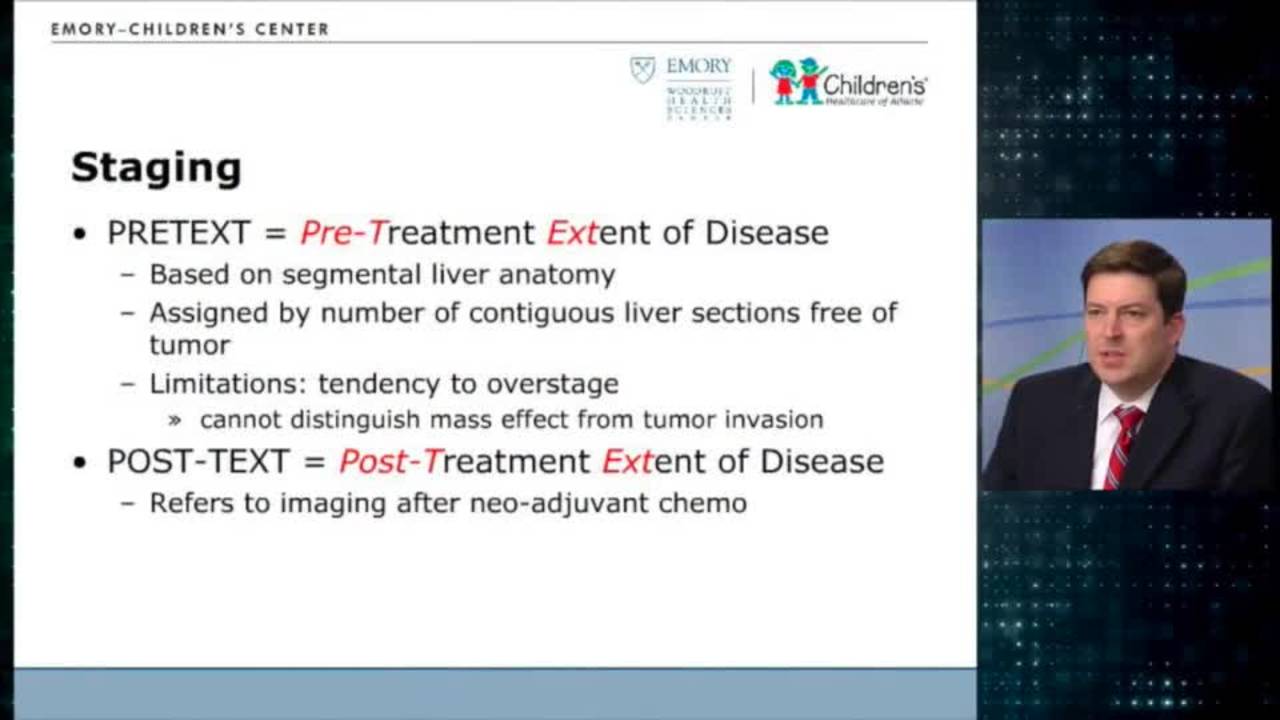
Hepatoblastoma: Update Course 2014
24 min · Published Nov 2018
Podcast
Evolution of pediatric surgical oncology as a subspecialty
Roshni Dasgupta · 26 min · Published Jun 2021
Video
Journal of Pediatric Surgery Article Review: June 2023, AAP Issue
Todd Ponsky · 13 min · Published Jul 2026
Video
Update Course 2023 - Updates in the use of ICG
19 min · Published Aug 2023
Podcast
Journal of Pediatric Article Review: June 2023, AAP Issue
13 min · Published Sep 2023
Video
Rare Ovarian Tumor in Infants: Small Cell Carcinoma of Ovary, Hypercalcemic Type & SMARCA4 Mutation
21 s · Published Oct 2026
Video
Can Normal X-Rays Miss Metastatic Neuroblastoma? A Pediatric Radiology Case Study
26 s · Published Oct 2026
Video
Can Fractures Be a Sign of Hepatoblastoma in Children? Understanding Pediatric Liver Cancer Symptoms
37 s · Published Oct 2026
Video
Pancreas, Muscle, and Subcutaneous Fat Atrophy in Patients Undergoing Radiation for Neuroblastoma
47 s · Published Oct 2026
Podcast
Wilms Tumor
Todd Ponsky · 64 min · Published Oct 2026
Podcast
Neuroblastoma
Todd Ponsky · 56 min · Published Oct 2026
What the experts said
Liver tumors are rare in children, and sorting out the diagnosis is crucial for good outcomes.
A one-year-old with a liver mass and very elevated alpha-fetoprotein has a presumptive diagnosis of hepatoblastoma.
Hepatoblastoma presents from the first year of life through perhaps 10 years of age, although there are a few that have been diagnosed older than that.
If a liver mass is a rhabdoid tumor, chemotherapy is not important and the lesion needs to be resected.
If it's a very low risk hepatoblastoma, probably it doesn't need a biopsy, it needs an upfront resection.
Most people favor needle biopsy of the liver rather than an open biopsy or a laparoscopic biopsy.
The biopsy should go through the normal part of the liver that will be resected with the specimen, not crossing the left lobe if it doesn't have tumor, because hepatoblastoma will seed.
Rhabdoid tumor is more common in very young children and is a bad actor.
A baby with tyrosinemia will develop hepatocellular carcinoma if they are not transplanted, usually in the first couple of years of life.
There is a mixed tumor that has features of hepatoblastoma and hepatocellular carcinoma that tends to occur in children over 6 years of age.
Alpha-fetoprotein ought to be automatic when evaluating a liver mass, as it helps narrow the diagnosis even in newborns.
There is a predisposition of premature infants to getting hepatoblastomas, usually in the first year or two of life rather than in the nursery.
For the biology arm of the Children's Oncology Group, they want 10 core biopsies, not just one biopsy with histology.
The complication rate and mortality seem higher with open biopsies than with the needle technique.
There is no role for frozen section in hepatoblastoma, either for initial biopsy or for margins.
The overarching goal of treatment for hepatoblastoma is to get the kids to a safe resection.
The pretext system is a pre-treatment extent of disease radiographic imaging-based system developed in Europe during SIOPEL 1.
Couinaud based the numerology of liver segments on the street map of Paris, with the caudate lobe (segment 1) representing the Île de Paris where Notre Dame is located.
A pretext 1 lesion has three contiguous sectors of the liver that are free, which can only occur in the left lateral segment, left lateral sector, or right posterior sector.
A pretext 2 lesion has two adjoining sectors free, which can happen three ways: right-sided lesion with left hemiliver free, left-sided lesion with right hemiliver free, or right posterior and left lateral lesions with right anterior and left medial free.
Pretext 3 means only one sector is free of disease, and pretext 4 means all sectors are involved.
It is more common for people to overread pretext than underread it.
Upfront resection is acceptable if it is a conventional hemihepatectomy or less, with at least 1 centimeter of normal liver between the middle hepatic vein and tumor, and no annotation factors.
If a lesion is resected upfront and histology shows well-differentiated pure fetal histology, that baby is done with no need for any chemotherapy, and survival is 100%.
Pulmonary metastases make up the vast majority of metastases in hepatoblastoma, and even small liver tumors can metastasize.
A pretext 1 lesion with metastatic disease in the lungs is a high-risk patient.
If a pretext 1 lesion has no vena cava, hepatic vein confluence, or portal vein involvement and the surgeon judges it resectable at diagnosis, it should be resected with an anatomic resection.
A pretext 1 lesion sitting on the vena cava without margin would be considered intermediate risk because of vascular involvement.
If the same patient is over 8 years of age, that moves the patient into a higher risk environment.
All pretext 1 lesions are not resectable upfront, and there are some pretext 2 lesions that are resectable upfront.
Annotation factors include V (vena cava/hepatic veins): V0 means within 1 cm, V1 means abutting, V2 means distorting, and V3 means tumor thrombus extending out of the vein.
Hepatoblastoma is like Wilms tumor in that you can get direct extension of tumor thrombus out of hepatic veins into the vena cava and even up into the heart.
Most hepatoblastomas are a mixture of fetal and embryonal histologies.
The most common adverse finding is small cell undifferentiated (SCU) histology, which is a primitive tumor with high nuclear-cytoplasmic ratio that makes the lesion much higher risk.
In AHEP 0731, patients with mixed fetal and embryonal histology after upfront resection were treated with two courses of cisplatin-based chemotherapy with excellent results.
If the diagnosis is hepatoblastoma, the child needs long-term central access and will have two rounds of cisplatin-based chemotherapy, then be reimaged.
After two rounds of chemotherapy, the surgeon should make a commitment about resectability and refer to a transplant center if there is any question about resectability.
Multifocal tumors should be referred straight away to a transplant center.
Children 6 years of age or older with hepatoblastoma are significantly higher risk patients.
High-risk biologic factors include metastases (always high risk), vascular involvement (intermediate or high risk), age 8 years or older (high risk), and alpha-fetoprotein less than 100 (high risk).
Pulmonary metastases in hepatoblastoma behave similarly to Wilms tumor metastases, with rapid responders having excellent outcomes without specific pulmonary therapy.
If pulmonary metastases get smaller but persist, the child will need pulmonary metastasectomy, which can be done thoracoscopically or open.
Before doing anything of consequence with the liver, ensure you can vascularly isolate it by dissecting the suprahepatic and infrahepatic vena cava and placing umbilical tapes for potential clamping.
Disasters during liver resection happen because of major bleeding or air embolism from the low-pressure vena cava system.
Use hypovolemic anesthesia with low CVP, preserving transfusions until later in the case, because high CVP causes the liver to swell and bleed more.
Take inflow before outflow to prevent the liver from swelling.
Anatomic resections are preferred over non-anatomic resections for hepatoblastoma.
Staplers work well for vascular structures but can be problematic in babies when the stapler width is wider than the margin, potentially causing false positive margins or vessel injury.
Liver transplant has great 3- and 5-year disease-free survival but requires lifelong immunosuppression with risks of rejection and secondary malignancies.
Extreme resections with vascular reconstruction can provide equivalent oncologic results to transplant without immunosuppression, but have higher complication rates including late portal hypertension.
Having a grossly positive margin or leaving gross residual disease behind is not acceptable.
If a child has negative margin resection and relapses locally in the liver, refer for transplantation rather than re-resection.
Hepatoblastoma is not thought to be radiation sensitive.
After resection following 4 rounds of chemotherapy with clear margins, patients usually receive 2 courses of consolidation chemotherapy.
Most recurrences happen within the first 3 years of therapy.
Upfront resection before chemotherapy is for pretext 1 or 2 lesions without annotation factors.
In AHEP 0731 in the US, about 90% of pretext 4 patients were transplanted.
Pretext 3 and 4 lesions should generally be resected after 4 courses of chemotherapy.
Most of the tumor shrinkage that will occur with chemotherapy happens in the first two rounds.
The Japanese have published using indocyanine green as a marker for thoracoscopic metastasectomy because it concentrates in the liver and lights up.