

From
Dr. Michael Helmrath
Growing functional intestinal tissue from stem cells with Dr. Michael Helmrath
With Dr. Michael Helmrath · hosted by Dr. Em Gootee
Part of
Esophageal Stricture 4 items
Chapter 3 of 8 · Evidence & Research
Nerve integration
Organoid Structure and Nerve Integration
Cued at 1:45 · stops at 3:15 · press play
Expert statements on this page
No expert statements were drawn from this page.
Host summaries · secondary, not cited in answers
Educational content from recorded physician discussions — not medical advice. Talk to your (or your child's) care team about your situation.
Video
Care transition from a pediatric intestinal rehabilitation program to adult care and the risk of all-cause mortality: A retrospective cohort study
1 min · Published May 2026
Podcast
Managing overwhelming intestinal catastrophe in neonates: when to operate
Michael Helmrath · 17 min · Published Feb 2022
Video
Reliance on total parenteral nutrition (TPN) and travelling abroad
1 min · Published Dec 2023
Podcast
Intestinal Failure with Dr. Brad Warner
52 min · Published May 2017
Podcast
Introduction to intestinal rehabilitation and intestinal failure in pediatric surgery
Michael Helmrath · 14 min · Published Dec 2021
Podcast
Intestinal Rehabilitation, Episode 1: What is intestinal rehabilitation?
14 min · Published Dec 2021
Video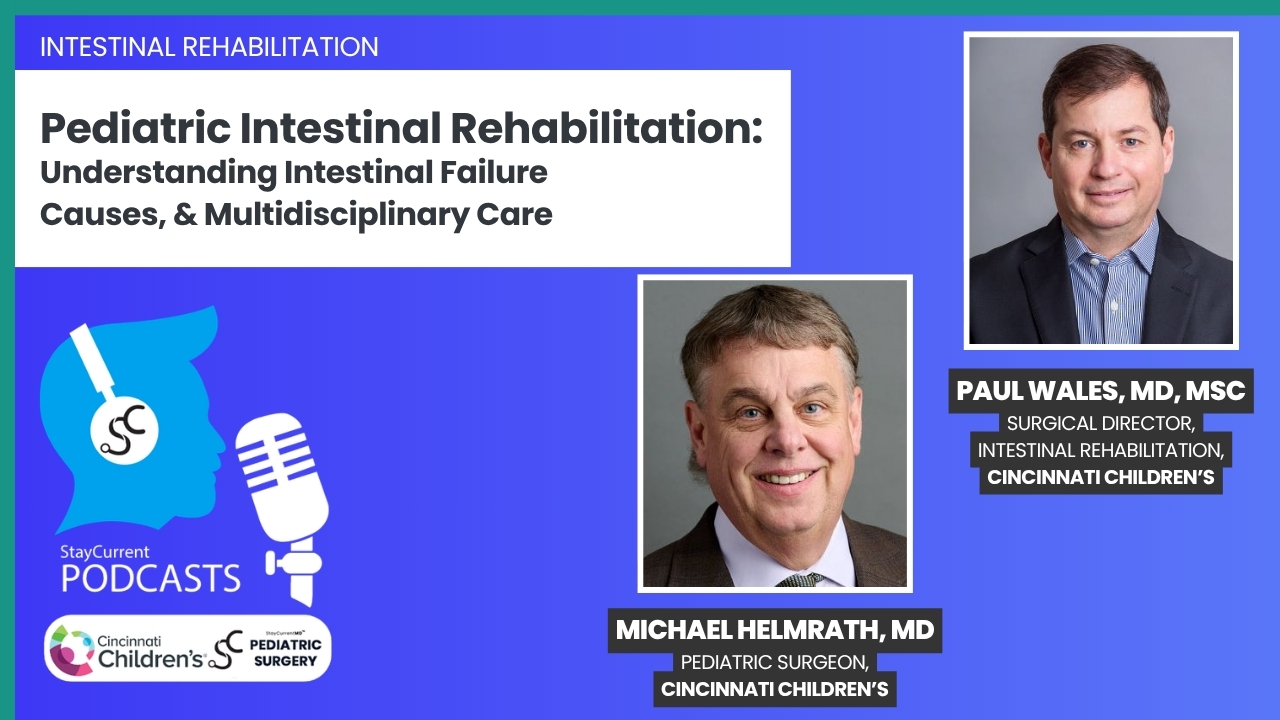
Pediatric Intestinal Rehabilitation: Understanding Intestinal Failure, Causes, & Multidisciplinary Care
12 min · Published Nov 2026
Video
April 29, 2025 with Michael A. Helmrath, MD
Michael Helmrath · Published Apr 2025
Video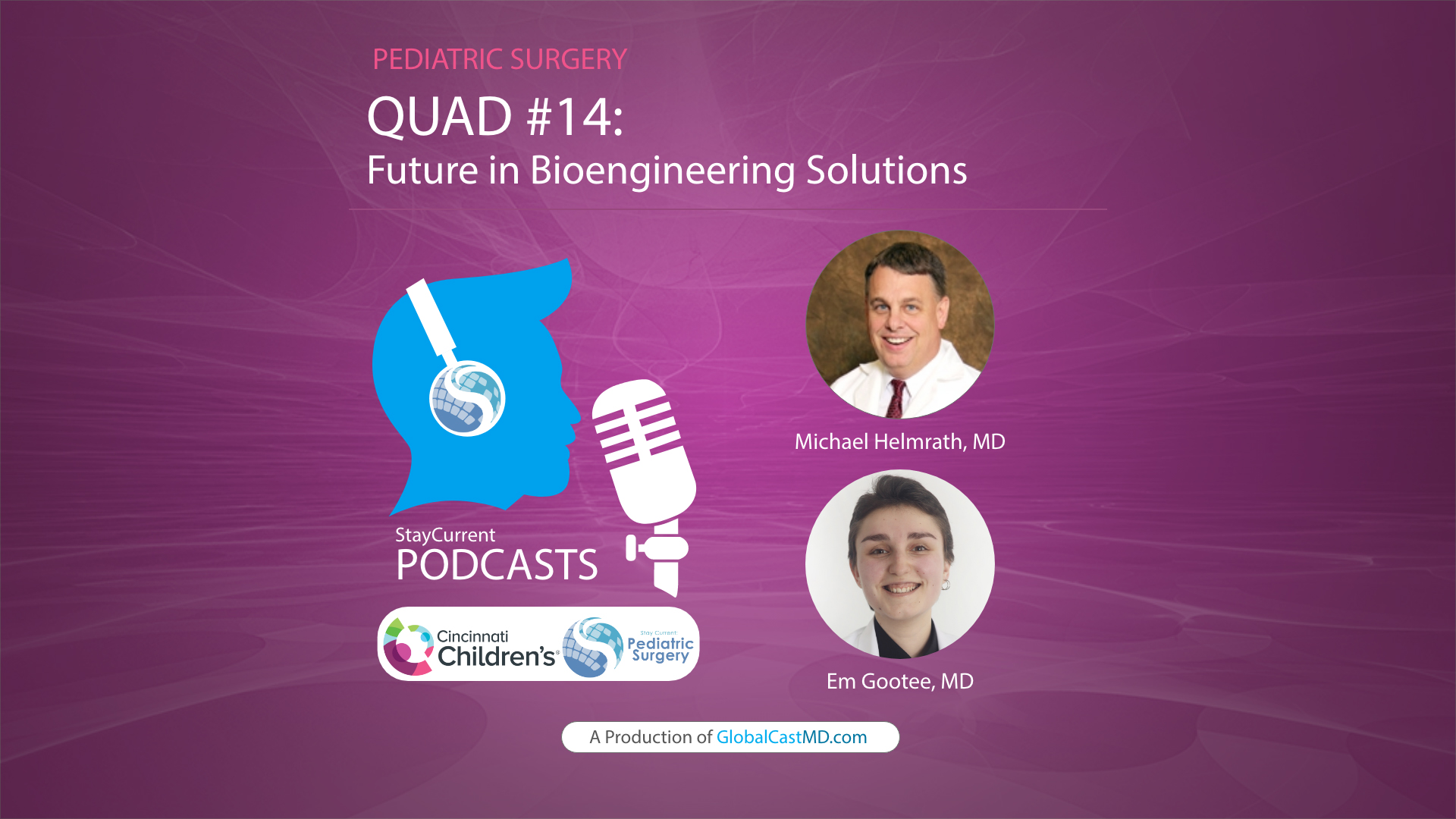
QUAD #14 Future in Bioengineering Solutions with Dr. Michael Helmrath
CCHMC Pediatric Surgery · Published Aug 2024
Podcast
Intestinal rehabilitation in pediatric short bowel syndrome: expert strategies for autonomy
Michael Helmrath · 12 min · Published Jun 2024
Video
Intestinal Rehabilitation Webinar 2023 - Top 5 Key Takeaways
CCHMC Pediatric Surgery · 12 min · Published Jun 2024
Video
Xavier's journey from short bowel syndrome to eating again
Michael Helmrath · 3 min · Published Jan 2024
What the experts said
The gut includes complexity beyond the epithelial lining: nerves, muscles, immune system, luminal bacteria recognition, and microbiota.
The first bowel made roughly 11 years ago was small bowel, which was able to be transplanted into the animal.
Colon transplants into animals but not as well as small bowel, while antral structures (esophagus and stomach) did not and do not readily transplant into the animal.
Nerves are not present in the grafts initially; they are just mesenchyme and endoderm, but nerves can be added by adding neurosphere to the dish when transplanting.
When nerves are present in grafts, they cause the ingrowth of human vasculature; cells in the graft that are endothelial progenitors are told what to do by nerves.
Nerve presence is important for tissue used for the esophagus.
Growing cells in a confined space to make a long tube resulted in nerves co-developing by progenitors within the typical HIO without adding neurospheres.
Peristalsis starts in the cells of Cajal and the mesenchyme, then is affected and modulated by the nerve.
The tissue demonstrates the ability to both contract and relax, which are important properties for building esophagus.
HIOs can be separated in a dish with the inside being epithelium/endoderm and the outside being mesenchyme, like an Oreo cookie, and can be recombined with any mesenchyme.
When separated and recombined, the mesenchyme and endoderm remain fully faithful to their original identity.
A rat model was developed by dividing the bowel and damaging it with hot EDTA and a brush, then placing HIO fragments inside the lumen.
At 7 days after fragment placement, IPS-generated fragments show both epithelial engraftment (staining brown for human KU 80) and mesenchymal engraftment, while control somatic stem cells rarely show engraftment.
Cincinnati Children's was awarded Organoid Cure funding to put together data to grow human intestine to put into a patient and obtain FDA approval.
Working with Georgia Tech, the team developed a hydrogel that when exposed to UV light polymerizes like glue and holds tissue in place without killing cells, allowing cells to migrate out.
The first step is tissue agnostic, with intestinal transplant serving as a tool to gather information.
Diseases like esophageal strictures are very applicable to this therapy.
Dr. Helmrath anticipates using this therapy within the current decade in patients.
The lab has developed methods to grow from a single stem cell drawn from blood the entire GI tract from mouth to anus.
A single organoid grown in a dish for roughly a month and transplanted into an animal produces human intestine on top of the kidney of the mouse that is fully laminated and looks no different than a biopsy.
Nerves formed in confined space growth are much better compared to when added externally and are very similar to human controls.
Grafts can be externally stimulated and nerve function can be blocked with TTX, and relaxation can be blocked by L-NAME.
L-NAME hydrochloride can be used in animal modeling to construct cardiovascular and cerebrovascular disease models and has been widely applied for several decades as an antagonist of nitric oxide synthase.
The mesenchyme from HIO can be combined with other endoderms to create different tissue types including colon.
The cells migrate in a non-confined space such that at 10 weeks the whole epithelium is human, with muscle cells aligned with existing rat cells and fully functional.
A custom accelerator space is dedicated to translating the team's work with world-class scientists.
The hydrogel delivery method could be used for recalcitrant strictures by dilating, spraying cells, and applying UV light to keep cells localized.