


From
Live Event Content
Dr. Timothy B. Lautz - Best of the Best in Pediatric Surgery 2025
With Dr. Ramy Shaaban
Part of
Cancer 17 items
Chapter 2 of 4 · Emerging & Future Directions
AI in healthcare
AI applications and impact in modern healthcare
Cued at 0:35 · stops at 3:35 · press play
Expert statements on this page
No expert statements were drawn from this page.
Host summaries · secondary, not cited in answers
Educational content from recorded physician discussions — not medical advice. Talk to your (or your child's) care team about your situation.
Video
Dr. Ramy Shaaban - Best of the Best in Pediatric Surgery 2025
Dr. Todd Ponsky · 9 min · Published Mar 2025
Video
Off the grid: how I got off the grid & you can too | Lee Ponsky | TEDxCLE
Dr. Lee Ponsky · 20 min · Published Jul 2015
Video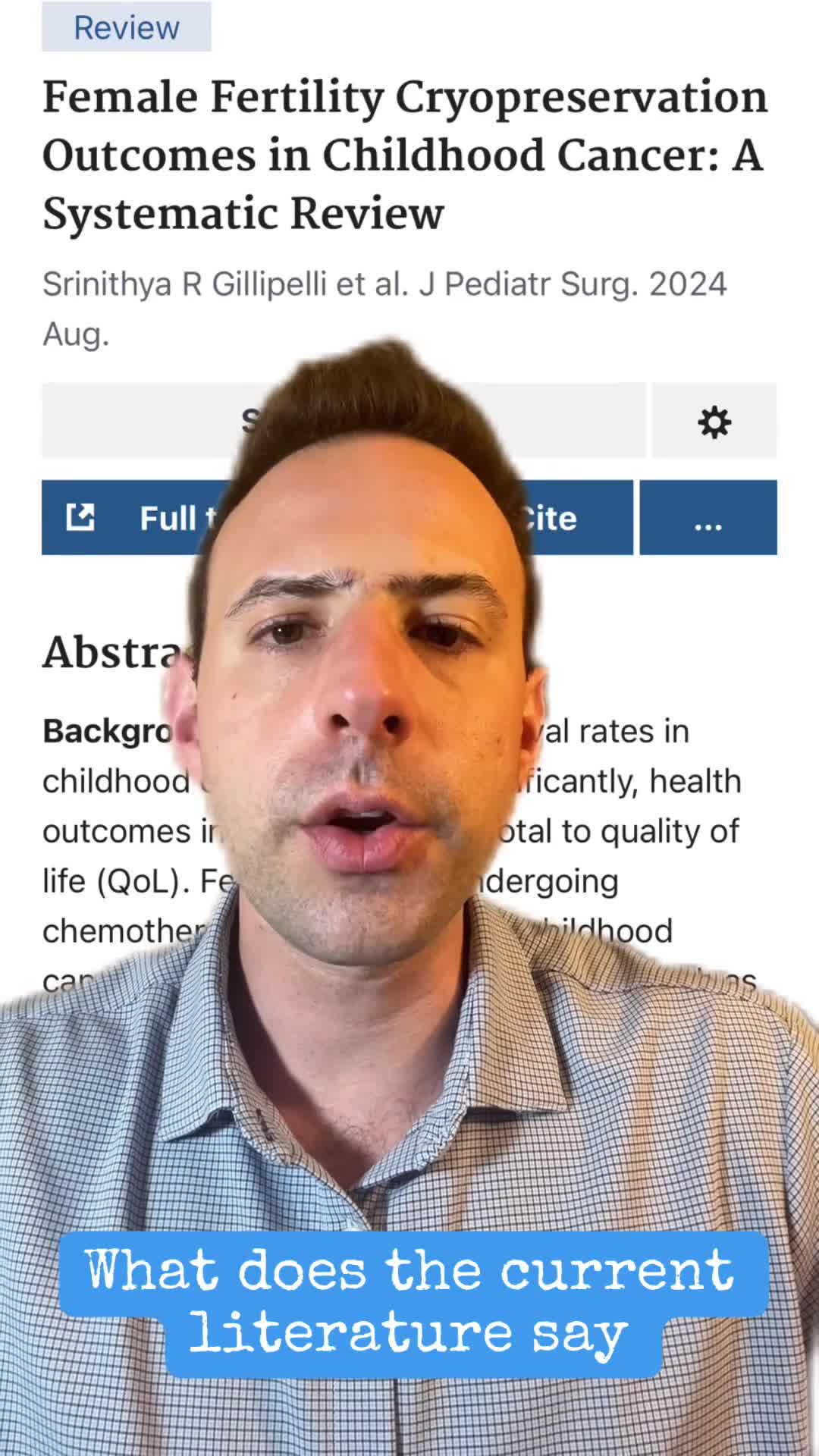
Female Fertility Cryopreservation Outcomes in Childhood Cancer: A Systematic Review
56 s · Published Dec 2024
Video
Disruptive AI technologies transforming healthcare and medical education
34 min · Published Aug 2023
Video
Young Adult Cancer Program | Cincinnati Children's
Joseph G. Pressey · 3 min · Published Nov 2019
Podcast
Unconscious Bias
Todd Ponsky · 58 min · Published Oct 2026
Video
2025 Pediatric Surgery Update Course: Top 10 Key Takeaways #9
Ramy Shaaban · 2 min · Published Jul 2025
Podcast
Update Course Rewind: 2024 Top Ten Key Takeaways
Ramy Shaaban · 18 min · Published Jun 2025
Podcast
Update course rewind: 2024 top ten key takeaways in pediatric surgery
Ramy Shaaban · 18 min · Published Jun 2025
Podcast
Top 10 AI Websites and Tools for Medical Research and Education
Ramy Shaaban · 23 min · Published May 2025
Podcast
Update Course 2024 - AI: TOP 10 websites & tools for everyday usage
Ramy Shaaban · 23 min · Published May 2025
Podcast
Practical applications of generative AI in medical research and education
Ramy Shaaban · 23 min · Published May 2025
Video
Clinical & Research Update: Renal Tumors with Drs. Ethan Smith, Lindsay Haacker, Michael Daugherty, and Meera Kotagal
71 min · Published Sep 2026
Video
Clinical & Research Update: Neuroblastoma with Drs. Katherine Somers, Cara Morin, Juan Gurria, and Meera Kotagal
67 min · Published Sep 2026
Video
Clinical & Research Update: Sarcoma w/ Drs. Roshni Dasgupta, Joseph Pressey, Arthur Meyer, Luke Pater
66 min · Published Sep 2026
Video
2026 Laparoscopic Pediatric Hernia Repair
123 min · Published Jun 2026
Video
Beyond the Spectrum: Diagnosis, Myths & Management - Caitlin Couch & Leslie Lopez - APP Conference 2026
50 min · Published May 2026
Video
Dysautonomia: Navigating the Journey - Martha Willis - APP Conference 2026
55 min · Published May 2026
What the experts said
Google's DeepMind AlphaFold is solving protein structure prediction, helping researchers develop new treatments faster.
IBM Watson Health analyzes complex patient data to assist doctors in making better decisions.
AI technologies are not replacing doctors, they are giving them superpowers, accelerating drug discovery, personalizing treatment and handling administrative tasks more effectively.
ChatGPT is already being used to assist in decision making and ensuring clinicians have the right information at their fingertips when they need it.
Machine learning is already being used in diagnostic imaging, helping doctors detect diseases like cancer earlier and more accurately.
Predictive analytics using machine learning helps forecast health risks, allowing doctors to intervene before problems become severe.
Artificial intelligence is a tool, not a replacement for human expertise.
Prompt engineering is a rising field; doctors need to understand how to accurately prompt AI to get the best results.
Generative AI can create content including text, images, audio and video, opening new doors to medical education, research and patient engagement.
AI is not here to replace doctors but to assist them, working best when paired with human experts.
Medicine is about human connection, listening, empathizing and making complex decisions that require experience and intuition.
AI is streamlining administrative tasks like clinical documentation, with AI able to generate patient summaries instantly, saving hours of paperwork.
When creating AI content and dealing with patient information, it is very important to use local generative AI models instead of large language models that share information externally.
The platform being used for AI should be disclosed when creating AI-generated content.
At USU, a team is creating a virtual patient connected to generative AI using local generative AI, feeding the virtual patient with virtual cases to make the patient act like they have that medical case, then injecting that into virtual reality.