


From
Live Event Content
Dr. Sabine Irtan - Best of the Best in Pediatric Surgery 2025
With Dr. Sabine Irtan
Chapter 2 of 4 · Evidence & Research
Study cohort
Study Design and Patient Characteristics
Cued at 1:21 · stops at 2:58 · press play
Expert statements on this page
No expert statements were drawn from this page.
Host summaries · secondary, not cited in answers
Educational content from recorded physician discussions — not medical advice. Talk to your (or your child's) care team about your situation.
Video
Neuroblastoma: Update Course 2014
CCHMC Pediatric Surgery · 25 min · Published Nov 2018
Video
Neuroblastoma: Update Course 2016
CCHMC Pediatric Surgery · 25 min · Published Jul 2017
Podcast
Topics in 10: Neuroblastoma
10 min · Published Sep 2019
Podcast
Hepatoblastoma with Dr. Greg Tiao
10 min · Published Feb 2022
Video
Neuroblastoma vs. Nephroblastoma (Wilms Tumor): Pediatric Surgery Differences Explained
3 min · Published Nov 2026
Video
Social Determinants of Health Influence on Survival in Wilms Tumor, Neuroblastoma, and Hepatoblastoma
1 min · Published Jan 2026
Video
Rare Ovarian Tumor in Infants: Small Cell Carcinoma of Ovary, Hypercalcemic Type & SMARCA4 Mutation
21 s · Published Oct 2026
Video
Can Normal X-Rays Miss Metastatic Neuroblastoma? A Pediatric Radiology Case Study
26 s · Published Oct 2026
Video
Can Fractures Be a Sign of Hepatoblastoma in Children? Understanding Pediatric Liver Cancer Symptoms
37 s · Published Oct 2026
Video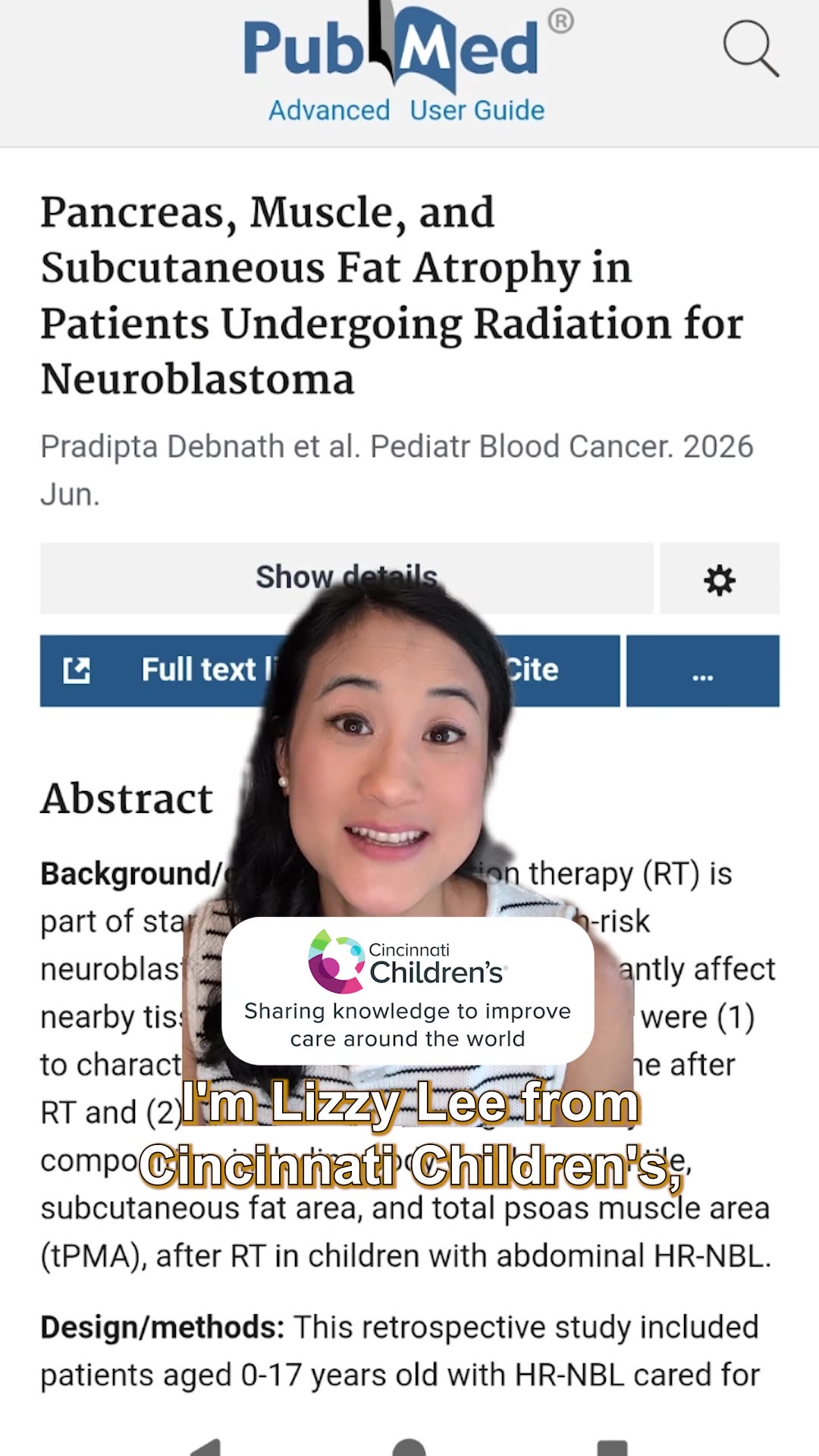
Pancreas, Muscle, and Subcutaneous Fat Atrophy in Patients Undergoing Radiation for Neuroblastoma
47 s · Published Oct 2026
Podcast
Hepatoblastoma
Todd Ponsky · 54 min · Published Oct 2026
Podcast
Wilms Tumor
Todd Ponsky · 64 min · Published Oct 2026
Video
Clinical & Research Update: Renal Tumors with Drs. Ethan Smith, Lindsay Haacker, Michael Daugherty, and Meera Kotagal
71 min · Published Sep 2026
Video
Clinical & Research Update: Neuroblastoma with Drs. Katherine Somers, Cara Morin, Juan Gurria, and Meera Kotagal
67 min · Published Sep 2026
Video
Clinical & Research Update: Sarcoma w/ Drs. Roshni Dasgupta, Joseph Pressey, Arthur Meyer, Luke Pater
66 min · Published Sep 2026
Video
2026 Laparoscopic Pediatric Hernia Repair
123 min · Published Jun 2026
Video
Beyond the Spectrum: Diagnosis, Myths & Management - Caitlin Couch & Leslie Lopez - APP Conference 2026
50 min · Published May 2026
Video
Dysautonomia: Navigating the Journey - Martha Willis - APP Conference 2026
55 min · Published May 2026
What the experts said
Patients with high-risk neuroblastoma need a heavy burden of treatment associating chemotherapy, immunotherapy, radiotherapy, and surgery to be cured.
The role of surgery in high-risk neuroblastoma remains controversial.
The study included 283 patients (108 females, 175 males) who had a diagnosis at a median age of 35 months.
The primary tumor site was the abdomen in 95% of patients.
The tumor origin was the adrenal gland in 81% of patients.
The postoperative imaging was performed at a median of 62 days after surgery and was mainly a CT scan or MRI.
Residue was present in half of the patients on post-operative imaging.
The median volume of the residue was 0.27 mL.
The residue was a microcalcification in 28 patients.
Excluding patients with microcalcifications, the median residue volume was 1.04 mL, and only 11% of patients had a residue of more than 5 mL.
The residue was linked to the presence of IDRF in 71% of patients.
MIBG positivity of the residue was present in 70.5% of patients with a post-operative MIBG available.
There was no impact of the radiological postoperative residue on event-free survival and overall survival.
MIBG-positive residue had an impact on event-free survival and overall survival with a difference of more than 20% of survival.
Patients who had an MIBG-positive residue had 25% and 27% five-year event-free survival, whereas patients with no residue or no MIBG-positive residue had 51% five-year event-free survival.
External validation on the entire high-risk neuroblastoma cohort in patients with stage 4 neuroblastoma who had surgery and post-surgical MIBG evaluation confirmed the results, especially in patients with complete response of the metastasis.
The difference between patients with MIBG-positive residue and patients with no residue or no MIBG-positive residue was still present for patients with partial or minimal response with a 10% survival difference.
Half of the patients operated on in expert centers have a tumor residue objectively identified on postoperative images of less than 1 mL.
The residue was MIBG-positive in around 20% of patients.
Radiologically detected postoperative tumor residues impact outcomes only if active disease was demonstrated through post-operative MIBG scanning, which could have an impact on future radiotherapy strategies.
Complete resection should be maintained as a major surgical goal.
Metastatic response is an important prognostic cofactor in stage 4 neuroblastoma.
In COG data, there was zero correlation between what the surgeon said they resected and what was actually present on post-operative imaging.
For patients for whom the surgeon said they left nothing, almost half of the patients had still something on the postoperative images.
For patients for whom the surgeon said they left something, residue was found in two-thirds of patients and no residue was found in one-third of patients.
Kewarm stated in a 2020 GCO paper that complete macroscopic excision of the primary tumor improved both overall and event-free survival in a cohort of 1,531 patients with stage 4 neuroblastoma.
In Kewarm's study, the success of the intervention and judgment on the post-operative residue was based on the operative report with no systematic radiological assessment of residue performed.