


From
Live Event Content
Disruptive AI technologies transforming healthcare and medical education
With Dr. Rami Shaman · hosted by Dr. Todd Ponsky & Dr. Em Gootee
Part of
Cancer 17 items
Chapter 4 of 7 · Fundamentals
Machine learning
Machine Learning in Healthcare
Cued at 10:41 · stops at 10:49 · press play
Expert statements on this page
No expert statements were drawn from this page.
Host summaries · secondary, not cited in answers
Educational content from recorded physician discussions — not medical advice. Talk to your (or your child's) care team about your situation.
Video
Dr. Timothy B. Lautz - Best of the Best in Pediatric Surgery 2025
Dr. Todd Ponsky · 10 min · Published Mar 2025
Video
Dr. Ramy Shaaban - Best of the Best in Pediatric Surgery 2025
Dr. Todd Ponsky · 9 min · Published Mar 2025
Video
Off the grid: how I got off the grid & you can too | Lee Ponsky | TEDxCLE
Dr. Lee Ponsky · 20 min · Published Jul 2015
Video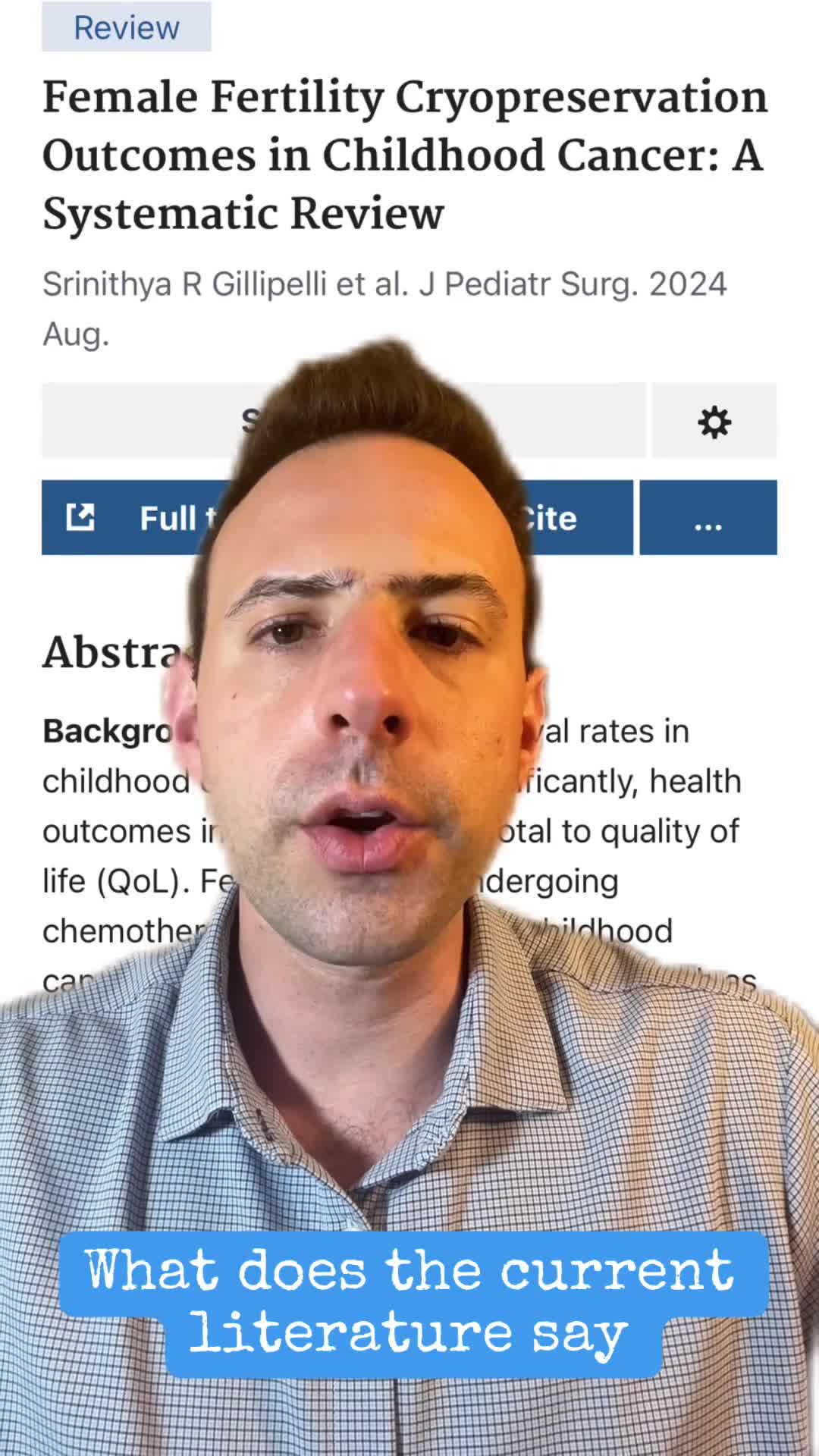
Female Fertility Cryopreservation Outcomes in Childhood Cancer: A Systematic Review
56 s · Published Dec 2024
Video
Young Adult Cancer Program | Cincinnati Children's
Joseph G. Pressey · 3 min · Published Nov 2019
Podcast
Unconscious Bias
Todd Ponsky · 58 min · Published Oct 2026
Video
Clinical & Research Update: Renal Tumors with Drs. Ethan Smith, Lindsay Haacker, Michael Daugherty, and Meera Kotagal
71 min · Published Sep 2026
Video
Clinical & Research Update: Neuroblastoma with Drs. Katherine Somers, Cara Morin, Juan Gurria, and Meera Kotagal
67 min · Published Sep 2026
Video
Clinical & Research Update: Sarcoma w/ Drs. Roshni Dasgupta, Joseph Pressey, Arthur Meyer, Luke Pater
66 min · Published Sep 2026
Video
2026 Laparoscopic Pediatric Hernia Repair
123 min · Published Jun 2026
Video
Beyond the Spectrum: Diagnosis, Myths & Management - Caitlin Couch & Leslie Lopez - APP Conference 2026
50 min · Published May 2026
Video
Dysautonomia: Navigating the Journey - Martha Willis - APP Conference 2026
55 min · Published May 2026
What the experts said
Netflix wanted to hire an AI specialist for a million dollars a year salary
AI is replacing people who don't know how to use AI with people who know how to use AI
ChatGPT is much better than Google for information retrieval
Todd Ponsky uses ChatGPT 15 times a day
Todd Ponsky has not personally written a letter of recommendation in the last 3 months, using ChatGPT instead by uploading CVs and personal statements
Free online filters exist that can detect with a certain amount of certainty whether text is AI-created
Colleges know that students are using ChatGPT to write their college essays
Cincinnati Children's Hospital can now create videos of every faculty member teaching a topic using deep fake technology with their voice and likeness, without the faculty member doing anything
Cincinnati Children's has a membership for Wysa mental health chatbot that employees can access with their work email address
Healthcare produces massive amounts of data through patient records, lab results, imaging, and more, which when digitized become the foundation of AI systems
AI algorithms can analyze radiology images to detect early signs of cancer or predict a patient's risk of developing certain diseases based on medical history
AI systems continually enhance effectiveness by feeding them more data and refining algorithms based on prediction accuracy feedback
AI can help with earlier disease detection, perfecting robotic surgery, administrative tasks, reducing human errors through diagnostic assistance, and personalized treatment recommendations based on genetic makeup and disease history
Google's DeepMind AlphaFold system predicts protein 3D structure from amino acid sequence with potential applications in understanding diseases and drug discovery
In the last 60 years, the scientific community has determined the structures of over 180,000 proteins in atomic detail using advanced experimental methods
Determining the exact structure of a protein remains an expensive and time-consuming process, meaning we only know the exact 3D structure of a tiny fraction of proteins known to science
AlphaFold Database provides open access to over 200 million structure predictions to accelerate scientific research
Machine learning algorithms can be trained on vast datasets of images to identify and diagnose diseases, detecting tumors in X-rays or MRIs often with greater accuracy than human experts
Zebra Medical Vision uses ML to analyze medical imaging and detect diseases in organs such as liver, cardiovascular, and lungs
Path AI concentrates on delivering more accurate diagnosis from pathology slides
Machine learning is instrumental in predictive analytics such as patient readmissions, potential outbreaks, patient no-shows, and adverse events
ML algorithms, particularly deep learning models, can process and analyze vast amounts of text including doctors' notes and extract valuable information
23andMe employs machine learning to analyze genetic data and deliver personalized health insights
Tempus leverages ML to assist physicians in making more personalized treatment decisions, particularly for oncology patients
ML-powered chatbots and applications can provide 24/7 support to individuals experiencing stress, anxiety, depression, or other mental health concerns, offering coping strategies and resources as an interim solution when human therapists are not immediately available
Wysa provides emotional help by tracking mood, highlighting optimism, and reframing thinking in an approachable manner
Large language models can aid healthcare professionals by providing real-time evidence-based responses to clinical inquiries, scanning immense volumes of medical literature in seconds, summarizing findings, or suggesting diagnoses based on symptom descriptions
LLMs can automate documentation, assist in medical data entry, and respond to routine queries, freeing up valuable time for medical professionals
Glass AI leverages GPT-4 combined with evidence-based guidelines, schemas, and case studies created by clinicians to generate differential diagnoses or draft clinical plans based on submitted clinical problem representations
To use ChatGPT effectively, you must give it a role (e.g., 'you are a pediatric physician') before asking questions, a technique called prompt engineering
Microsoft Co-Pilot can access a folder of presentations and papers to write content based solely on the user's own work without taking anything from outside sources
Files uploaded to ChatGPT are completely secure with end-to-end encryption and do not go into the internet or cloud
Microsoft Co-Pilot will be included in the next version of Microsoft Office within a couple of months