


From
StayCurrentMD
Congenital Diaphragmatic Hernia with Dr. Charlie Stolar
With Dr. Charlie Stolar · hosted by Dr. Todd Ponsky & Dr. Avi Schlager
Chapter 5 of 9 · Surgical Management
Repair timing
Surgical Repair Timing and Approach
Cued at 46:47 · stops at 47:38 · press play
Expert statements on this page
No expert statements were drawn from this page.
Host summaries · secondary, not cited in answers
Educational content from recorded physician discussions — not medical advice. Talk to your (or your child's) care team about your situation.
Video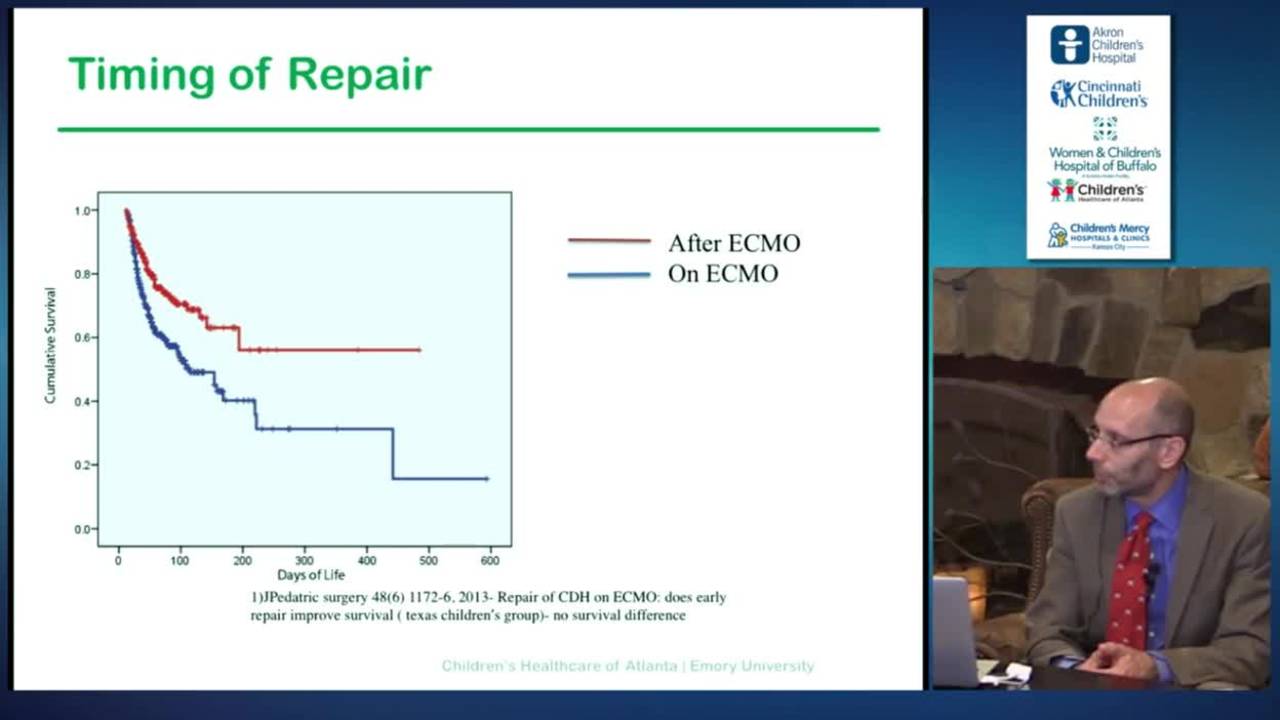
CDH-ECMO - VV vs. VA - Repair on ECMO: Update Course 2015
10 min · Published Nov 2015
Video
Challenges in Diaphragmatic Hernia Repair: Update Course 2016
44 min · Published Oct 2018
Podcast
Case-Based Journal Review: Congenital Diaphragmatic Hernia 2023
19 min · Published Oct 2023
Video
Controversies in Congenital Diaphragmatic Hernia: Update Course 2018
41 min · Published Aug 2018
Podcast
IFMSS 2019 Clinical Studies
19 min · Published Nov 2022
Video
Improving Outcomes for Congenital Diaphragmatic Hernia (CDH): Protocol Changes at Cincinnati Children's
5 min · Published Jun 2026
Podcast
Diaphragm pacing as alternative to mechanical ventilation in pediatric respiratory failure
1 min · Published Nov 2026
Podcast
Fetoscopic endoluminal tracheal occlusion for congenital diaphragmatic hernia
4 min · Published Nov 2026
Podcast
FETO procedure for late-diagnosed severe CDH with liver herniation
4 min · Published Nov 2026
Podcast
Severe CDH case with FETO: unexpected anatomic findings and clinical outcome
3 min · Published Nov 2026
Podcast
Pediatric pancreatitis: diagnosis, causes, and genetic insights with Dr. Juan Gurria
3 min · Published Nov 2026
Podcast
Understanding craniosynostosis: skull sutures, growth patterns, and diagnosis in infants
10 min · Published Nov 2026
What the experts said
CDH occurs in approximately 1 out of every 3,000-4,000 pregnancies managed by community obstetricians.
CDH diagnosis is usually made at the 20-week anatomy scan when ultrasonographers see the stomach in the same cross-sectional plane as the heart.
CDH represents a growth arrest of both lungs, with the ipsilateral side more severely affected than the contralateral side.
At birth, CDH lungs are affected by a mix of pulmonary hypoplasia and altered pulmonary vascular resistance with altered transitional circulation.
CDH is a medical physiologic emergency, not a surgical emergency.
The diagnosis of CDH alone is not an indication for cesarean section.
Antenatal interventions for CDH are no better than investigational and experimental at best.
Babies with CDH should be born at a full-service children's facility with ECMO capability.
Maybe 10-15% of babies diagnosed with CDH will benefit from ECMO.
In single-center experiences, presence of liver in the chest is of no prognostic value for CDH.
Lung-to-head ratio (LHR) is of limited prognostic value except when very low (less than 0.8).
Associated congenital heart disease and central nervous system abnormalities augur for poor prognosis in CDH.
If shown 100 children with CDH, 80-85% will survive to become teenagers.
Steroids have tremendous value for preterm labor under 35 weeks but their role in near-term CDH babies (37-39 weeks) is arguable.
Exit-to-ECMO for CDH is essentially moving the goalposts and deck chairs around on the Titanic for non-viable babies.
We are born with about 1/2 to 2/3 of our full complement of alveoli and can grow the balance sometime after birth.
All therapy for CDH should be guided by preductal oximetry, not postductal, because all babies have some degree of pulmonary hypertension with shunting.
If preductal saturation is 90% (PaO2 of 65 torr), the brain is doing fine because this is fetal hemoglobin.
Neonatal ventilators would be thrown out as lethal devices if someone tried to invent them today because they trash lungs in a heartbeat.
CDH babies should not be paralyzed and should have minimal sedation to maintain spontaneous breathing.
Most CDH babies don't tolerate conventional ventilator settings (rate 40, peak pressure 25-28, PEEP 5) and require unconventional high-rate (100 breaths/min) low-pressure ventilation.
High-frequency oscillatory ventilation (HFOV) as rescue therapy rarely spares CDH babies from ECMO.
Nitric oxide is a waste of money for CDH babies; meta-analyses show it's terrific for premature babies with immature lung disease but of no value in CDH.
The best drug for CDH is oxygen.
ECMO should not be used in babies under 36 weeks gestational age initially, though this has been pushed down to 35 weeks, maybe 34 weeks, with intracranial hemorrhage rates taking off below 32 weeks.
The smallest ECMO arterial perfusion cannula available is about 8 French, and resistance is related to both length and diameter, making adequate flow difficult in very small babies.
For ECMO candidacy, the real risk for intracranial hemorrhage is the germinal matrix, which is usually OK by 35-36 weeks gestation, so it's gestational age that matters, not size.
The broad principle for ECMO candidacy is whether you can get out of ECMO with reasonable confidence if you get in—don't start something you can't finish.
VV ECMO is terrific if the heart works, but in CDH the heart function is often depressed and it's hard to get the cannula in with the shifted mediastinum.
VA bypass is essentially dialing in a PaO2, while VV ECMO is much more annoying with mixing, cannula position issues, and CDH babies are generally too unstable for VV.
Echo guidance during ECMO cannulation is really helpful to prevent driving the arterial cannula out the subclavian artery or the venous cannula into the innominate vein.
If the arterial cannula goes out the subclavian artery, you'll have a very well-perfused hand and think preductal sats look good, but the baby isn't seeing the oxygen.
The first few hours on ECMO can be unstable; hyperkalemia cardiac arrest can occur if blood isn't washed, but you just perfuse through it and give calcium.
ECMO flow should be slowly increased over 45 minutes to 1.5 hours to about 100-125 cc/kg/min (about 80% of cardiac output) to reduce intracranial hemorrhage incidence.
The hyperoxia test—turning FIO2 up to 1.0 on the ventilator while on ECMO—gives courage to begin weaning if the PaO2 rises, showing the baby can use their lungs.
For babies stuck on ECMO at 2 weeks, ensure they are maximally dried out (bone dry, eyes sucked into back of head, turned into a prune) before considering on-ECMO repair.
The problem in CDH is not that bowel is in the chest; the problem is growth arrest of the lungs that happened at 14-15 weeks gestation. Getting bowel out of the chest is not miraculous.
Heparin inhibits conversion of fibrinogen to fibrin, so only platelets (beat-up ones) make clot on ECMO. A platelet thrombus lasts 48-72 hours, giving a window to operate and get off ECMO before bleeding starts.
Preferred approach is to wean ECMO down to 20 cc/kg/min, do the operation, accept 1 day of post-op edema, then have 2-3 days to get off ECMO before bleeding starts.
If you take a baby off ECMO then operate, every patient gets stiff after surgery, pulmonary hypertension relapses, and you're talking about a second ECMO run.
When operating on ECMO, load with Amicar preoperatively, do it as an abdominal operation, use a patch with low threshold to avoid tension, place a Jackson-Pratt drain under the patch, and place a chest tube.
Futility on ECMO starts to rear its head after about 2-3 weeks.
The typical stable CDH baby not requiring ECMO takes 3-4 days to wean to minimal ventilator settings (FIO2 0.4, conventional settings) before repair.
Use the infant ventilator instead of an anesthesia machine intraoperatively because infant anesthesia machines have high dead space and are not very compliant.
For repair timing, three variables matter: pre/post-ductal gradient on pulse ox, right ventricle dilation on echo, and RV pressure versus LV pressure (RV should be no more than systemic).
The thoracoscopic approach for CDH is gorgeous with a sparkling view, but the recurrence rate is really high—about 25% in under a year in Dr. Stolar's series of 35 stable kids.
The APSA outcomes committee meta-analysis came to a very similar conclusion about high thoracoscopic CDH recurrence rates.
For open CDH repair, need a real subcostal incision (not a small two-finger incision), rotate the liver out of chest and abdomen, eviscerate bowel, and mobilize the posterior leaflet like unrolling a window shade down to rib.
The medial part of CDH repair is hardest because sometimes the esophagus or aorta is hanging out with nothing to sew to.
When there's no diaphragm to sew to medially, make an upside-down U-shaped incision on the pericardium and rotate that down to where the diaphragm would be to begin the repair.
Favor monofilament suture (like PDS) because it doesn't saw through tissue when pulled, unlike Vicryl which saws tissue.
Favor non-biologic material like 1mm Gore-Tex for patches, and anchor the patch to the ribs laterally by getting a needle around the rib.
Make the patch somewhat balloon-shaped with redundancy so the baby doesn't rip sutures out taking a deep breath; over time it gets incorporated into fibrous tissue.
For thoracoscopic CDH repair, use 3 ports (4mm camera with 30-degree lens, 3mm neonatal instruments), insufflation peak pressure 5-7 cm (no more), and put solid organs (spleen or left liver lobe) in last to plug the hole and keep bowel down.
If you can see through the diaphragm tissue (it's nothing but pleura and peritoneum), resect it back to muscle for a fresh edge to sew together, or the plication will fail.
There is no indication for a chest tube in CDH except for active air leak or anticipated/active bleeding. The ipsilateral lung is small and won't fill the pleural space—that's how God made this lung.
A pneumothorax in CDH is a pneumothorax ex vacuo, not air under pressure. Putting in a chest tube on water seal suction will just distort the mediastinum and precipitate a pulmonary hypertensive crisis.
The typical stable CDH baby will be crummy for about a day postoperatively, then get better and be extubated in 4-5 days and go home.
CDH is a field defect affecting the whole foregut from pharynx to ligament of Treitz. Everything—esophagus, stomach, gastric emptying—has abnormal motility.
If you do a GI series on CDH kids, the esophagus will be very dilated, ectatic, and abnormal-looking. Manometry and impedance manometry are abnormal.