
IFMSS 2019 Clinical Studies
With Dr. Steven Fenton & Dr. Uchenna Kennedy & Dr. Oliulinka Olutoye & Dr. Nina Bentz · hosted by Dr. Beth Remey & Dr. Ray Hankey · StayCurrentMD
Educational content from recorded physician discussions — not medical advice. Talk to your (or your child's) care team about your situation.
More about congenital diaphragmatic hernia
same diagnosisDive deeper → Congenital Diaphragmatic Hernia (24 items)Video
Improving Outcomes for Congenital Diaphragmatic Hernia (CDH): Protocol Changes at Cincinnati Children's
5 min · Published Jun 2026
Video
BOB Ped Surg 2023 - Shelby Sferra, AAP - Presentation
5 min · Published Feb 2023
Video
BOB in Ped Surg 2023 - AAP Winner - Shelby Sferra, MD
11 min · Published Feb 2023
Podcast
Stay Current Journal Club: Episode 1 - Ventricular Dysfunction in CDH and...
16 min · Published Feb 2021
Podcast
Journal of Pediatric Surgery Article Review: September 2023
13 min · Published Mar 2024
Video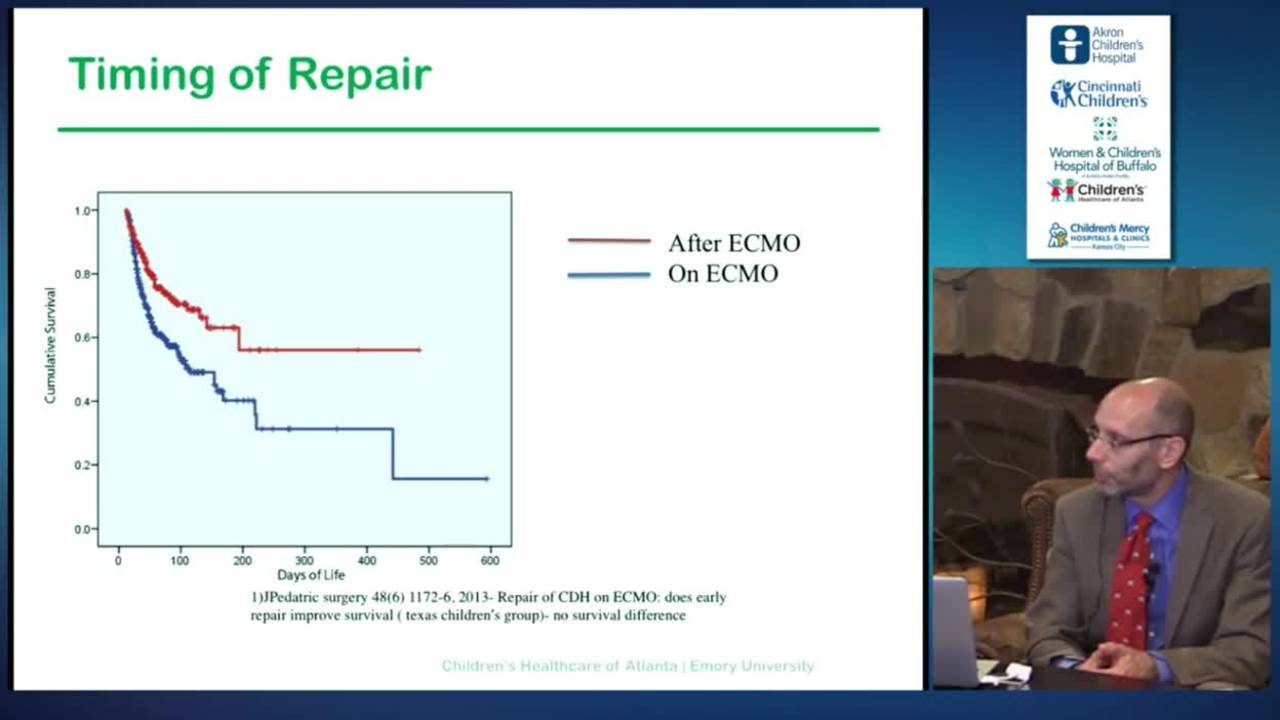
CDH-ECMO - VV vs. VA - Repair on ECMO: Update Course 2015
10 min · Published Nov 2015
Only a few other public items share this expert — go deeper there →
Video
Pediatric Surgical Oncology Research Collaborative (PSORC): Studying Rare Pediatric Tumors
56 s · Published May 2026
Video
Update Course Rewind 2025: Hirschsprung + ARM: Rare but Real
1 min · Published May 2026
Video
Update Course Rewind 2025: Hirschsprung + ARM: Rare but Real
1 min · Published May 2026
Video
Pooling Patients to Study Rare Pediatric Tumors: An Introduction to PSORC
56 s · Published May 2026
Video
The fetal frontier: A review of current and emerging fetal therapies for genetic diseases
44 s · Published May 2026
Video
Indocyanine green assists with sentinel lymph node mapping in pediatric and adolescent patients
1 min · Published May 2026
What the experts said
Primary Children's Hospital ECMO program was established in 2003, with first CDH protocol implemented in 2007
The 2016 CDH protocol change places infants in a quiet NICU area for the first 72 hours with immediate intubation on high frequency oscillator and decreased mean airway pressure
The protocol minimizes stimulation by using transport-capable beds to avoid moving the infant between beds
Echo is not performed within the first 24 hours if a prenatal echo already exists
Oxygen is weaned according to preductal saturations only, with no routine postductal saturation monitoring
Oxygen resuscitation starts at FIO2 of 0.4 instead of 1.0
Inhaled nitric oxide and other vasodilators or pressor agents are used only for clinically significant hypoperfusion
Median mean airway pressure decreased from 13 to 11 after protocol implementation
Higher mean airway pressures compromise gas exchange and lung vascularization, potentially increasing pulmonary hypertension
The protocol is applied to all prenatally diagnosed CDH cases regardless of severity
ECMO utilization rate decreased from 37% to 13% after protocol implementation
Overall survival increased from 74% to 89%, a statistically significant change
Survival was significantly improved for liver-down CDH cases
Survival increased for liver-up CDH cases but was not statistically significant
Survival without ECMO use increased after protocol implementation
Since 2016, 97% of CDH cases received prenatal MRI compared to 24% before the fetal center was established
In the study period since 2016, there were 53 isolated left CDH cases after exclusions
Among infants with MRI total fetal lung volume observed-to-expected less than 15%, ECMO utilization was 38% rather than the expected 100%
ECMO criteria include PaO2 never rising above 50 and inability to get CO2 levels below 100
The MRI less than 15% group had 50% survival
The CDH protocol is implemented uniformly by all neonatologists in the closed NICU unit, not by select individual providers
The hardest aspect of implementing the protocol was changing the culture around practices like routine early echocardiography, immediate transport, and postductal saturation monitoring
The study compared giant omphalocele outcomes in infants born before 34 weeks gestational age versus after 34 weeks
Neonatal intubation requirement was significantly higher in the preterm giant omphalocele group
Tracheostomy and ventilator dependence at discharge occurred at a rate of 31% in the preterm giant omphalocele group, though not statistically significant
34 weeks was chosen as the cutoff for preterm versus term based on fetal lung maturity being significantly better after 34 weeks
Neonatal death rate was 26% in the preterm giant omphalocele group versus 6% in the term group, a statistically significant difference
Three main prenatal findings suggest esophageal atresia: polyhydramnios, small stomach, and distended proximal esophageal pouch
Postnatal radiographs showing air in the stomach confirm the presence of a distal tracheoesophageal fistula
The study classified prenatal stomach size as absent (no visible fluid), small amount of fluid, or normal sized
Almost all cases of pure esophageal atresia had a small stomach on prenatal imaging
43% of cases with distal tracheoesophageal fistula also had a small stomach on prenatal imaging
Small stomach size on prenatal imaging does not reliably discriminate between pure esophageal atresia and EA with tracheoesophageal fistula
The study included both ultrasound and MRI imaging, and neither modality could distinguish pure EA from EA with TEF based on stomach appearance
There are no current guidelines for mental health screening in mothers with prenatally diagnosed fetal anomalies
The study enrolled patients at their first fetal concern center visit and administered three surveys at different time points: before surgeon consultation, after surgeon consultation, and following delivery
The surveys assessed five validated measures including depression, anxiety, PTSD, and resilience
Over one-third of mothers with prenatally diagnosed fetal anomalies screened positive for depression, anxiety, and PTSD
Only 25% to 33% of mothers who screened positive for mental health disorders had prior histories of psychiatric diagnoses
The majority of fetal anomaly diagnoses in the study were rated in the mid-severity range by both surgeons and mothers
Overall resilience scores were lower in the study population of mothers with prenatally diagnosed fetal anomalies
There was no difference in mental health screening results between pre-consultation and post-consultation surveys with the pediatric surgeon
Prior data shows higher rates of anxiety and depression in mothers with prenatal fetal anomaly diagnoses
Data from the trauma literature shows no clear correlation between disease or injury severity and development of PTSD