


From
StayCurrentMD
Cardiopulmonary Impact of the Minimally Invasive Repair of Pectus Excavatum in Pediatric Patients: A Prospective Pilot Study
hosted by Lizzy Lee, PA-C
Part of
Pectus Excavatum 58 items
Chapter 1 of 1 · Evidence & Research
Cardiopulmonary outcomes after minimally invasive pectus excavatum repair
Cued at 0:24 · stops at 0:39 · press play
Expert statements on this page
No expert statements were drawn from this page.
Host summaries · secondary, not cited in answers
Educational content from recorded physician discussions — not medical advice. Talk to your (or your child's) care team about your situation.
Video
Novel index to estimate the cephalocaudal extent of the excavation in pectus excavatum - JPS article
1 min · Published May 2023
Video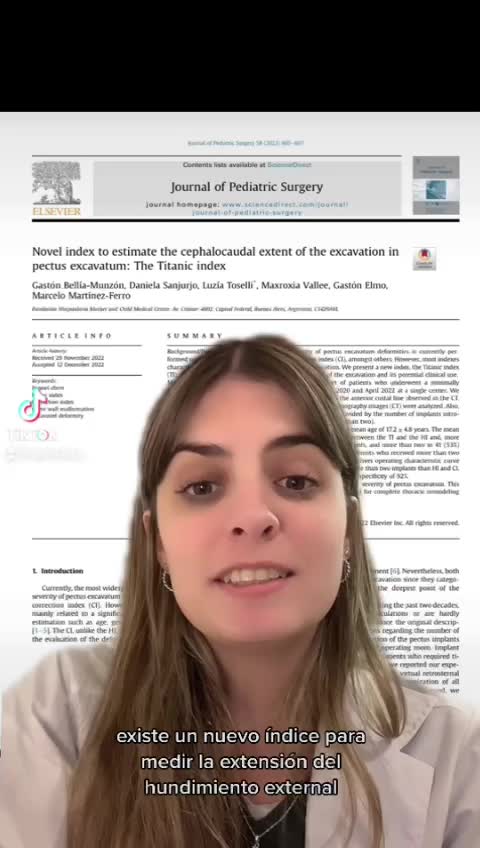
Novedoso indice para estimar la extensión cefalocaudal del hundimiento esternal en el pectus excavatum: El Índice Titanic
Published May 2023
Video
Quick Literature Updates Episode 13
4 min · Published Nov 2023
Video
Impact of Cryoanalgesia Use During Minimally Invasive Pectus Excavatum Repair on Hospital Days and Total Hospital Costs Among Pediatric Patients
59 s · Published Jan 2024
Video
BOB Ped Surg 2023 - Brittany Hegde, PAPS - Presentation
Published Feb 2023
Video
Criteria for Pectus Repair: Update Course 2015
55 s · Published Nov 2015
Podcast
Diaphragm pacing as alternative to mechanical ventilation in pediatric respiratory failure
1 min · Published Nov 2026
Podcast
Fetoscopic endoluminal tracheal occlusion for congenital diaphragmatic hernia
4 min · Published Nov 2026
Podcast
FETO procedure for late-diagnosed severe CDH with liver herniation
4 min · Published Nov 2026
Podcast
Severe CDH case with FETO: unexpected anatomic findings and clinical outcome
3 min · Published Nov 2026
Podcast
Pediatric pancreatitis: diagnosis, causes, and genetic insights with Dr. Juan Gurria
3 min · Published Nov 2026
Podcast
Understanding craniosynostosis: skull sutures, growth patterns, and diagnosis in infants
10 min · Published Nov 2026
What the experts said
This was a prospective pilot study
Study included patients under 18 who had cardiopulmonary exercise testing before minimally invasive repair of pectus excavatum and then after removal of their pectus bar
25 patients total completed both tests
Results showed a significant improvement in O2 pulse after the repair
O2 pulse is a measure of how much oxygen the heart pumps per beat
Improved O2 pulse suggests better heart function after the repair
The improvement may reflect relief of cardiac compression that was present preoperatively due to pectus excavatum
Minimally invasive repair of pectus excavatum does appear to improve heart performance during exercise