
Novel index to estimate the cephalocaudal extent of the excavation in pectus excavatum - JPS article
hosted by Dr. Ellen Incisco · StayCurrentMD
Part of
Pectus Excavatum 58 items
Educational content from recorded physician discussions — not medical advice. Talk to your (or your child's) care team about your situation.
Video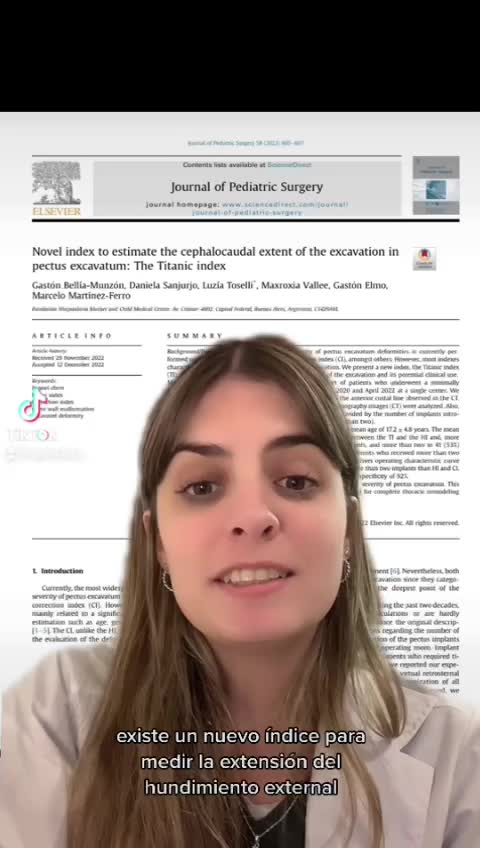
Novedoso indice para estimar la extensión cefalocaudal del hundimiento esternal en el pectus excavatum: El Índice Titanic
Published May 2023
Video
Cardiopulmonary Impact of the Minimally Invasive Repair of Pectus Excavatum in Pediatric Patients: A Prospective Pilot Study
55 s · Published Apr 2025
Video
Quick Literature Updates Episode 13
4 min · Published Nov 2023
Video
Impact of Cryoanalgesia Use During Minimally Invasive Pectus Excavatum Repair on Hospital Days and Total Hospital Costs Among Pediatric Patients
59 s · Published Jan 2024
Video
Criteria for Pectus Repair: Update Course 2015
55 s · Published Nov 2015
Video
Vacuum Bell Therapy for Pectus Excavatum: Long-term Experience at a Single Center
58 s · Published Apr 2025
Video
Pediatric Surgical Oncology Research Collaborative (PSORC): Studying Rare Pediatric Tumors
56 s · Published May 2026
Video
Update Course Rewind 2025: Hirschsprung + ARM: Rare but Real
1 min · Published May 2026
Video
Update Course Rewind 2025: Hirschsprung + ARM: Rare but Real
1 min · Published May 2026
Video
Pooling Patients to Study Rare Pediatric Tumors: An Introduction to PSORC
56 s · Published May 2026
Video
The fetal frontier: A review of current and emerging fetal therapies for genetic diseases
44 s · Published May 2026
Video
Indocyanine green assists with sentinel lymph node mapping in pediatric and adolescent patients
1 min · Published May 2026
What the experts said
The Haller index and correction index are the currently primarily used indices for pectus excavatum and tell us about the severity of the deformity.
The Titanic index takes into account the extent of the pectus excavatum deformity.
The Titanic index is calculated as the percentage of the sternum that lies behind the anterior costal line as seen on CT scans.
The study was a retrospective review of patients at an institution in Argentina who had undergone minimally invasive repair of pectus excavatum.
The study found a weak correlation between the Titanic index and the other indices (Haller and correction index).
The Titanic index might be more helpful for helping determine how many bars a patient is going to need for repair.
The threshold established was 66.5%, meaning that patients with a higher Titanic index than that probably needed more than 2 bars.
More study is needed for this index.