
2025 Pediatric Surgery Update Course - Updates in Esophageal Atresia Management
With Dr. Matt Dellinger · Live Event Content
Educational content from recorded physician discussions — not medical advice. Talk to your (or your child's) care team about your situation.
Video
Comparison of robotic versus thoracoscopic repair for congenital esophageal atresia
56 s · Published Feb 2024
Video
Posterior Tracheopexy For Severe Tracheomalacia
Dr. Todd Ponsky · 2 min · Published Feb 2018
Video
BOB in Ped Surg 2023 - PAPSA Winner - Mohamad Mahmoud Qinawy, MD
16 min · Published Feb 2023
Podcast
Journal of Pediatric Surgery Article Review: February 2023, BAPS issue
12 min · Published Apr 2023
Video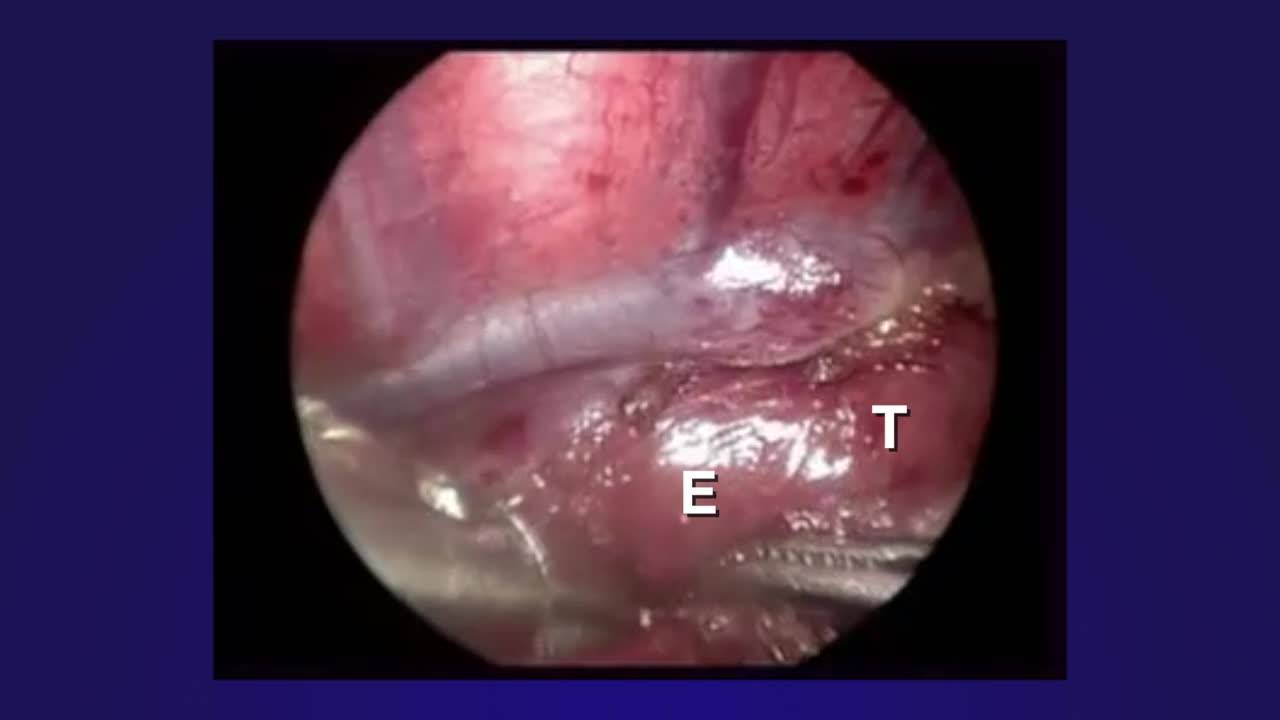
Thoracoscopic Repair of Esophageal Atresia with Distal Tracheo-esophageal...
5 min · Published Feb 2020
Video
Tips and Tricks: EA & TEF
Dr. Steve Rothenberg · 9 min · Published Dec 2012
Only a few other public items share this expert — go deeper there →
Video
Mental Health and Gun Safety in Pediatrics - Catherine Neyer - APP Conference 2026
48 min · Published May 2026
Video
Overview of the Surgical Management of Acute and Chronic Pancreatitis in Children with Dr. Juan Gurria
66 min · Published Apr 2026
Video
Clinical & Research Update: Pediatric Liver Tumors - A Case-Based Discussion with Drs. Katherine Somers & Alex Bondoc
69 min · Published Apr 2026
Video
Beyond ChatGPT_ AI Tools You’re Not Using (But Should) - Vail, CO
Dr. Todd Ponsky · 97 min · Published Jan 2026
Video
Beyond ChatGPT: AI Tools You’re Not Using (But Should)
Dr. Todd Ponsky · 109 min · Published Oct 2025
Video
2025 Pediatric Surgery Update Course - Updates in Lap Chole and Cholecystitis Management
18 min · Published Aug 2025
What the experts said
Unusual fistula locations can occur in EA, including peck bronchus or main stem bronchus fistula.
Up to 20% of patients with EA will have a laryngeal cleft.
Rare findings on preoperative bronchoscopy include subglottic or molecular cysts that may have implications for respiratory support and postoperative course.
Preoperative bronchoscopy has only approximately 50% sensitivity for predicting clinically significant tracheomalacia; about half of patients without evidence of tracheomalacia on preoperative bronchoscopy will go on to develop clinically significant tracheomalacia.
Posterior tracheopexy involves placing horizontal mattress sutures in the posterior membranous portion of the trachea under flexible bronchoscopic guidance and suturing them to the anterior longitudinal ligament of the spine.
Recurrent laryngeal nerve injury occurs in 11% of EA repair patients overall, which may be an underestimation.
In H-type EA repairs, which are often addressed through a cervical surgical approach, recurrent laryngeal nerve injury rates are up to 50%.
Injury rates for recurrent laryngeal nerve may be higher during thoracoscopic EA repair when mobilizing the proximal pouch.
Modifying nerve monitoring electrodes to small endotracheal tubes for use in EA repair is technically challenging and has a learning curve.
In a 2012 survey of IPEG surgeons by Dr. St. Peter, 60% of approximately 170 surgeons over 30 countries responded that they would routinely do preoperative bronchoscopy for EA repair.
An Italian group found that preoperative bronchoscopy was useful in 45% of EA patients, including for identifying proximal fistula in type A or type C, fistula occlusion concerns, and alteration of operative approach.
Laryngeal clefts come in different forms, and major clefts may require careful consideration before proceeding with general anesthesia as patients can decompensate if intubated.
Primary tracheopexy at the time of EA repair in children with moderate to severe tracheomalacia (75% or greater collapse) has been associated with fewer life-threatening events, fewer hospitalizations for respiratory illnesses, and improved weight-for-age scores at 12 months, according to studies from Boston, Johns Hopkins, All Children's, and a group in the Netherlands.
Posterior tracheopexy was originally described in cases of recurrent tracheoesophageal fistula to separate suture lines and prevent second recurrence.
Data from Austin shows that intraoperative recurrent laryngeal nerve monitoring appears to decrease nerve injury rates in high-risk cases, defined as esophageal atresia, cardiac surgery, or a combination thereof.