


From
StayCurrentMD
Quick Literature Updates Episode 17
With Dr. Alex Halpern · hosted by Dr. Em Gootee & Dr. Cecilia Gigena & Dr. Lizzie Lee
Chapter 1 of 3 · Evidence & Research
Robotic EA repair
Introduction and Robotic vs Thoracoscopic EA Repair
Expert statements on this page
No expert statements were drawn from this page.
Host summaries · secondary, not cited in answers
Educational content from recorded physician discussions — not medical advice. Talk to your (or your child's) care team about your situation.
Video
Comparison of robotic versus thoracoscopic repair for congenital esophageal atresia
56 s · Published Feb 2024
Podcast
Journal of Pediatric Surgery Article Review: February 2023, BAPS issue
12 min · Published Apr 2023
Video
Finnish Pediatric Surgery Hub - From Centralization to Collective Learning and Sharing of Expertise
48 s · Published Feb 2025
Video
Prophylactic Acid-suppression Medication to Prevent Anastomotic Strictures After Oesophageal Atresia Surgery
Published Dec 2023
Video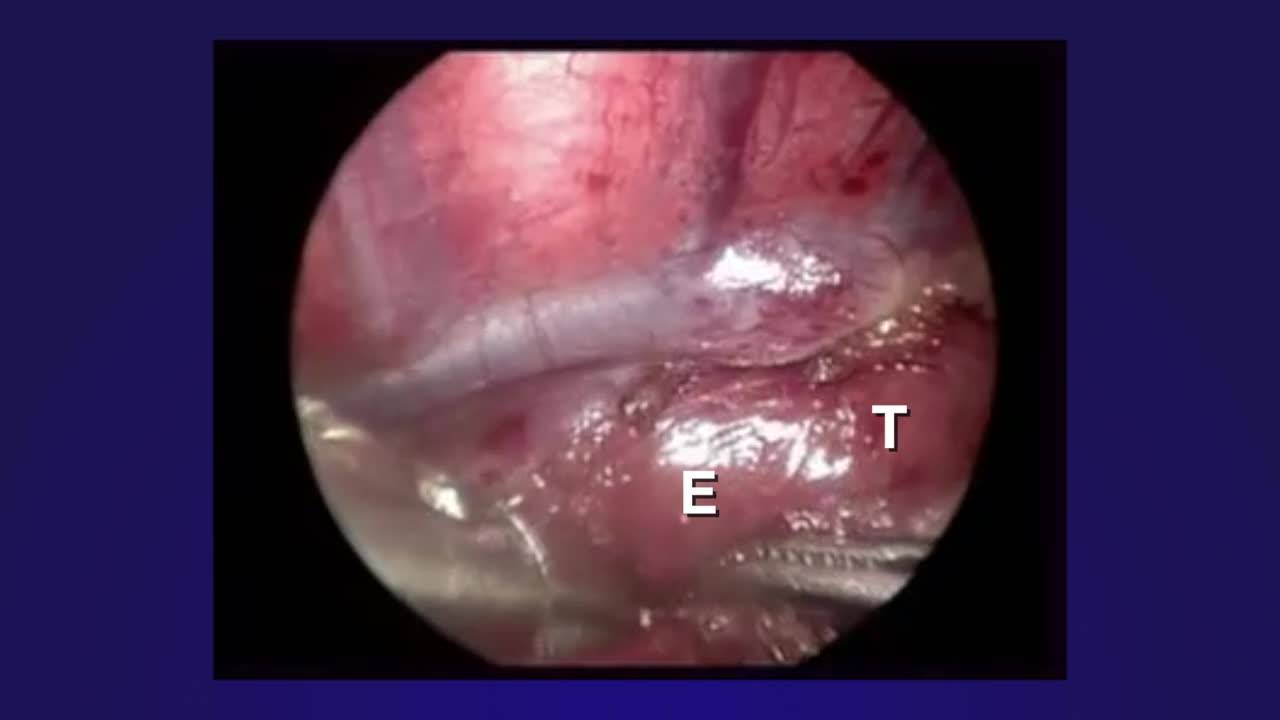
Thoracoscopic Repair of Esophageal Atresia with Distal Tracheo-esophageal...
5 min · Published Feb 2020
Video
BOB Ped Surg 2023 - Basma Magdy, PAPSA - Presentation
Published Feb 2023
Video
Validation of an anorectal malformation trainer - Can a high-fidelity model simulate real life?
1 min · Published Jun 2026
Video
Complications and Long-Term Outcomes of Patients With Cloacal Malformation After Bowel Neovagina...
1 min · Published Jun 2026
Video
Safety and utility of long-acting steroid injection for management of post-operative stricture...
1 min · Published Jun 2026
Video
Association Between Social Determinants of Health and Choice of Urinary Reconstruction in Children
1 min · Published Jun 2026
Video
The Perineal Body Preserving PSARP (PPP)
11 min · Published Jun 2026
Video
Update Course Rewind 2025: Hirschsprung + ARM: Rare but Real
1 min · Published May 2026
Video
Quick Literature Updates Ep 27
4 min · Published Feb 2026
Video
Quick Literature Updates Ep 26
4 min · Published Jan 2026
Video
Quick Literature Updates Ep 23
4 min · Published Oct 2025
Video
Quick Literature Updates Ep 22
4 min · Published Oct 2025
Video
Quick Literature Updates Ep 21
4 min · Published Sep 2025
Video
2025 Pediatric Surgery Update Course - Updates in Pediatric Surgery feat. JPS Articles
Dr. Todd Ponsky · 15 min · Published Aug 2025
Video
Intestinal Atresia Types Explained: Grossfeld Classification for Pediatric Surgery
1 min · Published Sep 2026
Video
Derivation and validation of the Pediatric Community-Acquired Pneumonia Severity (PedCAPS) score: A prospective cohort study
50 s · Published Sep 2026
Video
FETO for Late-Diagnosed Severe Congenital Diaphragmatic Hernia (CDH) at Cincinnati Children's with Dr. Beth Rymeski
4 min · Published Sep 2026
Video
Severe Congenital Diaphragmatic Hernia (CDH) Case: FETO Management & Unexpected Findings with Dr. Beth Rymeski
3 min · Published Sep 2026
Video
Fetoscopic Endoluminal Tracheal Occlusion (FETO) Procedure: Step-by-Step Guide with Dr. Beth Rymeski
4 min · Published Sep 2026
Video
Choledochal Cyst Types Explained: Pediatric Surgery Fundamentals
1 min · Published Sep 2026
What the experts said
Delayed diagnosis of Hirschsprung disease does affect certain outcomes in these patients.
The Zeng et al. study was a retrospective multi-center study done in China comparing robotic repair versus thoracoscopic repair for esophageal atresia.
After propensity score matching, the study included 126 patients with 63 in each group (robotic vs thoracoscopic).
Robotic surgery for esophageal atresia had longer operative time but shorter anastomotic time compared to thoracoscopic repair.
The robotic group had lower anastomotic strictures and lower readmissions within 2 years post-op compared to thoracoscopic repair.
Robotic surgery is a good answer for esophageal atresia repair.
The Pediatric Colorectal and Pelvic Learning Consortium conducted a multi-center retrospective review from 2017 to 2023 examining delayed diagnosis of Hirschsprung disease.
The Hirschsprung study included 679 patients from 14 different sites.
Increased age at diagnosis of Hirschsprung disease was associated with a greater likelihood of undergoing fecal diversion after initial pull-through procedure.
Increasing age at diagnosis of Hirschsprung disease was associated with an increased risk of constipation or incontinence requiring intervention postoperatively.
The Hirschsprung study did not find an association between age at diagnosis and 30-day complication rate after initial pull-through.
The Hirschsprung study did not find an association between age at diagnosis and need for pull-through revision.
The Children's Hospital in Pakistan conducted a randomized control trial including 124 patients in 2021 to 2022 who needed stoma reversal.
The Pakistani stoma reversal trial aimed to compare surgical site infections and cosmetic outcomes of scars in patients receiving purse-string or linear skin closure techniques.
The purse-string closure group had way fewer surgical site infections compared to the linear closure group for stoma reversal.
The purse-string closure group had much better scar quality compared to the linear closure group for stoma reversal.
When reversing a stoma, purse-string closure technique is the best way to do it.