


Chapter 1 of 7 · Surgical Management
Incidental hernia
Incidental hernia discovery during laparoscopic G-tube placement
Expert statements on this page
No expert statements were drawn from this page.
Host summaries · secondary, not cited in answers
Educational content from recorded physician discussions — not medical advice. Talk to your (or your child's) care team about your situation.
Video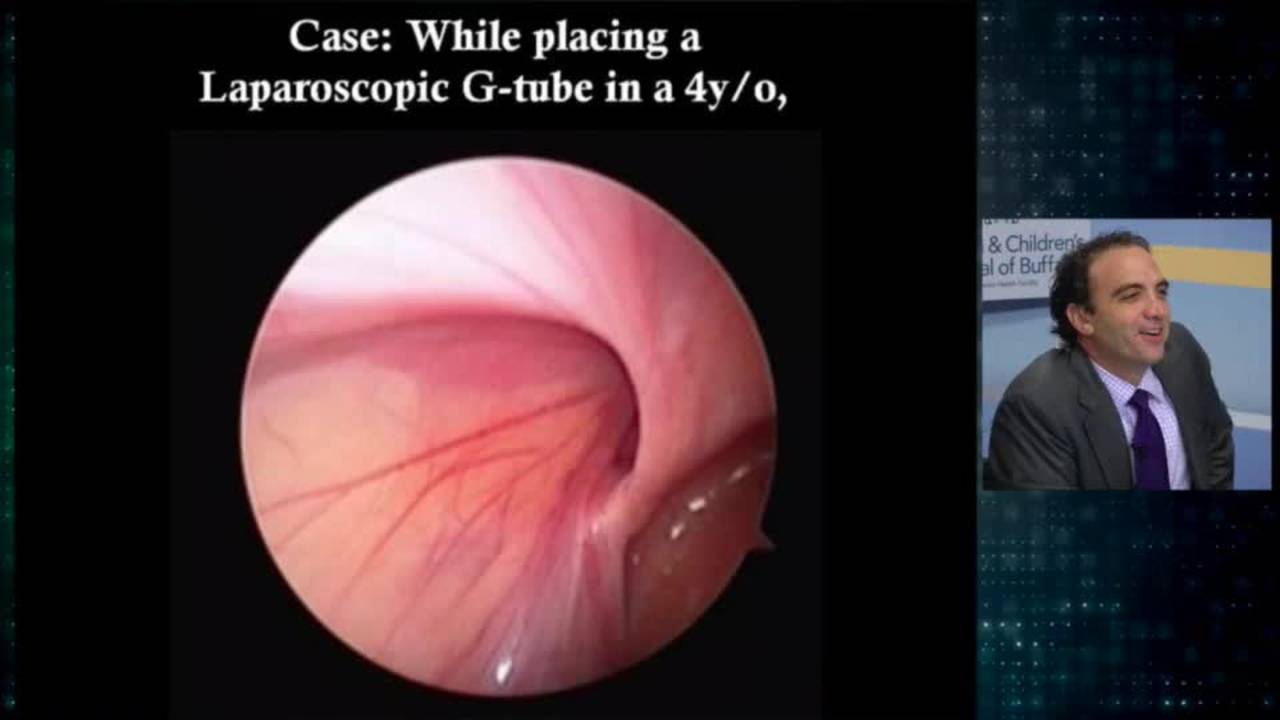
Groin Controversies: Update Course 2016
Dr. Todd Ponsky · 28 min · Published Jul 2017
Video
2026 Laparoscopic Pediatric Hernia Repair
123 min · Published Jun 2026
Video
Pediatric Hernia: Update Course 2013
52 min · Published Jul 2017
Video
2024 Laparoscopic Hernia Event
102 min · Published Jun 2024
Video
Focus on Technique- Laparoscopic Pediatric Hernia Repair 2015
Dr. Todd Ponsky · 140 min · Published Mar 2014
Video
Laparoscopic Pediatric Hernia Repair: Online Course 2017
Dr. Todd Ponsky · 102 min · Published Aug 2017
Video
Acute Cholecystitis
Todd Ponsky · 32 min · Published Jul 2026
Video
Update Course Rewind 2025: Updates in NEC Management
11 min · Published Jul 2026
Video
Pediatric Pre-Operative Bowel Prep
Todd Ponsky · 1 min · Published Jul 2026
Video
Journal of Pediatric Surgery Article Review: September 2021
Todd Ponsky · 11 min · Published Jul 2026
Video
22. HerniaTalk LIVE Q&A: Pediatric Hernias
Todd Ponsky · 59 min · Published Jul 2026
Video
ATLS 2021 Pediatric Surgery Update
Todd Ponsky · 16 min · Published Jul 2026
Video
Intestinal Atresia Types Explained: Grossfeld Classification for Pediatric Surgery
1 min · Published Sep 2026
Video
Derivation and validation of the Pediatric Community-Acquired Pneumonia Severity (PedCAPS) score: A prospective cohort study
50 s · Published Sep 2026
Video
FETO for Late-Diagnosed Severe Congenital Diaphragmatic Hernia (CDH) at Cincinnati Children's with Dr. Beth Rymeski
4 min · Published Sep 2026
Video
Severe Congenital Diaphragmatic Hernia (CDH) Case: FETO Management & Unexpected Findings with Dr. Beth Rymeski
3 min · Published Sep 2026
Video
Fetoscopic Endoluminal Tracheal Occlusion (FETO) Procedure: Step-by-Step Guide with Dr. Beth Rymeski
4 min · Published Sep 2026
Video
Choledochal Cyst Types Explained: Pediatric Surgery Fundamentals
1 min · Published Sep 2026
What the experts said
A patent processus vaginalis confers a 4 times greater risk than the general population of developing a hernia at some point in life
For children under age 5, there is concern that a patent processus vaginalis has not been present long enough to declare whether it will become symptomatic
High ligation is the appropriate repair for a patent processus vaginalis at any age, from day of life one to end of life
If there is a muscle problem in the inguinal floor, that represents a different type of hernia than a patent processus vaginalis
Digital examination up the inguinal canal is painful for children and causes them to cower during subsequent examinations
In rabbit studies, when injury was caused to the peritoneum during hernia repair, the closure was much more durable; even when the stitch was cut out after 12 weeks, the closure remained intact
Hydrodissection with bupivacaine (0.25% or 0.5%) dissects the cord structures away from the peritoneum during laparoscopic hernia repair
When performing percutaneous laparoscopic hernia repair, it is acceptable to leave 1 millimeter of tissue and skip over the vas deferens rather than risk injury
Prolene suture knots are thick and patients complain about them; ethibond or other braided sutures produce softer knots
Braided non-absorbable suture produces better hernia repairs than monofilament in rabbit studies
Non-absorbable sutures (silk, ethibond) used in hernia repairs can spit out of the groin or form abscesses years after placement
A retractile testis is defined as one that can be pulled down into the scrotum and stays there after release
Retractile testes should be followed with brief office visits every year until after puberty, when the larger testis size prevents retraction
Once a patient has gone through puberty and has a good-sized testis, it will stay in the scrotum and cannot retract
If a testis can be pulled down easily, even if it retracts back up, it should be considered descended
A testis that cannot be palpated in the office may descend into the scrotum once the patient is under anesthesia
After hernia repair, scarring can sometimes cause a previously retractile testis to ride up into a higher position
Testis ascent after open hernia repair occurs when cremaster muscle or cord vessels become entrapped in the external oblique closure
Ultrasound is not useful for non-palpable testis; if no testis is palpable on exam, proceed directly to laparoscopic exploration
For intra-abdominal testis at the internal ring, Fowler-Stevens orchiopexy is the appropriate procedure
Retrospective data and prospective pilot data suggest that one-stage Fowler-Stevens is just as effective as two-stage
Witt argues that hernia repair is not the type of conversation to have quickly in the waiting room because if there were injury, it would be a rushed conversation about something the patient may never have a problem with
Adult surgeons at a SAGES hernia course do not perform digital examination up the inguinal canal; they palpate externally over the internal and external ring areas
Studies show that clinicians cannot reliably distinguish direct from indirect inguinal hernias on physical examination
The first operation for hernia repair was herniotomy, which worked 70% of the time but had a 30% recurrence rate
Ladd and Gross introduced high ligation for pediatric hernias
Adult surgeons developed floor repairs (McVay, Bassini) which have a 10% recurrence rate
Lichtenstein mesh repair reduced adult hernia recurrence to 1%
A true retractile testis has occasionally been reported to ascend and become trapped in a higher position
If a testis is in the inguinal canal, it should be palpable on physical examination; if not palpable, the exam was inadequate