
Collection

Pediatric Surgical Outcomes
Educational content from recorded physician discussions — not medical advice. Always talk to your child's care team about your child's situation.
Content of this collection
Featured
11 items
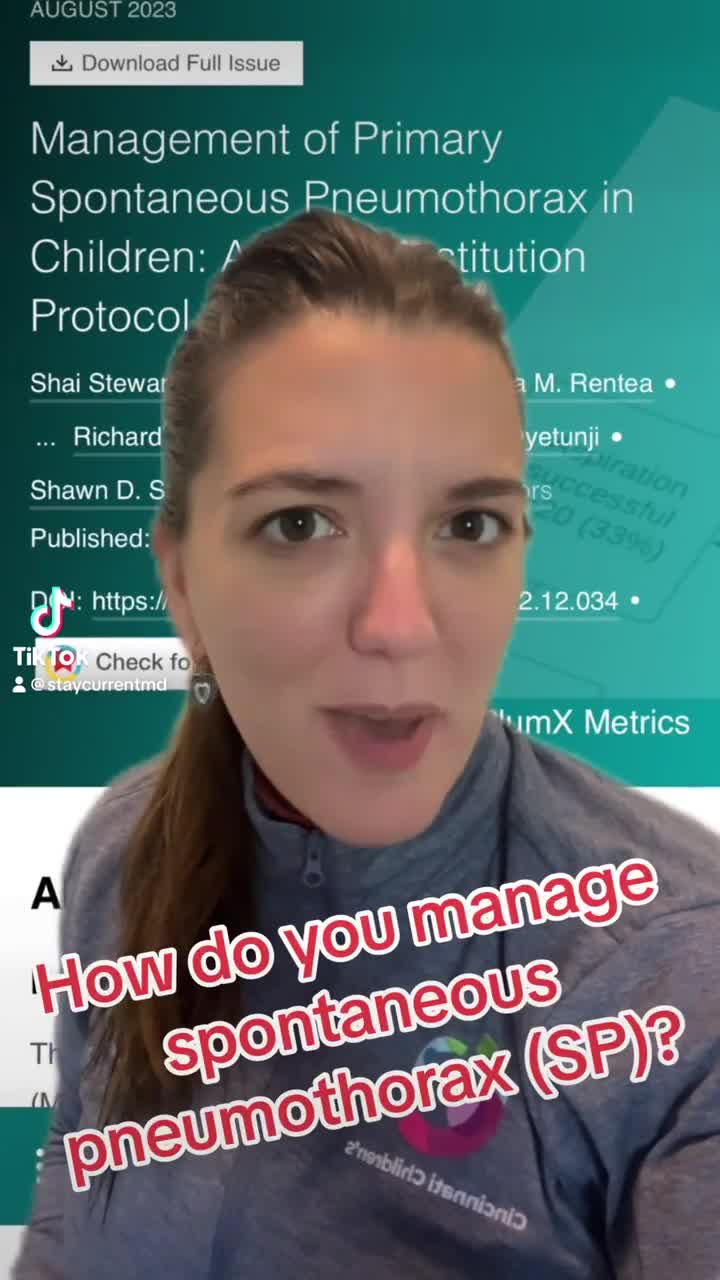

Management of Primary Spontaneous Pneumothorax in Children
Watch →
New article you should know about by Dr. Cecilia Gigena
"Management of Primary Spontaneous Pneumothorax in Children: A Single Institution Protocol Analysis"
Authors: Shai Stewart, James A. Fraser, Rebecca M. Rentea, Pablo Aguayo, Davi
video · Sep 2023
Manejo del neumotórax primario espontáneo en niños
Watch →
Nuevo artículo que debes conocer de la Dra. Cecilia Gigena
"Manejo del neumotórax primario espontáneo en niños: análisis del protocolo de una sola institución"
Autores: Shai Stewart, James A. Fraser, Rebecca M. Rentea, Pablo Aguayo, D
video · Sep 2023
Management of Primary Spontaneous Pneumothorax in Children
Read →
New infographic by Dr. Cecilia Gigena
"Management of Primary Spontaneous Pneumothorax in Children: A Single Institution Protocol Analysis"
Authors: Shai Stewart, James A. Fraser, Rebecca M. Rentea, Pablo Aguayo, David Juang, Jason D.
article · Oct 2023
Manejo del Neumotórax Espontáneo Primario en Niños
Read →
Nueva infografía de la Dra. Cecilia Gigena
"Manejo del neumotórax espontáneo primario en niños: análisis del protocolo de una sola institución"
Autores: Shai Stewart, James A. Fraser, Rebecca M. Rentea, Pablo Aguayo, David Juang, Jaso
article · Oct 2023
Evaluation and Management of Primary Spontaneous Pneumothorax in Adolescents and Young Adults: A Systematic Review From the APSA Outcomes & Evidence-Based Practice Committee
Read →
K Elizabeth Speck, Afif N Kulaylat, Joanne E Baerg, Shannon N Acker, Robert Baird, Alana L Beres, Henry Chang, S Christopher Derderian, Brian Englum, Katherine W Gonzalez, Akemi Kawaguchi, Lorraine Kelley-Quon, Tamar L Levene, Rebecca M Ren
article · Jan 2024
Evaluación y tratamiento del neumotórax espontáneo primario en adolescentes y adultos jóvenes: una revisión sistemática del Comité de prácticas basadas en evidencia y resultados de APSA
Read →
Nueva infografîa por la Dra. Em Gootee traduciada por la Dra. Cecilia Gigena
"Evaluación y tratamiento del neumotórax espontáneo primario en adolescentes y adultos jóvenes: una revisión sistemática del Comité de prácticas basadas en evid
article · Jan 2024
Evaluation and Management of Primary Spontaneous Pneumothorax in Adolescents and Young Adults: A Systematic Review From the APSA Outcomes & Evidence-Based Practice Committee
Watch →
New article you should know by Cecilia Gigena
"Evaluation and Management of Primary Spontaneous Pneumothorax in Adolescents and Young Adults: A Systematic Review From the APSA Outcomes & Evidence-Based Practice Committee"
Authors: K.
video0:58 · Jan 2024
Management of Gastroschisis: Timing of Delivery, Antibiotic Usage, and Closure Considerations (A Systematic Review From the American Pediatric Surgical Association Outcomes & Evidence Based Practice Committee)
Read →
Mark B. Slidell, Jarod McAteer, Doug Miniati,Stig Sømme, Derek Wakeman, Kristy Rialon, Don Lucas, Alana Beres, Henry Chang, Brian Englum, Akemi Kawaguchi, Katherine Gonzalez, Elizabeth Speck, Gustavo Villalona, Afif Kulaylat, Rebecca Rentea
article · Sep 2024
Management and Outcomes of Pediatric Lymphatic Malformations: A Systematic Review From the APSA Outcomes and Evidence-Based Practice Committee
Read →
Carlos Theodore Huerta, Alana L. Beres, Brian R. Englum, Katherine Gonzalez, Tamar Levene, Derek Wakeman, Yasmine Yousef, Brian C. Gulack, Henry L. Chang, Emily R. Christison-Lagay, Phillip Benson Ham, III, Sara A. Mansfield, Afif N. Kulayl
article · Nov 2024
Management and Outcomes of Pediatric Lymphatic Malformations: A Systematic Review From the APSA Outcomes and Evidence-Based Practice Committee
Watch →
Carlos Theodore Huerta, Alana L. Beres, Brian R. Englum, Katherine Gonzalez, Tamar Levene, Derek Wakeman, Yasmine Yousef, Brian C. Gulack, Henry L. Chang, Emily R. Christison-Lagay, Phillip Benson Ham, III, Sara A. Mansfield, Afif N. Kulayl
video0:59 · Dec 2024
Management of Gastroschisis: Timing of Delivery, Antibiotic Usage, and Closure Considerations
Watch →
Mark B Slidell, Jarod McAteer, Doug Miniati, Stig Sømme, Derek Wakeman, Kristy Rialon, Don Lucas, Alana Beres, Henry Chang, Brian Englum, Akemi Kawaguchi, Katherine Gonzalez, Elizabeth Speck, Gustavo Villalona, Afif Kulaylat, Rebecca Rentea
video0:55 · Jan 2025
Summaries and takeaways+ Show
Summary of this collection+ Show
Key points, with the moment each was said+ Show
Featured picks for families are being prepared — the summaries above are written for you.
Takeaways+ Show
Spontaneous pneumothorax management in adolescents remains debated. A retrospective series of 59 patients (ages 12–18) at Children's Mercy Hospital compared simple aspiration versus video-assisted thoracoscopic surgery (VATS) [e7190-c1, e7190-c2, e7190-c4]. Under a protocol escalating from aspiration to VATS if needed, 33% received aspiration and 66% ultimately underwent VATS [e7190-c5, e7190-c6]. Aspiration yielded a 45% recurrence rate and 20.4-hour median stay, while VATS showed 25% recurrence and 3.1-day stay [e7190-c7, e7190-c8, e7190-c9, e7190-c10]. The trade-off is clear: aspiration offers shorter initial hospitalization but higher recurrence; VATS provides better durability at the cost of longer admission and operative risk.
Gastroschisis evidence synthesis by the ABSA Outcomes Committee supports delivery after 37 weeks, prophylactic skin-flora antibiotics until closure, and primary fascial repair when hemodynamics and abdominal domain allow [e9626-c1, e9626-c2, e9626-c3, e9626-c4]. Sutureless techniques are safe, effective, and do not prolong feeding or length of stay [e9626-c5, e9626-c6]. High-quality RCTs remain needed .
- Simple aspiration for adolescent spontaneous pneumothorax has 45% recurrence vs. 25% for VATS, but median stay is 20 hours vs. 3 days. [e7190-c7, e7190-c8, e7190-c9, e7190-c10]
- Two-thirds of adolescents initially managed with aspiration for pneumothorax ultimately required VATS in a protocol-driven series. [e7190-c5, e7190-c6]
- Gastroschisis delivery should occur after 37 weeks; prophylactic skin-flora antibiotics reduce infection until closure. [e9626-c2, e9626-c3]
- Primary fascial repair is supported for gastroschisis when hemodynamics and abdominal domain permit; sutureless repair is safe and effective. [e9626-c4, e9626-c5]
- Sutureless gastroschisis repair does not delay feeding or increase length of stay compared to sutured closure. [e9626-c6]
For patients & families
Doctors at Children's Mercy Hospital studied how to best treat collapsed lungs (pneumothorax) in teenagers. They looked at 59 young patients between ages 12 and 18 who had this problem between 2016 and 2021. The hospital's approach was to start with a simple procedure called aspiration—using a needle to remove air—and if that didn't work, move to a surgical procedure called VATS. About one-third of patients received the simpler aspiration treatment, while two-thirds needed the surgery. The doctors found that patients who had aspiration went home faster—about 20 hours—but 45% had the problem come back. Patients who had surgery stayed in the hospital about 3 days but only 25% had it happen again. In a separate review, doctors also studied the best ways to care for babies born with gastroschisis, a condition where intestines are outside the body at birth, finding that waiting until after 37 weeks for delivery and repairing the opening right away when possible led to good outcomes.
Doctors at Children's Mercy Hospital studied how to best treat collapsed lungs (pneumothorax) in teenagers. They looked at 59 young patients between ages 12 and 18 who had this problem between 2016 and 2021. The hospital's approach was to start with a simple procedure called aspiration—using a needle to remove air—and if that didn't work, move to a surgical procedure called VATS. About one-third of patients received the simpler aspiration treatment, while two-thirds needed the surgery. The doctors found that patients who had aspiration went home faster—about 20 hours—but 45% had the problem come back. Patients who had surgery stayed in the hospital about 3 days but only 25% had it happen again. In a separate review, doctors also studied the best ways to care for babies born with gastroschisis, a condition where intestines are outside the body at birth, finding that waiting until after 37 weeks for delivery and repairing the opening right away when possible led to good outcomes.
The doctors in this collection+ Show
All expert statements+ Show
Every expert statement below comes from the recorded discussions, with its speaker and moment.
Management of Gastroschisis: Timing of Delivery, Antibiotic Usage, and Closure Considerations
The ABSA Outcomes and Evidence-based Practice Committee performed a systematic review on optimal initial management of gastroschisis.
Host summaryAlex Halpern summarizing a resource — not the host's own clinical position0:10 ↗
Delivery after 37 weeks is optimal for infants with gastroschisis.
Host summaryAlex Halpern summarizing a resource — not the host's own clinical position0:17 ↗
Prophylactic antibiotics covering skin flora are adequate to reduce infection risk until closure in gastroschisis.
Host summaryAlex Halpern summarizing a resource — not the host's own clinical position0:21 ↗
Studies support primary fascial repair for gastroschisis as long as hemodynamics and abdominal domain permit.
Host summaryAlex Halpern summarizing a resource — not the host's own clinical position0:27 ↗
Sutureless repair for gastroschisis is safe and effective.
Host summaryAlex Halpern summarizing a resource — not the host's own clinical position0:27 ↗
Sutureless repair does not delay feeding or increase length of stay in gastroschisis patients.
Host summaryAlex Halpern summarizing a resource — not the host's own clinical position0:37 ↗
There is a need for high quality randomized controlled trials to help provide evidence-based care for infants with gastroschisis.
Host summaryAlex Halpern summarizing a resource — not the host's own clinical position0:41 ↗
Manejo del neumotórax primario espontáneo en niños
The study was a retrospective analysis conducted at Children's Mercy Hospital Kansas City
Host summaryCecilia Gigena summarizing a resource — not the host's own clinical position0:00 ↗
The study analyzed patients aged 12 to 18 years with spontaneous pneumothorax presenting between 2016 and 2021
Host summaryCecilia Gigena summarizing a resource — not the host's own clinical position0:00 ↗
The study included 59 patients total
Host summaryCecilia Gigena summarizing a resource — not the host's own clinical position0:00 ↗
The hospital protocol involved starting with simple aspiration, which if it failed, proceeded to VATS
Host summaryCecilia Gigena summarizing a resource — not the host's own clinical position0:00 ↗
33% of patients were treated with simple aspiration
Host summaryCecilia Gigena summarizing a resource — not the host's own clinical position0:00 ↗
66% of patients were treated with VATS
Host summaryCecilia Gigena summarizing a resource — not the host's own clinical position0:00 ↗
Patients treated with simple aspiration had a recurrence rate of 45%
Host summaryCecilia Gigena summarizing a resource — not the host's own clinical position0:00 ↗
Patients treated with simple aspiration had a median hospital stay of 20.4 hours
Host summaryCecilia Gigena summarizing a resource — not the host's own clinical position0:00 ↗
Patients treated with VATS had a recurrence rate of 25%
Host summaryCecilia Gigena summarizing a resource — not the host's own clinical position0:00 ↗
Patients treated with VATS had a median hospital stay of 3.1 days
Host summaryCecilia Gigena summarizing a resource — not the host's own clinical position0:00 ↗
Management of Primary Spontaneous Pneumothorax in Children
The study is a retrospective analysis from Children's Mercy Hospital in Kansas City examining spontaneous pneumothorax management.
Host summaryCecilia Gigena summarizing a resource — not the host's own clinical position0:00 ↗
The study population included patients between 12 and 18 years old with spontaneous pneumothorax between 2016 and 2021.
Host summaryCecilia Gigena summarizing a resource — not the host's own clinical position0:00 ↗
The institutional protocol was to start with simple aspiration and escalate to VATS if aspiration failed.
Host summaryCecilia Gigena summarizing a resource — not the host's own clinical position0:00 ↗
The study included 59 patients total.
Host summaryCecilia Gigena summarizing a resource — not the host's own clinical position0:00 ↗
33% of patients received simple aspiration as their treatment.
Host summaryCecilia Gigena summarizing a resource — not the host's own clinical position0:00 ↗
66% of patients ended up receiving VATS.
Host summaryCecilia Gigena summarizing a resource — not the host's own clinical position0:00 ↗
The aspiration group had a 45% recurrence rate.
Host summaryCecilia Gigena summarizing a resource — not the host's own clinical position0:00 ↗
The aspiration group had a median length of stay of 20.4 hours.
Host summaryCecilia Gigena summarizing a resource — not the host's own clinical position0:00 ↗
The VATS group had a 25% recurrence rate.
Host summaryCecilia Gigena summarizing a resource — not the host's own clinical position0:00 ↗
The VATS group had a median length of stay of 3.1 days.
Host summaryCecilia Gigena summarizing a resource — not the host's own clinical position0:00 ↗
What's new+ Show