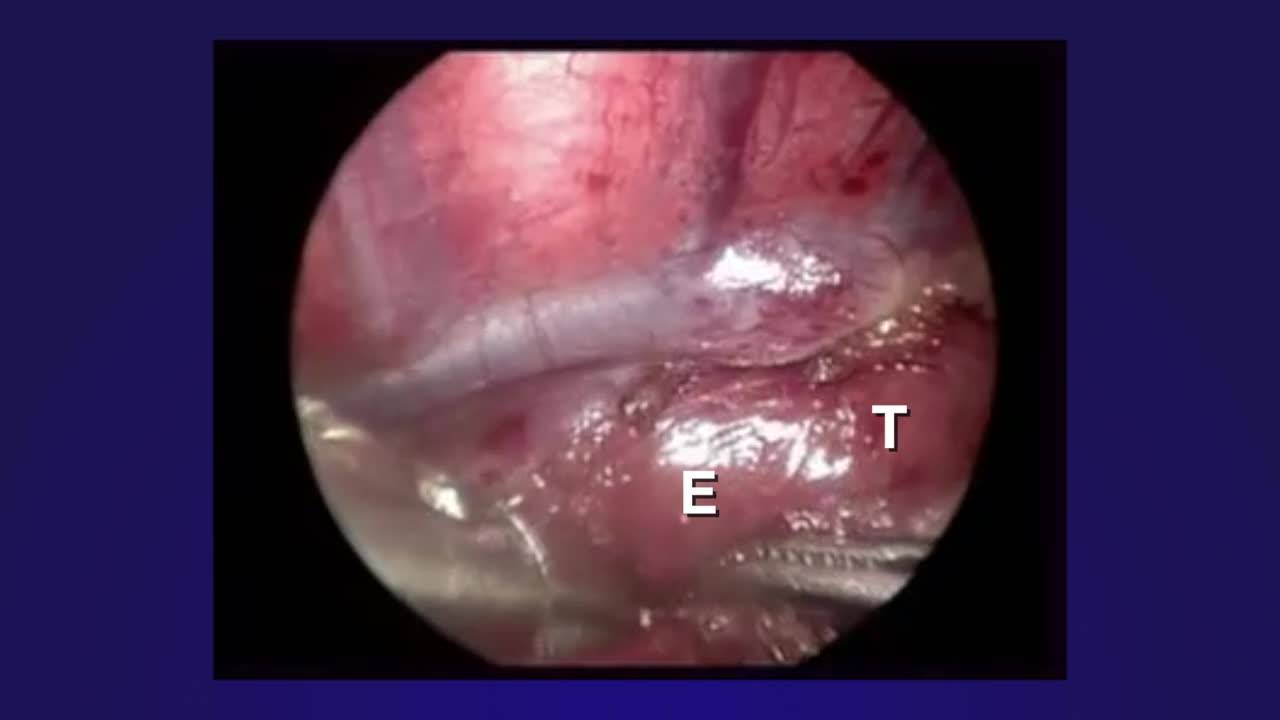
Hi, welcome back to Stay Current in Pediatric Surgery. I'm Ellen Ancisco. I'm I'm Tom Bash, and I'm Cecilia Gena. We're research fellows at Cincinnati Children's Hospital, and along with Stay Current, we're sharing knowledge to improve child health around the globe. And for this week, we are highlighting some more articles from the Journal of Pediatric Surgery. The articles are listed and linked in the description below. Follow along and read with us. The issue we're highlighting this week is from February 2023 and this is the BAPS issue. BAS? Is the British Association of Pediatric Surgery, and these are highlighted papers that were presented in the last year's conference. And Doctor Mark Davenport from the UK is the editor who helped us choose these articles for this podcast. Hello, I'm Mark Davenport, uh, the UK editor for the Journal of Pediatric Surgery. Awesome, so let's get started with the first one. The first article we're highlighting is called Thoracoscopic Approach for Esophageal atresia, a Real Game Changer. This was the Karl Stortz lecture at G at Babs last year. It was given by Doctor Patkowski. My name is Derek Potkowski. I am a pediatric surgeon. and also pediatric neurologist. I'm working at the Department of Pediatric Surgery of Rosslav Medical University. And he highlighted his experience in doing thoracoscopic repair for oesophageal atresia. He notes that in Poland, where he comes from, they've been doing thoracoscopic esophageal atresia repair since 2005 exclusively. We were happy that our first procedure was successful. When we did another one, it was much easier. Of course, at the beginning, the first procedure took us almost 4 hours. Right now it's a 1 hour procedure, but of course it's very difficult, but we are very happy to have no conversion. And since the beginning when we started with the thoracoscopic approach, all cases were managed by one team and only by thorachoscopic approach. He gives us some tips for things that he's learned along the way that will help make us better at doing thoracoscopic esophageal atresia repair. The first, you need experience in endoscopic surgery. And then just you need time, and you must be very experienced in endoscopic suturing. You must be very slow. If you do it slowly, you will do it fast. And what do you think, Cecilia? I mean, he's one of the best pediatric surgeons in the world, and I think that he perfected this thoracoscopic technique. Also, one thing that he mentioned is the importance to centralize the care of these patients. Even if this is a higher cost, but probably the costs of complications are much, much more higher than transportation. At my center we have about 15 to 20 cases a year. It depends on the year, and it shows that with such a number of cases you can get a good experience. Because it's not an easy operation, so it's better to have them made by experts that know how to do this theracoscopically because he thinks it's not the same to do it that way than open. And indeed this is probably the key factor. Distinguish him from many of his peers, and that was Doctor Davenport again, the editor who helped us choose these articles. The Centre in Rocklaw has become the center to refer cases of esophageal atresia and certainly the long gap esophageal atresia to from the whole of Poland, and with that experience and with his technology and technique, he has shown that you can give outstanding results for it. Here's what Todd had to say. First of all, It's great that Babs had Darius as their Stewart's lecturer, because I actually think he's probably gonna go down as one of the most brilliant pediatric surgical minds of our era. So regarding this particular paper though, I think we're starting to understand that these centers of excellence are probably a smart thing to do, and we are seeing better outcomes. And a lot of countries will have a very hard time doing that. It depends on your health care system. That won't happen in the United States very easily. And it's a shame because it probably should. And also if you look at most of the European countries, it's 4 or 6 hours drive from one side to the other side of the country, but that's the side of a basically a state in the United States. So, the centralization part could be done maybe in the state base. Next, we have M's article. The next article is from Sheffield, England, the role of stoma in the initial and long-term management of Hirschsprung Disease. We talked to the senior author for this paper. Hi, I'm Govind Murti. I'm a consultant pediatric surgeon in Sheffield Children's Hospital in the UK and I specialize in lower GI surgery. We were interested in is to see what the role of stoma in the management of Apring's disease in modern or current practices. They retrospectively look into the data from January 2004 to August 2021, and they had 95 patients in their cohort. If nearly 50 to 47% of our cohort. needed a stoma before the primary. In the stoma cohort, 38 of them had ileostomies and the remaining has colostomies. The most common indications for initial stoma was for nearly 40% washout failure. In case you're used to the term rectal irrigations, that's the same thing as rectal washouts in this paper. And he mentioned that for the last 40 years when we moved from three-stage surgical management to primary pull-through, started feeling like stoma is a failure. Stomma doesn't mean always a failure. Sometimes it's a necessity. Comes with the nature of the disease. Of the 20 patients that needed post pull through stoma formation, 7 of them happened within 30 days and 13 happened after 30 days. So there was a larger number of them needed it after 30 days, and most usually because of constipation, because of soiling. Well, it's just about the same, so I think this does represent real life surgical reporting from a representative group, Sheffield. Reflecting the overall management of Hirschprung's disease within the UK. That was Doctor Mark Devenport. As you're reading the article and as we were talking to Todd, we were realizing that this, sequence seemed a little bit different than what we usually hear about in the US. And so we talked to one of the colorectal experts at Cincinnati Children's, Doctor Beth Rmey. That it does not seem reflective at all of the type of things that that we see in our practice here, and I think that would be seen in a lot of practices in the United States. She pointed out that, you know, typically we see Many primary pull-throughs these days, as I said. So either a neonatal pull-through or, uh, you know, if the scheduling prohibits or if the baby is small, putting them home on irrigations and having them come back for a pull through in the first couple of months of life. The only patients that we would divert pre-poll through are if it is a delayed presentation, misdiagnosis, and they perforate. And then the other group. For the complicated cardiac babies. I think it's OK to manage patients by doing washouts at their houses and only use the stoma if they need it, but I think that what they can improve and even Doctor Murthy said it himself, it's to teach the parents how to do the washouts. The last thing I think Doctor Ray Maski pointed out is that it sounds like In Sheffield they're doing mostly do Hamel pull-throughs, whereas in Cincinnati, at least, they primarily do more Swenson's. Both can be just as good, but as far as technique goes, that is one difference. I think this paper just demonstrates the wide variability in practice around the world. I mean, I guess it depends a lot on the healthcare system, uh, on the individual practices, and, and also just traditional approaches. Cecilia is the last one. OK, so for the last paper of today we have a randomized control trial using soap for the prevention of surgical site infections in Tanzania. This is a randomized trial conducted in Mahambile National Hospital in Tanzania, and what they did is they had two groups. One received a bath. With plain soap prior to the surgery and the other one didn't. There was uh actual intervention by trained carers to direct the sort of method of of cleansing uh concentrating on areas known to harbor commensal and pathogenic bacteria. And again that was Dr. Mark Davenport. And they gathered 252 patients. 114 had a bath prior to surgery, and of them only 11.4% developed an SSI or surgical site infections, whereas in the other group, 40.6% of the patients develop NSSI. So analyzing that they have that with clean soap they reduced the odds of having surgical site infections by 80%. Uh, not only that, uh, they looked at length of stay, and in the interventional arm that was reduced from, it was 12 days, uh, compared to the non-interventional group which was 22 days. That's super important and one of the things I think it's cool about this is that it seems that in Tanzania it wasn't that common to give the patients a bath prior to. Surgery and just by implementing it, they definitely improved the patients' outcomes. Doctor Amski, who we discussed the last paper with, happened to recently have traveled to Tanzania with a group from Cincinnati Children's, and she mentioned that before implementing preoperative washing in their patients, um, they had, they similarly had higher SSI rates and afterwards, they decreased the rate of SSI as this paper shows. Yeah, I mean, the first year that we operated there, almost every kid got a wound infection, and then we started the next year we had the nurses do pre-op baths up on the floor the day before, and that year we had like 0 wound infections. So I do think that pre-op bathing is not sort of on the standard thing of things that people think about. Uh, I think this is an important trial. It was well designed, analyzed really in quite substantial detail. And I think the results seem fair and unambiguous and would have implications for that particular surgical environment, this is Tanzania, low to middle income country, clearly surgical site infections are a major problem. Awesome. We had 3 articles from the BAPS issue. One about thoracoscopic esophageal atresia repair and some tips from Dr. Patkowski. Then we talked about stomas and Hirschsprung disease and the experience in a hospital in the UK. And finally, a randomized control trial for preventing SS. in pediatric surgery patients in Tanzania with pre-operative soap washing. If you liked this episode, don't forget to follow us on social media, subscribe to our YouTube channel. Listen to previous episodes of this podcast or other podcasts, wherever you get your podcast from, and don't forget to download the Steak or an app or an App Store or Play Store. OK, so keep an eye and don't miss our update course 2023 that's going to be on August, so stay tuned for more information. Awesome. I'm Ellen and Cisco. I'm I'm Tom Bash, and I'm Cecilia Geno. We're research fellows at Cincinnati Children's and along with Stay Current, we're sharing knowledge to improve child health around the globe.
Comments