


From
StayCurrentMD
Ovarian Torsion with Dr. Jennifer Dietrich
With Dr. Jennifer Dietrich · hosted by Dr. Todd Ponsky
Part of
Ovarian Torsion 8 items
Chapter 1 of 12 · Fundamentals
Initial evaluation
Introduction and Initial Evaluation of Lower Abdominal Pain
Expert statements on this page
No expert statements were drawn from this page.
Host summaries · secondary, not cited in answers
Educational content from recorded physician discussions — not medical advice. Talk to your (or your child's) care team about your situation.
Video
Update Course Rewind: Ovarian Torsion Management 2023
Published Dec 2023
Video
Ovarian Salvage (Torsion & Benign Tumor): Practice Gap discussion at Update...
14 min · Published Aug 2018
Podcast
Ovarian Tumors Video Podcast
34 min · Published Mar 2018
Podcast
Pediatric Ovarian Tumors Video Podcast
34 min · Published Mar 2018
Video
William G. Lee, MD - Best of the Best in Pediatric Surgery 2024
Dr. Todd Ponsky · 8 min · Published Feb 2024
Video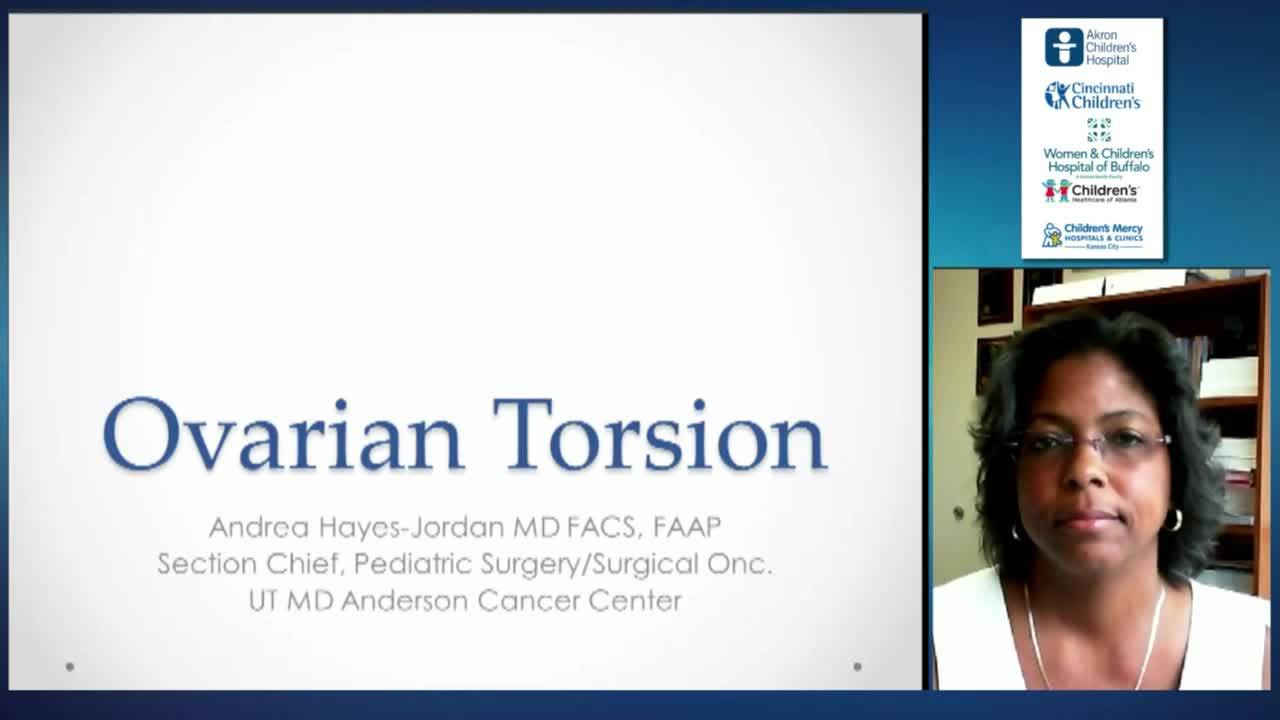
Ovarian Torsion Rapid Fire: Update Course 2015
12 min · Published Nov 2015
Only a few other public items share this expert — go deeper there →
Video
Intestinal Atresia Types Explained: Grossfeld Classification for Pediatric Surgery
1 min · Published Sep 2026
Video
Derivation and validation of the Pediatric Community-Acquired Pneumonia Severity (PedCAPS) score: A prospective cohort study
50 s · Published Sep 2026
Video
FETO for Late-Diagnosed Severe Congenital Diaphragmatic Hernia (CDH) at Cincinnati Children's with Dr. Beth Rymeski
4 min · Published Sep 2026
Video
Severe Congenital Diaphragmatic Hernia (CDH) Case: FETO Management & Unexpected Findings with Dr. Beth Rymeski
3 min · Published Sep 2026
Video
Fetoscopic Endoluminal Tracheal Occlusion (FETO) Procedure: Step-by-Step Guide with Dr. Beth Rymeski
4 min · Published Sep 2026
Video
Choledochal Cyst Types Explained: Pediatric Surgery Fundamentals
1 min · Published Sep 2026
What the experts said
In all reproductive age females presenting with lower abdominal pain, a pregnancy test should be checked regardless of sexual history.
Ultrasound provides real-time and still pictures with better penetration capabilities regardless of patient BMI, as long as the female has a full bladder.
Significant asymmetry between ovaries on ultrasound, particularly enlargement on the side of pain, raises concern for adnexal torsion.
Complete absence of blood flow on ultrasound is the most concerning and more reliable finding; presence of blood flow is actually less reliable in diagnosing torsion.
Blood flow may be present in ovarian torsion because it could be just a torsed tube, in which case flow to the ovary would still be visible.
Intermittent torsion can occur, and if diagnosis is difficult, observation with repeat ultrasound may help if the patient's condition declares itself.
When the ovary is edematous with compromised blood supply, follicles become peripheralized to the ovary's periphery due to vascular congestion in the middle.
In the literature, cysts around 5 or 6 centimeters in size increase concern for torsion risk in the setting of symptoms, as they make the ovary and tube heavy enough to twist.
In prepubertal girls, normal ovaries can torse, and torsion is the most common reason these children undergo surgery for a gynecologic indication.
There is no specific size cutoff for torsion risk; diagnosis is based on clinical presentation. Prepubertal ovaries are very small (1-1.5 cm), but normal ovaries can still twist.
Complex features on ultrasound (partly cystic, partly solid) with hypervascular flow within the lesion and elevated tumor markers raise concern for malignancy.
CT is beneficial to distinguish an adnexal lesion from an abscess or appendiceal pathology when infection is a concern.
MRI is useful to distinguish torsion from Müllerian anomalies with outflow tract obstruction, where a hematosalpinx may mimic torsion on ultrasound.
Pelvic exams in adolescents are typically delayed until later teenage years or until the first Pap smear at age 21, unless specific concerns arise.
Tumor markers sent for complex adnexal masses include alpha-fetoprotein, serum beta-HCG quantitative, lactate dehydrogenase, and CA-125.
At Texas Children's Hospital, three out of four tumor markers return within an hour to hour and a half, allowing results before OR posting.
It is unpredictable whether a patient has a loose torsion with more time or a tight torsion with rapid ischemia development, so diagnosis should be addressed as soon as possible.
Ovarian torsion is a clinical diagnosis; if clinical suspicion is high, surgery should proceed regardless of ultrasound findings including blood flow.
If the diagnosis is uncertain, observation for a few hours is reasonable to see if a patient with intermittent torsion declares herself, but the patient should not be sent home.
A classic torsion presentation includes acute onset abdominal pain after physical activity (gymnastics, cartwheels), persistent pain unresponsive to over-the-counter measures, nausea and vomiting, and ultrasound showing ovarian asymmetry on the painful side.
Hemorrhagic ovarian cysts are more likely in females who are already menstruating, and menstrual history (regularity, timing of last cycle) helps determine risk for hemorrhagic or corpus luteum cysts.
Doppler can help differentiate hemorrhagic cysts from torsion: within a hemorrhagic cyst there is no flow, but peripheral to the cyst there is flow.
At surgery for torsion, the ovary is detorsed and any lesion (peritubal or ovarian cyst) is removed, as the lesion's weight made the adnexa prone to twisting.
Oophorectomy and salpingo-oophorectomy should be avoided at all times; even purple, black and blue ovaries can recover over time after detorsion.
For non-ischemic torsion, cystectomy is performed rather than simple drainage unless the cyst is clearly functional.
Peritubal cysts will recur if not completely excised; the technique involves opening the mesosalpinx beneath the fallopian tube and shelling out the cyst wall.
For expanding hemorrhagic cysts, the cyst should be removed and bleeding areas coagulated; if the cyst wall is not completely removed, the cyst may continue to bleed.
Even necrotic-appearing ovaries should be salvaged unless the tissue is literally falling apart during detorsion; ovarian function and follicles can return after a few months.
Follow-up studies at Texas Children's Hospital show return of ovarian function and evidence of follicles in patients who had torsed ovaries preserved.
Whether to remove the fallopian tube along with a necrotic ovary depends on whether the tube is involved in the torsion and completely devitalized or salvageable.
Bivalving may be needed when the ovary remains edematous after detorsion, to debulk the ovary and reduce re-torsion risk, especially when there is no lesion to remove.
Energy devices such as harmonic scalpel or monopolar hook can be used for ovarian bivalving and debulking procedures.
Oophoropexy is considered when a child has lost one ovary and presents with torsion of the remaining ovary, or in cases of recurrent torsion.
Oophoropexy may change future fertility potential, but preserving the ovary is better than losing it; in vitro technologies remain an option for egg retrieval.
Absorbable suture material can be used for oophoropexy to hold the adnexa still for 4-6 weeks while inflammation resolves, minimizing near-term re-torsion risk.
Clipping the utero-ovarian ligament does not always prevent torsion because torsion can occur on either the utero-ovarian ligament or the infundibulopelvic ligament.
Oophoropexy techniques include shortening the utero-ovarian ligament (by suturing it closer together), fixation to the pelvic sidewall (avoiding ureters), or fixation to the back of the uterus.
For tubal-ovarian abscess, antibiotics should be started and the abscess should not be disturbed unless the patient is crashing, to avoid seeding other pelvic structures.
Ectopic pregnancy can present similarly to torsion with acute pain and an adnexal mass, and may not be visible on transabdominal ultrasound if beta-HCG levels are below the threshold for visualization.
For tubal ectopic pregnancy, a salpingostomy is made, the ectopic pregnancy is removed, hemostasis is ensured, and tissue is submitted for pathology; the tube is not sutured closed.
Pelvic structures heal well without suturing; suturing can cause more scar tissue and stricture formation than leaving small incisions to heal on their own.
Endometriosis in young adolescents presents with atypical lesions (clear or red) rather than the classic blue or black lesions seen in adults with advanced disease.
To identify clear endometriosis lesions, fill the pelvis with crystalloid fluid and examine the cul-de-sac closely with the camera underwater to see blebs pulling away from the peritoneum.
Endometriosis lesions can be excised with cold scissors when near the ureter or bowel, or ablated in other locations.
Patients can go home within a few hours after laparoscopic surgery if they meet postoperative milestones, with activity limited for 4-6 weeks to allow incision healing and avoid hernia formation.
Oral contraceptive pills can prevent recurrence if the torsion was caused by a functional cyst, but will not help with dermoid cysts or peritubal cysts.
Surveillance ultrasound is obtained at 3 months post-surgery (allowing time for inflammation to resolve), then at 3-6 months if the ovary is still recovering, then annually.
Studies from Boston Children's show that salvage rates are higher within the first 24 to 72 hours from onset of abdominal pain compared to one week.
The ovarian bivalving procedure, described at Boston Children's, involves making an incision into the ovarian cortex after detorsion to relieve compartment syndrome-like vascular congestion.