
Inguinal Hernia With M. Rosen
With Dr. Michael Rosen · hosted by Dr. Jeffrey Ponsky · Jeffrey Ponsky
Educational content from recorded physician discussions — not medical advice. Talk to your (or your child's) care team about your situation.
Podcast
Inguinal Hernia With M. Rosen
Jeffrey Ponsky · 31 min · Published Oct 2015
Podcast
Inguinal Hernia With M. Rosen
Jeffrey Ponsky · 31 min · Published Oct 2015
Podcast
Inguinal Hernia: Adult
31 min · Published Jan 2017
Video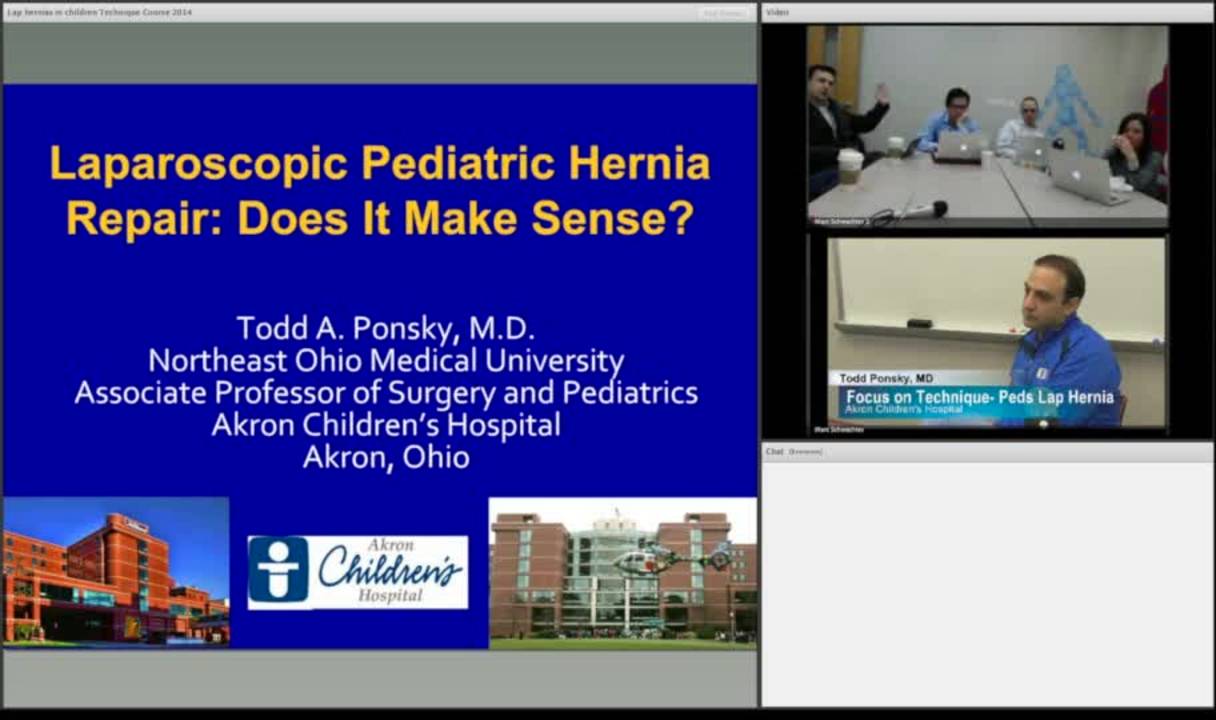
Focus on Technique- Laparoscopic Pediatric Hernia Repair 2015
Dr. Todd Ponsky · 140 min · Published Mar 2014
Video
2026 Laparoscopic Pediatric Hernia Repair
123 min · Published Jun 2026
Video
Pediatric Inguinal Hernia in Brief: Presentation, Workup, Diagnosis, Perioperative Considerations
Published Sep 2021
Video
V119 Use of transoral incisionless fundoplication for recurrent reflux after foregut surgery
Jeffrey Ponsky · Published Jul 2026
Video
From Idea to Ubiquity
Jeffrey Ponsky · Published Jul 2026
Video
Intra-operative Bile Leak During Cholecystectomy
Jeffrey Ponsky · Published Jul 2026
Video
Acute Cholecystitis
Todd Ponsky · Published Jul 2026
Podcast
Behind The Knife: The Surgery Podcast / Innovations in Surgery: PEG Tube
Jeffrey Ponsky · Published Jul 2026
Podcast
Spotify – Web Player
Jeffrey Ponsky · Published Jul 2026
Only a few other public items share this expert — go deeper there →
Video
Jeffrey L. Ponsky Master Educator in Endoscopy
Jeffrey Ponsky · Published Jul 2026
Podcast
Butts & Guts
Jeffrey Ponsky · Published Jul 2026
Video
StayCurrent Forums
Jeffrey Ponsky · Published Jul 2026
Video
V119 Use of transoral incisionless fundoplication for recurrent reflux after foregut surgery
Jeffrey Ponsky · Published Jul 2026
Video
StayCurrent Forums Trailer
Jeffrey Ponsky · Published Jul 2026
Podcast
Update Course Rewind: Pediatric Biliary Stones - Preventing Gallstone Pancreatitis 2024
Jeffrey Ponsky · 3 min · Published Aug 2025
What the experts said
In Fitzgibbons' VA study of minimally symptomatic to asymptomatic hernias in patients in their 70s-80s, the risk of presenting with an emergency problem requiring operation due to incarceration or strangulation was less than 1% (actually one-third of 1%).
In Fitzgibbons' original two-year VA study, almost one-third of patients in the observation group went on to develop symptoms and need an operation.
In long-term follow-up of Fitzgibbons' VA study patients (approximately five years), almost three-quarters of patients developed symptoms requiring repair.
The learning curve for laparoscopic inguinal hernia repair is real, with some studies showing 200 to 250 cases required.
In laparoscopic inguinal hernia repair, mesh is placed away from the nerves, and the risk of chronic pain when done correctly is lower than in open inguinal hernias.
Laparoscopic repair offers approximately one week to 10 days earlier recovery compared to open repair, not a month or three to four months.
The most important part of any laparoscopic repair is parietalization of the cord (stripping the peritoneum off the cord inferiorly and posteriorly), a principle promoted by Rene Stoppa during open preperitoneal repairs.
The risk of recurrence in laparoscopic repair is the peritoneum coming under the mesh and then going back out to the defect inferiorly.
According to Stoppa's original descriptions, for a unilateral inguinal hernia repair, one should never use less than a 15 by 15 centimeter piece of mesh (or 6 by 6 inch), which is much bigger than the vast majority of laparoscopic preformed meshes being placed.
Heavyweight mesh is approximately 90 grams per meter squared (Marlex or Prolene mesh), midweight mesh is 40-50 grams per meter squared, and lightweight mesh (Ultrapro) is less than 30 grams per meter squared.
The advantage of lighter weight mesh is less foreign body and potentially less contraction due to better ingrowth; the disadvantage is half the material, which in direct hernias where muscles never come back together puts the mesh at risk for fracturing.
There is no evidence that absorbable fixation causes reduction in pain, better fixation, or improved long-term outcomes compared to permanent fixation.
If absorbable fixation is put through a nerve, it is the neuroma that causes the problem, not the tack itself.
There is mounting evidence that medium-weight polypropylene mesh can be placed in a contaminated field, with several series demonstrating this in ventral hernias.
For incarcerated femoral hernias, the lacunar ligament can be released medially to gain an extra centimeter of space for reduction without destroying the inguinal floor or inguinal ligament.
For recurrent hernias, the surgeon should go where nobody has been before; if somebody has been in both places, go where you are best.
For bilateral hernias in a skilled laparoscopic surgeon, laparoscopy is the best approach.
Surgeons learning laparoscopic inguinal hernia repair should avoid bilateral and recurrent hernias during their learning curve, although these patients might benefit most, they have the highest risk.