
Pediatric Inguinal Hernia in Brief: Presentation, Workup, Diagnosis, Perioperative Considerations
With Dr. Mira Kodagalli · StayCurrentMD
Part of
Inguinal Hernia 28 items
Educational content from recorded physician discussions — not medical advice. Talk to your (or your child's) care team about your situation.
Podcast
Inguinal Hernias: Diagnosis and Management
16 min · Published Apr 2021
Podcast
Inguinal Hernia With M. Rosen
Jeffrey Ponsky · 31 min · Published Oct 2015
Podcast
Inguinal Hernia With M. Rosen
Jeffrey Ponsky · 31 min · Published Oct 2015
Video
BOB Ped Surg 2023 - Wendy Song, CAPS - Presentation
Published Feb 2023
Video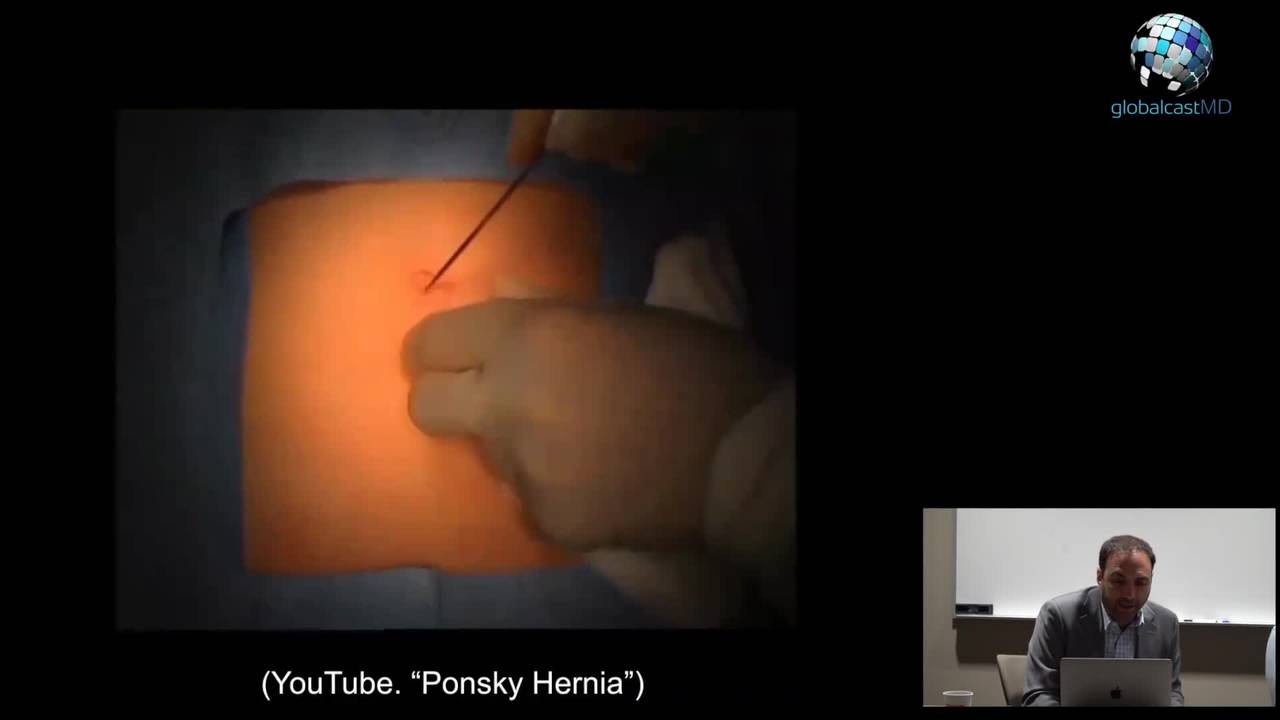
Laparoscopic Pediatric Hernia Repair: Online Course 2017
Dr. Todd Ponsky · 102 min · Published Aug 2017
Video
Focus on Technique- Laparoscopic Pediatric Hernia Repair 2015
Dr. Todd Ponsky · 140 min · Published Mar 2014
Only a few other public items share this expert — go deeper there →
Video
Pediatric Surgical Oncology Research Collaborative (PSORC): Studying Rare Pediatric Tumors
56 s · Published May 2026
Video
Update Course Rewind 2025: Hirschsprung + ARM: Rare but Real
1 min · Published May 2026
Video
Update Course Rewind 2025: Hirschsprung + ARM: Rare but Real
1 min · Published May 2026
Video
Pooling Patients to Study Rare Pediatric Tumors: An Introduction to PSORC
56 s · Published May 2026
Video
The fetal frontier: A review of current and emerging fetal therapies for genetic diseases
44 s · Published May 2026
Video
Indocyanine green assists with sentinel lymph node mapping in pediatric and adolescent patients
1 min · Published May 2026
What the experts said
Inguinal hernia repair is the second most common surgery performed by pediatric surgeons.
The incidence of inguinal hernias overall ranges from about 1% to 5% in full-term newborns.
The incidence of inguinal hernias increases to about 13% in premature infants who are less than 32 weeks of gestational age.
Most inguinal hernias in children are largely indirect, over 90%.
Direct hernias are pretty rare in children and are much more commonly found in adolescence.
Femoral hernias are very rare in children, and as in adults, are more common in females.
Indirect inguinal hernias in children are a congenital anomaly, meaning that they've occurred in development and are present at the time of birth.
Indirect inguinal hernias occur as a result of the failure of the processus vaginalis to fuse.
The right processus vaginalis usually obliterates after the left, which explains the higher prevalence of right-sided hernias.
The number one risk factor for inguinal hernias in children is prematurity.
More than half of the incarcerations that we see are in patients that are less than six months old.
Two-thirds of incarcerations are in those patients that are less than a year.
If the corrected gestational age is less than 60 weeks, premature patients are at a pretty increased risk of post-operative apnea, so you got to admit those patients after you do the repair.
One of the most important things in being able to reduce an incarcerated hernia is helping to keep the patient calm, sometimes that means pain control and sedation.
You have to keep applying pressure in a slow, gentle fashion and not just kind of come and go with your hands, because that gentle, slow pressure is what allows you to release the hernia.
If you can reduce an incarcerated hernia, then you want to go to the OR within the first 24 to 72 hours after the reduction.
The most important point in pediatric inguinal hernia repair is that you need to have high ligation of the processus vaginalis, whether you do it laparoscopically or open.
Unlike in adults, we don't generally use mesh in the repair of the pediatric inguinal hernia.
The outcomes between pediatric laparoscopic repairs and open repairs are thought to be similar, although there is some controversy on this topic.
If you're considering that the child needs an orchidopexy in addition to their hernia repair, then most would approach that hernia in an open fashion.
A floor repair should be considered in children who have long-standing or very large hernias, where you note that the floor might be blown out or unsupported.
Superficial site infections occur in less than 1% of kids after inguinal hernia repair.
The rates of recurrence after pediatric inguinal hernia repair vary from 1 to 5% depending on which studies you look at.
In general, we don't try to limit activities in children after a hernia repair, and most children can return to normal activities within one to two days.
If a patient does have an undescended testicle that's palpable in the inguinal canal, then you should plan to do an orchidopexy at the time of your inguinal hernia repair.
Children with an absent vas deferens noted on hernia repair should be worked up for cystic fibrosis or for unilateral renal agenesis in the post-op period.
If patients are having significant testicular pain after a hernia repair, the thing that concerns you most is testicular ischemia, and the best way to evaluate that is to get an ultrasound looking for Doppler flow.
In general, patients with testicular ischemia after hernia repair are monitored and observed with pain control and we only frankly remove a necrotic testicle and not necessarily one that is partially ischemic.
Dr. Todd Ponsky states that with laparoscopy, you don't necessarily need to wait for bowel edema to come down because it's really not that much more difficult in a laparoscopic case if there's swelling, and sometimes the edema can help lift the peritoneum off.
Dr. Todd Ponsky suggests that if it's in the middle of the day and you have time availability and a patient has an incarcerated hernia, you could not even try to reduce it in the emergency room and just go straight to the operating room under laparoscopy.