


From
Live Event Content
BOB Ped Surg 2023 - Wendy Song, CAPS - Presentation
Part of
Inguinal Hernia 28 items
Chapter 1 of 5 · Fundamentals
Study background
Introduction and Background
Expert statements on this page
No expert statements were drawn from this page.
Host summaries · secondary, not cited in answers
Educational content from recorded physician discussions — not medical advice. Talk to your (or your child's) care team about your situation.
Video
PAPS -Perioperative Opioid Use In Paediatric Inguinal Hernia Patients- A Systematic Review And Retrospective Audit Of Practice - Isabel Hageman
11 min · Published May 2022
Video
Delayed versus early repair of inguinal hernia in preterm infants
43 s · Published Nov 2023
Video
Surgeon annual volume impacts recurrence rates of pediatric inguinal hernia repairs: A multi-institutional study
54 s · Published Feb 2026
Video
A Retrospective Nationwide Comparison of Laparoscopic vs Open Inguinal Hernia Repair in Children
51 s · Published Feb 2026
Video
Reparación tardía versus temprana de la hernia inguinal en bebés prematuros
Published Nov 2023
Podcast
Pediatric Inguinal Hernia with Dr. Todd Ponsky
Todd Ponsky · 13 min · Published Oct 2026
Video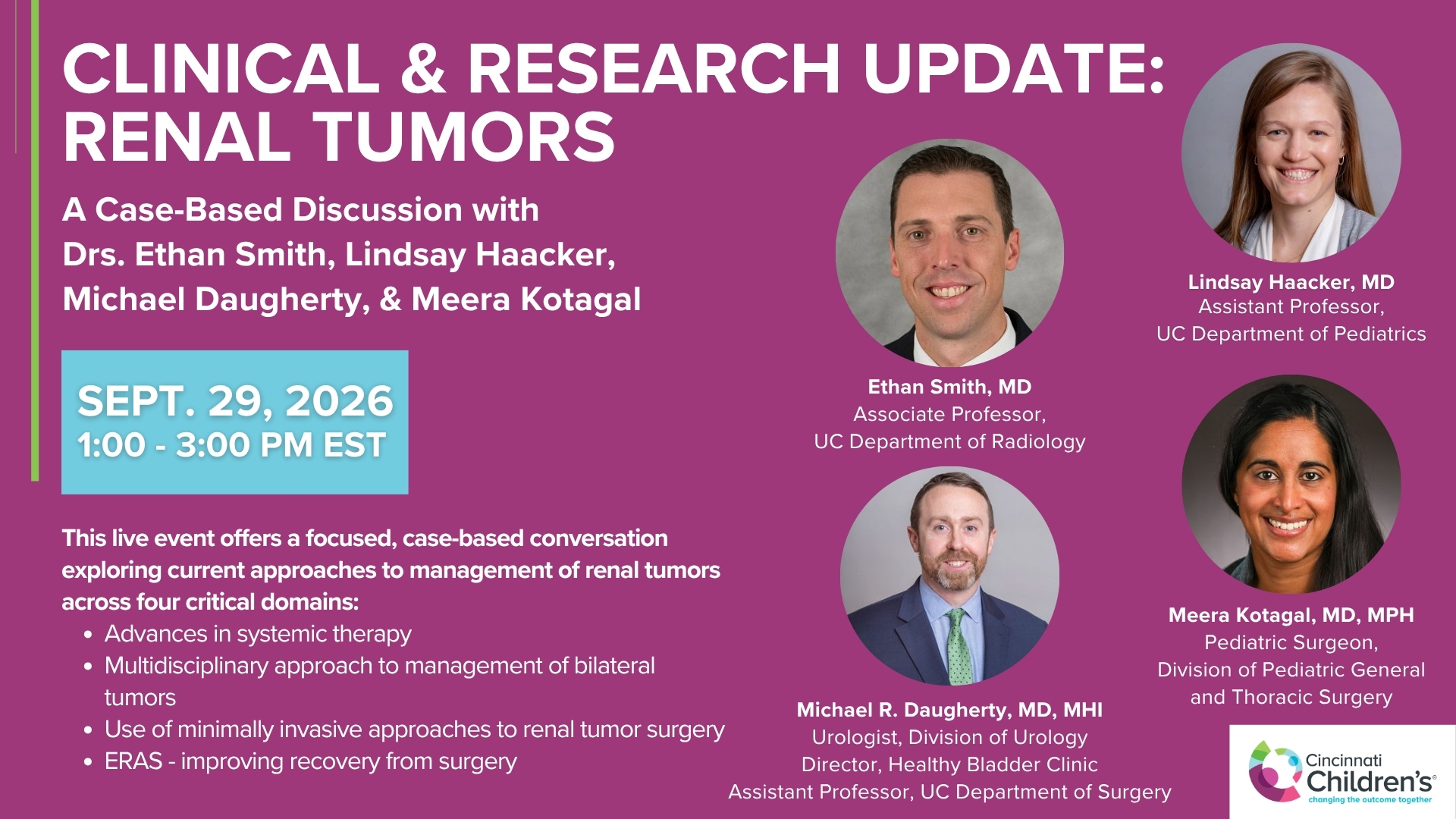
Clinical & Research Update: Renal Tumors with Drs. Ethan Smith, Lindsay Haacker, Michael Daugherty, and Meera Kotagal
71 min · Published Sep 2026
Video
Clinical & Research Update: Neuroblastoma with Drs. Katherine Somers, Cara Morin, Juan Gurria, and Meera Kotagal
67 min · Published Sep 2026
Video
Clinical & Research Update: Sarcoma w/ Drs. Roshni Dasgupta, Joseph Pressey, Arthur Meyer, Luke Pater
66 min · Published Sep 2026
Video
2026 Laparoscopic Pediatric Hernia Repair
123 min · Published Jun 2026
Video
Beyond the Spectrum: Diagnosis, Myths & Management - Caitlin Couch & Leslie Lopez - APP Conference 2026
50 min · Published May 2026
Video
Dysautonomia: Navigating the Journey - Martha Willis - APP Conference 2026
55 min · Published May 2026
What the experts said
Inguinal hernia repairs are some of the most common pediatric surgical procedures and are traditionally performed under general anesthesia for open surgery.
Many centers have recently started utilizing the minimally invasive approach with regional anesthesia instead of traditional general anesthesia with open surgery.
Over the last five years at BC Children's Hospital, surgeons and anesthesiologists have utilized four different combinations of surgical and anesthetic techniques: general anesthesia with open surgery (GO), caudal anesthesia with open surgery (CO), general anesthesia with laparoscopy (GL), and caudal anesthesia with laparoscopy (CL).
Caudal anesthesia with laparoscopy (CL) is a newer combination that was recently adopted and its safety was demonstrated in a prior case study.
The study was a retrospective cohort study including all infants less than one year old undergoing elective inguinal hernia repair from July 2016 to 2021 at a single tertiary care teaching center.
All inguinal hernia repairs with concomitant procedures and emergent procedures from strangulated or incarcerated hernias were excluded from the study.
Eight surgeons and 25 anesthesiologists contributed patients with approach dictated by practitioner preference.
Of 465 infants initially assessed for eligibility, 338 patients were included in the final study analysis.
Most patients underwent an open procedure with only 63 cases being laparoscopic, and there was a relatively even split between caudal anesthesia and general anesthesia.
Of the 338 patients included, most were pre-term males and were followed for a median of 2.5 years.
There were two crossovers: one conversion in the GL group to open surgery because the patient was unable to tolerate the pneumoperitoneum, and one case requiring conversion to general anesthesia in the caudal group because the patient did not tolerate the incision despite initially passing the pinch test.
There was no statistical difference found between groups for the aggregate post-operative complication rates, including recurrence.
Metachronous hernias occurred at a similar rate for open and laparoscopic approaches, albeit with a modest follow-up, irrespective of anesthetic choice.
Total OR time was significantly different between groups with caudal anesthesia with open surgery being the shortest.
Caudal anesthesia with open surgery was significantly shorter than caudal anesthesia with laparoscopy by 15 minutes and general anesthesia with open surgery by 9 minutes in total OR time.
There was no difference between the groups in anesthetic preparation time or skin to skin time.
Overall post procedure time was significantly shorter in patients receiving a caudal blockade than general anesthesia, with four minutes saved in the laparoscopic group and eight minutes in the open group.
The use of laparoscopy with caudal anesthesia (CL) appears to be a safe and effective option in terms of post-operative complications compared to other groups.
Caudal anesthesia with open surgery appeared to be the most resource efficient inguinal hernia repair method.
Due to the retrospective nature of the project, it is subject to the normal bias of any retrospective review.
Due to lack of cross hospital EMRs, the study follow-up was unable to capture post-operative complications managed at any other hospital or clinic.