
Clinical & Research Update: Pediatric Liver Tumors - A Case-Based Discussion with Drs. Katherine Somers & Alex Bondoc
With Dr. Alex Tobin & Dr. Alex Bondoc & Dr. Katherine Somers & Dr. Ranga (Ranganathan) · hosted by Dr. Sophia Schermerhorn · Live Event Content
Cued at 66:36 · stops at 67:21 · press play
Educational content from recorded physician discussions — not medical advice. Talk to your (or your child's) care team about your situation.
Video
Hepatoblastoma with Dr. Greg Tiao
CCHMC Pediatric Surgery · Published Mar 2022
Podcast
Hepatoblastoma with Dr. Greg Tiao
10 min · Published Feb 2022
Podcast
Hepatoblastoma
54 min · Published Nov 2017
Video
BOB Ped Surg 2023 - Andrew Fleming, AAP - Presentation
Published Feb 2023
Video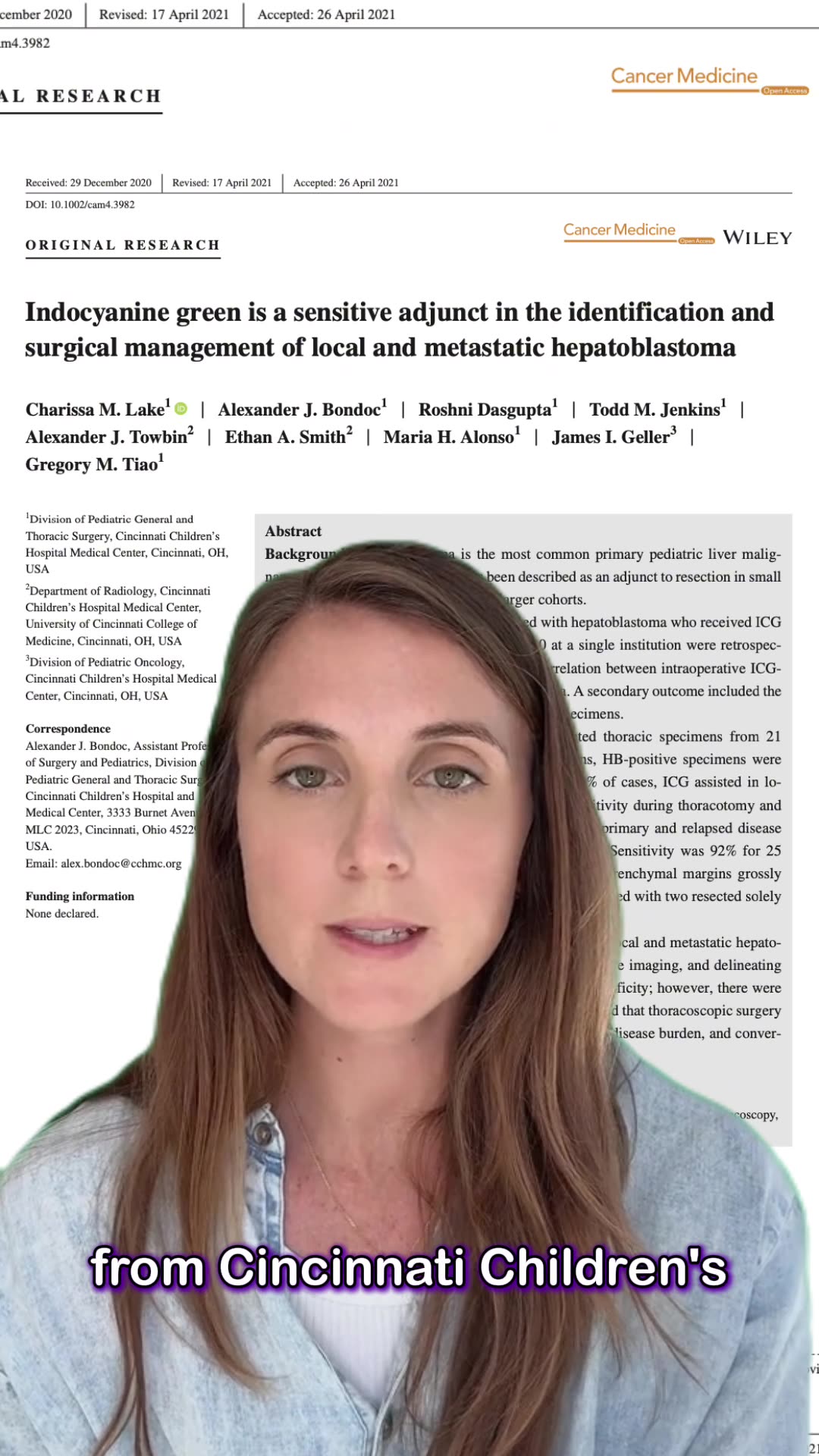
Indocyanine green is a sensitive adjunct in the identification and surgical management of local and metastatic hepatoblastoma
1 min · Published Jan 2026
Podcast
Journal of Pediatric Surgery Article Review: June 2022, AAP Issue
15 min · Published Sep 2022
Only a few other public items share this expert — go deeper there →
Video
Mental Health and Gun Safety in Pediatrics - Catherine Neyer - APP Conference 2026
48 min · Published May 2026
Video
Overview of the Surgical Management of Acute and Chronic Pancreatitis in Children with Dr. Juan Gurria
66 min · Published Apr 2026
Video
Beyond ChatGPT_ AI Tools You’re Not Using (But Should) - Vail, CO
Dr. Todd Ponsky · 97 min · Published Jan 2026
Video
Beyond ChatGPT: AI Tools You’re Not Using (But Should)
Dr. Todd Ponsky · 109 min · Published Oct 2025
Video
2025 Pediatric Surgery Update Course - Updates in Lap Chole and Cholecystitis Management
18 min · Published Aug 2025
Video
2025 Pediatric Surgery Update Course - Updates in Lap Chole and Cholecystitis Management
18 min · Published Aug 2025
What the experts said
Rib fractures or vertebral fractures are fairly common as a presentation factor with hepatic tumors in young children, particularly hepatoblastoma.
Fractures in hepatoblastoma patients will heal as they go through their therapy, and kids tend to be rather unbothered by their fractures once cancer therapy is underway.
Precocious puberty in a Tanner stage one patient is a sign that should prompt consideration of underlying malignancy on the differential.
Weight loss or sarcopenia during active cancer therapy is associated with poor outcomes across all pediatric cancer diagnoses.
Advanced nutritional support is a key part of care for pediatric liver tumor patients to ready them for surgical interventions.
With a young child, pulmonary metastasis, and a large liver mass, hepatoblastoma is the diagnosis 99.9% of the time.
There is data in pediatrics about the approach of a tumor board as it pertains to the success and long-term outcomes of patients whose cases are presented at a tumor board style multidisciplinary conference.
You get the maximal effect of tumor shrinkage after the first block or cycle of chemotherapy in intermediate risk patients; you typically won't get as much shrinkage after subsequent blocks.
Indocyanine green (ICG) is highly sensitive but not specific for tumor detection; it can help find multifocal disease.
In about 15% of lung resections for hepatoblastoma metastases, ICG fluorescence finds lesions not visible on high-resolution CT imaging.
You can see tumor through vessel walls with indocyanine green.
The FIT trial (AHEP 1531) mandated liver biopsy for diagnosis before starting treatment.
Once chemotherapy begins and the tumor gets replaced by pools of blood and fibrous tissue, there's nothing for the chemotherapy to kill, and the size doesn't decrease much further beyond a certain point.
For patients with successful primary tumor resection, the first surgical goal is always primary tumor resection whenever possible.
After primary tumor resection, consolidation chemotherapy alternates carboplatin-doxorubicin cycles with staged lung metastasectomy procedures.
In patients with known vascular invasion and metastatic disease, continuing chemotherapy despite beautiful response helps weed out any remaining circulating cells that remain active.
Hematogenous metastases to the lungs are the primary metastatic site for hepatoblastoma.
PRETEXT criteria define metastatic disease as more than 2 nodules greater than 3 millimeters in diameter or 1 nodule greater than 5 millimeters in diameter.
Even when one side of the chest shows no viable tumor after chemotherapy, the other side is still cleared surgically because that is the best pathway to long-term disease control and maintenance of remission.
ICG fluorescence correlates with the viability of lung metastases; non-fluorescent masses may represent dead tumor.
Patients with hepatoblastoma are frequently born prematurely.
Known risk factors for developing hepatoblastoma include Beckwith-Wiedemann syndrome, hemihypertrophy syndromes, trisomy 18, autosomal recessive polycystic kidney disease, and extreme prematurity.
It's not just autosomal recessive polycystic kidney disease children who develop hepatoblastoma; there is increased incidence in end-stage renal disease early in life.
Cisplatin's primary toxicity is renal, and it can cause chronic kidney disease.
Platinum-based chemotherapy can be delivered to patients on peritoneal dialysis using advanced pharmacokinetic and pharmacodynamic modeling systems without typical mandated hyperhydration.
Hepatoblastoma typically presents in the toddler range (first and second year of life), but predisposed patients can develop it as early as congenital or immediately post-delivery.
For known predisposition patients, screening protocol includes ultrasound and alpha-fetoprotein levels, taking into account that AFP has a very different range of normal values in the first months of life.
PRETEXT 4 multifocal disease mandates liver transplant as the surgical approach.
In deceased donor liver transplant for hepatoblastoma, you cannot have extrahepatic disease because of the huge induction of immunosuppression required.
In the United States, a child with hepatoblastoma automatically gets status 1B categorization on the deceased donor list, which is the second highest stratum for organ allocation.
A patient with hepatoblastoma typically does not have underlying liver disease, unlike most liver transplant candidates.
Vincristine-irinotecan is a less intensive regimen that can be used as maintenance therapy while waiting for organ offers during transplant listing.
Conventional hepatoblastoma is genomically quiet with very low mutation burden and invariably has either a point mutation or small deletion in exon 3 of the CTNNB1 gene.
Hepatocellular neoplasm NOS shows more genomic instability with chromosomal gains and losses, characterized by CTNNB1 deletion, often with large deletions or complete exon 3 skipping (exon 2 joined to exon 4).
Beta-catenin immunohistochemistry is frequently very weak positive or even negative in hepatocellular neoplasm NOS, which is a clue to diagnosis along with pleomorphic appearance and macrotrabecular arrangement.
Hepatocellular neoplasm NOS can be targeted with high-risk hepatoblastoma therapy to shrink tumors and make them amenable to surgery in most cases.
Every child with a new cancer diagnosis meets with oncology genetic counseling team for complete genetic testing including germline testing if something is identified.
Radiomics can predict pure fetal histology hepatoblastoma with area under the receiver operating curve of about 0.85.
Pure fetal histology hepatoblastoma patients are cured with resection alone and don't need chemotherapy.
Artificial intelligence can segment hepatoblastoma tumors very accurately at the level of an expert.