


From
StayCurrentMD
Indocyanine green is a sensitive adjunct in the identification and surgical management of local and metastatic hepatoblastoma
With Dr. Sophia Schermerhorn
Chapter 1 of 1 · Evidence & Research
ICG fluorescence imaging in hepatoblastoma surgery
Expert statements on this page
No expert statements were drawn from this page.
Host summaries · secondary, not cited in answers
Educational content from recorded physician discussions — not medical advice. Talk to your (or your child's) care team about your situation.
Video
BOB Ped Surg 2023 - Andrew Fleming, AAP - Presentation
Published Feb 2023
Video
Retreatment with Cisplatin May Provide a Survival Advantage for Children with Relapsed/Refractory Hepatoblastoma: An Institutional Experience
1 min · Published Jan 2026
Video
Aggressive Pursuit of No Evidence of Disease Status in Hepatoblastoma Improves Survival
Published Jun 2023
Video
Error Traps and Culture of Safety in Pediatric Surgical Oncology
CCHMC Pediatric Surgery · Published Sep 2019
Podcast
Image Guided Surgery Video Series, Episode 2 - Lung Nodule Localization &...
17 min · Published Jun 2022
Podcast
Journal of Pediatric Surgery Article Review: June 2022, AAP Issue
15 min · Published Sep 2022
Video
Oncology Tumor Board Showdown: Pediatric Oncology 5 Question Quiz
1 min · Published Oct 2026
Video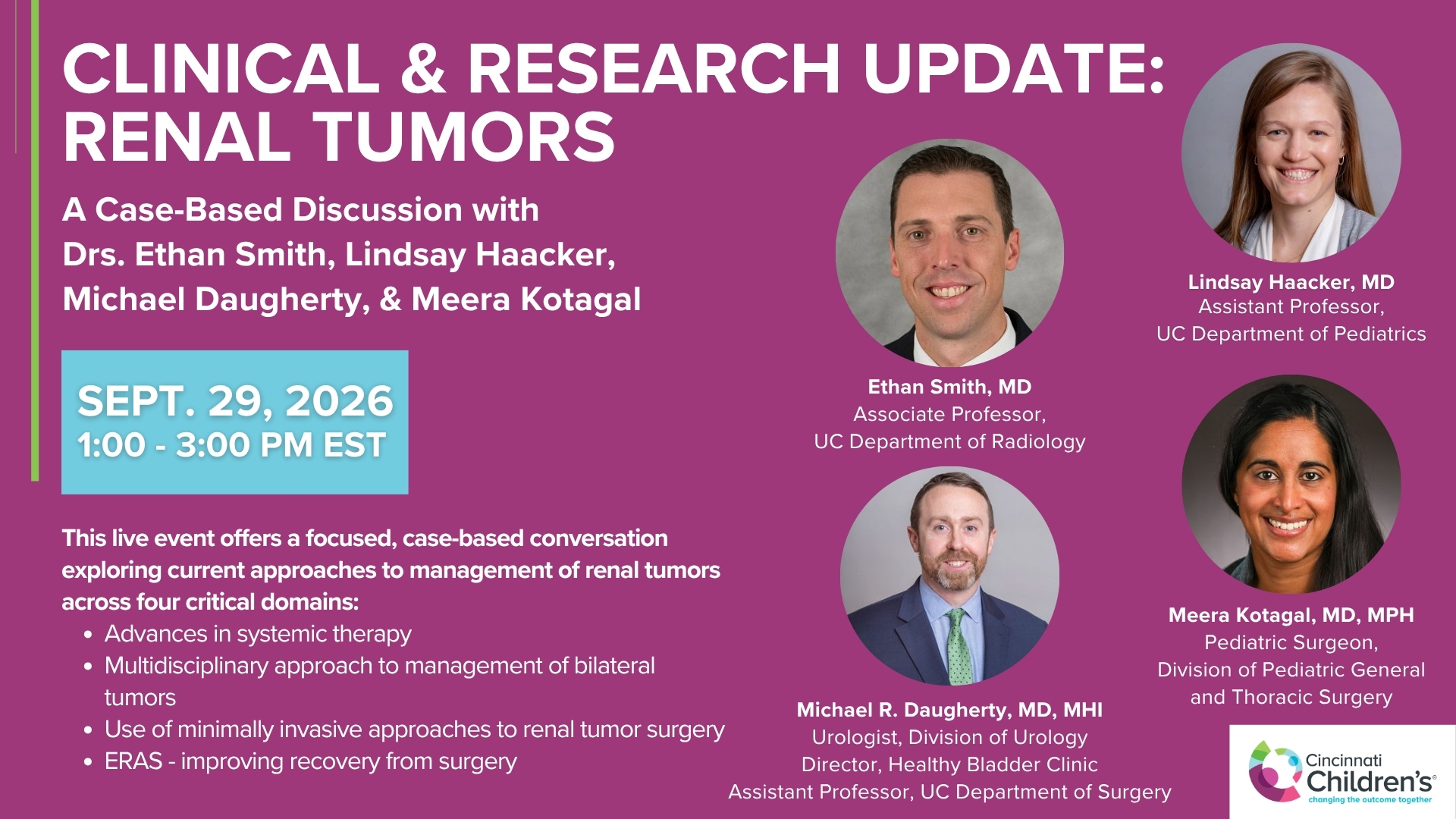
Clinical & Research Update: Renal Tumors with Drs. Ethan Smith, Lindsay Haacker, Michael Daugherty, and Meera Kotagal
71 min · Published Sep 2026
Video
Clinical & Research Update: Sarcoma w/ Drs. Roshni Dasgupta, Joseph Pressey, Arthur Meyer, Luke Pater
66 min · Published Sep 2026
Video
Update Course Rewind 2025: Nerve Monitoring in Pediatric Thyroid Surgery
6 min · Published Jul 2026
Video
Journal of Pediatric Surgery Article Review: June 2023, AAP Issue
Todd Ponsky · 13 min · Published Jul 2026
Podcast
Update Course Rewind 2025: Robotics in Pediatric Surgery: Which indications benefit the most?
Juan Pablo Gurria · 4 min · Published Jun 2026
Video
Clinical & Research Update: Neuroblastoma with Drs. Katherine Somers, Cara Morin, Juan Gurria, and Meera Kotagal
67 min · Published Sep 2026
Video
Indocyanine green assists with sentinel lymph node mapping in pediatric and adolescent patients
1 min · Published May 2026
Video
Pancreas, Muscle, and Subcutaneous Fat Atrophy in Patients Undergoing Radiation for Neuroblastoma
1 min · Published Apr 2026
Video
Clinical & Research Update: Pediatric Liver Tumors - A Case-Based Discussion with Drs. Katherine Somers & Alex Bondoc
69 min · Published Apr 2026
Video
Pediatric and Young Adult Image-Guided Percutaneous Bone Biopsy-A New Standard of Care?
1 min · Published Feb 2026
Video
Enhanced Recovery After Surgery (ERAS) Improves Length of Stay and Decreases Complications After Resection of Abdominal Neuroblastoma
1 min · Published Feb 2026
Video
Intestinal Atresia Types Explained: Grossfeld Classification for Pediatric Surgery
1 min · Published Sep 2026
Video
Derivation and validation of the Pediatric Community-Acquired Pneumonia Severity (PedCAPS) score: A prospective cohort study
50 s · Published Sep 2026
Video
FETO for Late-Diagnosed Severe Congenital Diaphragmatic Hernia (CDH) at Cincinnati Children's with Dr. Beth Rymeski
4 min · Published Sep 2026
Video
Severe Congenital Diaphragmatic Hernia (CDH) Case: FETO Management & Unexpected Findings with Dr. Beth Rymeski
3 min · Published Sep 2026
Video
Fetoscopic Endoluminal Tracheal Occlusion (FETO) Procedure: Step-by-Step Guide with Dr. Beth Rymeski
4 min · Published Sep 2026
Video
Choledochal Cyst Types Explained: Pediatric Surgery Fundamentals
1 min · Published Sep 2026
What the experts said
This is a single institution retrospective review of patients who received ICG prior to either pulmonary metastatectomy or liver resection for hepatoblastoma
ICG was highly sensitive for detecting hepatoblastoma, about 90%
In a meaningful number of cases, ICG was able to detect tumor deposits that were not visible, palpable, or detectable on preoperative imaging
Specificity was lower than sensitivity with false positives
False positives often represented vascular changes or inflammation
There were no adverse outcomes associated with any of the additional resections guided by ICG
ICG was effective in both open and minimally invasive surgery
ICG was effective in both relapse and primary disease