


From
StayCurrentMD
Update Course Rewind: When & How to Operate CDH Patients on ECMO 2024 Part 2
With Dr. Rebecca Stark & Dr. Steven Lee · hosted by Dr. Em Gootee
Chapter 3 of 4 · Surgical Management
Repair timing
Timing of surgical repair and institutional buy-in
Cued at 2:21 · stops at 2:44 · press play
Expert statements on this page
No expert statements were drawn from this page.
Host summaries · secondary, not cited in answers
Educational content from recorded physician discussions — not medical advice. Talk to your (or your child's) care team about your situation.
Podcast
Timing and anticoagulation strategies for CDH repair on ECMO
4 min · Published Nov 2026
Video
BOB Ped Surg 2023 - Shelby Sferra, AAP - Presentation
5 min · Published Feb 2023
Video
BOB in Ped Surg 2023 - AAP Winner - Shelby Sferra, MD
11 min · Published Feb 2023
Podcast
Protocol changes improve CDH survival rates at Cincinnati Children's Hospital
5 min · Published Nov 2026
Video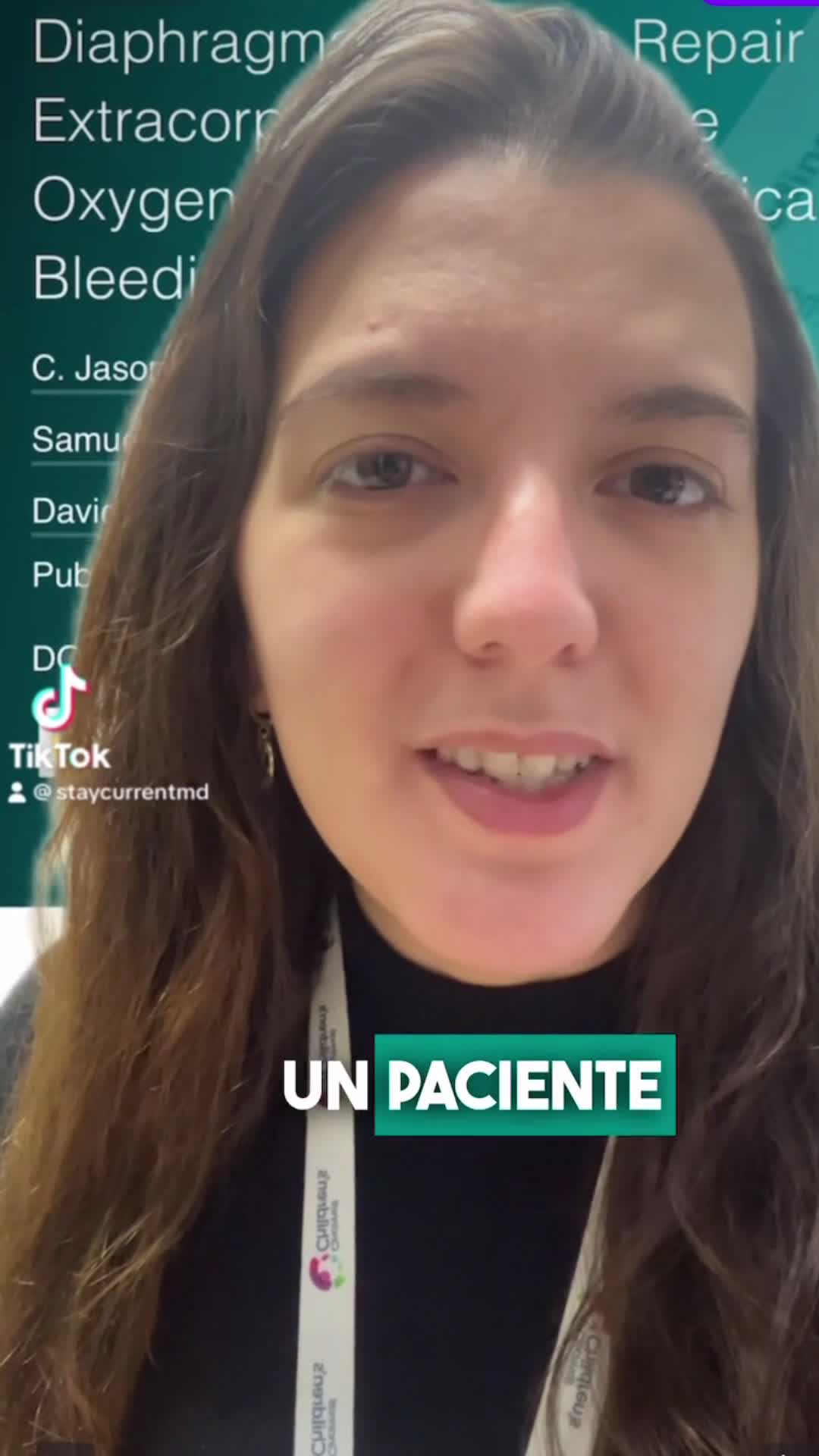
El momento de la reparación de la HDC en ECMO influye en el riesgo de hemorragia quirúrgica
Published Nov 2023
Video
Improving Outcomes for Congenital Diaphragmatic Hernia (CDH): Protocol Changes at Cincinnati Children's
5 min · Published Jun 2026
Podcast
Diaphragm pacing as alternative to mechanical ventilation in pediatric respiratory failure
1 min · Published Nov 2026
Podcast
Fetoscopic endoluminal tracheal occlusion for congenital diaphragmatic hernia
4 min · Published Nov 2026
Podcast
FETO procedure for late-diagnosed severe CDH with liver herniation
4 min · Published Nov 2026
Podcast
Severe CDH case with FETO: unexpected anatomic findings and clinical outcome
3 min · Published Nov 2026
Podcast
Pediatric pancreatitis: diagnosis, causes, and genetic insights with Dr. Juan Gurria
3 min · Published Nov 2026
Podcast
Understanding craniosynostosis: skull sutures, growth patterns, and diagnosis in infants
10 min · Published Nov 2026
What the experts said
Bivalirudin eliminates concerns about heparin-induced thrombocytopenia (HIT) and falling antithrombin III (AT3) levels.
Bivalirudin is used predominantly as the sole anticoagulant drip for most ECMO cases at the speaker's institution.
Most places still use heparin for ECMO anticoagulation, but the practice is shifting quickly toward bivalirudin.
Transitioning to early CDH repair on ECMO is challenging for lower-volume institutions (one or two cases per year) and requires buy-in from the entire team.
Building team buy-in for early repair requires showing data and assembling a dedicated team including anesthesiologists and neonatologists willing to operate in the OR and on weekends.
With bivalirudin, surgical repair can be performed as early as 8 hours after ECMO initiation once levels are stable, which happens quickly.
Early repair on ECMO results in much less tissue edema, making it very similar to performing repair off ECMO.
Bivalirudin is a direct thrombin inhibitor used to prevent blood clots, especially during cardiac and vascular procedures.
Dilute thrombin time for monitoring bivalirudin is five times more specific and sensitive than PTT and can be created by any lab.
Bivalirudin has a very short half-life of approximately 20 minutes, allowing immediate effects when turned on or off.
Bivalirudin has much less variability between patients in terms of anticoagulation effectiveness compared to heparin.
Some groups perform risk stratification after initiating ECMO: high-risk babies proceed with earlier repair, while lower-risk babies are weaned off ECMO before repair.
It is impossible to predict with 100% certainty which babies will successfully wean off ECMO, and late repair (when babies cannot come off ECMO) is the worst time to operate.
Early repair on ECMO promotes good lung growth.
Cannula position is important for assessing left-sided heart disease, which is a major contributor to overall cardiac function in CDH patients.
Early repair places patients in a better position to come off ECMO urgently if needed.
Out of 90 centers contributing to the CDH Study Group, almost 80% are performing early repair on ECMO.
Practice patterns for CDH repair timing have shifted dramatically over the last three years.
CDH repair can be safely performed on ECMO with minimal to no bleeding complications when meticulous operative techniques are used.
The optimal window for early CDH repair on ECMO is between 8 to 24 hours after cannulation.
Bivalirudin is a safe anticoagulant for CDH repair on ECMO.
A smaller, consistent surgical team can enhance outcomes for CDH repair on ECMO.