


From
StayCurrentMD
Update Course Rewind: Surgical Management of Pilonidal Disease 2024
With Dr. Nelson Rosen · hosted by Dr. Em Gootee
Part of
Pilonidal Disease 10 items
Chapter 3 of 5 · Surgical Management
Minimally invasive
Minimally Invasive Surgical Approaches
Cued at 2:52 · stops at 3:42 · press play
Expert statements on this page
No expert statements were drawn from this page.
Host summaries · secondary, not cited in answers
Educational content from recorded physician discussions — not medical advice. Talk to your (or your child's) care team about your situation.
Video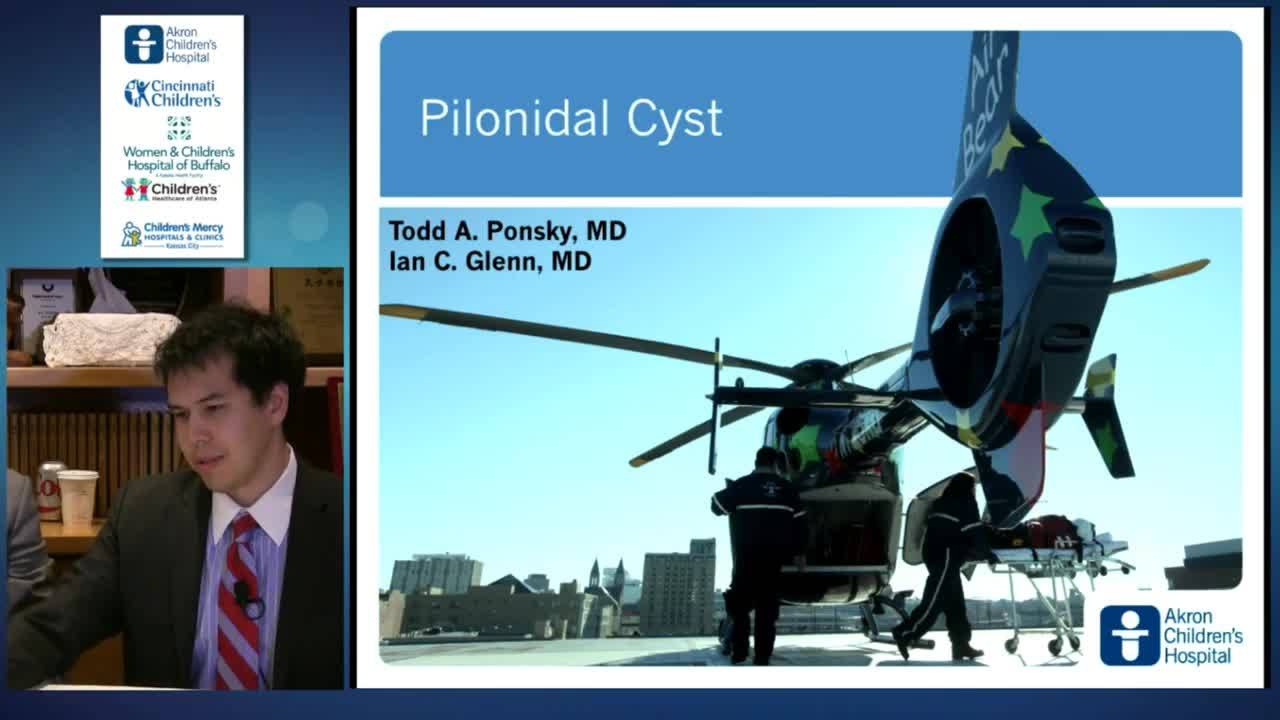
Pilonidal Cyst Case Presentation: Update Course 2015
5 min · Published Nov 2015
Video
Minimal Treatment of Pilonidal Disease - APSA Practice Gaps 2019
Published Mar 2020
Video
Burden of pilonidal disease and improvement in quality of life after treatment in adolescents
Published Oct 2023
Video
Intussusception - Soft Tissue Abscess - Pilonidal Cyst - Bleeding Meckel's...
19 min · Published Nov 2018
Video
Carga mental de la enfermedad pilonidal y mejora de la calidad de vida tras el tratamiento en adolescentes
Published Oct 2023
Video
BOB Ped Surg 2023 - Fereshteh Salimi Jazi, PAPS - Presentation
Published Feb 2023
Video
Anal Dilatations After PSARP: Current Practice, Evidence & Future Directions in Pediatric Colorectal Surgery
51 min · Published Nov 2026
Video
Update Course Rewind 2025: Timing of PSARP: Early vs. Delayed—Does It Really Matter?
3 min · Published Apr 2026
Video
Evaluation and management of pilonidal disease in adolescents
Nelson G. Rosen · 43 min · Published Sep 2025
Video
2025 Pediatric Surgery Update Course - Updates in Colorectal: Debunking Dogma
30 min · Published Aug 2025
Video
Update Course Rewind: Patient Education and Non-Surgical Management of Pilonidal Disease 2024
Published Jan 2025
Video
Best of the Best Gen Surg - Development of postoperative local tumors and distant metastases in diet, genetics and microbiome-dependent in a mouse model of colorectal cancer recurrence - Dr. Morgan
12 min · Published Sep 2022
Podcast
Diaphragm pacing as alternative to mechanical ventilation in pediatric respiratory failure
1 min · Published Nov 2026
Podcast
Fetoscopic endoluminal tracheal occlusion for congenital diaphragmatic hernia
4 min · Published Nov 2026
Podcast
FETO procedure for late-diagnosed severe CDH with liver herniation
4 min · Published Nov 2026
Podcast
Severe CDH case with FETO: unexpected anatomic findings and clinical outcome
3 min · Published Nov 2026
Podcast
Pediatric pancreatitis: diagnosis, causes, and genetic insights with Dr. Juan Gurria
3 min · Published Nov 2026
Podcast
Understanding craniosynostosis: skull sutures, growth patterns, and diagnosis in infants
10 min · Published Nov 2026
What the experts said
Wide excision and packing is probably the most common operation that happens worldwide for pilonidal disease, with most pilonidal work not done by people doing advanced pilonidal work.
Antibiotics are not used unless patients are coming in with an active infection.
Some patients with minimal external manifestation don't drain very effectively and experience severe pain with large, bulging abscesses, while others present with multiple draining abscesses but typically don't report pain or require antibiotics.
Wide excision with off midline closure goes back to the 1960s when Caris first described it, and the Limberg flap has been used since the 1940s.
Lord and Millard described a minimally invasive approach in 1965 that is almost the same operation Dr. Gibbs described in 2008.
Current success rates are closer to 70-75% where one minimally invasive operation gets you to full healing and lasting recurrence-free healing.
Some institutions use laser tract ablation, phenol to sclerose the tracts, or fibrin glue, but none have been proven superior.
For a first abscess, the approach is to drain it and see what you're dealing with.
Minimally invasive approaches are offered quickly because it is a 20-minute intervention under sedation with no activity restriction and no narcotic requirement.
In the Gibbs procedure, all pits are excised using circular punches, then the internal cavity is scraped out to remove inflammation, hair, and necrotic fat, leaving the wounds open to heal.
The Ebzi procedure was described in 2013, doing everything through a small incision with a large scope that is not available in the United States.
In the hybrid Gibbs approach, an eight French cystoscope is put into the openings after cleaning to make sure all hair is removed, and this has been done for the past five years with satisfaction.
If not starting with minimally invasive as the first surgical intervention for most people, you're doing it wrong.
All patients should get laser hair removal once they're healed.
Patients need to be attentive to hair removal (waxing or laser) throughout adolescence and into adulthood, with the longer they can sustain it, the better.
Laser is not permanent but knocks hair down to a lower level.
For patients where one or two minimally invasive approaches did not work and they have significant ongoing symptoms, the treatment moves to off-midline closure with the Bascom cleft lift as the preferred choice.
In Dr. Gibbs's study, they had a 15% recurrence rate over 10 years.
A Swedish study by Roland Anderson in 2017 with 113 patients used a minimally invasive approach with suture closure of all but one hole (left open to drain) and had excellent results.
A large prospective study by Nationwide Children's on laser hair removal after surgery found it significantly reduced recurrent disease, representing the first randomized prospective study on this subject.